Al-Azhar Mosque Cairo Guide: A Thousand Years of Living Islam
Al-Azhar isn't a monument. It's a working university mosque that has shaped Islamic thought for 1,074 years. Your Al-Azhar Mosque Cairo guide starts here.
Quick Facts
- Best time to visit
- October through April for comfortable temperatures. Visit on weekday mornings before 10am for the quietest experience. Avoid Friday noon to 2pm during congregational prayer.
- Entrance fee
- Free. No ticket required. Al-Azhar Park (separate site) costs EGP 50 (approx $1 USD).
- Opening hours
- Daily approximately 9am to 10pm, with closures during the five daily prayers (each 30 to 45 minutes). Friday midday closure can extend from noon to 2pm.
- How to get there
- Metro Line 3 to Al-Hussain station (EGP 8 to 10) then 5-minute walk. Taxi from Downtown Cairo EGP 40 to 70. Ride-share from Zamalek EGP 80 to 120.
- Time needed
- 90 minutes for the mosque alone. 3 to 4 hours combining with Al-Hussein Mosque, Bab Zuweila, and Khan el-Khalili.
- Cost range
- Mosque free. Budget EGP 150 to 300 for breakfast, drinks, and incidentals in the surrounding area. Licensed guide EGP 400 to 800 for a half-day Islamic Cairo tour.
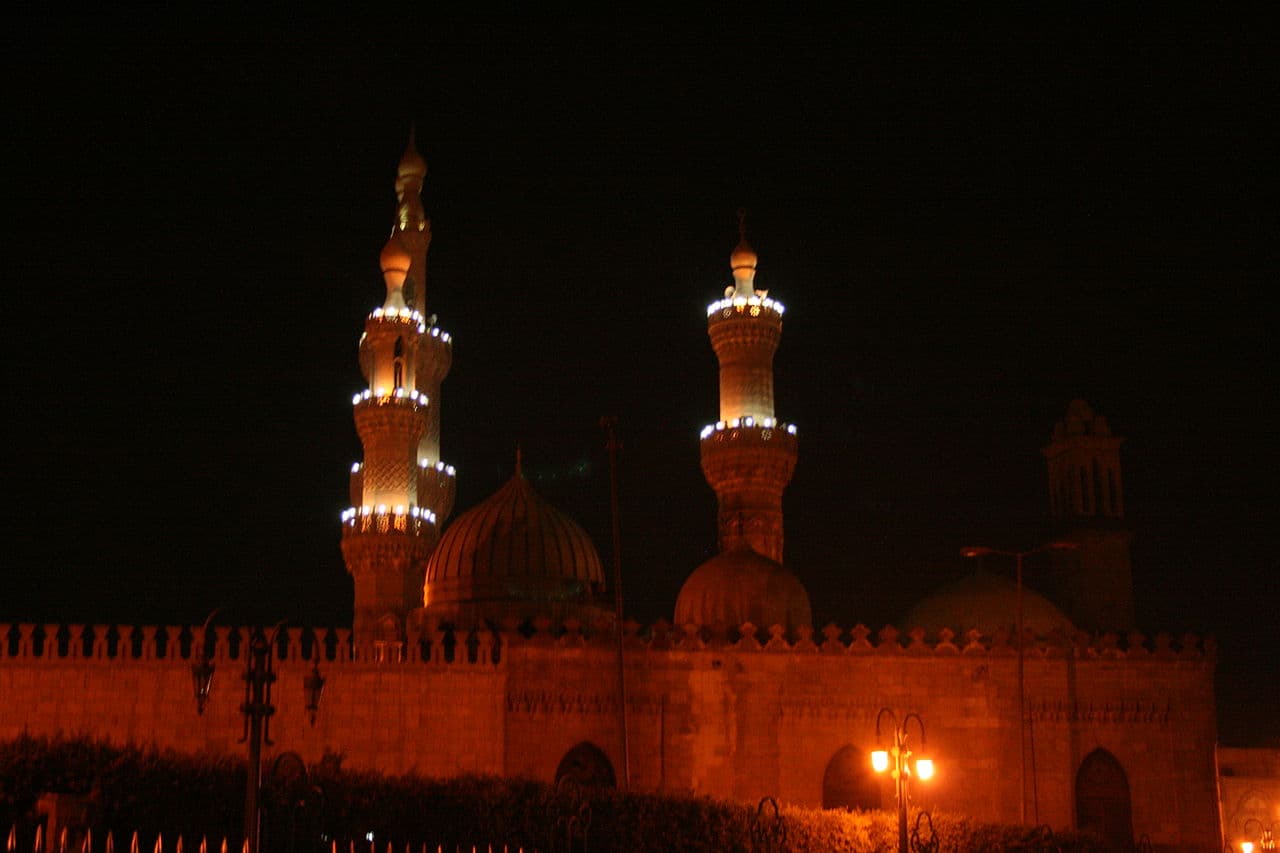
The theologians arguing in the courtyard are not performing for you. They are doing what theologians have done in this exact space since 970 CE, when the Fatimid general Jawhar al-Siqilli laid the foundation stone of a mosque designed to spread Ismaili Shia doctrine across the Sunni world. That plan failed spectacularly. Al-Azhar survived anyway, absorbed its conquerors, switched sects, and became the oldest continuously operating university on earth, the institution that declared Napoleon's occupation illegitimate, the voice that Egypt's presidents still need on their side before they can govern. The minaret in front of you is not decorative. It is a transmission tower for one of the longest-running arguments in human history.
Quick Facts
Best time to visit: October through April, when Cairo's heat is manageable and the light in the courtyard turns gold by mid-morning. Avoid Friday afternoons when the mosque fills for Jumu'ah prayer and is effectively closed to visitors.
Entrance fee: Free for the mosque itself. The adjacent Al-Azhar Park is a separate entity with its own admission (EGP 50, roughly $1 USD). There are no tickets to buy, no queues to manage, no timed entry slots.
Opening hours: Daily, approximately 9am to 10pm, with closures during the five daily prayers. Each prayer closure lasts 30 to 45 minutes. The longest closure is the Friday midday prayer, which can extend from noon until 2pm. Plan accordingly.
How to get there: The most direct route is the Metro to Al-Hussain station on Line 3 (EGP 8 to 10 depending on origin), then a 5-minute walk through Khan el-Khalili. A taxi from Downtown Cairo costs EGP 40 to 70. From Zamalek, budget EGP 80 to 120 by ride-share. Do not attempt to drive yourself into Islamic Cairo during daylight hours.
Time needed: 90 minutes for the mosque alone. Three to four hours if you combine it with the Al-Hussein Mosque, Khan el-Khalili, and a coffee at El Fishawy. A full morning if you want to sit in the courtyard long enough to actually feel the place.
Cost range: The mosque is free, but budget EGP 200 to 400 for a proper breakfast at one of the surrounding fuul and ta'meya shops, a glass of sugarcane juice, and something from Khan el-Khalili you will probably regret buying.
Why This Place Matters
Most visitors to Al-Azhar arrive thinking they are visiting a mosque. They are actually visiting the institution that has issued legal opinions on everything from the permissibility of organ donation to the apostasy laws that have gotten Egyptian intellectuals imprisoned. Al-Azhar's Grand Sheikh is appointed by the Egyptian president and cannot be removed by him, a constitutional arrangement that creates permanent, productive tension between religious authority and state power.
The mosque was founded in 970 CE by the Fatimid dynasty, who were Ismaili Shia Muslims ruling from North Africa. They built Al-Azhar to function as a counter-institution to the Sunni Abbasid Caliphate in Baghdad. The name almost certainly derives from Al-Zahra, a title of Fatima, the Prophet's daughter, underscoring the Shia theological programme embedded in the original architecture. When Saladin took Cairo in 1171 and dismantled Fatimid power, he suspended the Friday khutba at Al-Azhar for over a century as a deliberate act of ideological erasure. The mosque survived by becoming Sunni.
Under the Mamluks, who ruled Egypt from 1250 to 1517, Al-Azhar became the gravitational centre of Islamic scholarship in the Arabic-speaking world. Scholars from Andalusia, sub-Saharan Africa, Central Asia, and the Ottoman lands came here to study. The Mamluks added the minarets you see today, each one the signature of a different sultan, each one slightly different in design because no Mamluk ruler wanted his contribution confused with his predecessor's. This is not ego. It is patronage theology: your monument declares your piety, and piety meant funding scholars, not just soldiers.
What You Actually See and Experience
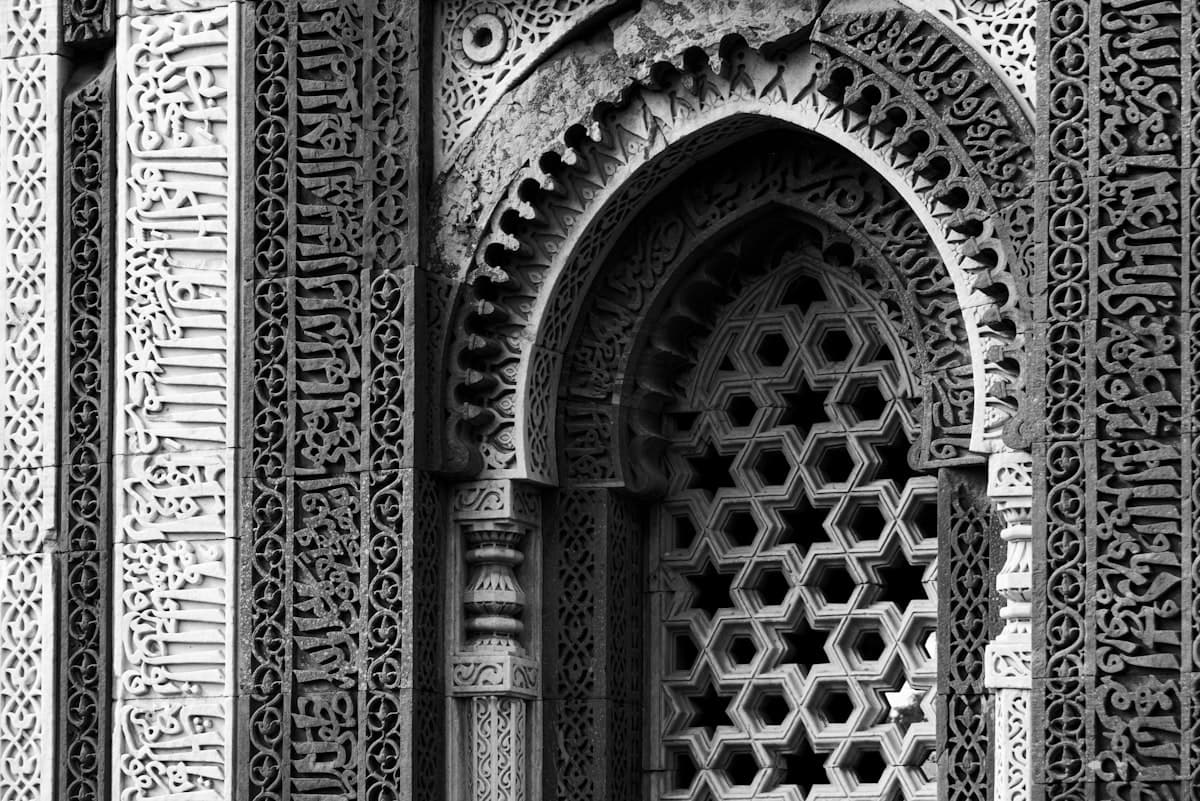
Enter through the Bab al-Muzayyinin, the Barbers' Gate, named for the tradition of students shaving their heads here before entering for the first time. The gate is Mamluk, fourteenth century, with the kind of stone interlace above the arch that takes a craftsman years to learn and that no government contractor today would know how to replicate.
The courtyard opens suddenly after the covered riwaq, and the effect is spatial, not spiritual in any touristic sense. It is large and quiet in a way that Khan el-Khalili, twenty meters away, is not. The floor is pale stone that holds the morning cool until around 10am. Students still sit here with books, though fewer than in previous decades since much of Al-Azhar's teaching moved to the university campus in Nasr City in the 1960s. The columns inside the prayer hall are a catalogue of architectural salvage: Roman, Fatimid, and Mamluk elements mixed without apology because whoever was building at any given moment used what was available.
Look up at the minarets from the courtyard. There are five of them now, added across five centuries. The oldest surviving one dates to the Mamluk sultan Qaytbay, late fifteenth century. Qaytbay is the same sultan who built the extraordinary fort at Alexandria's harbor and the mosque-madrasa in the City of the Dead that most visitors never find. His architectural patronage was systematic and deliberately competitive with Ottoman power, which was beginning to press down from the north.
The prayer hall itself is not open to non-Muslim visitors during prayer times, but between prayers you can enter wearing the robes provided at the entrance. The mihrab, the niche indicating the direction of Mecca, is Fatimid at its core, though it has been restored and re-restored so many times that the original stucco is mostly a structural memory. What you're looking at is the accumulation of a thousand years of maintenance, which is itself worth contemplating.
What Most Visitors Miss
The libraries. Al-Azhar holds one of the most significant collections of Islamic manuscripts in existence, over half a million texts, including documents that exist nowhere else. The main library is not routinely open to casual visitors, but if you contact the mosque administration in advance and have a credible academic or journalistic reason, access is sometimes possible. This is Egypt, which means the rules are real but so is the human relationship that can occasionally move around them.
Also missed: the madrasa annexes along the western edge of the complex. These small chambers with their mashrabiyya screens were where scholars slept and studied and died in residence, often for decades. The institution functioned as a welfare state for religious learning: tuition was free, accommodation was provided, and students received a small stipend from the waqf endowments that funded the whole operation. The waqf system, Islamic charitable endowment, is how Egypt maintained its scholarly infrastructure for centuries without state funding, a fact that becomes interesting when you consider how thoroughly the Nasser government dismantled it in the 1950s and 1960s.
The Connections
Al-Azhar sits in a neighborhood that is itself a palimpsest. The ground beneath Islamic Cairo contains a Pharaonic branch of the Nile that silted up in antiquity. The Romans built a fortress called Babylon directly to the south, the walls of which still stand inside the Coptic quarter. The Fatimids built their palace city, Al-Qahira, around Al-Azhar, and the Mamluks filled in the spaces between the Fatimid monuments with their own. The Ottomans added a layer of piety without much structural ambition. The French arrived in 1798 and found Al-Azhar's scholars leading the first major urban resistance to their occupation. Napoleon stabled horses in the prayer hall, a desecration that the Egyptians remember with more precision than the French do.
Walk five minutes northeast and you reach the mosque-madrasa of Sultan Hassan, built between 1356 and 1363, arguably the most architecturally serious building in Cairo and one of the most serious in the Islamic world. Sultan Hassan was a Mamluk who spent most of his reign imprisoned by his own amirs and was assassinated before his mosque was finished. The building contains his intention without containing his body: his tomb chamber is there, but his remains never were, because his enemies hid the corpse to prevent his tomb from becoming a pilgrimage site. History is specific here in ways that general descriptions cannot capture.
The Al-Hussein Mosque, directly across the square from Al-Azhar, is believed by many Egyptian Muslims to contain the head of Hussain ibn Ali, the Prophet's grandson, killed at Karbala in 680 CE. The relic, if it is there, arrived in Cairo during the Fatimid period. Whether or not you accept the theological weight of that claim, the devotion it generates is real and worth witnessing with appropriate respect rather than anthropological distance.
Common Mistakes
Arriving at Friday noon. The Friday congregational prayer draws thousands of worshippers and the mosque closes to visitors for the duration. The surrounding streets also become difficult to navigate. If Friday is your only option, arrive before 10am or after 2pm.
Wearing inappropriate clothing and relying on the provided robes. The robes at the entrance are shared, often worn, and occasionally damp. Women who arrive in sleeveless tops or short skirts will need to wear them regardless. Bring your own light linen layer. Men in shorts will also be asked to cover.
Treating the scholars and students as photographic subjects. Al-Azhar is a working institution. The men studying in the courtyard are not ambient decoration. Ask before photographing, and accept a refusal without theater.
Skipping the surrounding streets because Khan el-Khalili looks like the obvious destination. The alleys directly behind Al-Azhar, toward the Darb al-Ahmar neighborhood, contain Mamluk and Fatimid architecture that is almost entirely unvisited. The Mosque of al-Mu'ayyad Sheikh, built in the early fifteenth century with doors stolen from Sultan Hassan's mosque, is ten minutes on foot and consistently empty of tourists.
Confusing Al-Azhar Mosque with Al-Azhar University's main campus. The historic mosque is in Islamic Cairo. The sprawling modern university is in Nasr City, several kilometers away. They are institutionally the same entity but physically distinct. Do not take a taxi to Al-Azhar University expecting to find the mosque.
Coming only once, for an hour, midday. The mosque at 6am, opened for Fajr prayer, with the call to prayer still resonating off the Fatimid stone and almost no one else present, is a categorically different experience from the same space at 11am with tour groups moving through. If you are staying in Cairo for more than two days, come twice.
Assuming everything you see is original. Al-Azhar has been continuously modified, restored, damaged, and rebuilt for over a millennium. Significant restoration work happened in the nineteenth and twentieth centuries, not always with historical sensitivity. What reads as ancient may be Victorian-era reconstruction. This is not a criticism. It is the nature of living buildings.
Practical Tips
The best breakfast before or after Al-Azhar is at any of the fuul carts on the street directly south of the mosque, open from around 7am. A full breakfast of fuul, ta'meya, eggs, and bread costs EGP 40 to 60. El Fishawy coffeehouse in Khan el-Khalili has been open continuously since 1797, serves acceptable tea and indifferent coffee, and is worth sitting in for 20 minutes despite the aggressive souvenir sellers at its entrance.
Hire a local guide only through the mosque administration desk or through a reputable Cairo-based agency. The unofficial guides who approach you in the street range from genuinely knowledgeable to actively misleading. A good licensed guide for Islamic Cairo costs EGP 400 to 800 for a half-day and is worth every pound if you find the right person.
Safety in Islamic Cairo is not a serious concern for most visitors during daylight hours. The neighborhood is dense, commercially active, and locally controlled in the informal way that Egyptian urban spaces tend to be. The standard urban precautions apply: don't display expensive cameras on straps, keep your phone in a front pocket, don't follow anyone who approaches you with an offer that involves a carpet shop.
The Al-Azhar Mosque Cairo guide you read online will often tell you to combine this visit with the Citadel and Sultan Hassan in one day. This is possible but produces a kind of architectural indigestion. Better to spend a full morning in Islamic Cairo around Al-Azhar and return to the Citadel separately. Each of these sites deserves attention that a packed itinerary prevents.
Frequently Asked Questions
The Weekly Dispatch
More on Egypt, every Friday.
Cultural depth and places most guides never mention.
No spam. Unsubscribe anytime.