Al-Hussein Neighborhood: Cairo's Islamic Quarter Uncovered
Al-Hussein neighborhood in Cairo's Islamic quarter is not a relic. It is a living city layered over Fatimid, Ayyubid, and Roman bones. Here is how to read it.

Quick Facts
- Best time to visit
- October to March for tolerable temperatures. Early morning (8 to 10am) on any weekday for the lightest crowds on Al-Muizz Street.
- Entrance fee
- Al-Hussein Mosque: free (Muslims only). Al-Ghuri Complex: EGP 100 (approx $2 USD), students EGP 50. Wikala al-Ghuri: EGP 100 (approx $2 USD). Khan el-Khalili streets: free.
- Opening hours
- Neighborhood streets: open all hours. Al-Ghuri Complex: Saturday to Thursday 9am to 5pm, closed Friday. Tanoura performance at Wikala al-Ghuri: Tuesdays and Saturdays at 8pm, free. Al-Azhar Mosque: daily approx 9am to 9pm for visitors.
- How to get there
- Metro Line 1 to Ataba (EGP 10), 10-minute walk east. Uber/Careem from Tahrir Square approx EGP 30 to 50. Taxi EGP 40 to 60.
- Time needed
- 3 hours minimum for Al-Hussein Square, Khan el-Khalili, and Al-Muizz Street north section. Full day if combining with Al-Azhar, Al-Ghuri, and evening Tanoura performance.
- Cost range
- Budget: EGP 300 to 600 for entry fees, street food, and transport. Mid-range: EGP 1,000 to 2,000 with guided tour and restaurant lunch.
The mosque of Al-Hussein contains what Sunni Islam considers the most sacred object in Egypt: the head of Hussein ibn Ali, grandson of the Prophet Muhammad, killed at Karbala in 680 CE. Non-Muslims cannot enter to see it. Most visitors photograph the exterior and move on to Khan el-Khalili next door without ever knowing what is inside, or what it cost to bring it here, or how its arrival in Cairo in 1153 CE transformed an entire city's religious identity almost overnight.
That gap between what you photograph and what you understand is the central problem of the Al-Hussein neighborhood in Cairo's Islamic quarter. It is not a gap the neighborhood tries to hide. It simply assumes you already know.
Quick Facts
Best time to visit: October through March, when temperatures drop below 25°C and the light in the alleys turns gold rather than white. Avoid Ramadan evenings if you dislike crowds; embrace them if you love the spectacle of a city celebrating at midnight.
Entrance fees: The Al-Hussein Mosque is free for Muslim visitors. Non-Muslims are not permitted inside. Khan el-Khalili's market streets are free to walk. The Wikala of al-Ghuri is EGP 100 (approx $2 USD). The Al-Ghuri Complex (Madrasa and Mausoleum) charges EGP 100 (approx $2 USD) as part of the Egyptian Heritage sites ticket scheme; students with valid ID pay EGP 50.
Opening hours: The neighborhood streets never close. The Al-Hussein Mosque is open to Muslim visitors daily, approximately 5am to 11pm, closing briefly between prayers. The Al-Ghuri Complex is open Saturday through Thursday, 9am to 5pm; closed Friday. The Wikala al-Ghuri hosts the Tanoura folkloric dance performance on Tuesdays and Saturdays at 8pm, free of charge.
How to get there: Metro Line 1 to Ataba station (EGP 10, approx $0.20 USD), then a 10-minute walk east along Al-Azhar Street. Taxis from Downtown Cairo cost EGP 40 to 60. Uber and Careem typically run EGP 30 to 50 from Tahrir Square. If you are coming from Islamic Cairo's southern monuments, walk north through Al-Muizz Street: the journey itself is the point.
Time needed: Three hours minimum to walk the neighborhood seriously. A full day if you combine it with Al-Azhar Mosque, the Al-Ghuri Complex, and a late afternoon coffee at the Fishawi Café.
Cost range: Budget EGP 300 to 600 for entry fees, food, and transport. Mid-range EGP 1,000 to 2,000 if you add a guided tour and lunch at a sit-down restaurant near Al-Azhar.
Why This Place Matters
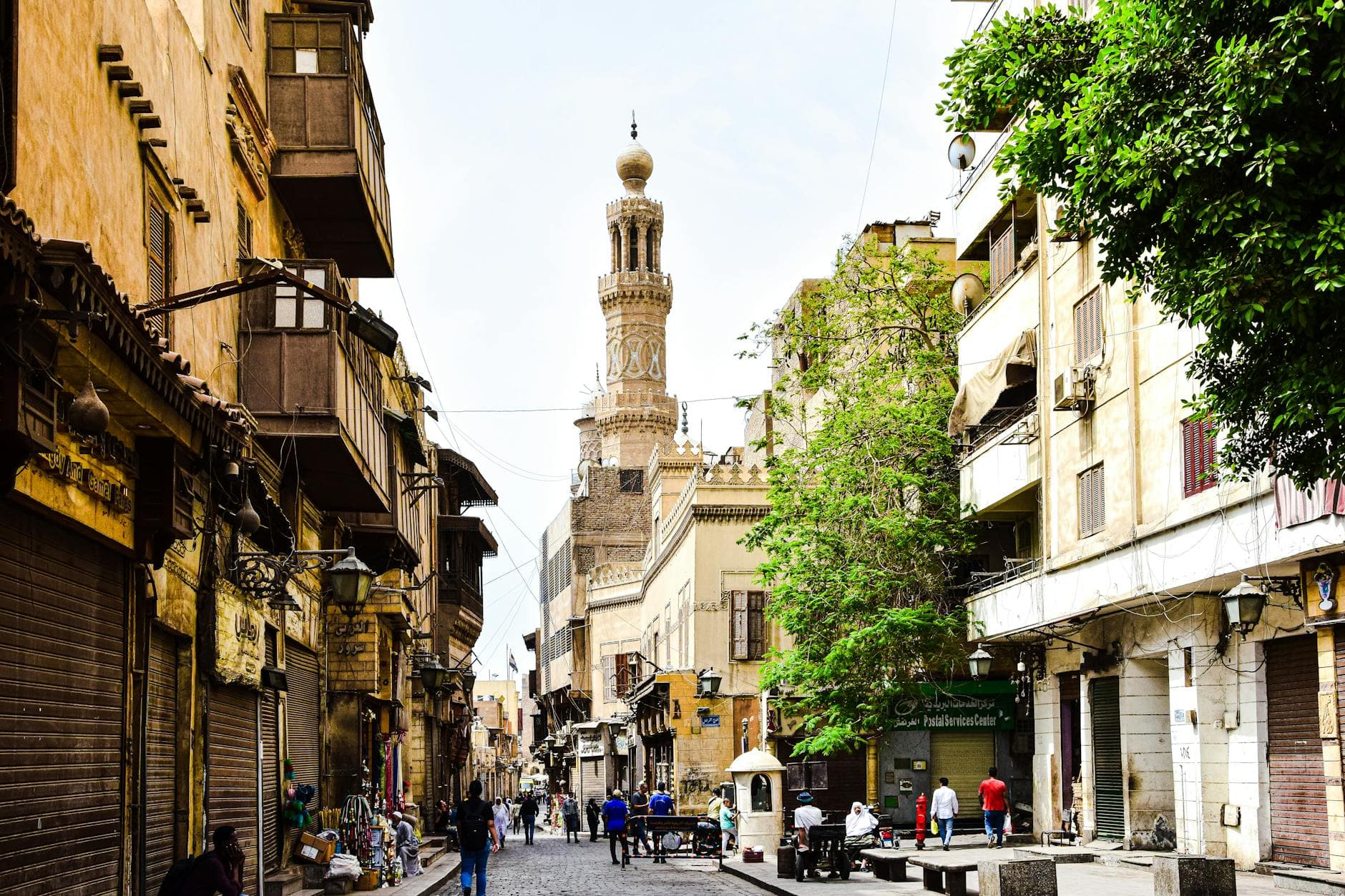
The Al-Hussein neighborhood did not begin as an Islamic space. Before the Fatimid general Jawhar al-Siqilli founded Cairo in 969 CE, this area was part of Fustat, Egypt's first Islamic capital, itself built on the ruins of the Roman fortress of Babylon. The Fatimids who founded Cairo were Ismaili Shia Muslims, a minority branch, and they built their city as a closed royal compound. Ordinary Egyptians lived outside its walls for two centuries.
The decisive break came in 1153 CE when a Fatimid vizier ordered the transfer of a relic, said to be the head of Hussein ibn Ali, from Ascalon (in modern-day Palestine) to Cairo. Ascalon was under threat from Crusader forces, and the relic's protectors feared its capture. The head traveled to Cairo and was interred in a shrine that became the Al-Hussein Mosque as it exists today, rebuilt and expanded many times across the following nine centuries.
That transfer did something unexpected. It turned a closed royal city into a pilgrimage destination. The neighborhood around the shrine became the commercial and spiritual heart of Cairo, which it remains today. When Saladin abolished the Fatimid caliphate in 1171 CE and converted Egypt back to Sunni Islam, he could not move or diminish the shrine because the population would not have tolerated it. The relic was too embedded, too loved. A Sunni sultan kept a Shia shrine intact because Cairo had already decided what it meant.
This is the pattern you encounter constantly in the Al-Hussein neighborhood of Cairo's Islamic quarter: each era absorbs the previous one rather than erasing it.
What You Actually Walk Through
Al-Muizz li-Din Allah Street is the neighborhood's spine. Named after the Fatimid caliph who founded Cairo, it runs approximately one kilometer from Bab al-Futuh (Gate of Conquest) in the north to Bab Zuwayla in the south, and it contains the highest concentration of medieval Islamic architecture anywhere on earth. UNESCO said so in 1979. The street agrees with them silently, without signage.
The Madrasa and Mausoleum of Sultan Qalawun, built in 1284 CE, stops most people because of its Gothic-influenced windows. Those arched windows were not an Egyptian aesthetic choice. The Crusaders had occupied parts of the Levant for nearly two centuries, and Mamluk craftsmen working for Qalawun had clearly absorbed European architectural details into their vocabulary. You are looking at a 13th-century exchange between two civilizations that were simultaneously at war.
The Al-Ghuri Complex, built between 1504 and 1505 by the last great Mamluk sultan Qansuh al-Ghuri, sits roughly 400 meters south of Al-Hussein Mosque. Al-Ghuri built his madrasa, mausoleum, and wikala (a merchant's inn) in a cluster because Mamluk sultans understood that institutional survival required endowing your own legacy. Al-Ghuri died at the Battle of Marj Dabiq in 1516 against the Ottoman army of Selim I. His body was never recovered. His mausoleum was built for him but never held him. That hollowness is not marked by any sign.
The Part Most Visitors Skip
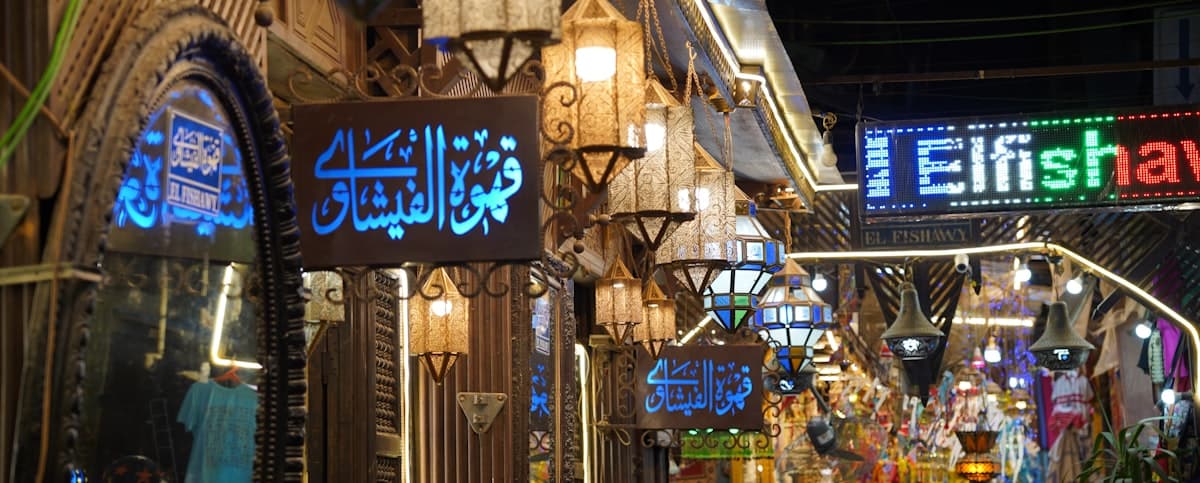
Fishawi's Café, open continuously since 1773 CE according to its own claim, sits inside Khan el-Khalili at the back of an alley lined with mirrors and brass. Naguib Mahfouz, Egypt's Nobel-winning novelist, came here for decades. He set large portions of his Cairo Trilogy in the streets immediately surrounding it. When you drink tea here, you are drinking in a literary landscape as much as a physical one: Mahfouz's characters, his merchants and prostitutes and religious students, were composites of the people who sat in these same chairs.
Fishawi's is not quiet or peaceful. It smells of tobacco and mint and the particular dusty warmth of old wood. It is genuinely worth sitting in for thirty minutes not because it is charming but because it is continuous. The city has changed around it in ways that should have swallowed it multiple times and it persists.
The Connections
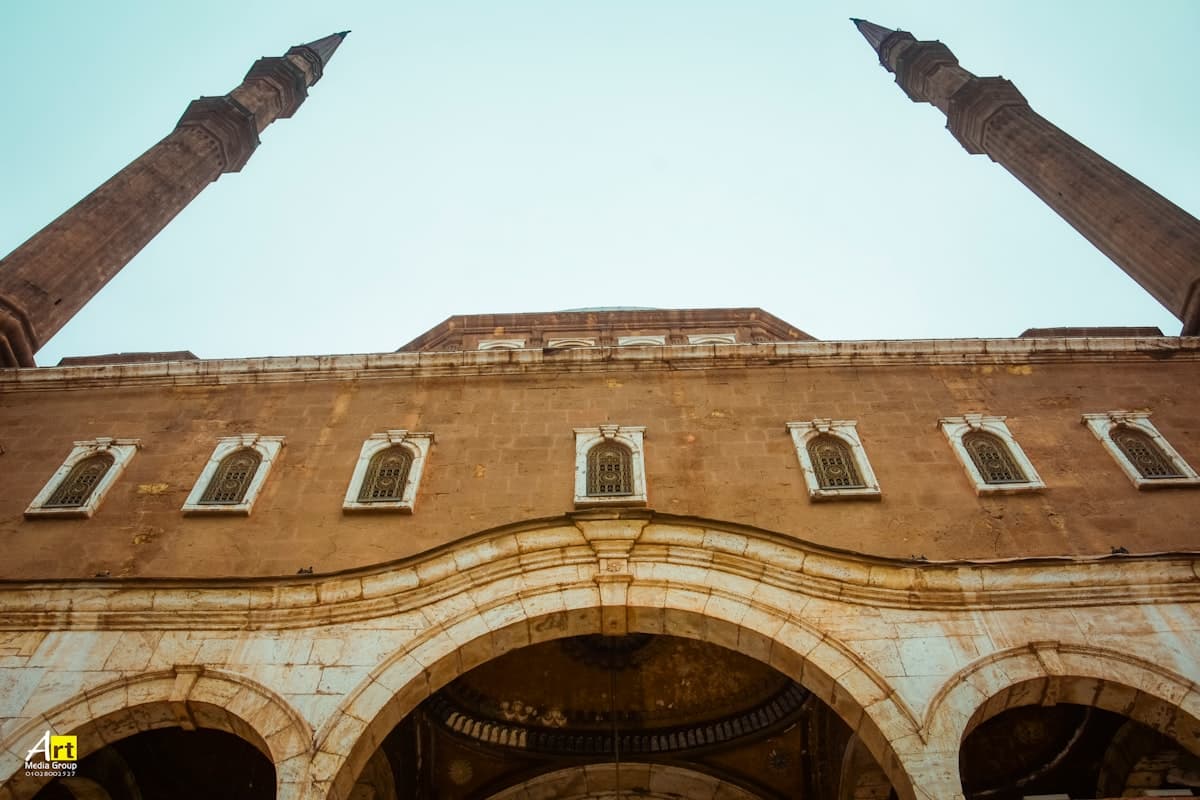
The Al-Hussein neighborhood connects to almost every other significant site in Cairo in ways that take time to see.
Al-Azhar Mosque, a ten-minute walk south on Al-Azhar Street, was founded by the Fatimids in 970 CE as a center for Ismaili Shia education. When Saladin's Ayyubid dynasty replaced the Fatimids, Al-Azhar was stripped of its Shia curriculum and converted to Sunni teaching. Today it is the oldest continuously operating university in the world, depending on how you define university, and its scholars issue religious rulings that govern the lives of millions of Muslims globally. Its founding ideology was systematically erased. Its institution survived anyway.
The Citadel of Saladin, visible from the higher streets of Islamic Cairo to the southeast, was built partly with stones taken from smaller Pharaonic pyramids at Giza. When Saladin needed limestone, he quarried the past. The stone in his walls came from tombs built roughly 3,700 years before he was born. This is the Egyptian pattern operating at its most literal: every layer cannibalizes what is below it.
The Roman fortress of Babylon, in Coptic Cairo about three kilometers south, sits directly on the Nile's east bank where the ancient Egyptians operated a canal connecting the Nile to the Red Sea. The Coptic churches inside Babylon's walls, some of them operating since the 3rd century CE, were there when the first Arab Muslim army arrived in 641 CE. They are still there. The Al-Hussein neighborhood is the Islamic chapter of a story that begins in Pharaonic engineering and runs without interruption to the present.
Common Mistakes
Arriving at midday in summer. The alleys of Khan el-Khalili have minimal shade. Between 11am and 3pm from May through September, the heat is genuinely punishing and the crowds are at their worst. Come at 8am or after 4pm.
Treating Khan el-Khalili as the neighborhood. The market is one block of one corner. The actual neighborhood extends north along Al-Muizz Street for a full kilometer and contains architecture far more significant than any silver shop.
Not knowing which buildings you can enter. Many monuments on Al-Muizz Street are open but unlabeled from the outside. If a door is open and a guardian is visible, you can usually pay a small fee and go in. If you assume everything is closed, you will walk past open mausoleums all day.
Buying from the first price offered. Prices in Khan el-Khalili begin approximately two to three times higher than what a local would pay. This is not unique to tourists; it is how the market operates. Negotiating is expected and not aggressive. Walking away is the most effective negotiating tool.
Missing the Tanoura performance. The free Sufi whirling performance at Wikala al-Ghuri on Tuesday and Saturday evenings is one of the more honest cultural performances available in Cairo, run by the Egyptian Ministry of Culture rather than a tourism company. Arrive thirty minutes early; it fills completely.
Photographing inside Al-Hussein Mosque as a non-Muslim. You cannot enter. Attempting to photograph the interior, or arguing about entry rules, will create a confrontation that reflects poorly on you and solves nothing.
Assuming the street food is dangerous. Koshary, ful, and ta'ameya from the carts around Al-Hussein square are consumed daily by thousands of Cairenes. High turnover means fresh food. The greater risk is eating at a tourist-facing restaurant that has been sitting still all day.
Practical Tips
Dress conservatively. This is not a request for performance; it is practical. Women in sleeveless tops attract persistent attention that makes the visit genuinely less pleasant. A light linen shirt and trousers or a long skirt are comfortable in the heat and allow you to enter any mosque or church in Cairo without discussion.
Hire a local guide for the Al-Muizz Street section specifically. The official guides licensed through the Egyptian Tourism Authority typically charge EGP 300 to 500 for a two-hour walk, and the ones who specialize in Islamic Cairo carry knowledge that no guidebook has caught up to yet. Your hotel can arrange one, or ask at the Al-Azhar Park visitor center, which maintains a list.
The neighborhood is safe for solo travelers, including women traveling alone, during daylight hours and early evening. Late at night, the area around Khan el-Khalili empties quickly and feels different. Use your judgment.
Atm machines exist on Al-Azhar Street near the Al-Hussein Mosque entrance. Cash is still preferred at most small shops and all monument entry points.
If you have one morning in Cairo and someone tells you to spend it at the Pyramids, you are receiving incomplete advice. The Pyramids will tell you what Egypt was. The Al-Hussein neighborhood in Cairo's Islamic quarter will tell you what Egypt is, and how it got there from the Pyramids without ever quite letting go of them.
Frequently Asked Questions
The Weekly Dispatch
More on Egypt, every Friday.
Cultural depth and places most guides never mention.
No spam. Unsubscribe anytime.