Al-Rifai Mosque Cairo Guide: Where Royals Meet the Sacred
The Al-Rifai Mosque Cairo guide you need: royal tombs, Sufi saints, and a building that took 43 years to finish. Here's what actually matters inside.
Quick Facts
- Best time to visit
- October to March for cooler temperatures. Weekday mornings for smaller crowds.
- Entrance fee
- EGP 200 (approximately $4 USD) for foreigners. EGP 20 for Egyptian nationals. Royal tombs included.
- Opening hours
- Daily 8am to 5pm. Closed to non-worshippers during Friday midday prayer, approximately 12pm to 2pm.
- How to get there
- Metro Line 2 to Sayyida Zeinab (EGP 8), then tuk-tuk EGP 5. Taxi from Downtown EGP 50 to 80. Uber EGP 60 to 100.
- Time needed
- 1 hour minimum for the mosque. 2 to 3 hours if combining with Sultan Hassan Mosque opposite.
- Cost range
- Half-day in the area: EGP 300 to 500 including transport, both mosque tickets, and a meal nearby.
Al-Rifai Mosque Cairo Guide: Where Royals Meet the Sacred
The last Shah of Iran is buried here. So is a Sufi saint who died in the thirteenth century. So is King Farouk, the corpulent, card-playing last king of Egypt, who was exiled to Rome in 1952 and whose body was eventually returned to this mosque in 1965 after a brief, undignified interval in history. None of them planned to share a building. The Al-Rifai Mosque was not built for any of them specifically. It was built by a princess who wanted something to impress her son, and it took so long to construct that she died before it was finished.
This is how Cairo works. Intentions and outcomes rarely match. Centuries collapse into the same room.
Quick Facts
Best time to visit: October through March, when the midday heat doesn't turn the courtyard into a kiln. Early morning on weekdays is when you'll have the space to think.
Entrance fee: EGP 200 for foreigners (approximately $4 USD). Egyptian nationals pay EGP 20. There is a separate ticket area inside for the royal tombs section, which is included in the entrance fee.
Opening hours: Daily from 8am to 5pm. The mosque is closed to non-worshippers during Friday prayer, roughly 12pm to 2pm. Plan around this.
How to get there: The mosque sits directly on Midan al-Qalaa (Citadel Square) in Islamic Cairo. The cheapest approach is the Cairo Metro to Sayyida Zeinab station (Line 2, fare approximately EGP 8), then a tuk-tuk or microbus for around EGP 5 to the square. Taxis from Downtown Cairo cost roughly EGP 50 to 80 depending on traffic. Uber typically runs EGP 60 to 100. Do not let anyone at the Citadel's main entrance guide you here for a fee. The mosque has its own entrance and is free to approach.
Time needed: One hour minimum for the mosque itself. Two hours if you want to sit with it, read the inscriptions, and walk the surrounding square, which puts you directly across from the Sultan Hassan Mosque, arguably the most architecturally serious building in Cairo.
Cost range: The mosque itself is inexpensive. Budget EGP 300 to 500 for a half-day in this area including transport and a meal nearby.
Why This Place Matters
The Al-Rifai Mosque guide you're reading right now would have been impossible to write 130 years ago, because the mosque didn't exist yet. Construction began in 1869 under the direction of Princess Khushyar Hanim, mother of Khedive Ismail, the ruler who also built the Cairo Opera House and tried to remake the city in a European image for the opening of the Suez Canal. The architect was Husayn Fahmi, and the project immediately ran into problems: funding disputes, political shifts, the death of the princess herself in 1885. Work stopped. The building sat incomplete for sixteen years. It was finally finished in 1912, during the reign of Khedive Abbas Hilmi II.
That 43-year construction timeline explains why the mosque looks the way it does: a kind of late Mamluk revival style that consciously echoes the Sultan Hassan Mosque directly opposite, built in the 1350s, but filtered through a nineteenth-century royal sensibility that wanted grandeur without the austerity. Where Sultan Hassan is severe and geometric, Al-Rifai is decorative, layered, almost theatrical. The two mosques face each other across the square like an argument between centuries.
What most visitors don't know: the site was chosen in part because it housed the zawiya, a Sufi lodge, of Ahmad ibn Ali al-Rifai, a twelfth-century Iraqi mystic and founder of the Rifaiyya Sufi order. His descendants and followers had maintained a small shrine here for centuries before the princess decided to build something enormous around it. That original shrine is still inside the mosque. Al-Rifai's actual remains are not here (he is buried in Iraq), but the spiritual connection was enough to sanctify the location and give the building its name.
What You'll Actually See
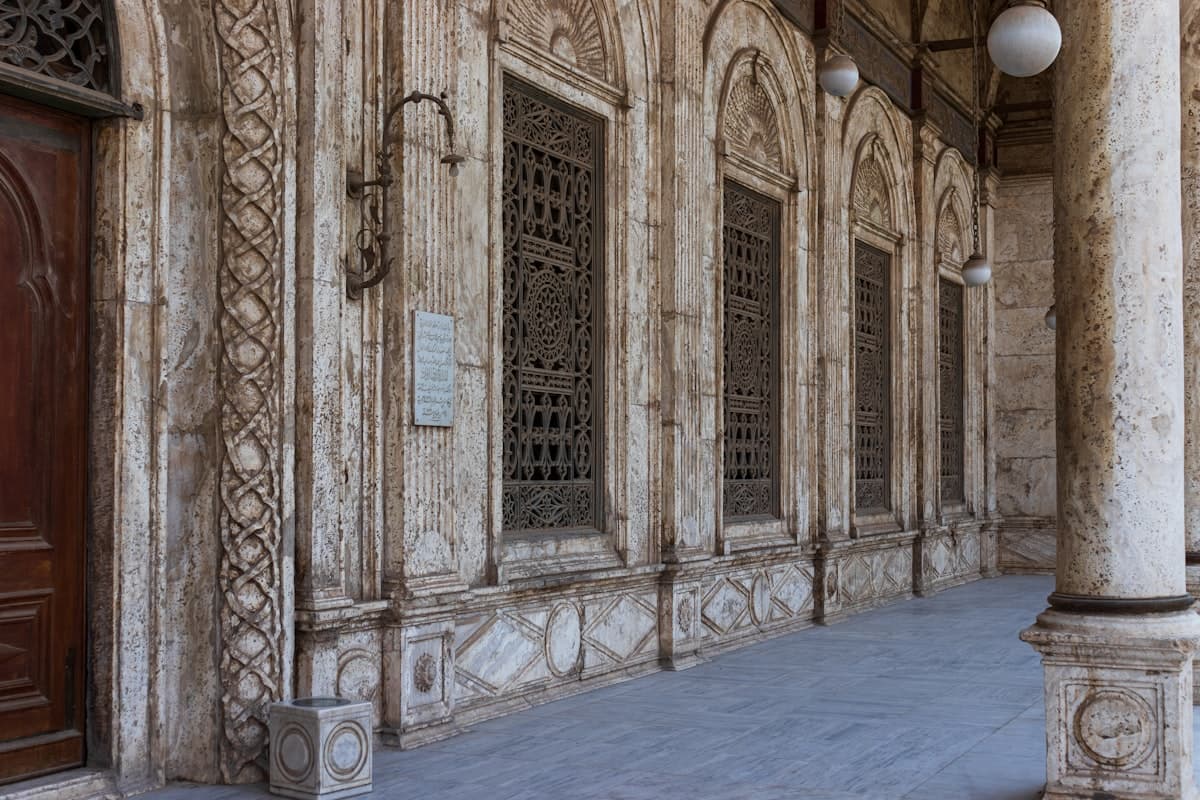
The exterior prepares you for scale but not for the particular quality of the interior light. The mosque is built from pale limestone that in the morning absorbs the sun slowly, going from grey to cream to something almost warm. The entrance portal is heavily carved, Mamluk in its vocabulary but softer in execution, with stalactite vaulting overhead as you pass through.
Inside, the prayer hall is large without being cold. The carpet is deep red. The chandeliers are enormous and were probably not the original lighting solution. What holds your attention are the carved wooden screens and the marble floors, which shift in pattern as you move between sections. The qibla wall, indicating the direction of Mecca, is inlaid with geometric tilework that mixes Ottoman, Mamluk, and Persian influences in a way that would have scandalized a purist but clearly satisfied the royal commissioners.
The tombs are in a separate chamber to the right as you enter. You will smell incense before you reach it. The room contains the graves of Khedive Ismail (the man whose mother started all this), King Fuad I, King Farouk, and Mohammad Reza Shah Pahlavi, the last Shah of Iran, who died in exile in Cairo in 1980 after President Sadat gave him refuge when no one else would. The Shah's tomb is marked simply. Egyptians light candles near it occasionally. He has no country to send him home.
Al-Rifai's shrine occupies a corner of the same space, separated by a carved wooden screen. People come to pray there, leave notes, touch the enclosure. This is not a museum practice. It is a living Sufi tradition that has continued here for centuries, now surrounded by royal marble. The juxtaposition is not ironic. In Cairo, it is just the texture of things.
The Sufi Connection Most Tours Skip
Ahmad ibn Ali al-Rifai founded one of the oldest Sufi orders in the Islamic world in the twelfth century. The Rifaiyya spread from Iraq through Egypt, Turkey, and into the Balkans. In Egypt, they became associated with specific practices including fire-walking and the handling of snakes during religious festivals, practices that were documented by European travelers in the nineteenth century with the kind of horrified fascination that tells you more about the Europeans than the Egyptians.
The zawiya that preceded the mosque was a functioning Sufi lodge, a place where disciples lived, studied, and performed their rituals. That function has not entirely disappeared. During the moulid (festival) of al-Rifai, the square and the mosque fill with Sufi brotherhoods from across Egypt. If you are in Cairo during a moulid season and want to understand what Islamic Egypt looks like when it is not performing for tourists, this is where you come.
The Connections
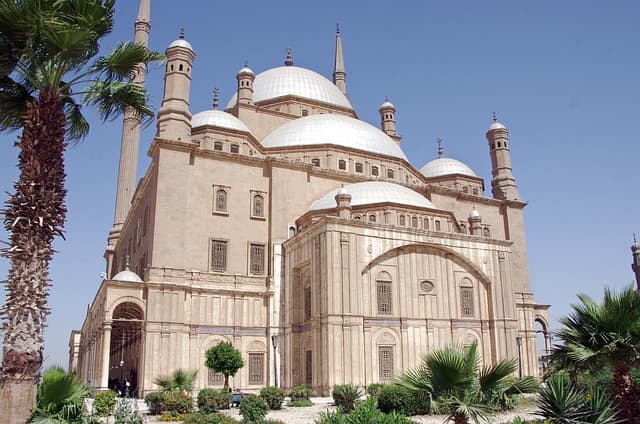
Stand in the square between Al-Rifai and Sultan Hassan and you are looking at a compressed architectural history of Islamic Cairo. Sultan Hassan Mosque was built by a Mamluk sultan in the 1350s, constructed so ambitiously and so quickly that workers died in the scaffolding collapses. Its stone was quarried partly from the outer casing of the pyramids at Giza, which the Mamluks treated as a convenient supply depot rather than a monument to protect. The mosque was never fully completed either.
The Citadel behind both mosques was begun by Saladin (Salah al-Din) in 1176 on a spur of the Muqattam Hills. Saladin chose the site because of the wind patterns: a specific microclimate kept the air cooler there than in the city below. The Citadel's position also meant it sat over the Pharaonic city of Memphis's northern reach, and excavations in the area have turned up artifacts from every civilization that used this valley.
The neighborhood descending from the square into Islamic Cairo, through the street now called Sharia al-Qalaa, follows the line of a canal that was operational in the Fatimid period (tenth to twelfth centuries) and may have followed an even older Pharaonic waterway. The city's water systems and the city's sacred architecture have always been mapped onto each other here.
Al-Rifai also connects to Egypt's twentieth-century political history more directly than most religious sites. The choice to bury Khedive Ismail here established it as a royal necropolis. The decision to return King Farouk's body here in 1965, made by Nasser's government despite the revolution that had exiled him, was a deliberate act of national narrative management: acknowledge the kings, contain them, move on. The Shah's burial in 1980 extended that pattern into Cold War geopolitics. Anwar Sadat's offer of refuge to Mohammad Reza Shah cost Egypt its membership in the Arab League for years.
Common Mistakes
Visiting during Friday midday. The mosque closes to non-worshippers for Friday prayer, typically between noon and 2pm. Many visitors arrive around this time because they've combined it with a morning at the Citadel. Check the timing before you go, and either arrive by 11am or wait.
Confusing the entrance with the Citadel entrance. Tour operators and informal guides near the Citadel will sometimes tell you that Al-Rifai requires a combined ticket or that you must enter through them. This is not true. The mosque has its own direct entrance on the square, and the ticket is purchased there.
Treating it as a photo stop between the Citadel and Khan el-Khalili. The standard tourist circuit treats Al-Rifai as a ten-minute interlude. The tomb chamber alone deserves thirty minutes if you want to understand what you're looking at. The Shah of Iran is buried here. That fact has a geopolitical weight worth sitting with.
Missing the Sultan Hassan Mosque opposite. These two buildings are in direct visual conversation. If you visit one without the other, you miss half the meaning of each. Sultan Hassan requires its own ticket (approximately EGP 180 for foreigners) and its own hour.
Dressing without thinking. The mosque is an active place of worship, not a heritage site that happens to have tourists. Women need to cover their hair and arms. Men should not wear shorts. Shoe covers or removal is required at the entrance. Staff will lend coverings if you've forgotten, but it's better not to begin the visit with that transaction.
Photographing the royal tombs without asking. Photography policies in the tomb chamber shift depending on who is working that day. Ask before raising a camera. The Sufi shrine area in particular is a place of active prayer, and photographing people in worship without permission is a failure of basic manners, regardless of what your lens can technically reach.
Coming only once. If you're in Cairo for ten days, this square rewards two visits: once in the early morning for the light on the stonework and the quiet, and once in the late afternoon when the Citadel's shadow moves across the facade and the call to prayer arrives from six directions at once.
Practical Tips
The square outside is not particularly aggressive with vendors compared to Khan el-Khalili, but you will be approached by informal guides near the Citadel entrance. A polite, firm refusal once is enough. If someone follows you, walk directly to the mosque ticket window.
Public toilets are available near the mosque entrance. They are functional. Bring your own tissue.
The best food nearby is not immediately obvious. Avoid the sit-down restaurants facing the square, which are priced for tourists and mediocre for everyone. Walk two streets into the residential neighborhood behind Al-Rifai toward Sayyida Zeinab and you'll find kushari shops and ful carts that charge EGP 20 to 40 for a filling meal.
If you're combining this with the Citadel, do the Citadel first. It requires more physical energy (it's on a hill, it's large, and the Mohamed Ali Mosque inside gets crowded by 10am). Come down to Al-Rifai when you're ready to slow down.
The mosque is accessible to visitors with mobility limitations at ground level, though the square's paving stones are uneven in places. The tomb chamber has a low threshold at the entry point.
Finally: this is not a place to rush. Cairo will try to rush you everywhere. The Al-Rifai Mosque rewards the specific patience of sitting still in a room where a Sufi mystic's shrine, an exiled king's grave, and a deposed shah's body share the same incense-heavy air. That combination exists nowhere else on earth. Give it the time it's asking for.
Frequently Asked Questions
The Weekly Dispatch
More on Egypt, every Friday.
Cultural depth and places most guides never mention.
No spam. Unsubscribe anytime.