Colossi of Memnon Guide: Beyond the Photo Stop in Luxor
The Colossi of Memnon stood for a thousand years before the Greeks named them. This guide goes past the photo stop into the full, strange story.
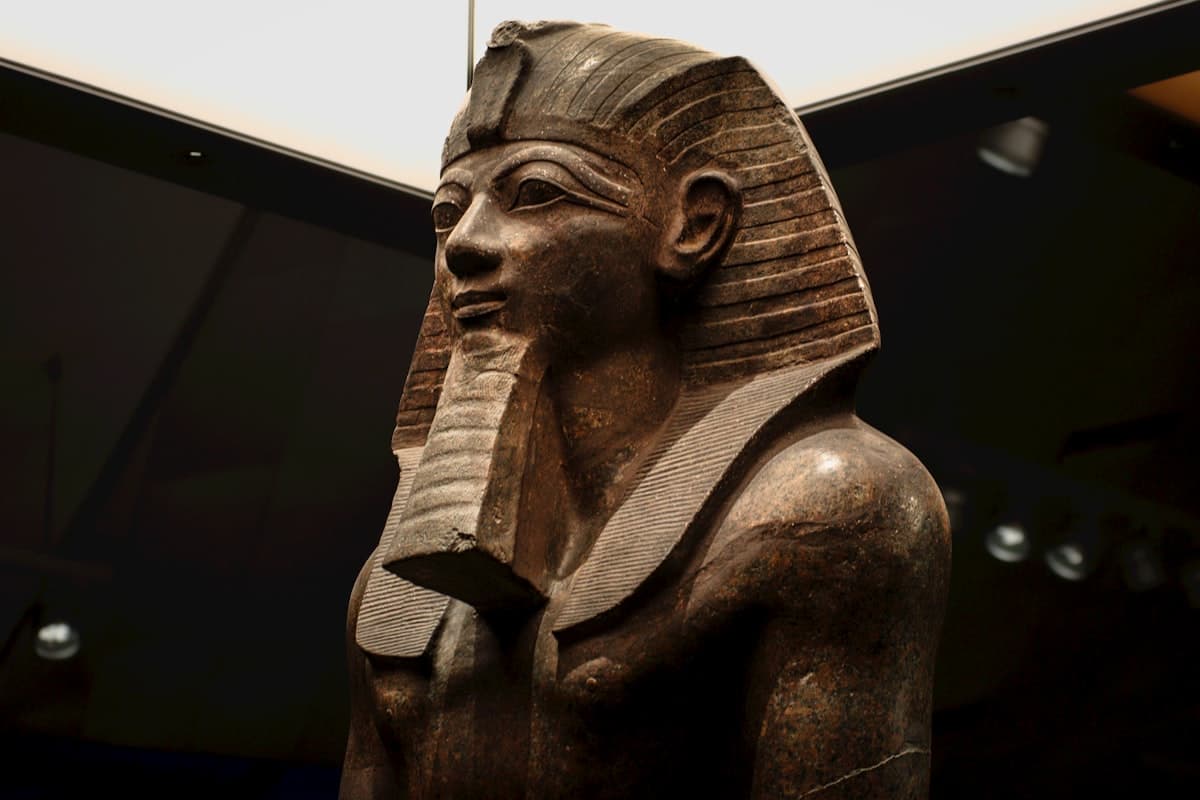
Quick Facts
- Best time to visit
- October to February for tolerable temperatures. Arrive before 8am year-round for direct light on the statues' faces and smaller crowds before East Bank tour groups cross.
- Entrance fee
- Free to view from the road. West Bank combined pass from EGP 450 (approx. $9 USD) for close access, bundled with other sites. Confirm at the on-site ticket kiosk.
- Opening hours
- Visible from the road at all hours. Surrounding Theban Necropolis zone open approximately 6am to 5pm (winter) and 6am to 4pm (summer).
- How to get there
- Public Nile ferry from near Luxor Temple: EGP 3-5. Then microbus or tuk-tuk to the Colossi: EGP 10-20. Private taxi round trip with waiting time from Luxor: EGP 200-400.
- Time needed
- 20-30 minutes at the statues alone. Allow a full day if combining with Valley of the Kings, Medinet Habu, the Ramesseum, or Hatshepsut's temple at Deir el-Bahari.
- Cost range
- Budget West Bank day EGP 600-900 including ferry, transport, and select site entries. Mid-range with private guide and multiple tombs EGP 2,000-3,500.
Quick Facts
Best time to visit: October to February, early morning (before 8am) for low light and thin crowds
Entrance fee: Currently free to view from the road. Entry to the surrounding West Bank archaeological zone is bundled with other tickets. The ticket kiosk near the Colossi sells combined West Bank passes starting at EGP 450 (approx. $9 USD) depending on which sites you add. Confirm locally as fees are revised regularly.
Opening hours: The statues are visible 24 hours from the roadside. The broader Theban Necropolis area operates roughly 6am to 5pm daily in winter, 6am to 4pm in summer.
How to get there: From Luxor's East Bank, take the public ferry from the dock near Luxor Temple (EGP 3-5 per person) then a microbus or tuk-tuk west (EGP 10-20). A private taxi from Luxor city to the West Bank and back, with waiting time, costs EGP 200-400 depending on the season and your negotiating. From the West Bank ferry landing, the Colossi sit about 1.5km south.
Time needed: 20-30 minutes at the statues themselves. Budget a full day if you're combining with the Valley of the Kings, Medinet Habu, or the Temple of Hatshepsut, all of which are within 5km.
Cost range: Budget day on the West Bank, EGP 600-900 including transport and select sites. Mid-range with guide and multiple tomb entries, EGP 2,000-3,500.
---
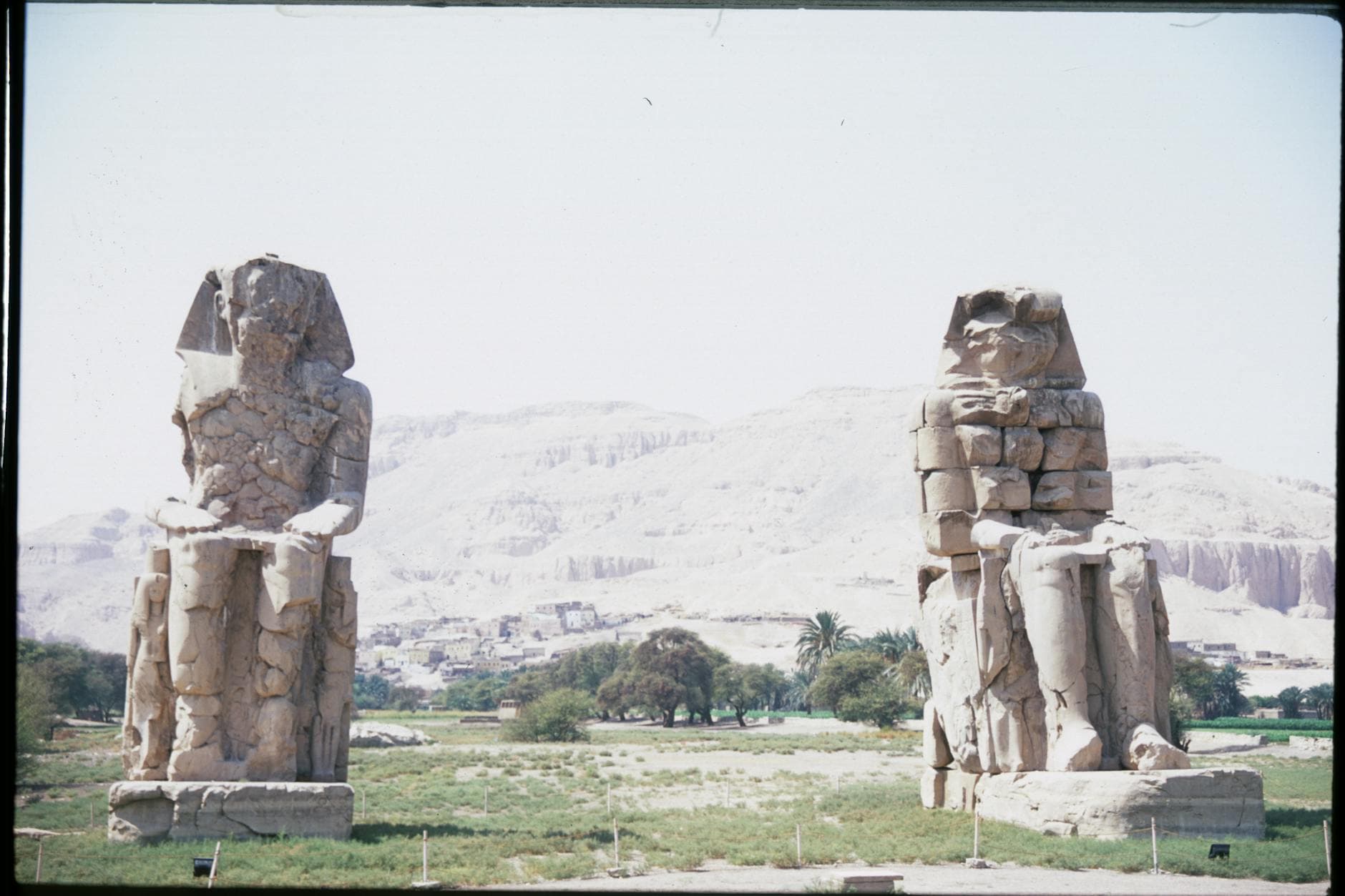
For roughly four hundred years, the Greeks and Romans who came to Egypt believed these two enormous seated figures were representations of Memnon, the Ethiopian king killed by Achilles at Troy. They were wrong on every count: wrong name, wrong king, wrong story entirely. The statues depict Amenhotep III, who ruled during the fourteenth century BCE and who built the largest mortuary temple in Egyptian history directly behind them. That temple no longer exists in any meaningful form. But the Colossi of Memnon, each one roughly 18 meters tall and weighing an estimated 720 tonnes, are still here, sitting in the middle of agricultural fields as if they simply forgot to fall down.
The name Memnon came from an acoustic accident. After an earthquake in 27 BCE cracked the northern statue, it began emitting a sound at dawn, a low, resonant tone that ancient visitors interpreted as the voice of the hero singing to his mother Eos, goddess of the dawn. Roman emperors came to hear it. Hadrian visited in 130 CE and had inscriptions carved recording that his wife Sabina heard the sound twice. When Emperor Septimius Severus repaired the crack around 199 CE, the sound stopped. It has never been heard since.
Why This Place Matters
Amenhotep III ruled Egypt at arguably its wealthiest and most diplomatically sophisticated moment. He corresponded as an equal with the kings of Babylon, Mitanni, and Assyria. The letters survive, found at Amarna, written in Akkadian cuneiform, the diplomatic lingua franca of the ancient Near East. He built so extensively across Egypt that later pharaohs simply usurped his statues by carving their own names over his, a faster and cheaper form of monument-building.
His mortuary temple was the largest ever constructed in Egypt, covering an area greater than Karnak. The two Colossi stood at its entrance. Behind them rose pylons, courts, hypostyle halls, sanctuaries, a sacred lake, and subsidiary temples spread across roughly 35 hectares of the West Bank plain. The Nile flooded it periodically for centuries, and later pharaohs mined it for ready-cut stone. By the time Napoleon's expedition arrived in 1798, almost nothing remained above knee height.
The German Archaeological Mission working this site since 1998 has changed that picture considerably. They have recovered thousands of fragments: colossal statues of Sekhmet, sphinxes, column bases, and a second pair of seated colossi that had been completely unknown. One of those recovered statues, a quartzite figure of Amenhotep III, is among the largest royal statues ever found in Egypt. It is now in the Cairo Museum, though most visitors walk past it without realizing what they're looking at.
So when you stand in front of the Colossi of Memnon, you are standing at the front gate of a temple that for centuries was the most important religious structure on the West Bank. The emptiness behind the statues is not just absence. It is erasure, and it took considerable effort.
What You're Actually Looking At
The two statues are not identical, and they have not always looked as they do now. Both depict Amenhotep III seated on his throne, hands flat on his knees, wearing the double crown. On the sides of each throne are carved figures of the Nile god Hapy binding the heraldic plants of Upper and Lower Egypt, a standard symbol of unified kingship. At the feet of each statue stand smaller carved figures: the pharaoh's wife Tiye and his mother Mutemwiya on the northern colossus, and Tiye alone on the southern one.
The faces visible today are largely reconstructed. Centuries of Nile flooding, stone robbery, and Greek and Roman graffiti (there are more than a hundred ancient inscriptions carved into the legs of the northern statue) degraded the original surfaces severely. The northern statue in particular had its upper portion completely rebuilt in Roman times using a different, softer sandstone. You can see the join if you look carefully, about a third of the way up. The original statues were carved from quartzite sandstone quarried at Gebel el-Ahmar near Cairo, transported roughly 700km upstream, an engineering undertaking whose logistics are still not fully understood.
Between the two statues, and often overlooked by visitors lingering near the road, a third colossus has been partially re-erected by the German mission. It is a standing figure, similarly scaled, and it gives a better sense of what the entrance zone of the temple complex once looked like when perhaps seven or eight colossal figures stood in alignment.
The Morning Sound and What It Actually Was
The acoustic phenomenon the ancients described as Memnon singing was almost certainly caused by morning dew evaporating from the cracked stone and expanding the material rapidly, creating vibrations. Physicist and historian Strabo visited around 20 BCE and was openly skeptical, writing that he was not sure he had heard anything real and suspected the priests of manufacturing the effect. He was probably right to be suspicious, though the natural explanation for the sound is now broadly accepted among archaeologists.
What's interesting is not the physics but the cultural machinery around it. The ancient world treated the sound as contact with the heroic dead, with myth made audible. Roman tourists carved their names into the statue's legs to record that they had been present for it, the way people now photograph themselves with the Colossi, hands outstretched, for Instagram. The impulse to claim proximity to the legendary is very old.
The Connections
Amenhotep III's reign connects to nearly everything consequential in the ancient world of his era, and the Colossi connect physically to layers of Egyptian history most visitors don't see.
His son, who came to the throne as Amenhotep IV and renamed himself Akhenaten, dismantled the religious establishment his father had perfected. The temples at Luxor and Karnak that Amenhotep III built or expanded were altered by Akhenaten, restored by Tutankhamun, and then fought over by every pharaoh of the Nineteenth and Twentieth Dynasties. The colossal statues of Ramesses II at the Ramesseum, visible from the Colossi of Memnon on a clear morning, are partly built from stone robbed from Amenhotep III's temple directly behind where you're standing.
The agricultural fields surrounding the Colossi were farmed continuously from antiquity through the Islamic period and into the present. The West Bank plain was never simply an archaeological zone: it was a working landscape. The village of Kom el-Hettan, which takes its name from the Coptic word for a mound of ruins, sits adjacent to the excavation site. Coptic Christian communities settled the West Bank during the early centuries of Christianity, converting some of the pharaonic structures into churches. The mortuary temple of Ramesses III at Medinet Habu, 2km south, shows Coptic-era modifications in its outer court.
In the early Islamic period, the limestone from abandoned structures across the West Bank was burned for quicklime to build new mosques and houses in Luxor city, then called al-Uqsur, meaning the palaces. The Luxor you see today was built partly from the Luxor that preceded it.
Common Mistakes
Treating the Colossi as a photo stop between other sites. Most West Bank itineraries route visitors past them without stopping properly. If you give them 20 minutes and actually walk between and around them, you will see details, the throne carvings, the smaller figures at the feet, the reconstructed third colossus, that are completely invisible from the road.
Arriving at midday. The statues face east, toward the rising sun, which means morning light falls directly on their faces. By 10am in summer, you are looking into harsh overhead glare bouncing off pale sandstone. The quality of what you see is dramatically different at 6:30am versus noon.
Ignoring the excavation site behind them. The German Archaeological Mission has an on-site presence and occasionally allows visitors to view ongoing work. The site behind the statues, officially Kom el-Hettan, is not routinely open to casual visitors, but asking at the ticket kiosk costs nothing and occasionally yields access.
Assuming the statues are solid. They are not. The Romans in particular modified the interior of the northern statue when they repaired it, and there are internal stress points that have required modern conservation intervention. The cracking and patching visible on the surface is documented and monitored.
Skipping the inscriptions. The lower legs of the northern colossus carry more than a hundred Greek and Latin inscriptions, several of them recording visits by named Roman officials and their experiences hearing the sound. They are weathered but legible with patience and a good eye. Nobody looks at them.
Booking a West Bank day that is too full. The Valley of the Kings, Hatshepsut's temple, Medinet Habu, and the Colossi in a single day leaves you exhausted and under-informed at every site. The West Bank deserves two days minimum.
Neglecting water and sun protection in the field. There is no shade at the Colossi. The site is open agricultural plain. In summer, temperatures at midday regularly exceed 42 degrees Celsius. People underestimate this every season.
Practical Tips
The best approach to the Colossi of Memnon is as part of a slow West Bank morning, not as an item on a checklist. Cross from the East Bank on the public ferry before 7am. The ferry runs continuously, costs almost nothing, and puts you on the West Bank before the tour groups have organized themselves. From the landing, a tuk-tuk to the Colossi takes ten minutes.
If you hire a West Bank guide, confirm they will actually stop and explain the statues rather than pause for five minutes while you photograph. The site rewards explanation. A good local guide costs EGP 400-700 for a half-day and will know the German mission's work, the recovered statues, and the acoustic history in detail.
There are no formal facilities at the Colossi themselves: no toilets, no shade, no food. The nearest tea and snacks are at the small kiosks near the ticket office, about 300 meters north. Bring water, more than you think you need.
The road running directly beside the statues carries active traffic, including horse carriages, microbuses, and private cars. Children selling alabaster will approach you. A simple, direct refusal is sufficient and kinder than a protracted negotiation.
For photography, the northern colossus is the more photogenic of the two due to its Roman-era reconstruction giving it a cleaner profile. The southern colossus retains more of its original surface texture and is the better subject if you are interested in the original stonework rather than the silhouette. Shoot before 8am or after 4pm.
The Colossi of Memnon guide most visitors never get is the one that explains what they are the remnants of. Once you understand that these two figures are all that survive of what was once Egypt's largest temple, built by a pharaoh at the height of his civilization's power, the scale of the loss makes the scale of the statues mean something different. They are not monuments. They are the front gate of something that is gone.
Frequently Asked Questions
The Weekly Dispatch
More on Egypt, every Friday.
Cultural depth and places most guides never mention.
No spam. Unsubscribe anytime.