Colossi of Memnon Guide: The Statues That Sang at Dawn
The Colossi of Memnon once made sound at sunrise, drawing Roman emperors to hear them. This guide tells you what they were, what you'll actually see, and why they matter.

Quick Facts
- Best time to visit
- October through February. Arrive before 6am for light and low crowds. Avoid May through August midday heat.
- Entrance fee
- Free to view from road. West Bank combined ticket: EGP 300 to 450 (approx $6 to $9 USD). Confirm at West Bank ticket office, fees updated regularly.
- Opening hours
- Statues visible from road at all hours. Excavation/site access: daily approximately 6am to 5pm.
- How to get there
- Ferry from East Bank: EGP 5 to 10. Bicycle rental from ferry landing: EGP 50 to 80/day. Private West Bank taxi: EGP 200 to 350 for half day. Site is 2km from ferry landing.
- Time needed
- 30 to 45 minutes at the statues. Two to three hours with excavation context. Full West Bank day if combining with Valley of the Kings, Hatshepsut temple, and Medinet Habu.
- Cost range
- Budget EGP 400 to 700 per person for full West Bank day with transport and site fees. Mid-range EGP 1,500 to 2,500 with private driver and licensed Egyptologist guide.
For three hundred years, travelers crossed the Mediterranean not to see the statues but to hear them. Every morning at dawn, the northern colossus emitted a sound, a low, resonant tone that Greeks and Romans interpreted as the voice of Memnon, the mythological Ethiopian king slain by Achilles, calling out to his mother Eos, goddess of the dawn. Emperors made the pilgrimage. Hadrian stood here in 130 CE with his empress Sabina and waited. The statues no longer sing. A Roman restoration in the 3rd century sealed whatever crack or moisture chamber produced the sound. The silence is its own kind of message.
This is your entry point to the Colossi of Memnon, and it matters because it tells you what kind of site this is: one where the most significant thing that ever happened here no longer happens, and where the name most people know, Memnon, has nothing to do with who these statues actually depict. They are Amenhotep III, one of the most powerful pharaohs of the 18th Dynasty, seated on his throne for the last 3,400 years, staring toward the Nile as if still expecting something important to arrive.
Quick Facts
Best time to visit: October through February, when temperatures are manageable before 10am. Arrive at or before 6am if you want the light and the quiet.
Entrance fee: The Colossi of Memnon themselves are viewable for free from the road. Access to the surrounding excavation site and the ongoing restoration of Amenhotep III's mortuary temple, which sits directly behind the statues, falls under the general West Bank ticket system. A combined West Bank ticket costs approximately EGP 300 to 450 (roughly $6 to $9 USD) depending on which sites you include. Confirm fees at the Luxor West Bank ticket office on the day, as Egyptian site fees are revised regularly.
Opening hours: The statues are visible from the road at all hours. The excavation area and temple zone: daily from approximately 6am to 5pm.
How to get there: From Luxor's East Bank, take a felucca or motor ferry across the Nile (EGP 5 to 10 per person) and then negotiate a bicycle rental (EGP 50 to 80/day) or microbus from the West Bank ferry landing. A private taxi for the West Bank circuit runs EGP 200 to 350 for a half day. The Colossi sit at the beginning of the road leading deeper into the necropolis, about 2km from the ferry landing.
Time needed: 30 to 45 minutes at the statues themselves. Two to three hours if you're engaging with the excavation context and walking the full perimeter. Most visitors combine this with the Valley of the Kings and Hatshepsut's temple in a full West Bank day.
Cost range: Budget EGP 400 to 700 per person for a West Bank day including transport and multiple site fees. Mid-range EGP 1,500 to 2,500 with a private driver and licensed guide.
Why This Place Matters

Amenhotep III ruled Egypt from approximately 1388 to 1351 BCE, and his reign represents the apex of New Kingdom wealth and diplomatic reach. He corresponded with Babylonian kings, married foreign princesses as strategic alliances, and built more extensively than almost any pharaoh before him. His mortuary temple on the West Bank was, at the time of its construction, the largest religious building in Egypt. The Great Temple of Amun at Karnak, which you can visit today on the East Bank, was partly his work too, and it was Amenhotep III who commissioned the Avenue of Sphinxes that once connected Karnak to Luxor Temple.
None of his mortuary temple survives above ground. The Nile flooded it repeatedly over centuries. Stone was quarried from its ruins to build other temples, including Merenptah's temple nearby. What remains is largely submerged archaeology and two 18-meter quartzite statues that were positioned at the temple's entrance as divine guardians.
The statues were already 900 years old when an earthquake in 27 BCE cracked the northern one and created the acoustic resonance that made it famous. By the time Roman tourists began arriving with their chisels to carve their names and reactions into the statue's legs, the connection to Amenhotep III had been almost entirely replaced by Greek mythology. Over 100 Greek and Latin inscriptions survive on the statue's lower half. Several were written by Roman prefects and officials. One was written by the empress Sabina herself after she heard the sound on her second attempt. You can read these inscriptions today. They are some of the most direct surviving records of ancient tourism in the world.
What You'll Actually See, and What Stands Behind It
The two statues sit in flat agricultural land with the Theban hills rising behind them, and on clear mornings the light hits them from the east in a way that makes the quartzite glow with a faint reddish warmth. They are heavily eroded. Faces are largely gone. The northern colossus, the one that sang, was restored and is noticeably smoother in its upper sections than the southern one. Both are seated on thrones carved with reliefs showing the Nile god Hapy binding together the heraldic plants of Upper and Lower Egypt, the lotus and papyrus. This image appears throughout Egyptian religious art, but seeing it at this scale, on this stone, after 34 centuries, shifts something.
Between and around the statues, excavation is ongoing. The German Archaeological Institute and an Egyptian mission have been working the site since 1998, and what they've found is significant: colossal statues of Sekhmet, the lion-headed goddess, sphinxes, columns, fragments of painted relief. The site map they've reconstructed suggests Amenhotep III's temple was larger than Abu Simbel and Karnak combined. That temple is gone. These two statues are what the entrance looked like.
The Inscriptions Most People Walk Past
At the base of the northern colossus, at roughly knee height on the exterior face, you can make out clusters of carved Greek letters. Most visitors photograph the full statue from a distance and move on. If you walk to the base and look carefully, you're reading the reactions of Roman travelers who stood in this same spot and felt compelled to leave proof they had been here, that they had heard the sound, that they believed. One inscription from a woman named Caecilia Trebulla records that she heard Memnon twice. The repetition suggests she wasn't sure she'd heard it the first time and came back. That uncertainty is human in a way that temple reliefs are not.
The Connections: One Site, Several Civilizations
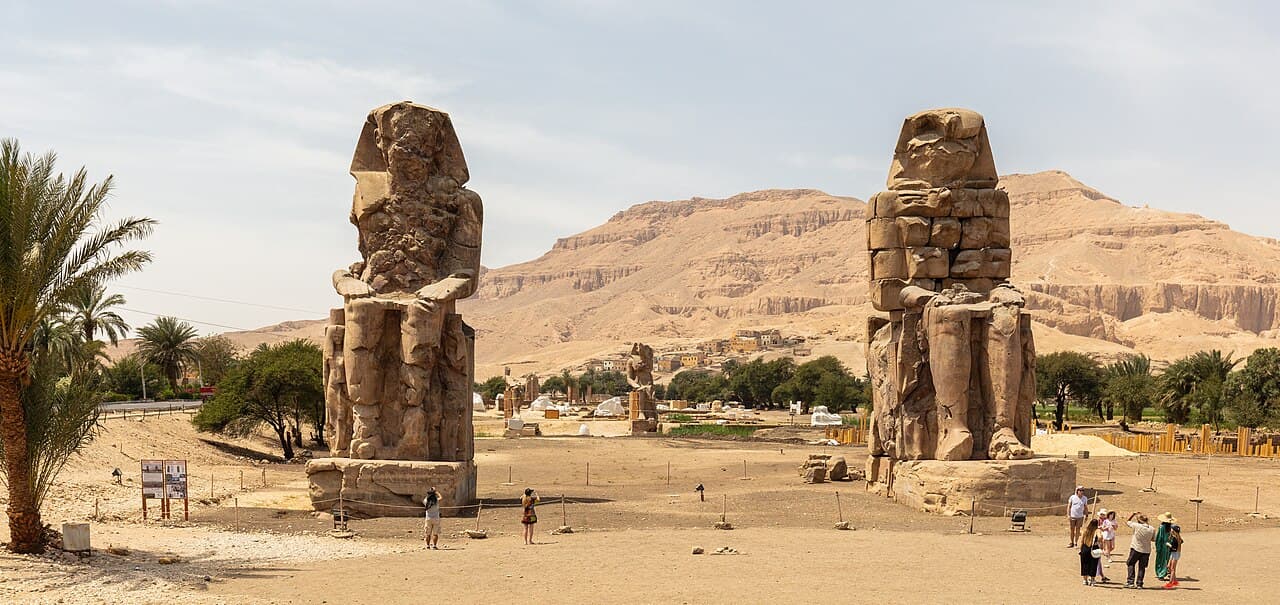
The land around the Colossi is agricultural, and has been continuously farmed since Pharaonic times. The Nile's annual inundation, which deposited the silt that made this valley extraordinarily fertile, is also what destroyed Amenhotep III's temple. The ancient Egyptians built their houses from mud brick, which dissolved back into the earth, and their temples from stone, which was later quarried. The stone from this temple fed later construction across the West Bank. Some blocks ended up in Coptic churches. Others were incorporated into medieval Arab structures. The Nile, the agriculture, the recycling of building material: this is the underlying logic of the entire West Bank landscape.
Four kilometers north, the village of Kom el-Hettan preserves the Arabic name for the area that corresponds to the ancient site. The local Qurna community, whose ancestors literally lived inside and on top of the Theban tombs for centuries, was relocated to a new village in the 2000s as part of an archaeological clearance effort. Their relationship to these monuments was complex and intimate in ways that don't fit neatly into the story of preservation versus exploitation. Some families had maintained and protected specific tombs for generations. Others had damaged them. The evacuation removed both.
Across the Nile on the East Bank, Luxor Temple sits on foundations that include earlier Pharaonic structures, and within its precinct stands an intact mosque, the Abu Haggag Mosque, built into the upper section of the temple when the temple floor was buried under centuries of accumulated earth. The mosque is still active. The connection between Amenhotep III's building projects on the West Bank and what you see at Luxor Temple today is direct: the same dynasty, the same reign, the same theology of divine kingship expressed in stone across both banks of the Nile.
Common Mistakes
Arriving at midday. The statues face east. The best light is in the first two hours after sunrise. By 10am in winter and 8:30am in summer, the light is flat and the heat begins. Every photograph you've seen of these statues that looks worth looking at was taken before 8am.
Treating this as a five-minute stop. Tour buses pull up, passengers photograph from the road, and leave in under ten minutes. If that's your experience, you've seen the statues the way you see a billboard. The excavation perimeter, the inscriptions, the agricultural context, the relationship between the statues and the hills behind them: these take time.
Missing the third statue. In 2014, excavators recovered a largely intact third colossus of Amenhotep III from the site, still partially buried. Depending on when you visit and the current state of the excavation, it may be visible. Ask at the site entrance. Most visitors don't know it exists.
Assuming the name Memnon is ancient Egyptian. It is entirely Greek. The Egyptians called this place the Temple of Amenhotep III. The Memnon story was Greek mythological overlay that replaced the actual history so completely that even today the Greek name is what appears in guidebooks. The man these statues depict was not named Memnon and had no connection to the Trojan War.
Skipping the western face of the statues. Everyone photographs from the east, from the road. Walk around to the western side. The throne reliefs are better preserved there and the scale of the statues reads differently when you're beside them rather than in front of them.
Bringing only bottled water. The West Bank road can be brutally exposed. One bottle is not enough if you're spending a full morning. Bring two liters per person minimum in summer, one liter minimum in winter.
Booking a West Bank tour that doesn't include a licensed Egyptologist guide. Generic drivers will tell you the statues are of Ramesses II, which they are not, and will know nothing about the ongoing excavations. The site rewards knowledge, and knowledge requires preparation or a guide who actually has it.
Practical Tips

The best version of a visit to the Colossi of Memnon is the first stop on a West Bank morning that begins before 6am. Take the first ferry across, rent a bicycle or hire a driver, and arrive at the statues as the sun clears the Theban hills. You will have the site largely to yourself for thirty to forty minutes before the organized tours begin arriving.
If you want context before you arrive, read anything about Amenhotep III's reign specifically. His relationship with his chief wife Tiye, who appears in relief on the throne bases of both statues, is one of the more documented royal partnerships in Egyptian history. She was Egyptian-born, not foreign, which was unusual for a chief queen of that era, and she wielded real political influence.
The excavation office near the site sometimes allows visitors to speak with team members or see recent finds, particularly on weekdays when work is active. This is not guaranteed and not advertised, but a polite request in Arabic or French is more likely to succeed than one in English.
The West Bank ticket office opens at 6am. Buy your combined tickets there before proceeding to individual sites. Attempting to buy tickets at each site separately is slower and occasionally more expensive.
If you're combining this with the Valley of the Kings in the same morning, do the Colossi first. The Valley gets crowded by 9am in high season, and the tombs are better visited before the tour groups arrive. The Colossi, being open air and free to view from the road, are slightly more forgiving of a later arrival, though you'll lose the light.