Coptic Cairo Neighborhood: A Complete Cultural Guide
Coptic Cairo isn't a ruin or a relic. It's a living quarter where Egypt's oldest Christians still pray in churches built over Roman fortresses. Here's how to visit it properly.
Quick Facts
- Best time to visit
- October to March for tolerable temperatures. Avoid Friday mornings due to road closures around surrounding mosques.
- Entrance fee
- Coptic Museum: EGP 450 (approx $9 USD), students EGP 225 with valid ID. Individual churches inside the compound are free. Ben Ezra Synagogue: included in compound access.
- Opening hours
- Daily 9am to 5pm. Closed some national and Coptic feast days. Confirm ahead for visits around January 7 (Coptic Christmas) or Coptic Easter.
- How to get there
- Metro Line 1 (red line) to Mar Girgis station, EGP 10 from central Cairo. Taxi from Downtown EGP 60 to 100. Tuk-tuk from Old Cairo edges EGP 15.
- Time needed
- 3 hours minimum for main sites. Half-day for museum, four churches, and Ben Ezra Synagogue. Full day if combining with Fustat ruins and Mosque of Amr ibn al-As.
- Cost range
- Entry plus museum EGP 450 to 600 per person. Local guide EGP 200 to 400. Full half-day including transport, entry, and lunch: EGP 800 to 1,200 per person.
The oldest continually inhabited neighborhood in Cairo is not Islamic. It predates the Arab conquest by at least six centuries, and the fortress walls that still stand in its southern corner were built by Roman emperor Diocletian, the man who persecuted Christians with particular enthusiasm before Christianity became the empire's official religion. The irony is architectural: inside those same walls, some of the earliest Christian communities in the world took shelter, built churches, and survived. That is Coptic Cairo in one compressed fact. It contains multitudes it has never bothered to advertise.
Quick Facts
Best time to visit: October through March, when temperatures are manageable and the light is soft enough to actually see the interior frescoes. Avoid Friday mornings when the surrounding streets are closed for prayers and transport becomes complicated.
Entrance fees: The main ticketed complex covers the Hanging Church, the Coptic Museum, and several smaller churches. Museum admission is EGP 450 for foreigners (approximately $9 USD), EGP 225 for students with valid ID. Individual churches within the compound are free once you're inside the ticketed area. Some churches outside the main complex, including the Church of St. Sergius and Bacchus, may have separate small fees or donation boxes.
Opening hours: Daily 9am to 5pm. The Coptic Museum closes on national holidays and some religious feast days; call ahead or check the Egyptian Museum Authority's listings if you're visiting around Coptic Christmas (January 7) or Easter.
How to get there: The Metro is the only sensible option. Take Line 1 (the red line) to Mar Girgis station. The station exits directly onto the street above the compound. Fare is EGP 10 from central Cairo stations. Taxis from Downtown will cost EGP 60 to 100 depending on traffic and your negotiating patience. A tuk-tuk from Old Cairo's edges runs about EGP 15.
Time needed: Three hours for a focused visit covering the museum and three or four churches. A full half-day if you plan to read inscriptions, sit in the churches, and walk the Jewish quarter and Ben Ezra Synagogue as well.
Cost range: Entry plus museum, EGP 450 to 600 per person. Add EGP 200 to 400 for a local guide. A full morning including transport, entry, and a meal at one of the nearby Coptic-run restaurants: EGP 800 to 1,200 per person.
Why This Place Matters
The Copts are not a fringe denomination. They are the direct descendants of ancient Egyptians, their name derived from the Greek word for Egypt itself, Aigyptos, which later became Qibt in Arabic. When the Arab armies arrived in 641 CE, the Coptic population was the Egyptian population. The country did not convert overnight; it took several centuries. The community that held out, preserved its liturgy in a language directly descended from pharaonic Egyptian, and continued to baptize its children in the Nile's water, that community is what you are walking through in Coptic Cairo.
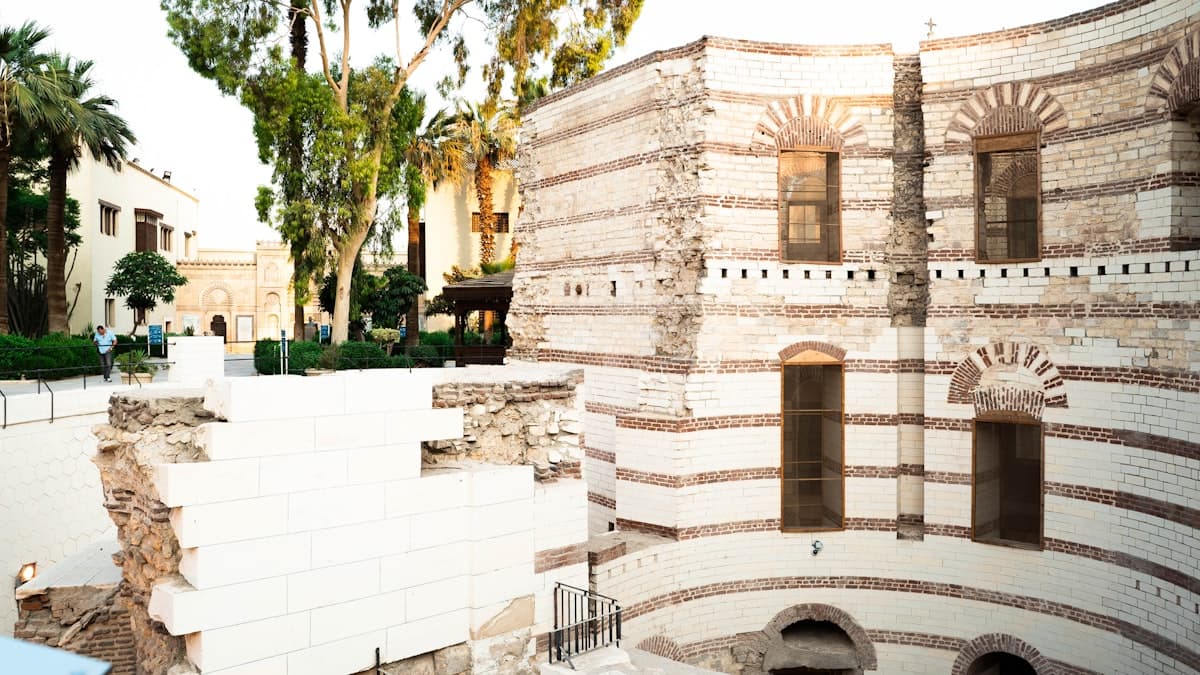
The neighborhood sits on the site of Babylon in Egypt, a Roman fortress whose name has nothing to do with Mesopotamia and whose origins scholars still debate. By the first century CE, it was a military settlement with a substantial Jewish population and, very quickly afterward, a Christian one. Tradition holds that the Holy Family sheltered here during the flight into Egypt, a claim that has shaped the spiritual geography of this pocket of Cairo for two millennia.
What makes the Coptic Cairo neighborhood a complete guide's subject worth serious attention is the density of history in a small space. You can walk from a Roman water gate that is now half-submerged due to the Nile's gradual shift, into a church where the liturgy is sung in Coptic, a language no one speaks at home anymore but which preserves the sound of ancient Egyptian more faithfully than any hieroglyphic transcription can. That is not metaphor. The Coptic liturgical language is the last living form of the language spoken by the builders of the pyramids.
What You'll Actually See
The Hanging Church
The Church of the Virgin Mary, called Al-Muallaqah in Arabic, which translates as the Suspended or Hanging Church, does not hang in any dramatic sense. It sits atop the gatehouse of the Roman fortress, its nave positioned over two Roman towers. The effect from street level is subtle; from inside, once you register that the floor beneath you is suspended over a two-thousand-year-old military structure, it reorients everything.
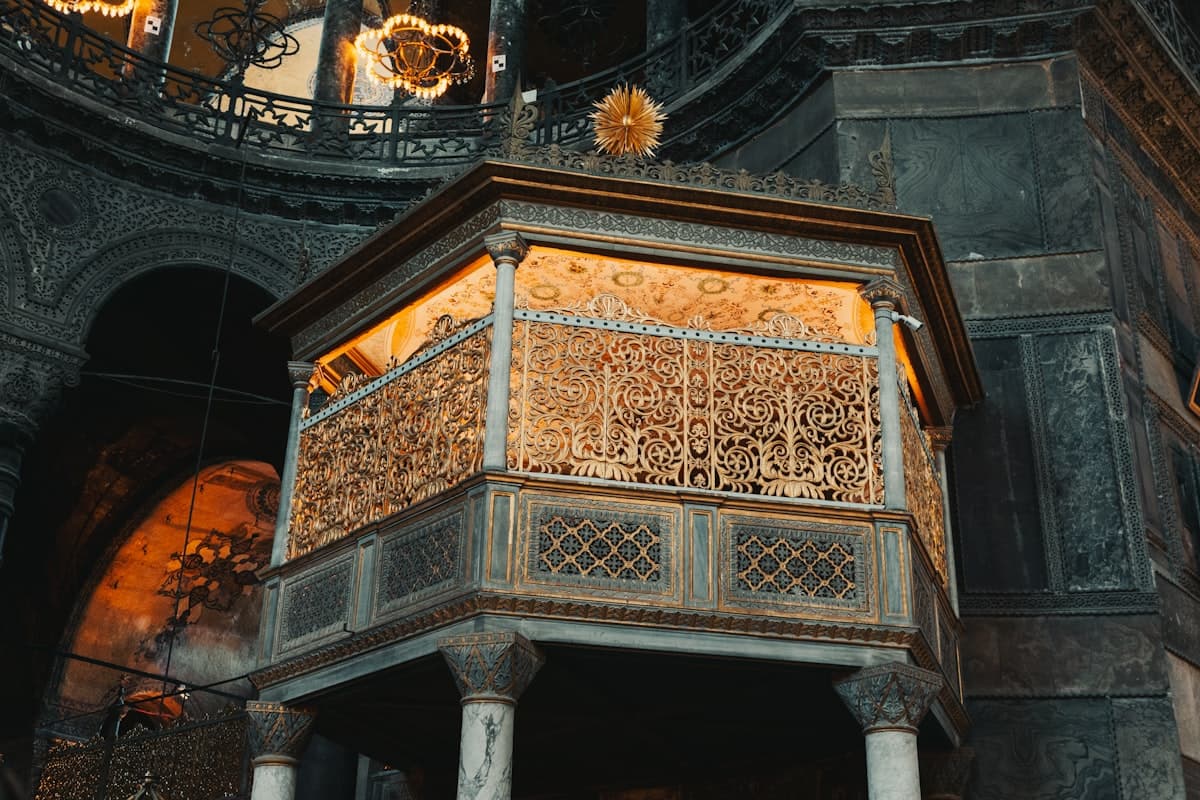
The church dates its founding to the third or fourth century, though what you see now is largely ninth and tenth century construction with significant later additions. The interior contains 110 icons, the largest collection of Coptic icons in Egypt. The oldest surviving ones date to the eighth century. The inlaid ivory pulpit, supported by thirteen columns representing Christ and the twelve apostles, is the most photographed object inside, but look past it to the layered marble screens and the particular quality of light that comes through the high windows in the late morning. The liturgy is sung here in Coptic on Sundays and feast days, and if you arrive during a service, you will understand why this language, despite being extinct as a spoken tongue, has never actually died.
The Coptic Museum
Opened in 1910 by Marcus Simaika Pasha, a Coptic notable who was alarmed by how many artifacts were leaving Egypt for European collections, the Coptic Museum holds the largest collection of Coptic Christian art in the world. Over 16,000 objects span textiles, manuscripts, woodwork, metalwork, and stone. The garden alone contains Roman and pharaonic architectural fragments used as building material by early Christian communities, which is its own argument about how civilizations cannibalize and repurpose each other.
The manuscript collection includes some of the Nag Hammadi texts, the Gnostic gospels discovered in Upper Egypt in 1945 in a sealed jar by a farmer who initially burned several of the codices for warmth before realizing their value. The museum displays facsimiles rather than the fragile originals, but the context here in Coptic Cairo is essential. These texts were hidden, probably by monks from a nearby community, when the orthodoxy of the fourth century began cracking down on alternative Christianities. Someone carried them into the desert and buried them. Someone else dug them up sixteen centuries later.
The Church of St. Sergius and Bacchus
This is the church built, according to tradition, directly over the crypt where the Holy Family sheltered during their time in Egypt. The crypt is below street level now and often has water seeping into it, a consequence of rising groundwater throughout Old Cairo. You descend a few steps into a small, damp space with bare stone walls and simple icons. There is no theatrical lighting, no audio guide explaining significance. The plainness is the point.
The church above dates largely to the fifth century, making it one of the oldest surviving churches in Egypt. The Coptic popes used to be elected and inaugurated here. That ceremony moved to other venues centuries ago, but the weight of that history remains in the proportions of the nave.
The Ben Ezra Synagogue
Do not skip this because it is a synagogue rather than a church. The Ben Ezra Synagogue is physically inside the Coptic quarter, built on the site of a church that was sold to the Jewish community in the ninth century to help pay a tax levied by the Abbasid governor. The original church may have been built on the spot where, according to local tradition, the infant Moses was found in the bulrushes by Pharaoh's daughter. The layering of claims here is not confusion; it is the actual texture of how sacred spaces work in Egypt.
In 1896, the synagogue's storage room, the geniza, was found to contain over 300,000 fragments of Jewish manuscripts, letters, legal documents, and commercial records spanning a thousand years. This Cairo Geniza, as scholars call it, became one of the most important documentary finds in Jewish history and rewrote the understanding of medieval Mediterranean trade, religious practice, and daily life. The fragments are now mostly in Cambridge and the Jewish Theological Seminary in New York. What remains in Cairo is a beautifully restored building with a complicated absence at its center.
The Connections
The Roman fortress of Babylon was built in part to control the canal connecting the Nile to the Red Sea, a canal that the pharaohs had originally dug and that the Romans periodically dredged and reopened for trade. When Amr ibn al-As and the Arab army took Egypt in 641 CE, the first thing they did after the siege of Babylon was establish their camp on the northeastern side of the fortress. That camp became Fustat, the first Islamic capital of Egypt, whose ruins lie a short walk northeast of the Coptic quarter. The Mosque of Amr ibn al-As, the oldest mosque in Africa, sits there now, repeatedly rebuilt over the centuries until almost nothing of the original structure survives.
The Coptic patriarchate, the headquarters of the Coptic Orthodox Church, was based in Alexandria for most of its history, a reflection of Alexandria's centrality in early Christian theology. The move to Cairo was gradual and contested. The current Pope of Alexandria and Patriarch of All Africa operates from a cathedral in Abbassiya, a short drive from Coptic Cairo, but the old quarter remains the spiritual heartland in a way that administrative addresses never quite capture.
The Fatimid caliphs who built Islamic Cairo in the tenth and eleventh centuries maintained relatively tolerant policies toward the Coptic community, employing Coptic architects and administrators. Several of the great Fatimid buildings in the nearby Khan el-Khalili area show Coptic influence in their decorative woodwork, because the craftsmen who made them were often Coptic. The separation between Islamic and Coptic Cairo is a geographic and legal category, not an accurate description of how the two communities actually built the city together.
Common Mistakes
Coming on a Friday morning. The roads around Old Cairo are partly closed for Friday prayers at the surrounding mosques. The Metro still runs, but surface traffic is a problem if you plan to combine Coptic Cairo with anything else that day.
Ignoring the outdoor spaces between churches. The narrow lanes between the buildings contain carved lintels, embedded Roman column drums, and medieval Arabic inscriptions that most visitors walk past without stopping. These fragments are the actual argument of the place, that every layer of civilization here used the material of the one before it.
Treating the museum as an afterthought. The Coptic Museum contains things you will not see elsewhere. The textile collection alone is a serious scholarly resource. Giving it twenty minutes because you want more time in the churches is a real loss.
Arriving without a hat and water in summer. The compound involves significant time in direct sun walking between buildings. June through September, the heat is not a minor inconvenience; it is a genuine obstacle to being able to absorb anything.
Photographing worshippers without permission. Several churches in the compound are active places of worship, not monuments. People are praying. Ask before pointing a camera at anyone, and accept refusal without argument.
Skipping the Ben Ezra Synagogue because of contemporary politics. This is a historical and architectural site whose geniza documents reshaped the understanding of an entire millennium of Mediterranean history. Whatever your feelings about current events, walking past it is a meaningful loss.
Assuming the ticket at the gate covers everything. The Coptic Museum ticket covers the museum and several churches, but some spaces have separate entry or donation expectations. Carry small bills in EGP.
Practical Tips
The Mar Girgis Metro station is the only transport option that guarantees you arrive without stress. The exit drops you directly at the compound entrance. The journey from Tahrir Square takes about eight minutes and costs EGP 10.
Hire a local guide at the gate rather than using a hotel-arranged guide, who will often rush you. Licensed local guides who specialize in Coptic Cairo charge EGP 200 to 400 for a two to three hour tour and know which priests are willing to talk, which side chapels are usually open, and when the Sunday liturgy draws the largest congregations.
Dress conservatively regardless of the season. This is a functioning religious compound. Shoulders and knees covered is the minimum. Carry a light scarf even in summer.
The best light for the Hanging Church's interior falls between 10am and noon when the high windows are directly lit. Come early for the museum (it opens at 9am) and work toward the churches as the morning progresses.
There are two small cafés and several street food vendors just outside the compound entrance, serving koshari, falafel, and tea. Eat outside the compound rather than trying to find food within it. The restaurants immediately adjacent to Mar Girgis station are frequented by locals, not tourists, and the food reflects that.
If you have any interest in Coptic liturgical music, the Cathedral of St. Mark in Abbassiya holds major services on Coptic feast days that draw thousands. It is a different experience from the intimacy of Coptic Cairo's small churches, but the music is an education in how a liturgical tradition survives largely unchanged across fifteen centuries.
Frequently Asked Questions
The Weekly Dispatch
More on Egypt, every Friday.
Cultural depth and places most guides never mention.
No spam. Unsubscribe anytime.