Dendera Temple: A Complete Guide to Hathor's Sanctuary
The Dendera temple Hathor goddess guide you actually need: zodiac ceilings, secret crypts, and the Roman emperor who posed as a pharaoh. 60km from Luxor.
Quick Facts
- Best time to visit
- October to February for manageable heat. Arrive at 7am opening to avoid tour groups that arrive from Luxor by 10am.
- Entrance fee
- EGP 450 per person (approx $9 USD). Students with valid ISIC card EGP 225. Ticket covers temple, crypts, and roof.
- Opening hours
- Daily 7am to 5pm. No extended summer or seasonal hours. Confirm locally during Ramadan.
- How to get there
- Private taxi from Luxor: EGP 400 to 600 return. Organized day tour from Luxor: EGP 350 to 600 per person. Independent: microbus Luxor to Qena (EGP 20 to 30) then tuk-tuk to temple (EGP 10 to 20).
- Time needed
- 2 hours minimum. 3 to 4 hours to cover hypostyle hall, sanctuary, crypts, roof, and exterior reliefs properly. Full day if combining with Abydos.
- Cost range
- Budget EGP 600 to 900 per person for day trip from Luxor including transport and entry. Mid-range EGP 1,500 to 2,500 with licensed Egyptologist guide.
The Romans built this temple. Not restored it, not added a courtyard to it. Built it, almost entirely, between 54 BCE and 68 CE. The structure most visitors photograph and attribute to ancient pharaonic Egypt was constructed while Augustus Caesar and Nero were running the Mediterranean world. That fact alone should recalibrate everything you think you know about Dendera before you arrive.
Quick Facts
Best time to visit: October through February. The Nile Valley in summer sits above 40°C and the temple's exterior stone absorbs heat like a storage heater. Arrive before 8am in any season.
Entrance fee: EGP 450 per person (approximately $9 USD at current rates). The ticket includes access to the main temple complex and the crypts. Photography is included in that price, though guards occasionally claim otherwise.
Opening hours: Daily 7am to 5pm. The site does not extend hours for summer or adjust significantly for Ramadan, so confirm locally before making a predawn drive.
How to get there: Dendera sits 4km from the town of Qena, which is 60km north of Luxor. From Luxor, you have three real options. A private taxi should cost EGP 400 to 600 return including waiting time, negotiate before you get in. Organized day tours from Luxor run EGP 350 to 600 per person including transport and a guide. Alternatively, take a microbus from Luxor to Qena (EGP 20 to 30), then a tuk-tuk or microbus from Qena to the temple (EGP 10 to 20). The independent route takes time and involves navigating Qena's station area, but it works.
Time needed: Minimum two hours for a competent walk-through. Three to four hours if you want to descend into the crypts, climb to the roof, and read the walls properly. Combine with Abydos (45km north) for a full day.
Cost range: Budget EGP 600 to 900 per person for the day trip from Luxor including transport and entry. Mid-range EGP 1,500 to 2,500 if you add a licensed Egyptologist guide and a meal in Qena.
Why This Place Matters
Hathor is one of the oldest deities in the Egyptian record, appearing in texts from the Old Kingdom, around 2600 BCE. She governed love, music, fertility, and the dead. She was also the goddess of foreign lands and of intoxication. The story behind the temple's founding ritual involves the annual drunkenness festival, when worshippers re-enacted Hathor being appeased with beer dyed red to resemble blood, after she had nearly destroyed humanity in her aspect as the Eye of Ra. The Greeks identified her immediately with Aphrodite. The Romans found her theology sophisticated enough to absorb into their own mystery cults.
The temple you walk through today is the third or fourth sanctuary built on this site. Pepi I of the Sixth Dynasty is recorded making offerings at Dendera around 2280 BCE. Thutmose III expanded the cult precinct. The current hypostyle hall was completed under Tiberius. What that means practically is that this is not a site frozen in one historical moment. It is a palimpsest, each layer of patronage visible if you know where to look.
The site also contains a Coptic church built directly into the temple's outer enclosure wall in the fifth century CE. The people who built that church would have considered the temple behind them a monument to idolatry. They built anyway, using the temenos wall as a foundation, because the stone was good and the location was established. That is Egypt in one image: continuity through transformation, nothing wasted.
What You'll Actually See
The Hypostyle Hall and Its Ceilings
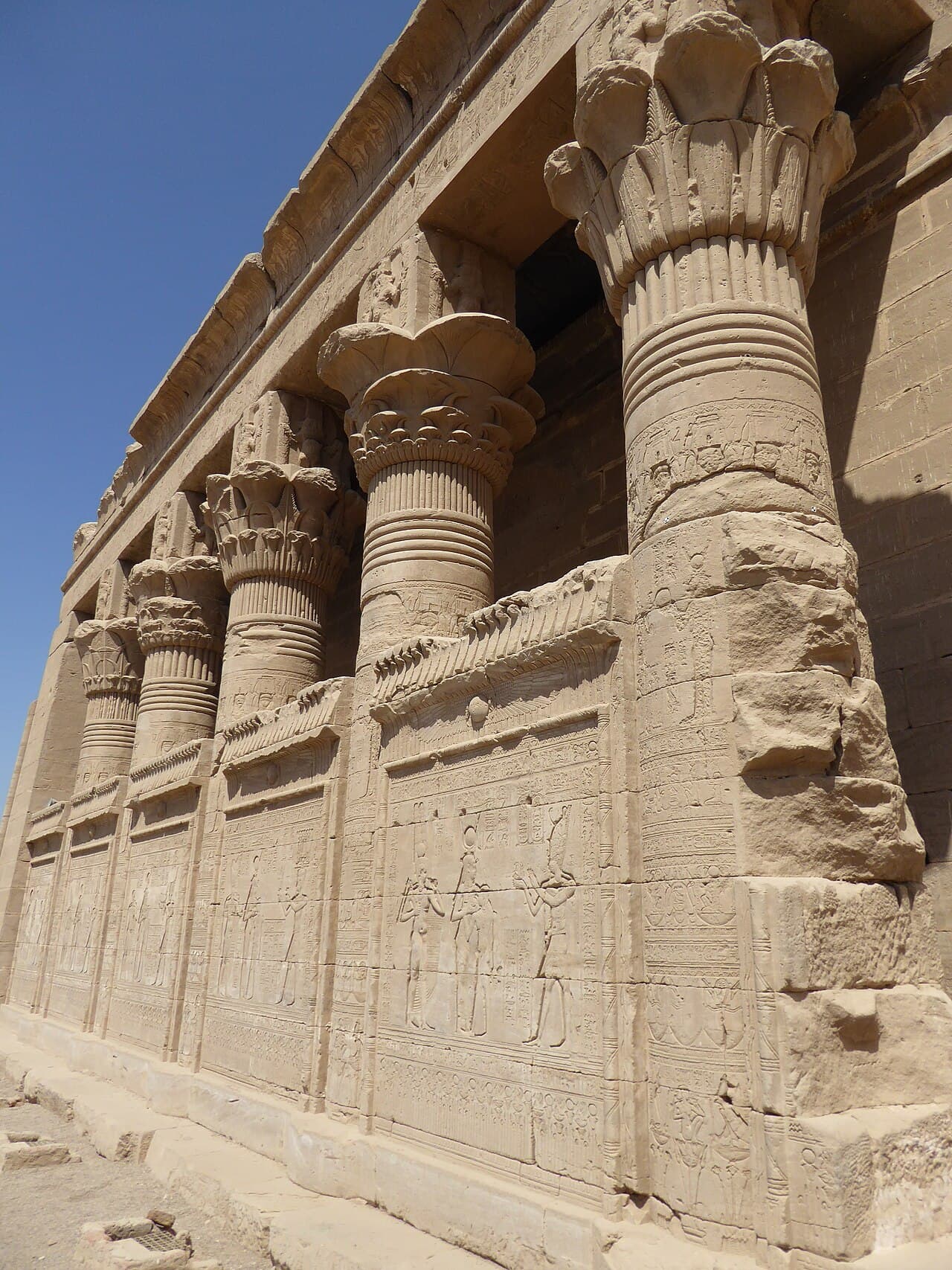
The first thing that stops you is the scale of the facade. Eighteen columns carry the pronaos roof, each column capital carved with Hathor's face looking outward in four directions. This four-faced representation is called a Hathor-headed capital and it appears at several Ptolemaic and Roman temples, but nowhere with this density. The faces are not identical. Some still carry traces of paint in the recesses around the eyes, a dark red-brown that survived two millennia in the dry air.
Look up before you do anything else. The astronomical ceiling of the hypostyle hall depicts the sky in full: the decans (36 star groups used to track time at night), the planets identified as moving stars, the lunar calendar, and solar barques carrying the sun through day and night. Napoleon's scholars documented this ceiling in 1799 and removed a section of the inner sanctuary's zodiac ceiling, a circular image now in the Louvre. What remains is a plaster cast, which is genuinely frustrating, but the reliefs elsewhere on the ceiling are original and largely uncrowded by attention.
The zodiac itself is the earliest firmly dated horoscopic zodiac in the Egyptian record. It is Babylonian in origin, adopted by the Greeks, and rendered here in an Egyptian artistic vocabulary. That convergence, happening in stone on a ceiling in Upper Egypt, is not a footnote. It is the story of the ancient Mediterranean world in one image.
The Crypts and What They Were Actually For
Most visitors do the main hall and the sanctuary and leave. This is a significant omission. Dendera has twelve crypts, narrow corridors carved into the thickness of the temple's outer walls, accessible through low doorways that require genuine ducking. These were not tombs. They were secure storage and ritual preparation spaces where cult statues and sacred objects were kept between ceremonies.
The reliefs inside the crypts are among the finest at the site, preserved by the very fact that almost no light and no tourists have reached them for centuries. One crypt contains a famous carving that has generated considerable controversy: two elongated figures that some writers have interpreted as depicting light bulbs or electrical technology. They are almost certainly ritual serpents emerging from lotus flowers, a standard iconographic motif. The fact that this requires saying something about how dramatically Dendera attracts fringe theorists, which slightly distorts the site's reputation in popular culture.
The crypts are accessed through the main sanctuaries on the west side of the temple. A guard will usually show you the way for a tip of EGP 20 to 50. Do not skip this.
The Roof and Hathor's New Year
Climb to the roof. The staircase is carved with processions, figures carrying ritual objects, moving upward in single file. These images recorded the New Year ceremony, when Hathor's cult statue was carried to the roof at dawn so that the sun's first rays could touch her face and restore her divine energy. You are walking the same path the priests walked with the statue.
From the roof you can see the Nile Valley fields to the east, the desert edge immediately to the west, and the remains of the outer temenos wall enclosing the complex. There is also a small open kiosk on the roof, a Roman-period structure with column columns open to the sky, used for the solar ritual. Sit in it for a moment. The Nile air comes through clean in the morning.
The Connections
Dendera does not exist in isolation and neither does Hathor. Sixty kilometers north is Abydos, home to the cult of Osiris and one of the most important pilgrimage sites in the ancient world. Hathor and Osiris were theologically entangled: she was one of the goddesses who mourned him, who helped reassemble his body after Set's dismemberment. The two sites were visited in sequence by pilgrims for at least two thousand years.
The Ptolemaic dynasty that began this temple's construction also built the temples at Edfu, Kom Ombo, Philae, and Esna, forming a chain of Nile Valley sanctuaries between Luxor and Aswan. Hathor of Dendera had a formal divine marriage relationship with Horus of Edfu. Once a year, Hathor's cult statue was loaded onto a sacred barque and sailed south to Edfu. The journey took two weeks and towns along the route held festivals as the barque passed. This was not metaphor. It was logistics, performed annually, maintained by an entire bureaucratic and religious infrastructure.
The Coptic church in the temenos wall connects Dendera to the history of Egyptian Christianity, which took root in Upper Egypt with particular intensity in the third and fourth centuries. The Theban region had some of the earliest monastic communities in the world. The monks and bishops who built that church at Dendera were not outliers. They were part of a broad transformation of the Nile Valley's sacred landscape that left almost no major temple without a Christian presence somewhere in its precincts.
Common Mistakes
Arriving at mid-morning. Tour buses from Luxor typically arrive between 10am and 11am. The hypostyle hall becomes genuinely crowded. Arrive at 7am when the site opens and you will have the main hall nearly to yourself for an hour.
Skipping the exterior circuit. Walk all the way around the outside of the temple. The rear exterior wall carries an enormous relief of Cleopatra VII and her son Caesarion (Julius Caesar's son) making offerings. This is one of the few surviving images of Cleopatra and it is on the outside of a wall that most visitors never walk around to see.
Trusting unofficial guides inside the temple. Men will approach you near the entrance offering to show you secret carvings for tips. Some know what they're talking about. Many do not. If you want expert guidance, hire a licensed Egyptologist in Luxor before you leave.
Ignoring the sanatorium. Outside the main temple, to the northeast, are the remains of a sacred sanatorium where the sick came to sleep and receive healing dreams from Hathor. This is one of the few places in Egypt where you can see the physical infrastructure of ancient therapeutic religion. It is almost always empty of other visitors.
Combining Dendera and Abydos without leaving enough time. Both sites deserve at least two hours each. If you book a standard tour that covers both in four hours total, you will rush both. Arrange private transport or a full-day tour that acknowledges the actual distances: Abydos is 45km from Qena, not next door.
Reading the zodiac ceiling without context. The plaster cast in the roof kiosk looks underwhelming if you don't know what you're looking at. Read about the Dendera zodiac before you go, even fifteen minutes of preparation will make the ceiling speak.
Underestimating the heat between May and September. The temple interior is not air-conditioned. Stone holds heat. Bring water, more than you think you need, and accept that the site is physically demanding in summer months.
Practical Tips
The town of Qena has no significant tourist infrastructure. There are local fuul and ta'amiyya shops near the market that serve a good breakfast for EGP 20 to 40, but no restaurants aimed at foreign visitors near the temple. Eat in Luxor before you leave or bring food.
Licensed Egyptologist guides can be arranged through reputable Luxor hotels or agencies for approximately EGP 600 to 1,200 for a private day tour. The quality difference between a licensed guide and an unlicensed one at this site is significant because Dendera's walls reward explanation.
The light inside the hypostyle hall is genuinely low. Bring a small torch if you want to read the lower register reliefs, which contain some of the most detailed offering scenes on the walls. Your phone light works but a dedicated torch is better for extended reading.
If you are coming from Cairo rather than Luxor, Qena is a stop on the main Luxor-Aswan railway line. Trains from Cairo take six to eight hours to Qena. First class on the overnight sleeper from Cairo costs approximately EGP 2,500 to 3,500 per person. From Qena station, the temple is a EGP 50 to 80 tuk-tuk ride.
Do not bring the Dendera temple guide books that were popular ten years ago. The scholarship has moved on significantly, particularly regarding the Roman-period astronomical reliefs. The publication by Egyptologist Sylvie Cauville remains the serious reference, though it is expensive and academic. For a readable introduction, Penelope Wilson's work on Ptolemaic temples provides good context.
Frequently Asked Questions
The Weekly Dispatch
More on Egypt, every Friday.
Cultural depth and places most guides never mention.
No spam. Unsubscribe anytime.