Edfu Temple Guide: Egypt's Best-Preserved Pharaonic Sanctuary
Edfu Temple is Egypt's most complete ancient sanctuary, but most visitors see only its surface. This Edfu Temple guide goes deeper into the story behind the stone.
Quick Facts
- Best time to visit
- October through February, when temperatures in Upper Egypt range 20-28°C. Avoid June through August when midday regularly exceeds 40°C.
- Entrance fee
- EGP 450 adults (approx $9 USD), EGP 225 Egyptian students with valid ID. Prices subject to change; verify on arrival.
- Opening hours
- Daily 6am-5pm (April-September), 6am-6pm (October-March). Open through Ramadan.
- How to get there
- From Aswan: private taxi EGP 500-700 round trip with waiting time; service taxi to Edfu town EGP 30-40/person then calèche to temple EGP 50-80 return. Many Nile cruises stop here between Aswan and Luxor.
- Time needed
- 2 hours minimum, 3 hours comfortable. Full day if combining with Kom Ombo (45km south).
- Cost range
- Budget day trip from Aswan EGP 800-1,200 including transport and entry. Mid-range with guide EGP 2,000-3,000.
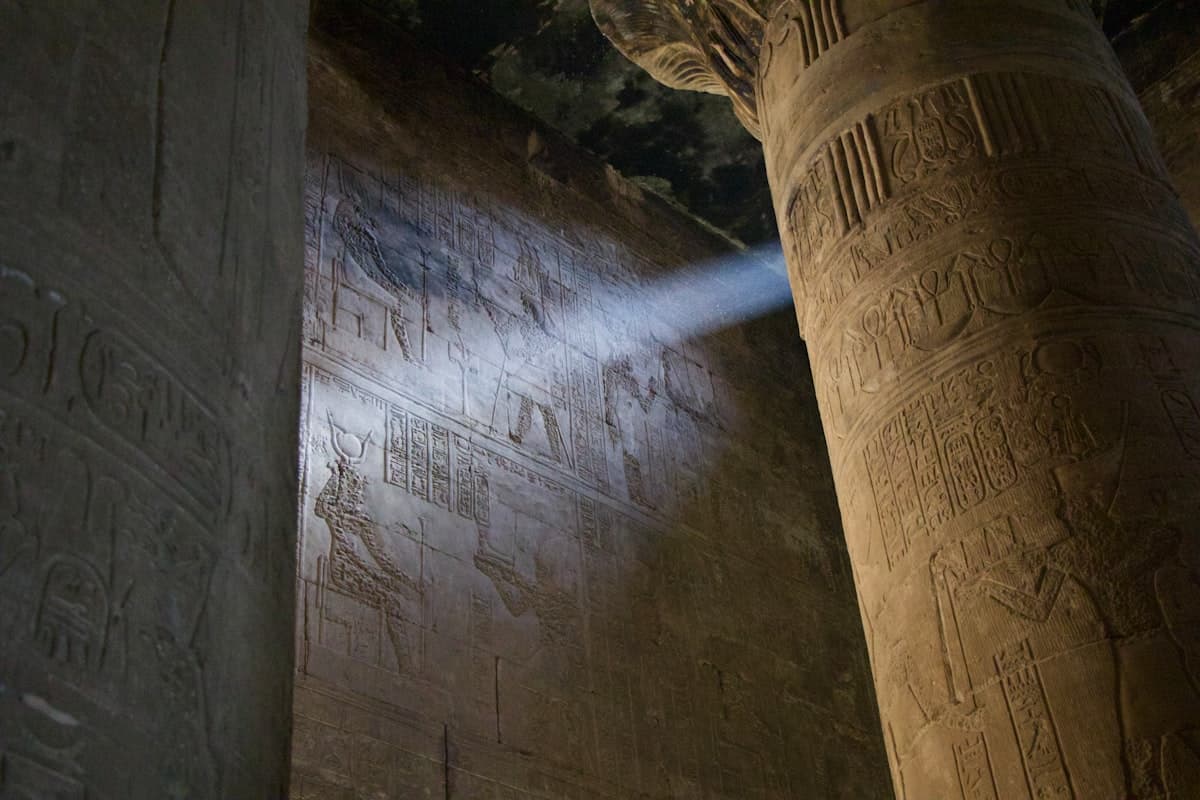
The priests who served Horus at Edfu kept a library. We know this because they carved the catalogue directly into the temple walls: 122 scrolls, listed by title, describing everything from ritual procedures to the mythological geography of the cosmos. The library itself is gone. The list remains, cut into limestone at eye level, where anyone who could read hieroglyphs could see exactly what knowledge the priests considered worth preserving. That detail, a catalogue carved in stone because papyrus burns, tells you more about ancient Egyptian civilization than almost anything else at Edfu.
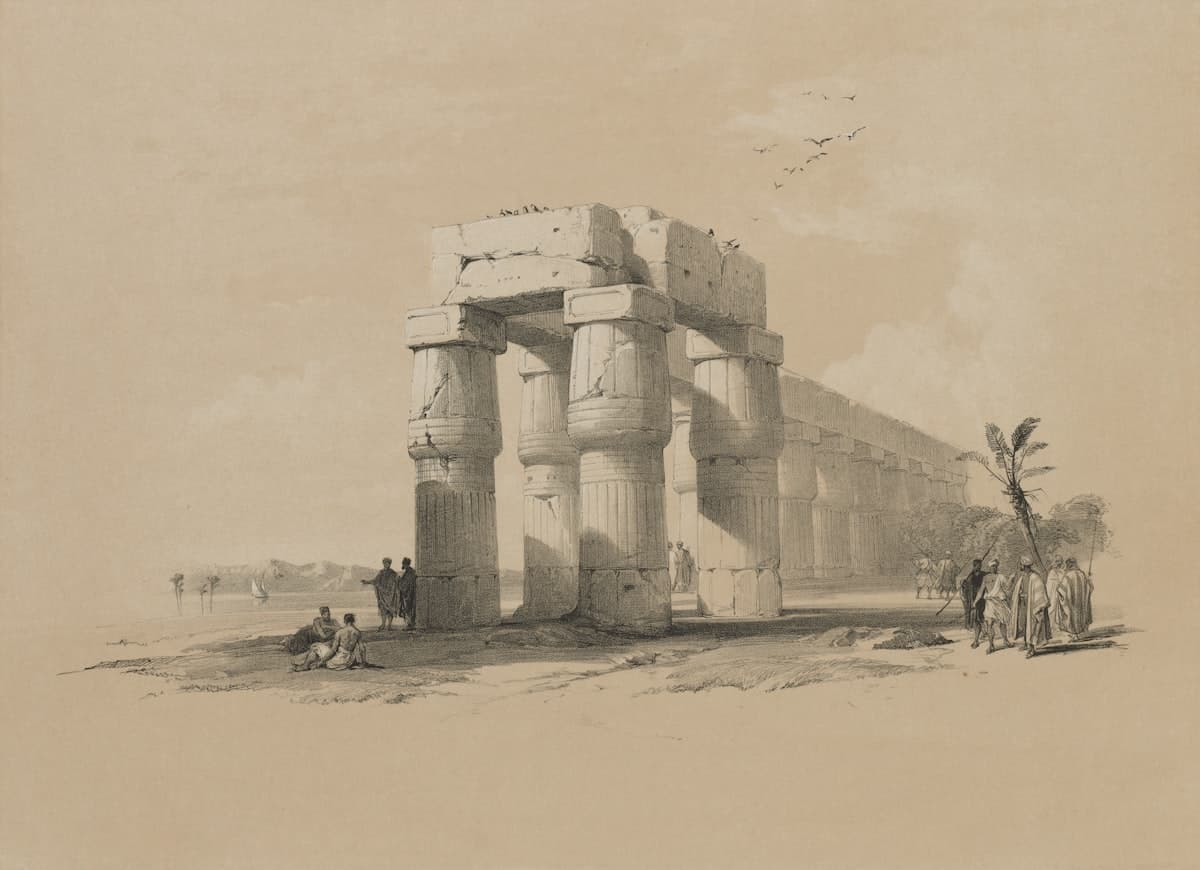
This is not a ruin. That distinction matters more here than anywhere else in Egypt. The Temple of Horus at Edfu is the most completely preserved ancient Egyptian temple in existence, not because it was well-protected, but because it was buried. For nearly fourteen centuries, sand and silt swallowed it whole, and the town of Edfu grew on top of it. When Auguste Mariette began excavating in 1860, he found houses built directly on the roof of the hypostyle hall. Families had been living on top of a sealed Ptolemaic temple for generations without knowing it. The removal of those houses, which took years and considerable force, remains one of the more uncomfortable chapters of 19th-century Egyptology.
What Mariette uncovered was a building frozen at the moment of its abandonment. Paintings that had never seen sunlight. Inscriptions that had never been scraped by medieval lime-burners. A sanctuary that looked, in critical ways, the way a working temple looked in 57 BCE, the year construction finally ended after 180 years of building.
Quick Facts
Best time to visit: October through February, when temperatures in Upper Egypt sit between 20-28°C. Avoid June through August when midday heat regularly exceeds 40°C.
Entrance fee: EGP 450 for adults (approximately $9 USD at current rates), EGP 225 for Egyptian students with valid ID. International student cards are accepted inconsistently. Check the current rate before visiting, as Egyptian pound fluctuations affect the dollar equivalent significantly.
Opening hours: Daily 6am to 5pm in summer (April through September), 6am to 6pm in winter (October through March). The site stays open through Ramadan but can be quieter in the middle of the day.
How to get there: Edfu sits roughly 115km north of Aswan and 65km south of Luxor. From Aswan, a private taxi costs approximately EGP 500-700 for a round trip with waiting time. Shared service taxis from Aswan's Souk area run to Edfu town for around EGP 30-40 per person but drop you in town, not at the temple. From town, a calèche (horse-drawn carriage) to the temple and back runs EGP 50-80, and the drivers will wait. Many Nile cruise itineraries stop here between Aswan and Luxor. If you're traveling independently, the calèche from the riverbank to the temple is the logical approach and takes about ten minutes.
Time needed: Two hours is realistic for a thorough visit without a guide. Three hours if you're reading inscriptions and exploring every chamber. Add an hour if you plan to climb to the roof terraces.
Cost range: Budget travelers combining Edfu with Kom Ombo in a single day taxi run can manage EGP 800-1,200 all-in from Aswan. Mid-range with a knowledgeable guide: EGP 2,000-3,000 including transport and guiding fees.
Why This Place Matters
Edfu is a Ptolemaic temple, meaning it was built by the Greek-speaking dynasty that ruled Egypt after Alexander the Great's conquests. The founder of the dynasty, Ptolemy III, laid the first stone in 237 BCE. His successors continued building for generations. The last hieroglyphs were added under Ptolemy XII, Cleopatra's father, around 57 BCE. This timeline is important because it places Edfu in a specific political context that most visitors overlook.
The Ptolemies were Macedonian Greeks who understood, with considerable political intelligence, that Egypt would not accept foreign rulers who ignored Egyptian religion. So they became patrons of Egyptian temples on an unprecedented scale. The Ptolemaic period produced some of the largest and most elaborate temple complexes Egypt ever saw, including Edfu, Kom Ombo, Dendera, and Philae. These were not acts of personal piety. They were acts of legitimacy. A Ptolemaic king carved in relief making offerings to Horus was demonstrating, in the language Egyptians understood, that the old contract between ruler and gods remained intact.
The priests who designed Edfu were antiquarians of extraordinary skill. They deliberately styled the temple in the manner of New Kingdom sacred architecture from a thousand years earlier, referencing building traditions that were already ancient when construction began. They inscribed texts in a deliberately archaic form of hieroglyphic script that even contemporary educated Egyptians may not have been able to read easily. Edfu is, among other things, a monument to the Egyptian impulse to preserve and formalize the past at the moment it felt most threatened.
The temple was dedicated to Horus, specifically Horus of Behdet, the falcon god in his solar aspect. But the mythological drama it stages is the conflict between Horus and Set, the cosmic battle that Egyptian theology used to explain the perpetual tension between order and chaos. The walls narrate this battle in detail across multiple chambers, and the priests performed ritual re-enactments of it annually. The temple was not a monument to the past. It was a machine for repeating a necessary mythological event, forever.
What You'll Actually See
The entrance is through a pylon, two massive trapezoidal towers flanking a gateway, that stands 36 meters high. This is roughly the height of a twelve-story building, and it bears colossal reliefs of Ptolemy XII smiting enemies in the style that Egyptian pharaohs had used for three thousand years before him. The scale is deliberate. Pylons were built to be visible from distance, to announce the transition from secular to sacred space before you arrived at the door.
Two granite falcons flank the entrance. One is nearly intact, wearing the double crown of Upper and Lower Egypt. This is Horus, and when you stand between these two figures, you are standing in a threshold that Egyptian theology considered genuinely dangerous. The pylons were not decorative. They were a barrier between the human world and the divine one.
Inside, the first hypostyle hall has twelve columns with elaborate floral capitals, no two quite identical. The ceiling is blackened, not by neglect or fire, but by centuries of lamp smoke from when Coptic Christians used this space as a church. Look for the Coptic crosses scratched into the column bases and the places where Christian occupants deliberately defaced the faces of the gods. This overlay of religious histories is not incidental. Edfu was a working Christian church at the same time the great mosques of Cairo were being built. The same stone absorbed both.
Deep in the temple, past the second hypostyle hall and the offering chamber, you reach the sanctuary. This is the innermost room, where the cult statue of Horus was kept in a naos, a free-standing granite shrine, that is still in place. The naos dates from before the current temple, carried over from an earlier structure on the same site. The room is small, dark, and after the scale of everything outside, startlingly intimate. This is where the daily ritual happened: the breaking of the clay seal on the naos door, the washing and dressing of the statue, the offering of food, the re-sealing of the door. Every day, for centuries.
The Roof and the Nilometer
Most visitors miss the roof terraces entirely. Stairs in the outer corridors lead up to chambers connected to the New Year festival, when the statue of Horus was carried to the roof to be exposed to the sun's rays in a ritual of renewal. The rooftop views over the surrounding town and the Nile valley are, practically speaking, the best way to understand the temple's scale from the outside.
Fewer visitors know that Edfu had its own Nilometer. The annual Nile flood determined everything in ancient Egypt: the agricultural calendar, the tax base, the survival of the population. Temples maintained Nilometers, graduated measuring columns in the river or in shafts connected to it, because the priests were responsible for coordinating the ritual calendar with the agricultural one. The priests at Edfu were not mystics disconnected from practical life. They were the administrative and intellectual class of their society.
The Connections
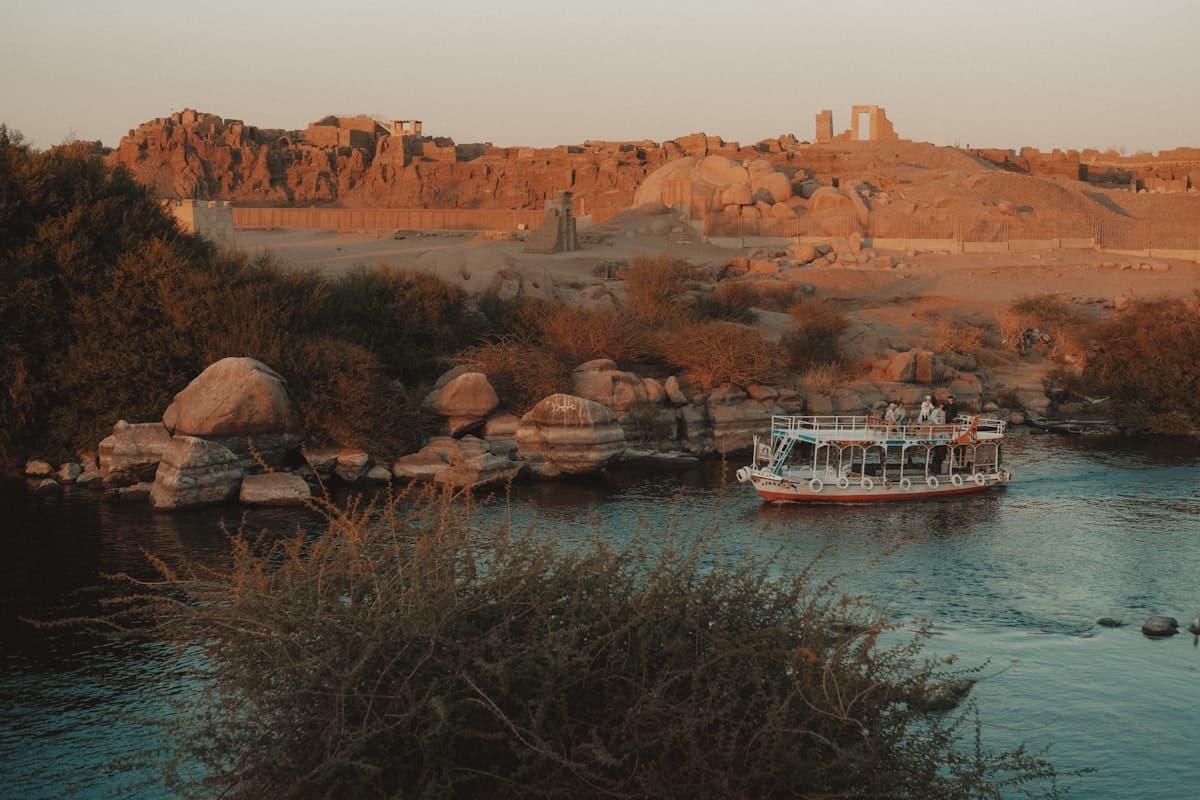
Edfu does not exist in isolation, and visiting it as a standalone stop misses its meaning. The site sits on a tell, a mound of accumulated occupation, that contains layers going back to the Old Kingdom. Before the Ptolemaic temple, there was a New Kingdom temple here. Before that, Middle Kingdom structures. The ground under your feet at Edfu contains roughly four thousand years of continuous sacred use on the same spot.
The relationship between Edfu and Dendera is liturgically significant. Once a year, the statue of Hathor at Dendera, about 100km to the north, was transported by river to Edfu for a reunion with Horus. This was the Festival of the Beautiful Meeting, a ritual marriage between two of Egypt's most important deities, celebrated with public festivities that lasted two weeks. The river journey, the arrival, the reunion, and the departure are all depicted on the temple walls at both ends. You can read the same event from two perspectives, at two different temples, separated by a full day's travel on the Nile.
Edfu also connects to Kom Ombo, 45km to the south, where a dual temple to Horus and Sobek was built in the same Ptolemaic period by the same dynasty. The architectural vocabulary is related, the political logic is identical, but the theology differs entirely. Visiting both in a single day is possible and worthwhile, but rushes both. They are better understood as a conversation rather than a list.
Common Mistakes
Arriving mid-morning from a Nile cruise. Most cruise ships dock at Edfu between 9am and 11am, which means the temple fills simultaneously with multiple boat loads of visitors. The same temple is nearly empty at 7am and again after 3pm. If you have any flexibility, use it.
Skipping the outer enclosure walls. The corridor between the outer wall and the temple proper, called the ambulatory, contains some of the most detailed reliefs in the complex, including scenes from the Horus and Set conflict that most visitors never find. The ambulatory is dim and narrow but legible.
Ignoring the Ptolemaic context. If you approach Edfu as a generic ancient Egyptian site, you miss the specific historical moment it represents: a Greek dynasty performing Egyptianness with extraordinary thoroughness, at the precise point when Rome was beginning to make Egyptian independence untenable. The temple is, among other things, a document of cultural anxiety.
Not hiring a guide for the first visit. The sheer density of inscription at Edfu, over ten thousand square meters of carved text and relief, is impossible to process without context. A good Egyptologist guide, hired locally for EGP 300-500 for two hours, will point you to specific texts and explain what the ritual sequence in each room was actually for.
Overlooking the library inscription. The list of 122 scrolls is on the inner face of the enclosure wall, in the corridor near the staircase. It is not labeled or highlighted. Most people walk past it. This is arguably the most affecting single inscription in the complex.
Underestimating heat inside. The inner chambers have no ventilation and accumulate heat through the morning. By noon in summer, some inner rooms approach 45°C. Bring water, drink it before you enter, and move through the inner sanctuary in the cooler hours.
Taking the calèche without agreeing on the price first. The carriage ride from the river landing to the temple is pleasant and the correct way to arrive. The price is not fixed. Agree on the round-trip fare, including waiting time, before you get in.
Practical Tips
The light inside Edfu's hypostyle halls is low, and phone cameras will struggle with the painted ceilings. A small torch or your phone's flashlight makes the color in the upper registers visible in a way that ambient light does not allow.
Water is sold at the entrance and inside the complex but at elevated prices. Bring at least one liter per person regardless of season. In summer, two liters minimum.
The temple faces west, which means the pylon catches the afternoon light at an angle that makes the reliefs extraordinarily legible. If photography matters to you, early morning gives you empty space and soft light; late afternoon gives you better definition on the carved surfaces.
Edfu town itself is a functioning Upper Egyptian city with a Thursday market that draws vendors from the surrounding villages. If your schedule allows, arriving the night before and leaving Thursday morning means you see both the market and the temple at its quietest. There is basic accommodation in Edfu, though most travelers use it as a day stop from Aswan or Luxor.
Combining Edfu with Kom Ombo on the same day is standard on cruise itineraries and entirely reasonable. Kom Ombo is 45km south of Edfu, closer to Aswan. If you're doing this independently, a private taxi for the full loop from Aswan, covering both temples with waiting time, runs EGP 700-900 depending on your negotiating and the season.
Frequently Asked Questions
The Weekly Dispatch
More on Egypt, every Friday.
Cultural depth and places most guides never mention.
No spam. Unsubscribe anytime.