Eliyahu Hanavi Synagogue Alexandria: Egypt's Jewish Past
The Eliyahu Hanavi Synagogue in Alexandria once served 50,000 Jews. Today it stands almost empty, and that absence tells Egypt's most complicated story.
Quick Facts
- Best time to visit
- October through April, when Alexandria's Mediterranean climate is mild and the humidity is low
- Entrance fee
- Free admission, donations to maintenance appreciated
- Opening hours
- Saturday through Thursday approximately 10am to 4pm, but hours vary and advance confirmation is strongly recommended
- How to get there
- Taxi or Uber from downtown Alexandria (Raml Station area) to Nabih El-Waqad Street, Manshiyya district, approximately EGP 30 to 60 (under $2 USD)
- Time needed
- 1 to 2 hours inside, add 1 hour to walk the surrounding Khedival-era neighborhood
- Cost range
- Free entry, half-day in the area including transport and lunch runs EGP 300 to 600 (roughly $10 to $20 USD)
At its peak in the 1940s, Alexandria had a Jewish population of around 50,000 people. They ran cotton exchanges, owned department stores, wrote poetry in French and Arabic, and prayed at eleven synagogues scattered across a city that had been Jewish, Greek, Roman, Arab, Ottoman, and briefly British, sometimes all at once. Today, fewer than a dozen Jewish residents remain in all of Egypt. The Eliyahu Hanavi Synagogue in Alexandria is what that disappearance looks like in stone and marble and silence.
This is not a sad story, exactly. It is a complicated one, and the synagogue is the best place in Egypt to sit with that complication.
Quick Facts
Best time to visit: October through April, when Alexandria's Mediterranean climate is cool and the humidity manageable. Summer in Alexandria is not brutal the way Luxor is, but the synagogue itself has no air conditioning.
Entrance fee: Free admission, though a small donation to maintenance is appreciated and genuine. The synagogue is managed by the Egyptian Jewish Community organization in coordination with the Egyptian government. There is no ticket booth.
Opening hours: The synagogue opens for visitors Saturday through Thursday, roughly 10am to 4pm, but hours are inconsistent and depend on staff availability. Jewish holidays may affect access. Always call ahead or check with your hotel concierge in Alexandria before making the trip a centerpiece of your day.
How to get there: From downtown Alexandria (Raml Station area), take a taxi or ride-share to Nabih El-Waqad Street in the Manshiyya district. The ride costs approximately EGP 30 to 60 (under $2 USD) depending on traffic. A tuk-tuk from nearby streets costs less but requires knowing where you're going. The synagogue is not far from the old Corniche and within walking distance of several Khedival-era buildings.
Time needed: One to two hours inside. Add another hour if you walk the surrounding neighborhood, which you should.
Cost range: The synagogue itself is free. A half-day in this part of Alexandria, including coffee, lunch at a nearby local restaurant, and transport, runs EGP 300 to 600 (roughly $10 to $20 USD).
Why This Place Matters
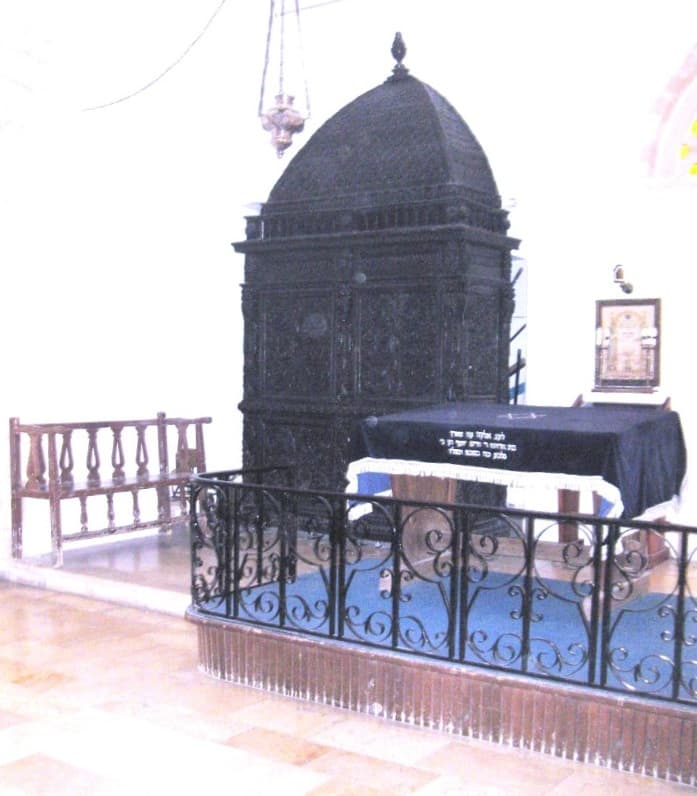
The Eliyahu Hanavi Synagogue, whose name translates as the Prophet Elijah, was built in 1354. That date deserves a moment. The Black Death was still moving through Europe. The Mamluk Sultanate ruled Egypt. Alexandria had already been Arab for seven centuries and would not see Napoleon for another four hundred years. The Jewish community in Alexandria was not a modern immigration story. It was a presence so old it predates Islam in Egypt by centuries, tracing its roots to the settlement of Jews in Alexandria under Alexander the Great himself in 331 BCE.
The building you visit today is largely a 19th-century reconstruction. The current structure was substantially rebuilt in 1850 under the patronage of the Egyptian Jewish community during a period of relative prosperity under Muhammad Ali's successors. What you see is a Neoclassical synagogue with Italian marble columns, a women's gallery running along three sides of the upper level, and a central bimah (the raised platform for Torah reading) that once anchored a congregation of thousands.
The Egyptian government has invested in its restoration. In 2020, a multi-year renovation was completed, returning the building to something approaching its former condition. The painted ceilings were cleaned. The wooden pews were repaired. The brass chandeliers were polished. The irony is total and the Egyptians who managed the restoration are aware of it: this is one of the best-maintained synagogues in the Arab world, and there is almost no one left to pray in it.
Alexandria's Jewish Community Was Not a Single Thing
The word "Jewish" barely contains the actual diversity of the Alexandria community at its height. There were Sephardic Jews whose families had arrived from Spain after 1492. There were Romaniote Jews, the Greek-speaking Jews of the eastern Mediterranean, one of the oldest Jewish communities on earth. There were Ashkenazi Jews who arrived from Eastern Europe in the late 19th and early 20th centuries. There were Karaite Jews, a distinct sect that rejects rabbinic law, who had their own separate congregation and their own separate cemetery. The Eliyahu Hanavi Synagogue served primarily the Sephardic community, while the Kait Bey Synagogue nearby served others. Knowing this changes what you see when you stand inside.
What You'll Actually See and Experience
You enter through a gate on a street that gives no particular indication of what is behind it. The forecourt is quiet. A caretaker, usually an older Egyptian man who is Muslim, will greet you and may offer to show you around. Accept. His knowledge of the building's history is often specific and personal in ways that no printed guide captures.
The interior is large, much larger than the neighborhood suggests from outside. The nave runs east toward Jerusalem, as required by Jewish law. The ark containing the Torah scrolls, the Aron Kodesh, faces east and is built into a white marble apse. The Torah scrolls themselves are still there, in their silver cases. This is not a museum. The objects are real and treated as sacred.
The ceiling is painted in geometric and floral patterns that mix Moorish, Ottoman, and European influences without apology. The marble floor reflects the chandeliers. The women's gallery above is accessible but often roped off. If you ask the caretaker, he may let you up.
What strikes most visitors who slow down is the scale of absence. The pews seat hundreds. The gallery seats hundreds more. The building was designed for a community that no longer exists here, and the preservation makes that fact louder, not quieter. A ruin is easier to accept than a perfect room with no one in it.
What Most Visitors Miss
Behind the main sanctuary, there is a smaller prayer room that was used for daily services when the full main hall was too large for the congregation. It is plainer, more worn, and somehow more affecting. The scratches in the wooden benches are real. The stain on the prayer stand is real. This is where the last Jews of Alexandria actually prayed as the community contracted year by year through the 1950s, 1960s, and 1970s.
Also overlooked: the geniza. Jewish law forbids the destruction of texts containing the name of God, so worn-out prayer books, letters, and documents are traditionally stored in a special repository called a geniza. The Cairo Geniza, discovered in the Ben Ezra Synagogue in Old Cairo in the 19th century, is one of the greatest archival discoveries in history, containing over 300,000 fragments of manuscripts including personal letters, legal documents, and biblical texts spanning a thousand years. Alexandria had its own geniza traditions, and the layers of text and memory embedded in this building run far deeper than any restoration reveals on the surface.
The Connections

The Eliyahu Hanavi Synagogue sits within a city that has been making and unmaking its communities for two and a half millennia. Alexander the Great established Alexandria in 331 BCE and immediately invited Jews to settle there. The ancient Jewish community of Alexandria produced the Septuagint, the Greek translation of the Hebrew Bible, which was made here in the 3rd century BCE and became the Old Testament of the early Christian church. Without Alexandrian Jews, there is no Septuagint. Without the Septuagint, the spread of Christianity looks entirely different.
The philosopher Philo of Alexandria, who lived from roughly 20 BCE to 50 CE, attempted to reconcile Jewish theology with Greek philosophy. His work directly influenced early Christian theologians including Origen and Clement of Alexandria, who were themselves Alexandrian. The intellectual tradition of this city crossed religious lines in ways that make modern sectarian categories feel thin.
Walk fifteen minutes from the synagogue and you reach the site of the ancient Pharos lighthouse, one of the Seven Wonders of the ancient world. Walk in the other direction and you reach the Catacombs of Kom el-Shoqafa, a burial site from the 2nd century CE that mixes Pharaonic iconography with Roman funerary architecture and Greek decorative motifs. No one community owns Alexandria's story. The synagogue is one thread in a braid that includes Coptic churches built over ancient temples, mosques raised on Byzantine foundations, and a library reconstructed over the ruins of its ancient predecessor.
The mass departure of Alexandria's Jews happened in two main waves: after the 1948 Arab-Israeli War and then more abruptly after the 1956 Suez Crisis, when President Nasser nationalized the canal and the political atmosphere for Egypt's Jewish community became untenable. Many families were given days to leave. They left with one suitcase each. Their property was nationalized. The cotton merchants, the lawyers, the poets, the shopkeepers: most went to France, to Brazil, to Israel, to the United States. Some went to Italy. The Alexandrian Jewish diaspora is scattered across the world and still holds reunions.
Common Mistakes
Arriving without confirming hours. The synagogue does not operate like a museum. There is no online booking system, no guaranteed opening time, and no staff member whose job is to wait for tourists. If you show up on a Jewish holiday, a Friday afternoon, or simply on a day when the caretaker is unavailable, you will find a locked gate. Call the Egyptian Jewish Community in Cairo (their number is findable through the Egyptian Tourism Authority or your hotel concierge) or arrive early and ask at the gate.
Treating it like a museum, not a sacred space. The Torah scrolls inside the ark are genuine religious objects, not exhibits. Dress modestly: covered shoulders and knees for everyone, head covering for men (small kippot are sometimes available at the entrance). Do not touch the ark or the scrolls.
Ignoring the neighborhood. The area around the synagogue in the Manshiyya district contains several Khedival-era buildings from the late 19th and early 20th centuries that are in various states of managed decline. They are not on any standard tour. Walk the streets between the synagogue and the Corniche and you will see the physical remains of the cosmopolitan Alexandria that Lawrence Durrell wrote about: the shuttered storefronts, the art nouveau balconies, the Arabic-French-Greek street signs that someone never got around to replacing.
Coming only for the synagogue and skipping the Jewish cemetery. The Chatby Jewish Cemetery, a short taxi ride away, is one of the oldest Jewish cemeteries in the world still accessible to visitors. The oldest stones date to the early centuries CE. It is almost never visited. The contrast between its ancient crowded stones and the silent synagogue tells the whole story of the community across two thousand years.
Assuming photography is always permitted. Always ask the caretaker first. Rules vary by day and circumstance. Photography near or of the Torah scrolls is generally not appropriate regardless of what you are told.
Not allowing time to simply sit. The instinct is to look, photograph, and move on. The building rewards people who sit in one of the pews for twenty minutes without an agenda. The light through the upper windows changes. The silence has texture. This is what the place is actually offering.
Booking a guide who doesn't know the specifics. Many Alexandria guides know the standard script: built in 1354, renovated in 1850, mostly empty now. Few know about the Karaite community, the Septuagint connection, or the geniza traditions. Ask your guide specifically what they know about Alexandria's Jewish community before you hire them for this stop.
Practical Tips
Alexandria is a three-hour train ride from Cairo. The Spanish Train (air-conditioned express service) costs approximately EGP 150 to 250 one way (around $5 to $8 USD) from Ramses Station. Arrive in Alexandria at Misr Station downtown, then take a taxi to the synagogue.
If you are building a full day in Alexandria around the synagogue, the logical additions are the Catacombs of Kom el-Shoqafa (EGP 180 for foreigners, roughly $6 USD), the Qaitbay Citadel (EGP 180 for foreigners), and the Stanley Bridge area for lunch at any of the seafood restaurants facing the sea. The Bibliotheca Alexandrina, the modern library built on or near the site of the ancient one, is worth a visit if you have a second day.
Do not hire a taxi driver who offers to wait for you during the visit and then charge you by the hour. Agree on the ride cost only. Ride-share apps (Uber and Careem both operate in Alexandria) are more predictable for pricing.
The best time to visit is a weekday morning between October and March. The synagogue is almost never crowded in any season, which is itself the point.
Frequently Asked Questions
The Weekly Dispatch
More on Egypt, every Friday.
Cultural depth and places most guides never mention.
No spam. Unsubscribe anytime.