Karnak Temple Religious Rituals Guide: What the Gods Demanded
Karnak wasn't built for tourists or kings. It was built for a god who needed feeding three times a day. A guide to the rituals, the priests, and what still echoes.
Quick Facts
- Best time to visit
- October to February for manageable temperatures. Arrive at 6am opening any month to avoid crowds in the hypostyle hall.
- Entrance fee
- EGP 450 (approx $9 USD), students EGP 225. Precinct of Mut separate, negotiated at gate. Sound and Light Show EGP 350 (approx $7 USD).
- Opening hours
- Daily 6am to 5pm October to April, 6am to 6pm May to September. First entry at 6am is strongly recommended.
- How to get there
- Taxi from Luxor East Bank corniche EGP 50 to 80 (10 minutes). Microbus along corniche road EGP 5. Calèche from central Luxor EGP 30 to 50. Nile felucca landing possible by negotiation.
- Time needed
- 3 hours minimum for main precinct. Full day recommended to include Open Air Museum and Precinct of Mut. Combine with Luxor Temple only if you allow a full day for both.
- Cost range
- Budget EGP 600 to 1,000 including entrance, transport, and water. Private Egyptologist guide adds EGP 1,500 to 2,500 for a half-day session.
The priests who served Amun at Karnak never let the god go hungry. Every morning before dawn, a selected priest entered the innermost sanctuary alone, broke the clay seal on the shrine doors, and performed the Opening of the Mouth ritual on the statue inside, believing that without this ceremony, the god's ability to breathe, speak, and receive offerings would simply cease. The statue was then washed, anointed with oil, dressed in fresh linen, and presented with food. This happened three times a day, every day, for over a thousand years. The tourists photographing the hypostyle hall outside had no access to any of it.
This is the essential fact that most visits to Karnak miss entirely: the temple was not a place of public worship. It was a divine residence, a machine for maintaining cosmic order, and the rituals performed inside it were the operational instructions for keeping the universe running. Understanding that changes everything about how you read the stones.
Quick Facts
Best time to visit: October to February, when temperatures are tolerable and the light at 6am is worth arriving early for. Avoid July and August unless extreme heat is your preference.
Entrance fee: EGP 450 (approximately $9 USD at current rates), students with valid ID pay EGP 225. The Sound and Light Show costs an additional EGP 350 (approximately $7 USD). Tickets are purchased at the main gate; carry cash as card readers are unreliable.
Opening hours: Daily 6am to 5pm in winter (October to April), 6am to 6pm in summer. The first hour after opening is the closest you will get to having the hypostyle hall to yourself.
How to get there: From central Luxor, a taxi from the East Bank corniche to Karnak costs EGP 50 to 80 and takes about ten minutes. A calèche (horse-drawn carriage) is cheaper but slower. The Luxor-Karnak microbus runs along the corniche road for EGP 5 but drops you a short walk from the gate. Nile-side felucca landing near the temple is possible if you negotiate with a boatman.
Time needed: A minimum of three hours. A full day is warranted if you intend to read the walls seriously, walk the sacred lake circuit, and visit the Open Air Museum. Combining with Luxor Temple on the same day is possible but leaves both sites underserved.
Cost range: Budget EGP 600 to 1,000 for entrance, transport, and water. Mid-range with a licensed Egyptologist guide runs EGP 2,500 to 4,000 for a half-day private tour.
Why This Place Matters
Karnak is not one temple. It is a religious city that accumulated over seventeen centuries, from the Middle Kingdom around 2000 BCE through the Ptolemaic period in the first century BCE. At its height it employed over eighty thousand people: priests, brewers, farmers, scribes, musicians, and weavers, all in service of a single deity. The estate of Amun owned roughly a third of all cultivable land in Egypt. This was not religion as private devotion. This was religion as state infrastructure.
The Karnak temple religious rituals performed here were also explicitly political. When a new pharaoh needed to consolidate power, he built at Karnak. Thutmose III, who may be the closest ancient Egypt produced to a military genius, erected an entire festival hall here after his campaigns in the Levant, filling its walls with the plants and animals he'd observed on campaign, creating what Egyptologists call the Botanical Garden room. Hatshepsut, whose monuments Thutmose III later defaced, erected two obelisks that still stand. Ramesses II added a court so enormous that it swallowed an earlier shrine whole.
The site sits on the east bank of the Nile because the ancient Egyptians associated the east with birth and the living. The west bank, where the Valley of the Kings lies, was the land of the dead. This geographic theology organized the entire city of Thebes, modern Luxor, into a single cosmological diagram. Karnak was its beating heart.
The Layers Beneath Your Feet
Before Amun dominated here, this site belonged to other gods and other times. Excavations beneath the Third Pylon revealed a cache of over seventeen thousand stone fragments from demolished earlier monuments, which Egyptologists have spent decades reassembling into what they call the Chapelle Rouge of Hatshepsut and other reconstructed structures. There is also evidence of Middle Kingdom construction beneath the current forecourt. When you stand in the hypostyle hall, you are standing on the compressed memory of at least eight centuries of prior building.
The Roman presence is not far away either. The nearby city of Luxor, ancient Thebes, had a significant Roman garrison, and the Luxor Temple itself was converted into a Roman military headquarters, with a chapel to the imperial cult inserted directly into pharaonic corridors. The Coptic Christians who followed them built churches inside Luxor Temple's courtyards, their saints' faces painted over reliefs of Amenhotep III. That three-way palimpsest of religious occupation is the normal condition of every sacred site in this city.
The Ritual Logic of the Temple's Architecture
Karnak's layout was not decorative. It was a theological argument expressed in stone, and reading it correctly transforms the visit.
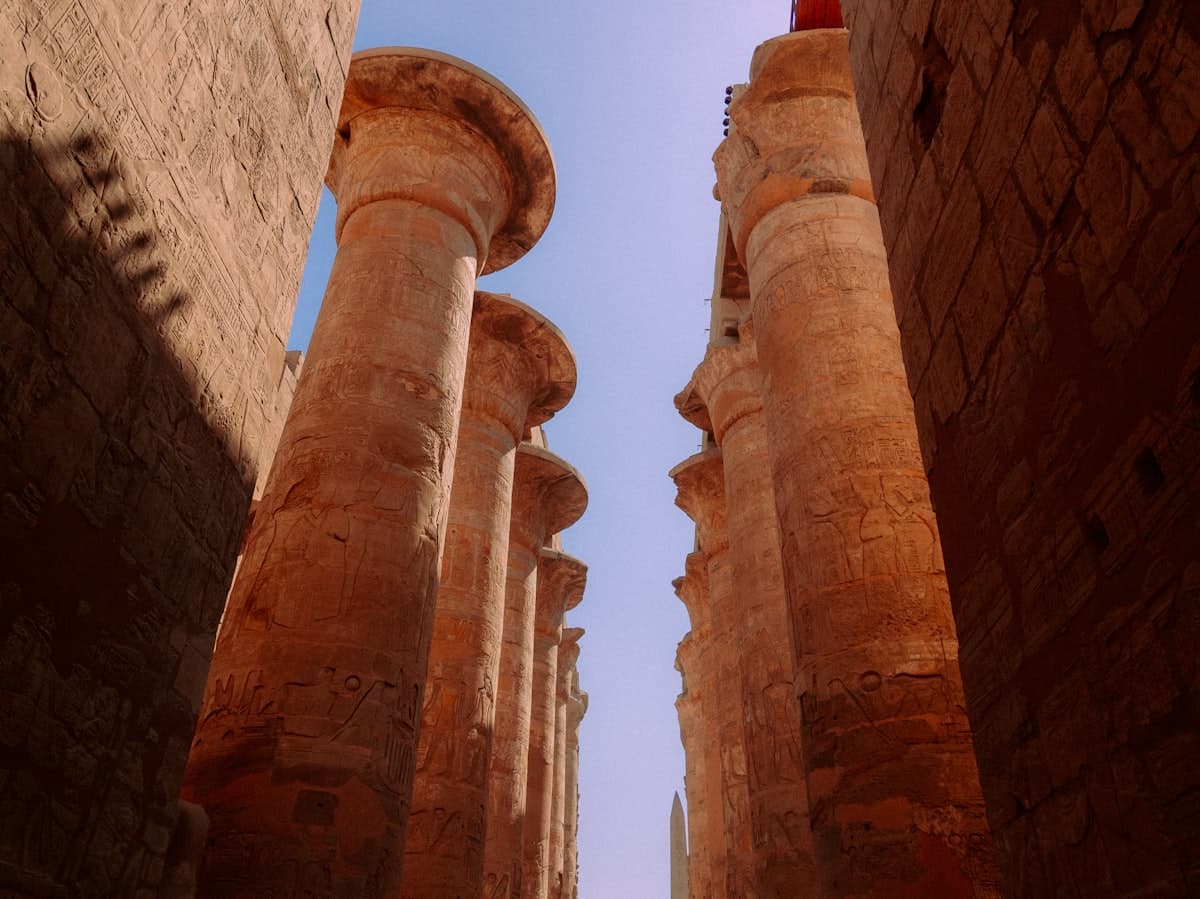
The temple was organized on an axis of increasing purity. The outermost areas, including the forecourt, were open to ordinary Egyptians on festival days. Moving inward, the hypostyle hall with its 134 massive columns was accessible to priests. The sanctuary at the core, housing the god's statue, was forbidden to everyone except the highest-ranking priests and, theoretically, the pharaoh himself. The light diminishes as you move inward, intentionally. The ceiling lowers. The columns crowd closer. You are entering the body of a mountain, and the god lives in the deepest cave.
The 134 columns of the hypostyle hall were built primarily by Seti I and his son Ramesses II, and each is covered in carved reliefs painted in colors that have almost entirely faded, though traces of red, blue, and yellow ochre survive in sheltered corners. Look at the upper registers of the central columns in morning light and you may still catch the pigment. The central two rows of columns are taller than the surrounding ones, creating a clerestory that let light and air into the hall's interior. This was not an accident of engineering. It was a calculated manipulation of light as sacred phenomenon.
What the Opet Festival Actually Was
Once a year, for approximately twenty-seven days, the divine statue of Amun was removed from his sanctuary, placed inside a gilded processional bark, and carried in public procession from Karnak to Luxor Temple two kilometers to the south. This was the Opet Festival, the most important religious event in the Theban calendar, and the avenue of ram-headed sphinxes you walk along today was built specifically for this procession.
The festival was also, unmistakably, a political ceremony. The pharaoh's divine legitimacy was renewed during Opet. He entered the inner sanctuary at Luxor Temple and emerged transformed, having been mystically identified with Amun. The public spectacle of the god's procession demonstrated the king's unique access to divine power. The beer and bread distributed to the crowds outside were the ancient equivalent of a national holiday press release.
The avenue was later extended by Nectanebo I in the 4th century BCE to reach all the way to Luxor Temple, and the sphinxes you see are from different periods, some ram-headed, some human-headed, depending on which pharaoh commissioned which section. The stretch nearest Karnak's first pylon dates to Ramesses II.
The Connections
Karnak does not end at its walls. The entire east bank of Luxor is organized around the religious infrastructure that Karnak generated. The workers who built and maintained the temple lived in a settlement northeast of the complex. Their administrators kept records that survive in papyrus collections now housed in Cairo, Turin, and London, giving us strike accounts from the 12th century BCE when workers walked off the job because their grain rations had not been delivered.
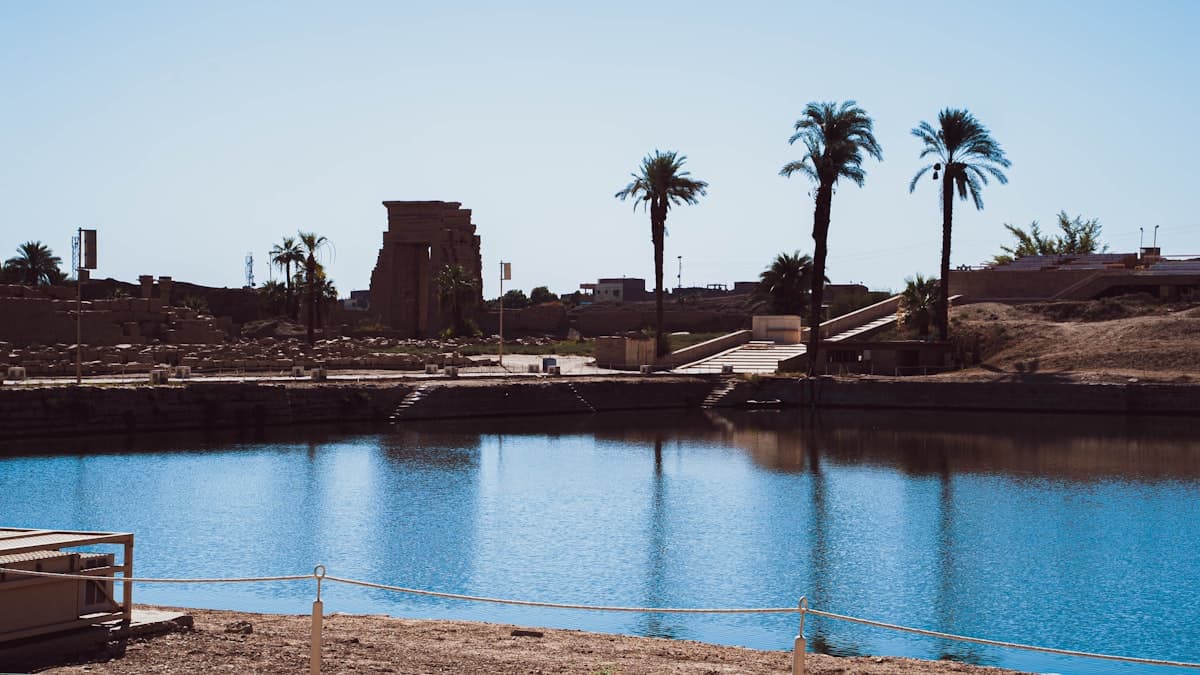
The sacred lake inside the complex, fed by groundwater from the Nile, was used for priestly purification rituals before dawn ceremonies. It is also where, according to one Ptolemaic text, the daily solar scarab was believed to emerge each morning. Today it is ringed by a concrete walkway and populated by geese. The viewing stand on its southern edge is where the Sound and Light Show audience sits each evening.
The influence extends further in time. The Coptic monastery of Deir el-Bahari on the west bank incorporates blocks from a Thutmoside chapel. The medieval Arab geographer al-Idrisi described Luxor in the 12th century CE as a city of enormous ruins whose purpose no one could explain. The Ottoman traveler Evliya Çelebi visited in the 17th century and guessed that the columns had been built by a giant race. The interpretive gap between those medieval observers and what we now know, through Champollion's decipherment of hieroglyphics in 1822 and a century of excavation, is itself a story about how civilizations lose and then slowly recover their own past.
Common Mistakes
Arriving after 9am in high season. The hypostyle hall between 10am and 2pm in December is a crowd management exercise. The first hour after 6am opening is not just quieter, it is photographically and experientially a different place, with low-angle light cutting between columns.
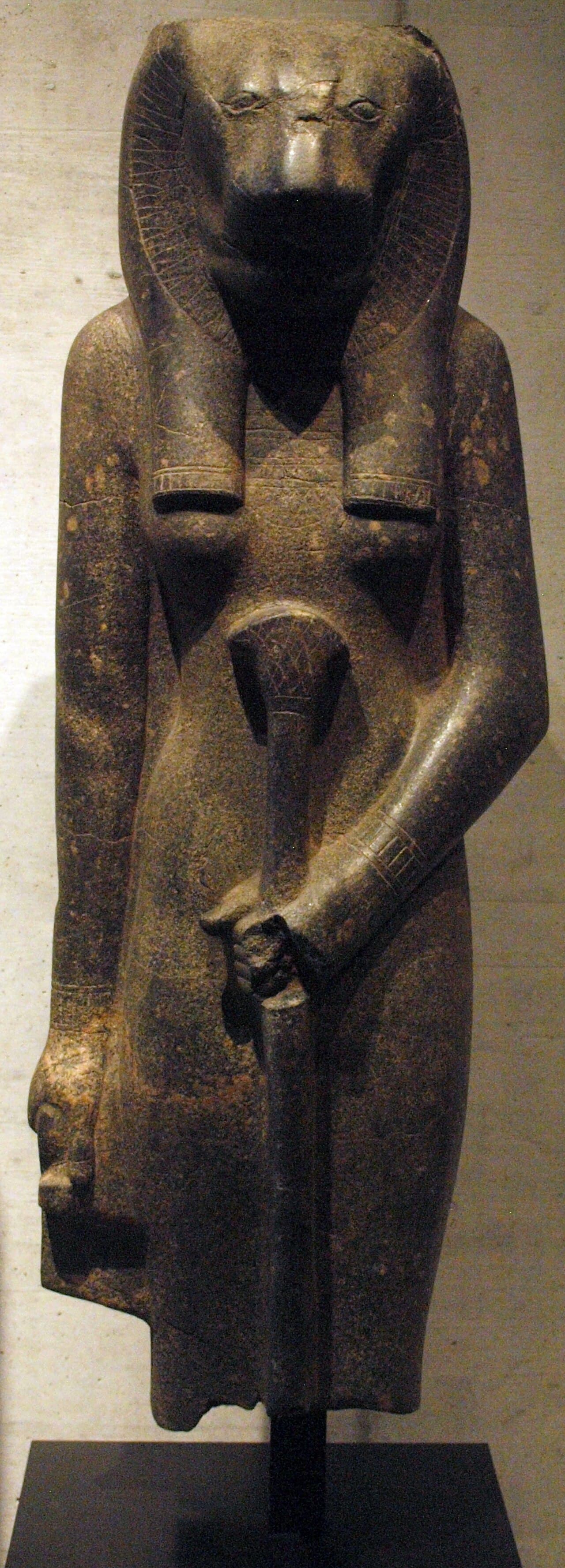
Ignoring the Precinct of Mut. Most visitors stay in the Precinct of Amun and never reach the Precinct of Mut to the south, connected by an avenue of sphinxes. Mut was Amun's consort, and her precinct contains over six hundred statues of the goddess Sekhmet, a collection so large and strange that it stops most people cold. It requires a separate ticket negotiated at the main gate.
Taking a guide who reads the walls literally. Many local guides at the gate translate hieroglyphic inscriptions as straightforward historical narrative. The walls of Karnak are theological texts, not history books. The battle reliefs of Ramesses II showing his victory at Kadesh are partly propaganda, Kadesh was largely a draw. An Egyptologist trained in religious iconography gives you a fundamentally different experience than a licensed tourist guide.
Missing the Open Air Museum. Located to the northwest of the main complex, the Open Air Museum houses reconstructed chapels including the White Chapel of Sesostris I, built around 1900 BCE and among the finest examples of Middle Kingdom relief carving anywhere in Egypt. It is included in the main ticket. Most visitors never find it.
Wearing dark clothing. In summer months especially, black absorbs heat in ways that make the two-kilometer walk through the complex genuinely dangerous. Light-colored, loose, long clothing is not a modesty recommendation here. It is a medical one.
Not drinking enough water. The complex is enormous and largely unshaded. Vendors inside sell water at EGP 20 to 30 per bottle. Bring at least one liter per person regardless of season.
Expecting the Sound and Light Show to add historical context. The evening show is atmospheric and uses the dramatic setting well. It is not historically rigorous and some of the narration reflects outdated scholarship. Enjoy it as theatre.
Practical Tips
Hire your guide before arriving at the gate, through a licensed Egyptologist referral service in Luxor or through your hotel, rather than accepting offers from touts outside the entrance. The touts are persistent but the quality gap is real. Expect to pay EGP 1,500 to 2,500 for a half-day private Egyptologist guide who specializes in religious iconography.
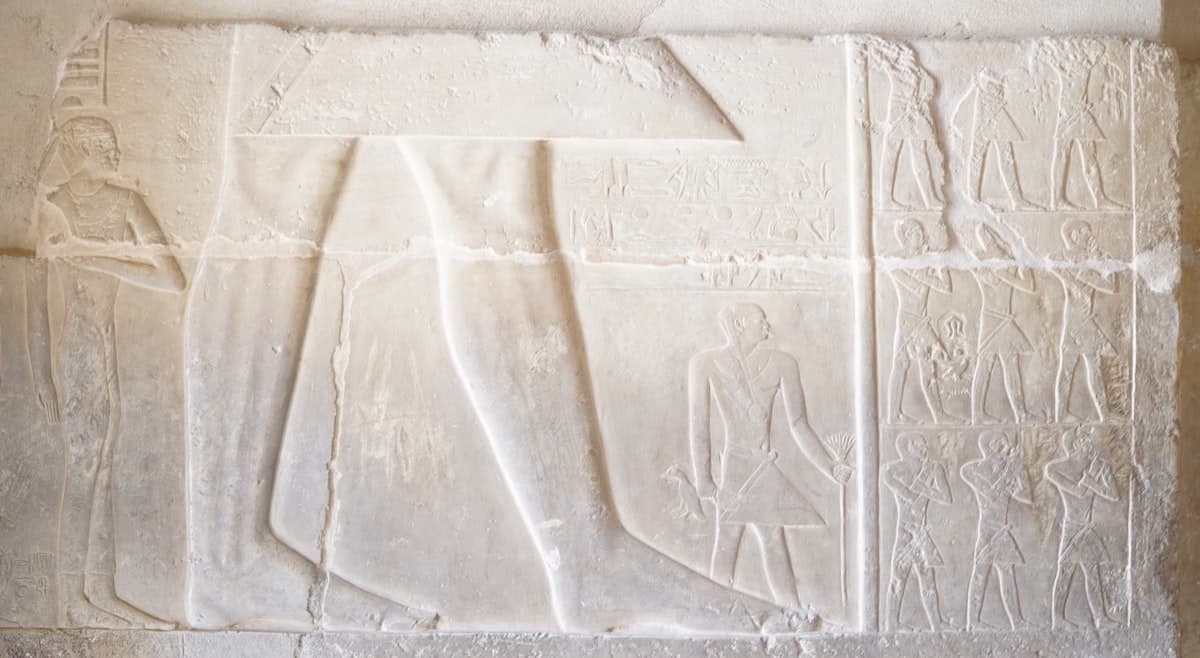
The Karnak temple religious rituals depicted on the walls of the hypostyle hall are most legible in the north half of the hall, where Seti I's reliefs are finer-grained and better preserved than his son Ramesses II's work on the south side. Seti's relief cutting is sunk relief at its most precise; bring a small flashlight to illuminate shadow details even in daylight.
The sacred scarab statue on the northeast corner of the sacred lake is now surrounded by tourists who circle it three times for luck, a tradition of entirely modern and tourist-industry invention. There is no ancient precedent for it. Circle it or don't, but know what you're doing.
Photography with a phone or camera is permitted throughout the complex without additional charge. Tripods technically require a permit but enforcement is inconsistent. The best interior shots of the hypostyle hall are from the northwest corner looking southeast in the first hour of morning, when the light enters through the clerestory at a low angle and the columns appear to glow from within.
If you plan to visit both Karnak and Luxor Temple, visit Karnak in the early morning and Luxor Temple in the late afternoon or evening, when the setting sun turns the sandstone a deep amber. They are connected by the ancient processional route, and walking even part of that avenue, past the ram-headed sphinxes, between 5pm and sunset in winter is one of the more affecting things you can do in this city.
Frequently Asked Questions
The Weekly Dispatch
More on Egypt, every Friday.
Cultural depth and places most guides never mention.
No spam. Unsubscribe anytime.