Kom Ombo Temple Guide: Egypt's Double God Sanctuary
Kom Ombo Temple was built for two gods simultaneously, split down the middle with perfect symmetry. This guide tells you what that actually means, and what most visitors miss.
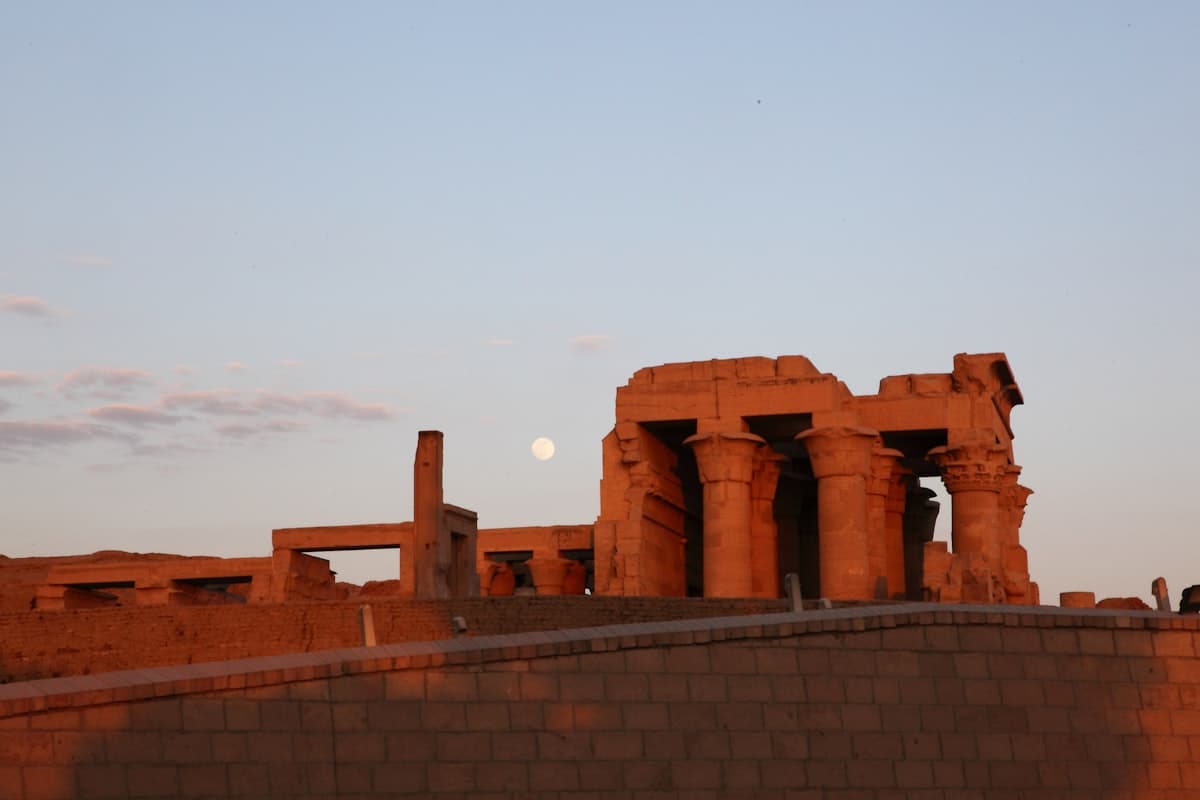
Quick Facts
- Best time to visit
- October to February for cooler temperatures and better light. Avoid June to August when midday heat exceeds 40C and the open courtyard is brutal.
- Entrance fee
- EGP 450 (approx $9 USD). Crocodile Museum additional EGP 100 (approx $2 USD). Student discount approximately 50% with valid ID.
- Opening hours
- Daily 9am to 5pm. Hours may vary seasonally. Confirm locally the morning of your visit.
- How to get there
- Microbus from Aswan bus station: EGP 10 to 15 per person, 45 minutes. Private taxi return from Aswan: EGP 300 to 500 including waiting time. Most Nile cruises stop at the dock 300 meters from the temple entrance.
- Time needed
- 2 hours minimum for the temple alone. Add 45 minutes for the Crocodile Museum. Half day if combining with Daraw camel market (Tuesdays and Sundays only).
- Cost range
- Budget day trip from Aswan: EGP 600 to 900 including transport and entry. Mid-range with licensed Egyptologist guide: EGP 1,500 to 2,000.
The ancient Egyptians did not believe in compromise. So when the priests of Kom Ombo needed to honor both Sobek the crocodile god and Haroeris the falcon god, they did not argue about which deity deserved the better real estate. They built two temples, fused at the spine, sharing one outer wall and one courtyard but maintaining entirely separate sanctuaries, separate ritual axes, and separate priests. The result is the only perfectly doubled temple in Egypt, and it has been confusing and delighting visitors since the Ptolemies finished it around 180 BCE.
Most people arrive here off a Nile cruise, spend forty-five minutes photographing the crocodile mummies, and leave. That is a shame, because Kom Ombo is the place where Egyptian medicine meets Egyptian religion, where the Ptolemaic Greek rulers of Egypt bent themselves into the grammar of pharaonic belief to hold power, and where a small museum in the back courtyard contains something that should stop you cold: surgical instruments from the first century BCE that look almost identical to what I studied in medical school.
Quick Facts
Best time to visit: October to February, when the light on the Nile at this bend is golden and the heat will not exhaust you. Arrive before 8am if you are on a cruise layover, before the other boats dock. Entrance fee: EGP 450 (approximately $9 USD). The Crocodile Museum inside the complex costs an additional EGP 100 (approximately $2 USD). Student prices are roughly half with a valid ID. Opening hours: Daily 9am to 5pm. Hours can shift seasonally; confirm with your hotel or cruise operator the morning of your visit. How to get there: From Aswan, the most practical option is a microbus from the Aswan bus station toward Kom Ombo town, roughly EGP 10 to 15 per person and a 45-minute ride. A private taxi from Aswan runs EGP 300 to 500 return including waiting time. Most Nile cruises stop here between Luxor and Aswan; the temple is 300 meters from the cruise dock. Felucca travelers can arrange a stop but need to coordinate docking with their captain in advance. Time needed: 2 hours minimum to see the temple meaningfully. Add 45 minutes for the Crocodile Museum. If you combine with Daraw camel market (Tuesdays and Sundays, 6km north), plan a half day. Cost range: Budget travelers doing this as a day trip from Aswan can manage for EGP 600 to 900 including transport and entry. Mid-range with a guide: EGP 1,500 to 2,000.
Why This Place Matters
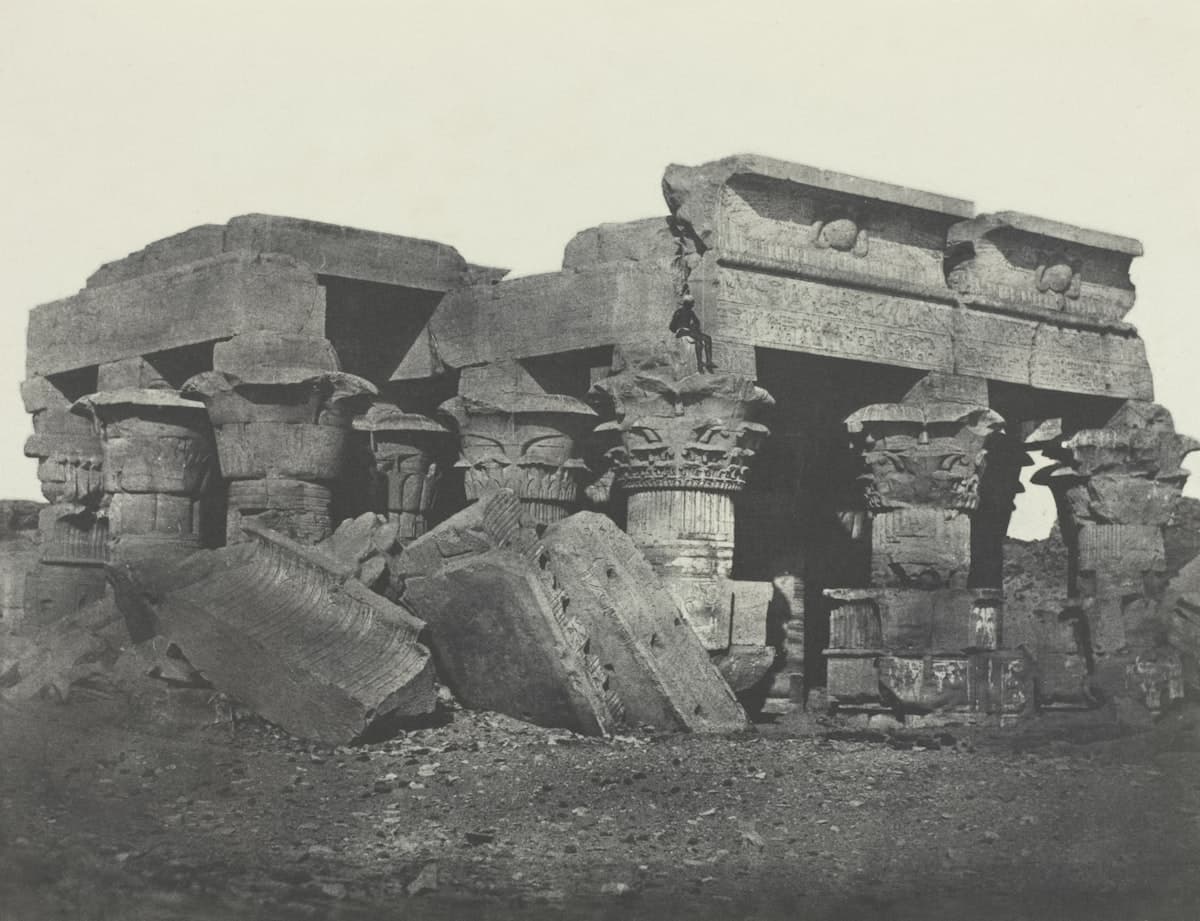
Kom Ombo is not simply old. It sits at a point where the Nile curves, where the floodplain narrows, and where Nile crocodiles once gathered in enormous numbers to bask on the sandbanks. The cult of Sobek was not metaphorical. The priests kept live crocodiles in a sacred lake adjacent to the temple, fed them, observed them, and when they died, mummified them as manifestations of the god. More than three hundred crocodile mummies have been found here, some over four meters long.
Haroeris, the elder form of Horus, shared the space because the theology made political sense. Sobek represented the fertile chaos of the river, its danger and its abundance. Horus in his elder aspect represented kingship, sky, and the ordered cosmos. Their cohabitation in one building was a statement about balance, the same concept the Egyptians called Ma'at: truth, order, and the right relationship between things. The temple's double axis, two of everything right down to the twin wells in the courtyard used for measuring the Nile flood, made that philosophy visible in stone.
The structure you walk through today was built primarily under the Ptolemaic dynasty, the Macedonian Greeks who ruled Egypt from 305 to 30 BCE. The Ptolemies were sophisticated colonialists. They understood that to rule Egypt, they needed to speak Egyptian religion fluently. The inscriptions here show Ptolemaic pharaohs performing rituals in perfect hieroglyphic grammar, offering to gods whose theology they had studied like a second language. Cleopatra VII, the last of the line, is shown in relief on the outer wall of the temple at Dendera, 200km north. Her family's fingerprints are on Kom Ombo too.
What You Will Actually See
The temple faces the Nile rather than the desert, which is unusual. When you approach from the dock along the corniche path, the pylons rise above the sugarcane fields and the river behind you catches the morning light in a way that the afternoon, with tour buses and cruise passengers, will not replicate.
The outer hypostyle hall has columns with elaborately carved capitals: lotus, papyrus, and composite forms that show Ptolemaic decorative ambition. Look at the ceiling in the first covered hall. The astronomical ceiling panels, partially preserved, show zodiac constellations mixed with Egyptian astronomical symbols. This is not accidental. The Ptolemies brought Greek astronomical knowledge into conversation with Egyptian cosmological tradition, and you can see the seam where they join.
On the interior walls, look for the famous medical relief in the left corridor of the outer ambulatory. It shows a collection of surgical instruments: scalpels, forceps, probes, bone saws, suction cups, and what appears to be a speculum. The ancient Egyptians had a sophisticated medical tradition documented in papyri dating back to 1600 BCE. The Edwin Smith Papyrus, now in New York, describes surgical procedures for head wounds and spinal injuries with a clinical precision that is startling. Kom Ombo connects that tradition to a physical place. The instruments on the wall were not decorative. They were real objects depicted because the temple had a function as a healing center. Patients who came seeking cures from Sobek and Haroeris would have been treated by priests who were also physicians.
The Crocodile Museum
The museum in the rear courtyard of the complex is small but worth every minute. It holds mummified crocodiles of various sizes, some wrapped in linen in the same manner as human mummies, some bare and brown as old wood, their teeth intact. The largest ones were mummified with their eggs clustered around them. A juvenile crocodile, no longer than your forearm, sits in a case looking more like a toy than a god.
What stops most visitors who bother to read the labels is this: the priests who mummified these animals used the same materials and techniques as those who mummified humans. Natron salt, linen, resin. The crocodile was not merely a symbol of Sobek. It was Sobek, temporarily housed in animal form. The same logic applied to the ibis of Thoth at Hermopolis, the ram of Khnum at Elephantine, and the cats of Bastet at Bubastis. The Egyptians were not naive. They understood that the animal was not literally the god. But they believed the god could inhabit an animal, that the divine could take form in the physical world. That theology lasted for three thousand years.
The Connections
Kom Ombo does not exist in isolation, and if you treat it as a standalone Nile cruise stop, you miss the larger conversation it is part of.
Fifty kilometers south, the Temple of Khnum on Elephantine Island at Aswan was the center of a cult devoted to the ram-headed god who shaped humanity on a potter's wheel. Khnum controlled the Nile inundation from caves beneath the island. The Kom Ombo cult of Sobek was downstream from Khnum, which placed the crocodile god in the zone where the Nile's waters had already passed the source of their power. The two cults were in theological dialogue for centuries.
The town of Kom Ombo today is one of the largest communities of Nubian Egyptians displaced by the construction of the Aswan High Dam in the 1960s and 1970s. The dam flooded Lower Nubia and required the relocation of around 100,000 people. Many were resettled in Kom Ombo and the surrounding agricultural land. The relationship between that displacement and this ancient temple, where the cult of Sobek celebrated the life-giving power of the Nile, is not something the official tourist narrative dwells on. But the Nubian community here carries it.
The temple also has a Roman layer. Augustus and Tiberius added to the outer walls after Rome absorbed Egypt in 30 BCE. The cartouches change as you move through the building, from Ptolemaic to Roman emperors who presented themselves in full pharaonic regalia. By the time Tiberius was adding reliefs here, the last native Egyptian pharaoh had been dead for three centuries. The tradition was that durable.
Common Mistakes
Arriving mid-morning on a cruise-ship day. The boats dock between 9am and 11am and leave after lunch. If you are not on a cruise, this is the worst window to visit. Arrive at 9am when the gates open or come after 3pm when the boats have gone.
Skipping the rear of the temple. Most visitors photograph the front halls and leave. The inner sanctuary rooms at the back have the most intact painted reliefs. The color survives in patches: ochre, blue, and red on walls protected from direct sunlight for two millennia. The medical instruments relief is back here too.
Not looking down. The floor level has been excavated in areas to show earlier phases of construction. You can see Roman-era paving over Ptolemaic foundations in the outer courtyard. The site has multiple building campaigns layered beneath your feet.
Treating the Crocodile Museum as optional. It costs EGP 100 and takes thirty minutes. The mummies are the most visceral evidence of Egyptian religious practice in the area, more immediate than reliefs on a wall.
Missing the Nile-gauge well. In the outer courtyard, two circular wells descend into the rock. These were Nilometers, used to measure the annual flood. The same technology was used at Elephantine Island in Aswan and on Rhoda Island in Cairo. They are part of a 2,000-year system of hydraulic monitoring that predates any European equivalent.
Going without any preparation on the theology. You do not need a Egyptology degree, but knowing who Sobek and Haroeris are before you arrive means you can read the building instead of photographing it. Fifteen minutes with a basic overview changes the entire experience.
Hiring an unofficial guide at the gate. Licensed Egyptologist guides in Aswan charge EGP 300 to 600 for a temple visit and are worth every pound. The unlicensed men who approach you near the dock entrance will tell you confident fictions and charge you more.
Practical Tips
Wear closed shoes. The temple floor is uneven and the stone is hot in summer. A light scarf is useful for blocking midday sun in the open courtyard areas, and women will feel more comfortable with shoulders covered, though there is no enforced dress code here as there is at mosques.
Bring cash. The ticket office does not reliably accept cards, and the small vendor area near the exit has decent cold water and sugarcane juice at non-extortionate prices if you arrive early enough before the cruise passengers do.
If you are coming from Aswan independently, the Tuesday and Sunday camel market at Daraw, 6km north, is worth combining into the same day. Daraw is the largest camel market in Upper Egypt. The camels arrive from Sudan via the Forty Days Road, an ancient trade route across the eastern Sahara. The market operates from early morning and is finished by noon. The combination of the market and the Kom Ombo Temple guide to the afternoon makes for one of the most layered day trips available from Aswan.
For the Kom Ombo Temple itself, the early morning visit, 9am when gates open, gives you the best light for photography and the fewest people. The Nile-facing orientation means the temple is front-lit in morning and back-lit by afternoon. Come in the morning.
Frequently Asked Questions
The Weekly Dispatch
More on Egypt, every Friday.
Cultural depth and places most guides never mention.
No spam. Unsubscribe anytime.