Luxor Temple and Ancient Egyptian Festivals: What the Walls Actually Say
Luxor Temple was never a tomb or a monument to the dead. It was a place of reunion, built for a festival that remade the pharaoh as a god every year. Here is what that means.
Quick Facts
- Best time to visit
- October to February for comfortable temperatures. Dawn visits (6am opening) or evenings after 5pm avoid the worst crowds year-round.
- Entrance fee
- EGP 600 (approx $12 USD) for foreign adults. EGP 300 for foreign students with valid ID. Luxor Pass covering multiple sites costs EGP 1,250 (approx $25 USD).
- Opening hours
- Daily 6am to 10pm. Ticket office closes at 9pm.
- How to get there
- Walkable from central Luxor hotels. Tuk-tuk from train station EGP 30 to 50. Calèche (horse carriage) EGP 50 to 80. No direct public bus service to the temple entrance.
- Time needed
- 2 hours minimum for a walk-through. 3 to 4 hours with the Opet reliefs and inner sanctuary. Combine with the Luxor Museum next door for a full half-day.
- Cost range
- Budget EGP 800 to 1,200 per day including entry, street food, and local transport. Mid-range EGP 2,500 to 4,000 including licensed Egyptologist guide and a restaurant meal.
The priests didn't open Luxor Temple every day. For most of the year, the inner sanctuary sat in total darkness, its doors sealed with clay bearing the high priest's stamp. The god Amun-Ra lived there, in the form of a small gilded statue, and he was not available for public worship. Luxor Temple existed, primarily, for one event: the Opet Festival, a annual procession of divine reunion that lasted between eleven and twenty-seven days depending on the era, and during which the pharaoh himself was ritually dissolved and reborn as a god inside these walls.
That is what you are walking into when you enter Luxor Temple. Not a monument to death, not a memorial, not a display. A machine for transformation.
Quick Facts
Best time to visit: October to February for tolerable temperatures. Dawn (doors open at 6am) gives you roughly forty minutes before the tour buses arrive. The site stays open until 10pm, and the evening light show, while not subtle, does reveal reliefs that the daytime crowds trample past without noticing.
Entrance fee: EGP 600 (approximately $12 USD) for foreign adults. EGP 300 for foreign students with valid ID. Egyptian nationals pay significantly less. The Luxor Pass, available at the Luxor Inspectorate office near Karnak, covers both Luxor Temple and Karnak plus most West Bank sites for EGP 1,250 (approximately $25 USD) and pays for itself on the second or third site.
Opening hours: Daily 6am to 10pm. The ticket office closes at 9pm.
Getting there: Luxor Temple sits on the Corniche in the center of the East Bank, walkable from most Luxor City hotels. A tuk-tuk from the train station costs roughly EGP 30 to 50. A calèche (horse-drawn carriage) from the souk area runs EGP 50 to 80 and your driver will attempt to take you to his cousin's papyrus shop, which you should politely decline. There is no cheaper or more direct option.
Time needed: Two hours minimum if you read the walls. Three to four hours if you want to understand what you're looking at. Evening visits often feel unhurried in ways that morning visits do not.
Cost range: Budget EGP 800 to 1,200 per day including entry, food from street stalls, and local transport. Mid-range EGP 2,500 to 4,000 including a licensed Egyptologist guide (worth every pound) and a sit-down meal on the Corniche.
Why Luxor Temple Matters: The Festival Was the Point
Most visitors walk through Luxor Temple thinking it is roughly similar to Karnak: columns, reliefs, obelisks, pharaohs smiting enemies. The scale is smaller. The crowds are thinner. Then they leave, feeling they have checked a box.
What they missed is this: Karnak was Amun's home. Luxor Temple was where he came to meet his other self.
The Opet Festival, celebrated during the second month of the Nile's inundation season (roughly August to October in modern terms), was the most important ritual event in the New Kingdom Egyptian calendar. The gilded barque of Amun-Ra was carried from Karnak, 2.7 kilometers south, to the inner sanctuary of Luxor Temple, where the god merged with his more primordial, sexually potent form called Amun-Min. The pharaoh entered with the god. He emerged renewed, his divine kingship recharged for another year. This wasn't metaphor. It was, to every person watching the procession from the Avenue of Sphinxes, an observable fact.
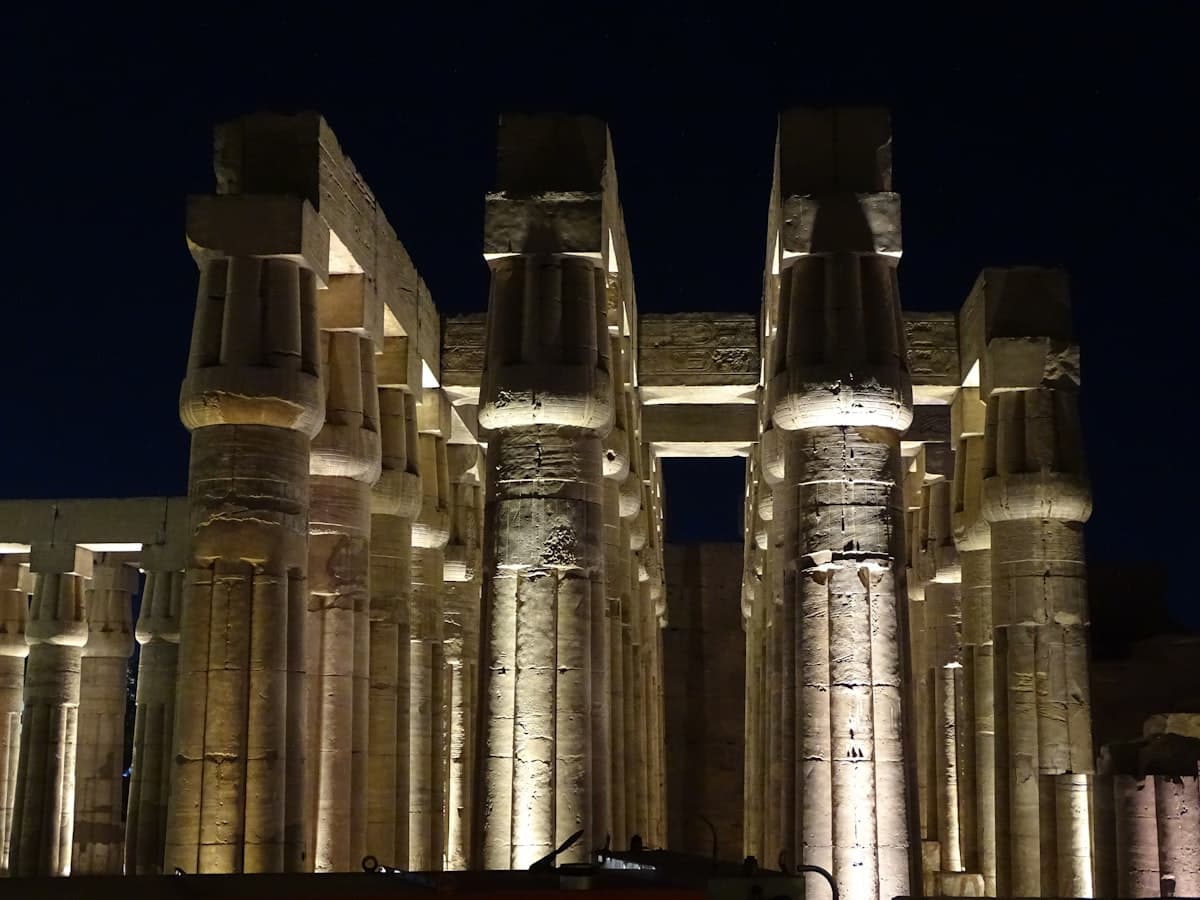
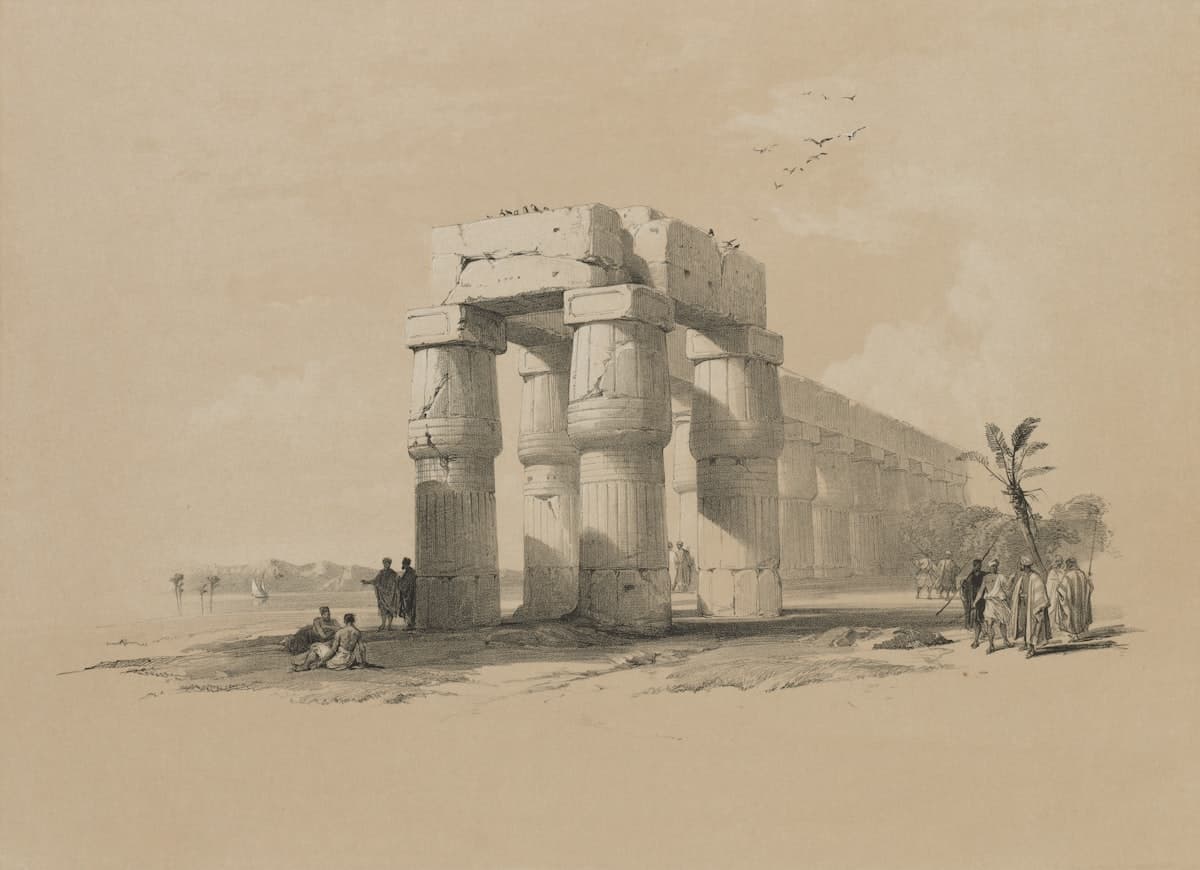
The entire temple was designed around this logic. The outer courts are processional space, built for spectacle and crowds. The colonnade hall of Amenhotep III, with its fourteen papyrus-cluster columns, was the corridor of approach. The inner sanctuary is small, intimate, and sealed from ordinary sight. The architecture is a theological argument made in sandstone.
The connection to ancient Egyptian festivals inscribed on these walls is not decorative. The Opet procession reliefs in the colonnade, carved under Tutankhamun and finished under Horemheb, are the most complete visual record we have of how the festival actually worked. Specific details survive: the number of offering bearers, the order of the barques, the musicians, the acrobats, the soldiers keeping the crowd back, the slaughtered cattle, the loaves.
What Alexander the Great Understood That Most Tourists Don't
When Alexander arrived in Egypt in 332 BCE, he went directly to Luxor Temple. He had himself depicted inside the inner sanctuary, in pharaonic dress, performing the same rituals that Amenhotep III had performed 1,100 years earlier. The carved image survives. Alexander is in full Egyptian regalia, making offerings to Amun, on the walls of a room he ordered rebuilt.
This was not tourism. It was a political and theological necessity. You could not rule Egypt without the Opet Festival. You could not participate in the Opet Festival without Luxor Temple. Alexander, who understood power in ways that remain instructive, grasped this immediately.
The Romans understood it too. The Roman legionary camp that was installed within the temple precinct in the third century CE didn't destroy the sanctuary. The soldiers built their camp around it. The tetrastyle temple of the imperial cult was erected in what had been the outer court of Ramesses II, using the existing columns as structural anchors. When you walk through the temple today and suddenly encounter a section that feels like a Roman basilica, you are not confused. You are correct.
The Walls Most People Walk Past
The colonnade of Amenhotep III runs roughly 100 meters along the western wall of the hypostyle hall. The Opet Festival reliefs occupy both sides of this corridor. On the eastern wall, the procession moves from Karnak to Luxor. On the western wall, it returns. The detail is extraordinary and almost entirely ignored by visitors who are already heading for the selfie spot near the obelisk.
Look at the boats. The barques of Amun, Mut, and Khonsu, the Theban triad, are towed by ropes held by priests, sailors, and soldiers. Ahead of the procession, smaller figures burn incense from long-handled censers. The smoke is carved rising from the censers in looping spirals. The figures playing sistra (ancient Egyptian rattles that were believed to ward off evil and call divine attention) are shown with their arms raised mid-shake. These are not static images. They are frames from a film.
Now look at the crowd. On the lower registers, ordinary Egyptians watch the procession. Acrobats perform. Women ululate, their mouths carved open. A man leads a bull decorated with a sun disk between its horns, destined for sacrifice. These are real people, rendered 3,400 years ago, behaving exactly as Egyptian crowds behave at the Moulid al-Nabi today: fervent, chaotic, joyful, pressing against the barriers.
The Abu el-Haggag Mosque and the Festival That Never Stopped
Built into the northeastern corner of the outer court of Ramesses II, at a height that tells you it was constructed when the temple was buried under fifteen meters of accumulated Nile silt and urban debris, is the Mosque of Abu el-Haggag. It is still active. Friday prayers are held here. The imam delivers the khutba in a mosque whose floor sits at the level of the ancient column capitals below.
Every year, during the Moulid of Abu el-Haggag, the mosque's founder and Luxor's patron saint, the local community processes through the streets of the city carrying boats on their shoulders. Wooden boats. The connection to the Opet Festival's barque procession has been noted by every Egyptologist who has ever worked in Luxor. Whether it represents a genuine thread of cultural memory across 1,500 years of religious change, or a remarkable parallel that developed independently, is debated. The boats are real either way. The procession is real. The Luxor temple ancient Egyptian festivals have not entirely stopped. They have changed languages.
The Connections: What Luxor Temple Is Embedded In
The Avenue of Sphinxes connecting Luxor Temple to Karnak was partially excavated and restored beginning in the 1990s and reopened ceremonially in 2021 after a decades-long project that required relocating an entire neighborhood. Walking it today, you pass over ground where Coptic monasteries once stood (fragmentary wall paintings were found and removed to the Luxor Museum), where Ottoman merchant houses were demolished, where Roman milestone markers were discovered still in place. The avenue itself is 2,700 meters long and was lined with 1,057 human-headed sphinxes. Several hundred survive.
The Luxor Museum, seven minutes' walk north along the Corniche, holds objects from the temple cache discovered in 1989 when workers renovating the floor of the court of Amenhotep III found a pit containing 26 statues, including a perfectly preserved pink granite figure of Amenhotep III himself. The museum also holds the reconstructed Akhenaten talatat blocks, small sandstone blocks that were used as fill inside the second pylon at Karnak but originated from Amenhotep IV's short-lived Aten temple at Karnak, which was systematically demolished after the Amarna period. One heresy, recycled into the infrastructure of the next orthodoxy.
On the West Bank, the Luxor temple ancient Egyptian festivals had a counterpart site: Medinet Habu, where the bark of Amun rested on the journey. The connection between East and West Bank ritual geography is poorly understood by most visitors who treat the two banks as separate itineraries rather than a single ceremonial landscape.
Common Mistakes That Cost You the Experience
Arriving mid-morning. The tour buses from Hurghada arrive between 9am and 11am. By 10am, the colonnade is impassable for looking at anything carefully. Come at 6am or after 5pm.
Skipping the inner sanctuary because it's roped off. The inner sanctuary is accessible, but you need to ask the guards. It is not advertised. Bring a small tip (EGP 20 to 50) and patience. The Alexander reliefs are in here. This is where the entire theological logic of the temple resolves.
Confusing the two colossi of Ramesses II at the entrance. One is seated, one is standing. The standing figure is a later replacement from a different site. The seated figure is original. The details of the double crown on the original are sharper than almost any other colossal sculpture in Luxor. Nobody points this out.
Not reading the Opet reliefs before you arrive. The reliefs reward preparation. Download or buy a copy of the Epigraphic Survey's documentation of the colonnade before your visit. Without context, you are looking at a wall of figures. With context, you are watching a ceremony unfold in sequence.
Taking the audio guide at face value. The standard audio guide describes the temple in the vocabulary of monuments and pharaohs. It does not explain the Opet Festival with any depth, and it says nothing useful about the Roman or Islamic layers. Hire a licensed Egyptologist guide from the Luxor Tourist Authority list. Budget EGP 400 to 600 for two to three hours.
Ignoring the mosque. The Abu el-Haggag Mosque is not a photographic obstacle in your wide-angle shot of the court of Ramesses II. It is the most direct evidence that this temple has been in continuous religious use for 3,300 years. It deserves five minutes of your attention.
Leaving before dark. The evening light transforms the colonnade in ways that have nothing to do with the light show. The papyrus-bundle columns lose their daytime harshness. The reliefs acquire depth. The crowds are gone.
Practical Tips
Bring water. The site has no shade except inside the colonnade and the mosque. In summer, the heat between 9am and 4pm is serious and the open courts of Ramesses II become difficult to stand in for long periods.
The ticket booth is at the northern entrance on the Corniche. There is no southern entrance for general visitors despite what some older guidebooks suggest.
The Luxor Pass requires a passport photo and is issued at a small office near the Karnak ticket booths. If you are visiting Karnak, Luxor Temple, the Valley of the Kings, Medinet Habu, Deir el-Bahari, and the Luxor Museum within a few days, it is cheaper than buying individual tickets. Do the math before you commit.
Licensed guides can be booked through the Luxor Tourist Guides Syndicate. Unlicensed guides offering services at the temple entrance vary enormously in quality and are not regulated. The best Egyptologist guides in Luxor are genuinely among the best in the world, deeply specialized, and worth finding.
If you are in Luxor during the Moulid of Abu el-Haggag (date varies, based on the Islamic calendar), stay for the procession. It begins after evening prayers at the mosque and moves through the streets with noise, lanterns, incense, and boats carried on shoulders. You will not see this in any travel brochure and it is the most honest possible way to understand what Luxor Temple actually is.
Frequently Asked Questions
The Weekly Dispatch
More on Egypt, every Friday.
Cultural depth and places most guides never mention.
No spam. Unsubscribe anytime.