Mount Sinai Hiking Guide: The Mountain That Made Three Religions
A complete Mount Sinai hiking guide covering both routes, what pilgrims and tourists actually experience, and the layered history most visitors never hear.
Quick Facts
- Best time to visit
- March to May and September to November. Summer heat makes daytime hiking dangerous; winter nights on the summit drop below freezing.
- Entrance fee
- Mountain hike is free. Saint Catherine's Monastery entrance approximately EGP 150 (roughly $3 USD). No student discount currently listed.
- Opening hours
- Mountain: no closing time, night hike standard. Monastery: Mon to Thu and Sat, 9am to 12pm only. Closed Fri, Sun, and Greek Orthodox holidays.
- How to get there
- From Sharm el-Sheikh: shared taxi EGP 80 to 150 per person, private taxi EGP 400 to 600. From Cairo: overnight bus from Turgoman terminal EGP 150 to 200, 7 to 8 hours. Local taxi from Saint Catherine's town to monastery EGP 30 to 50.
- Time needed
- 5 to 6 hours for the night ascent and sunrise round trip. Full day if combining with a monastery visit.
- Cost range
- Budget EGP 500 to 900 per day including simple accommodation and food. Mid-range EGP 1,500 to 2,500 with private guide and better lodging.
The monks of Saint Catherine's Monastery have been waking before dawn every single day since the sixth century. Not to greet tourists. Not to perform for cameras. They wake because this is what their rule demands, and because the mountain above them is, in their understanding, the place where God spoke to Moses from a burning bush and handed humanity its moral architecture. Whether you believe that or not will shape everything about how you experience the Mount Sinai hiking guide that follows.
Quick Facts
Best time to visit: March to May and September to November. Summer (June to August) brings brutal Sinai heat; the daytime ascent becomes genuinely dangerous above 30°C. Winter nights on the summit can drop below freezing.
Entrance fees: There is no fee to hike the mountain itself. Saint Catherine's Monastery charges approximately EGP 150 (roughly $3 USD) for entrance to the church and grounds. The Burning Bush garden is free to view from outside.
Opening hours: The monastery is open Monday to Thursday and Saturday, 9am to 12pm. Closed Fridays, Sundays, and Greek Orthodox holidays (plan around these carefully). The mountain itself has no closing time, which is why most people hike at night.
Getting there: From Sharm el-Sheikh, a shared taxi (servees) runs to Saint Catherine's town for around EGP 80 to 150 per person. A private taxi costs EGP 400 to 600. From Cairo, buses depart from the Sinai Terminal at Turgoman for EGP 150 to 200 and take seven to eight hours. The monastery is 3.5 km from Saint Catherine's town; taxis from town cost EGP 30 to 50.
Time needed: The standard night ascent and dawn summit takes five to six hours round trip via the Steps of Repentance. Budget a full day if you add the monastery visit.
Cost range: Budget EGP 500 to 900 per day including accommodation in Saint Catherine's town; mid-range EGP 1,500 to 2,500 with a private guide and better lodging.
---
Why This Mountain Matters Beyond the Postcard
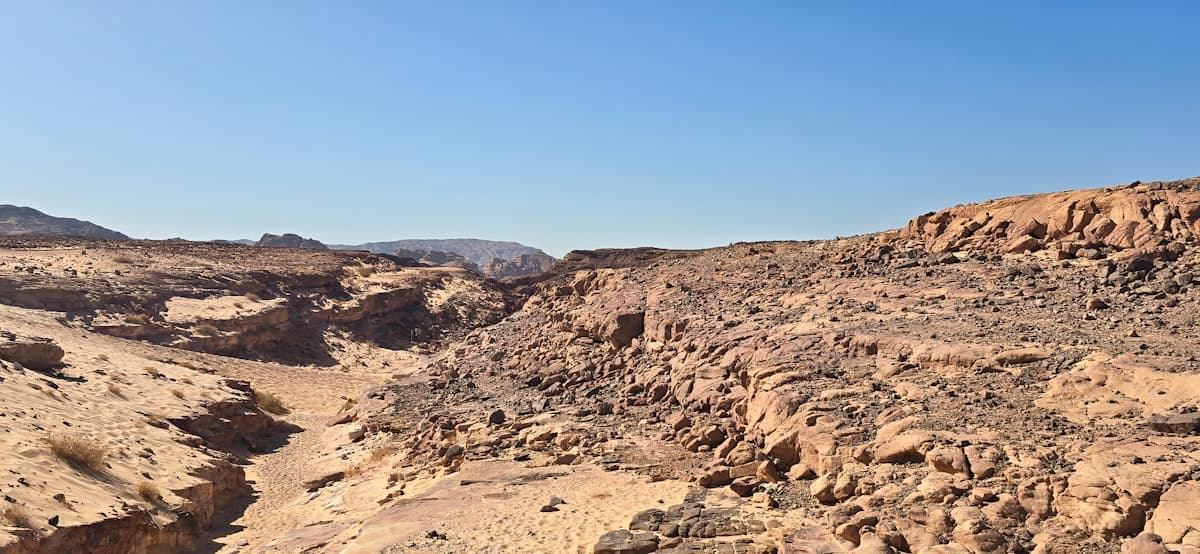
Jabal Musa, which is what Egyptians and Bedouin call it, meaning Mountain of Moses, sits at 2,285 meters in the southern Sinai massif. The surrounding peaks are taller and geologically older, but no mountain in Egypt carries more concentrated human meaning per square meter.
The identification of this specific peak as the biblical Mount Sinai dates to the fourth century, when the Byzantine empress Helena, mother of Constantine the Great, sent a delegation to identify and consecrate holy sites across the eastern Mediterranean. The monks who settled here after Helena's intervention were not primarily interested in tourism. They were interested in martyrdom and proximity to the divine. The Emperor Justinian eventually built walls around their community in 565 CE, less out of piety than strategic calculation: the Sinai was the land bridge between Africa and Asia, and a fortified monastery was useful.
What almost no one tells you is that the monastery's library is the second largest collection of early Christian manuscripts in the world, after the Vatican. During the nineteenth century, a German scholar named Constantin von Tischendorf visited three times and, depending on who tells the story, either rescued or stole the Codex Sinaiticus, one of the oldest complete manuscripts of the Christian Bible. It now sits in the British Library. The monks have never forgiven this.
For Muslims, the mountain is also sacred. The Quran references Moses and the mountain multiple times. A small mosque sits near the summit, built centuries ago, used by Muslim pilgrims who made this journey long before modern tourism existed. Three traditions, one granite peak.
---
The Two Routes Up: What Your Body Will Actually Experience
The Mount Sinai hiking guide most people encounter online tells you there are two routes. What it rarely tells you is that they are nothing alike in character.
The Camel Path
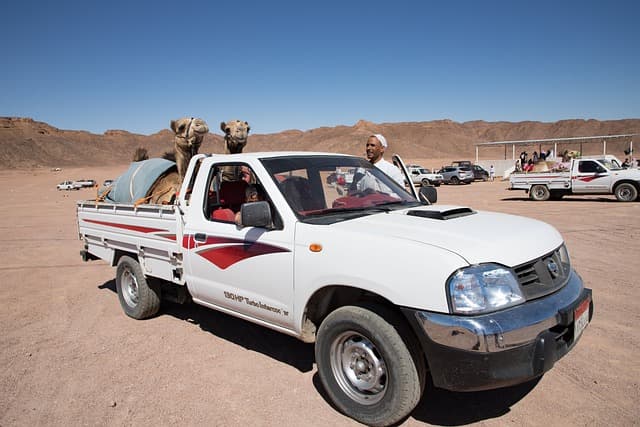
This is the standard ascent, roughly 8 kilometers from the monastery, gaining about 750 meters in elevation. The path is wide, compacted by millions of feet, and gradual enough that camels can (and do) walk it. For the first six kilometers, it is genuinely manageable at a moderate pace. Local Bedouin guides will accompany you whether you want them or not, offering camel rides for around EGP 250 to 400 one way. The going rate is negotiable but do not expect deep discounts; this is one of the primary income sources for the Jabaliyya Bedouin, whose ancestors were brought from Romania and Greece by Justinian to serve the monastery in the sixth century and who have lived here ever since.
The Camel Path ends at a plateau called Elijah's Basin, where a small stone shelter sells tea and chocolate at prices that accurately reflect the effort required to carry supplies up a mountain. This is where the second option matters.
The Steps of Repentance
From Elijah's Basin, you have two choices for the final 750 steps to the summit: a gentle switchback path, or the Steps of Repentance. The steps were cut directly into the granite by a monk named Faranji in the sixth century as an act of penitence. They are steep, uneven, and in places require you to use your hands. They are also the right way to arrive at the summit if you care about the journey meaning something. The effort is the point. Your legs will know the difference between walking to a view and climbing toward something.
The Summit at Dawn
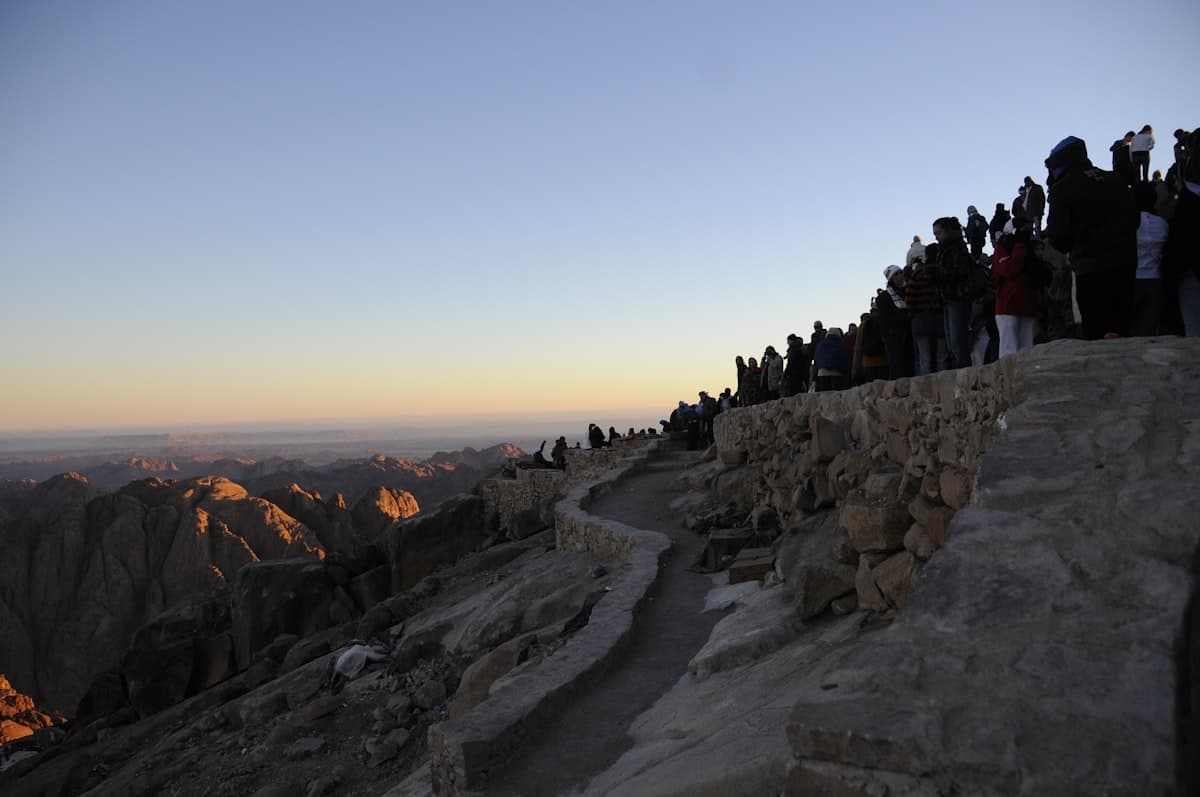
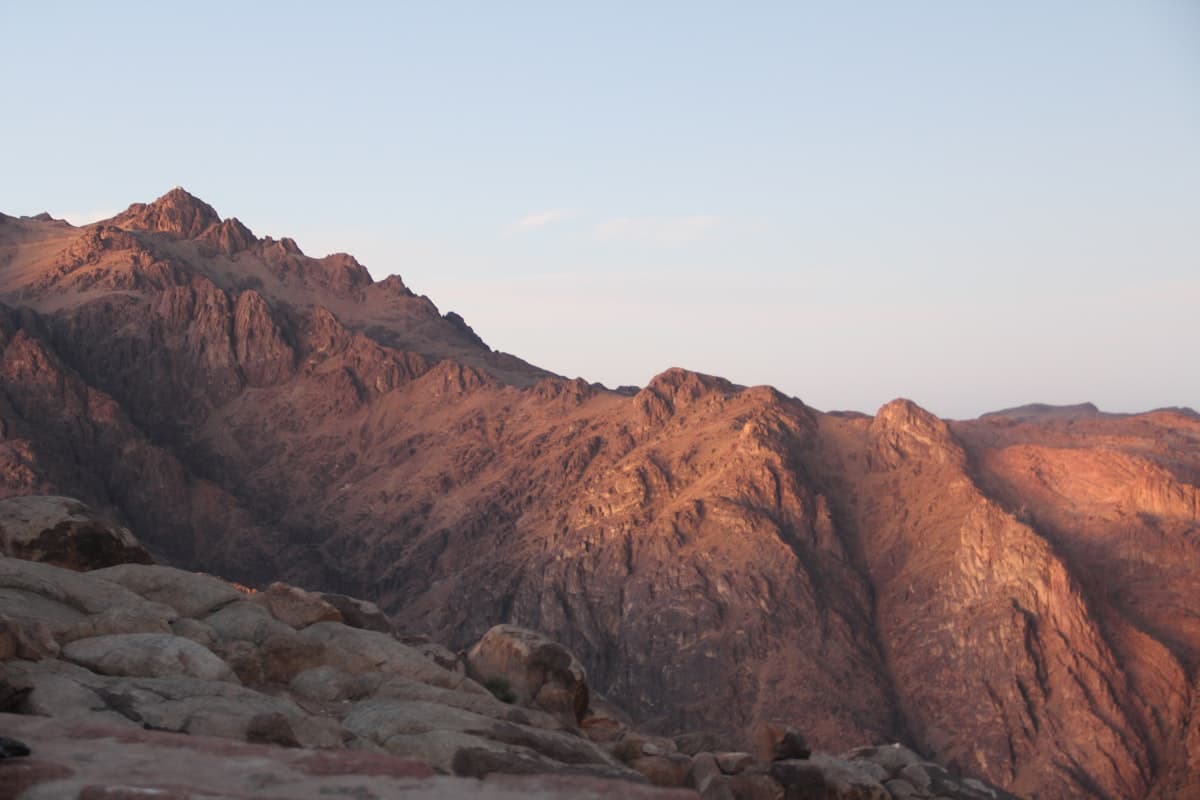
At 2,285 meters, the sunrise over the Sinai range is a specific quality of light you will not find replicated elsewhere in Egypt. The granite turns from black to deep red to orange, and the shadows below resolve slowly into the valley where the monastery sits like a toy fortress. On cold mornings, the summit is crowded with pilgrims wrapped in rented Bedouin blankets (EGP 20 to 30, available at the base and at Elijah's Basin). The silence before the sun clears the horizon is genuine and brief. Use it.
The summit has both a small Christian chapel and the mosque mentioned earlier. Neither is always open, but both are there, side by side on a granite outcrop, which tells you something about the mountain's long history of holding multiple truths at once.
---
The Monastery Itself: What Most Hikers Miss
The majority of people who hike Jebel Musa descend, eat something, and leave without properly visiting Saint Catherine's Monastery. This is a significant error.
The monastery is officially the oldest continuously inhabited Christian monastery on earth. Its walls have never been breached. Napoleon wrote them a letter of protection. The Ottoman sultans granted them firmans, imperial decrees of protection, because the monastery held a document, now believed to be a later copy but historically treated as authentic, purporting to be a letter from the Prophet Muhammad himself granting the monks protection and tax exemption in perpetuity. The monastery displayed this document to every new Islamic ruler for fourteen centuries. The strategy worked.
Inside, the mosaic of the Transfiguration in the apse of the basilica dates to the reign of Justinian, making it one of the finest surviving Byzantine mosaics in the world, older than anything in Ravenna. The icon collection, much of it surviving because Sinai was too remote to be affected by Byzantine iconoclasm, represents an unbroken visual record of Christian art from the sixth century forward.
The Burning Bush itself, or rather the living shrub the monks identify as descended from the original, grows in the garden. Botanists identify it as Rubus sanctus, a species of bramble found almost nowhere else in the Sinai. Whether that fact increases or decreases its significance depends entirely on you.
---
The Connections: Sinai as a Crossroads, Not an Endpoint
Sinai is the part of Egypt that does not look like Egypt in anyone's imagination, which is precisely why it matters to understanding the country whole.
The Jabaliyya Bedouin who live around Saint Catherine's are, as mentioned, descended from the workers Justinian imported in the sixth century. They converted to Islam over subsequent centuries but maintained their identity distinct from other Bedouin tribes. Their relationship with the monastery is layered: occasionally adversarial over land rights, historically symbiotic in terms of protection and trade, and currently complicated by Egyptian government development policies that have repeatedly attempted to relocate them.
The Sinai itself changed hands between Egypt and Israel between 1967 and 1982. During Israeli administration, significant archaeological work was done in the peninsula, some of which the Egyptian government has been slow to integrate into official interpretations of the region's history. The monastery, predictably, outlasted that political episode as it has outlasted every previous one.
From Saint Catherine's, the ancient pilgrimage routes connected to Gaza, to Aqaba, to the Hejaz. The mountain was never isolated. It was always a waypoint in a much larger geography of the sacred.
---
Common Mistakes That Have Real Consequences
Starting the ascent too late. The standard advice is to begin the Camel Path at 2am to reach the summit for sunrise around 5:30 to 6am. Starting at midnight is reasonable; starting at 1am is cutting it fine; starting at 2am means you arrive after the light has already changed. The dawn on Sinai is not a metaphor. It is the specific experience you came for.
Underestimating the cold. The summit in spring and autumn sits around 5 to 10°C before sunrise. Hikers who come in t-shirts because it was warm in Sharm el-Sheikh end up spending EGP 20 per hour renting blankets from Bedouin vendors who have been watching this mistake repeat itself for decades. Bring a proper layer.
Skipping the Steps of Repentance. The switchback path at the end is tempting after a long climb, but the Steps are shorter and they are the historical route. More practically: the steps are less crowded on the descent, which matters when you are tired.
Arriving at the monastery on a Friday, Sunday, or Greek Orthodox holiday. It will be closed. This happens to a remarkable number of visitors who did not check the calendar. The monastery's holiday schedule follows the Julian calendar, which means dates shift relative to the Gregorian calendar each year.
Not carrying enough water. There are tea sellers at Elijah's Basin and occasionally on the path, but their water is expensive and supply is inconsistent. Carry at least 1.5 liters per person from the base.
Using a phone as your only light source. The Camel Path is well-trodden but not lit. Phone batteries drain faster in cold. Bring a headlamp with fresh batteries.
Tipping your guide too little or not at all. Bedouin guides work this mountain every night of their working lives. A reasonable tip for a guide who stayed with you for five to six hours is EGP 100 to 150 minimum, more if they were genuinely useful.
---
Practical Tips for the Actual Trip
Book accommodation in Saint Catherine's town, not in Sharm el-Sheikh, unless you enjoy a two-hour drive at midnight. The town has several simple guesthouses and one mid-range hotel (El Wadi) where a double room runs EGP 800 to 1,400. Camping near the base of the mountain is possible but requires coordination with the local Bedouin community.
Guides are not mandatory but are worth considering for first-time hikers, particularly for navigation before dawn. Local guides can be arranged through Saint Catherine's guesthouses for EGP 150 to 300 for the round trip. They will not provide commentary on Byzantine theology, but they will ensure you do not take a wrong turn at 3am.
The path to the summit is accessible to reasonably fit hikers of almost any age. There are people in their seventies who do it. There are also young people who find it harder than expected because they have not hiked before. Honest assessment: the Camel Path is moderate, the final steps are hard, and the cold makes everything more demanding.
Photography on the summit requires patience and some aggression about positioning. Arrive fifteen minutes before you think you need to and claim a spot facing east. The crowd is real. The light is worth it.
Leave nothing on the mountain. The Sinai's ecosystem is fragile and the area around the summit shows the wear of heavy visitation. The monastery community and local Bedouin have repeatedly raised concerns about litter. This is their home, not a backdrop.
Frequently Asked Questions
The Weekly Dispatch
More on Egypt, every Friday.
Cultural depth and places most guides never mention.
No spam. Unsubscribe anytime.