Sidi Ibrahim al-Dessuqi Shrine: A Complete Cultural Guide
Four million pilgrims visit Dessuq each year for a saint born in 1255 who founded one of Islam's four major Sufi orders. Most Egyptians know his name. Most travelers have never heard of it.

Quick Facts
- Best time to visit
- Month of Sha'ban (Islamic calendar) for the main moulid, or any Friday morning year-round for a quieter but active visit
- Entrance fee
- Free. No admission charge. Donations are customary but not required.
- Opening hours
- Effectively dawn to 11pm daily, aligned with the five prayer times. Shrine chamber accessible during all waking hours.
- How to get there
- Bus from Cairo Torgoman station: EGP 80 to 120, approx 4 hours. Microbus from Tanta: EGP 15 to 20, approx 45 minutes. No direct train service to Dessuq.
- Time needed
- 2 hours for the shrine alone, full day during moulid season, or half-day combined with Tanta on a Delta circuit
- Cost range
- Budget EGP 300 to 500 per day outside moulid season. Basic guesthouse EGP 200 to 400 per night. Street meals EGP 20 to 50.
Sidi Ibrahim al-Dessuqi Shrine: A Complete Cultural Guide
Four million pilgrims descend on the Delta town of Dessuq every year during the moulid of Ibrahim al-Dessuqi, a thirteenth-century Sufi master who founded one of the four great Sufi brotherhoods, the Burhaniyya, at a moment when Egypt was simultaneously recovering from the Mongol invasion and absorbing the wreckage of the Crusades. His shrine is not a tourist attraction in any conventional sense. There are no ticket booths, no audio guides, no numbered plaques. What there is: a mosque built over the grave of a man whose followers in Sudan alone number in the millions, a courtyard that becomes a sea of green and gold banners three times a year, and a spiritual tradition so deeply embedded in Egyptian popular Islam that to miss it is to miss a major chapter of how this country actually works.
Most Western travel writing about Egypt skips Dessuq entirely. This is a failure of imagination. The shrine of Ibrahim al-Dessuqi is one of the four holiest Islamic pilgrimage sites in Egypt, alongside the shrines of al-Hussein, Sayyida Zeinab, and Ahmad al-Badawi in Tanta. Among Egyptians, this is not a matter of debate.
Quick Facts
Best Time to Visit: The three annual moulid celebrations offer the most immersive experience. The largest falls in the month of Sha'ban, typically drawing the biggest crowds. For a quieter visit, any Friday morning outside of moulid season works well.
Entrance Fee: Free. The mosque and shrine complex are open to all, with no admission charge. Donations are customary but never solicited aggressively.
Opening Hours: The mosque is open continuously for prayer, effectively 24 hours. The shrine chamber within is accessible during normal waking hours, generally from dawn prayer until after the final Isha prayer, roughly 5am to 11pm.
How to Get There: From Cairo: Buses from Cairo's Torgoman station to Dessuq run regularly, approximately 3.5 to 4 hours, cost around EGP 80 to 120 (approximately $1.60 to $2.50 USD). Shared microbuses are cheaper but slower. From Alexandria: Buses from Sidi Gaber station, roughly 2 hours, EGP 50 to 70 (approximately $1 to $1.50 USD). From Tanta: Microbus direct to Dessuq, under an hour, EGP 15 to 20 (approximately $0.30 to $0.40 USD). Tanta is itself a major Sufi pilgrimage center and makes a logical pairing. Dessuq is a small city in Kafr el-Sheikh Governorate, in the western Nile Delta. Most visitors arrive by road.
Time Needed: For the shrine itself, two hours is enough to absorb the space, observe the ritual life, and walk the surrounding streets. During moulid, plan a full day or stay overnight to catch the dhikr ceremonies that continue past midnight.
Cost Range: Dessuq is not a tourist economy. Street food costs EGP 20 to 50 per meal. A basic guesthouse room near the shrine runs EGP 200 to 400 per night (approximately $4 to $8 USD). Budget the day at EGP 300 to 500 all-in outside of moulid season.
Why This Place Matters
Ibrahim al-Dessuqi was born in 1255, the same decade the Mongol armies of Hulagu Khan sacked Baghdad and effectively ended the Abbasid Caliphate. Egypt, under the Mamluk Sultanate, was one of the few Muslim powers to halt the Mongol advance, defeating them at the Battle of Ain Jalut in 1260. Al-Dessuqi grew up in this fractured, anxious world and became a scholar and mystic whose reputation spread across the Arabic-speaking world during his lifetime. He died in 1288.
What distinguishes him, and what gives the Sidi Ibrahim Dessuqi shrine its particular weight, is his founding of the Burhaniyya Dessuqiyya order, recognized in classical Islamic scholarship as one of the four major Sufi brotherhoods, alongside the Qadiriyya, the Shadhiliyya, and the Ahmadiyya. The other three founders are buried in Iraq, Morocco, and Tunisia respectively. Al-Dessuqi is the only one buried in Egypt, which is part of why his shrine functions as a destination for pilgrims from across the Arabic-speaking and African Islamic world.
The Mamluk state actively promoted Sufi shrines as instruments of social cohesion. The mosque at Dessuq was rebuilt and endowed multiple times during the Mamluk period, then again under the Ottomans, and the current structure incorporates architectural layers from at least three centuries. The green-domed chamber over the grave follows a visual tradition established in Cairo's City of the Dead and repeated across the Delta.
What You Will Actually See and Experience
Dessuq is a working Egyptian provincial city, not a heritage precinct. The shrine mosque sits in the center of town, and you approach it through ordinary Delta streets: produce sellers, motorcycle repair shops, children on their way to school. The transition into the shrine precinct is abrupt. The noise does not disappear but it changes register.
The mosque courtyard is large enough to hold thousands during moulid. On an ordinary day it holds clusters of pilgrims from Upper Egypt and Sudan, women in black and white thobes sitting in circles reading the Quran, men performing ablutions at the outdoor taps with the practiced efficiency of people who have made this journey before. The architecture is Ottoman in its current dominant form, with some Mamluk elements visible in the qibla wall inside, but no one here is thinking about architectural periods. This is a place people come to ask for things: health, children, relief from debt, a good marriage for a daughter.
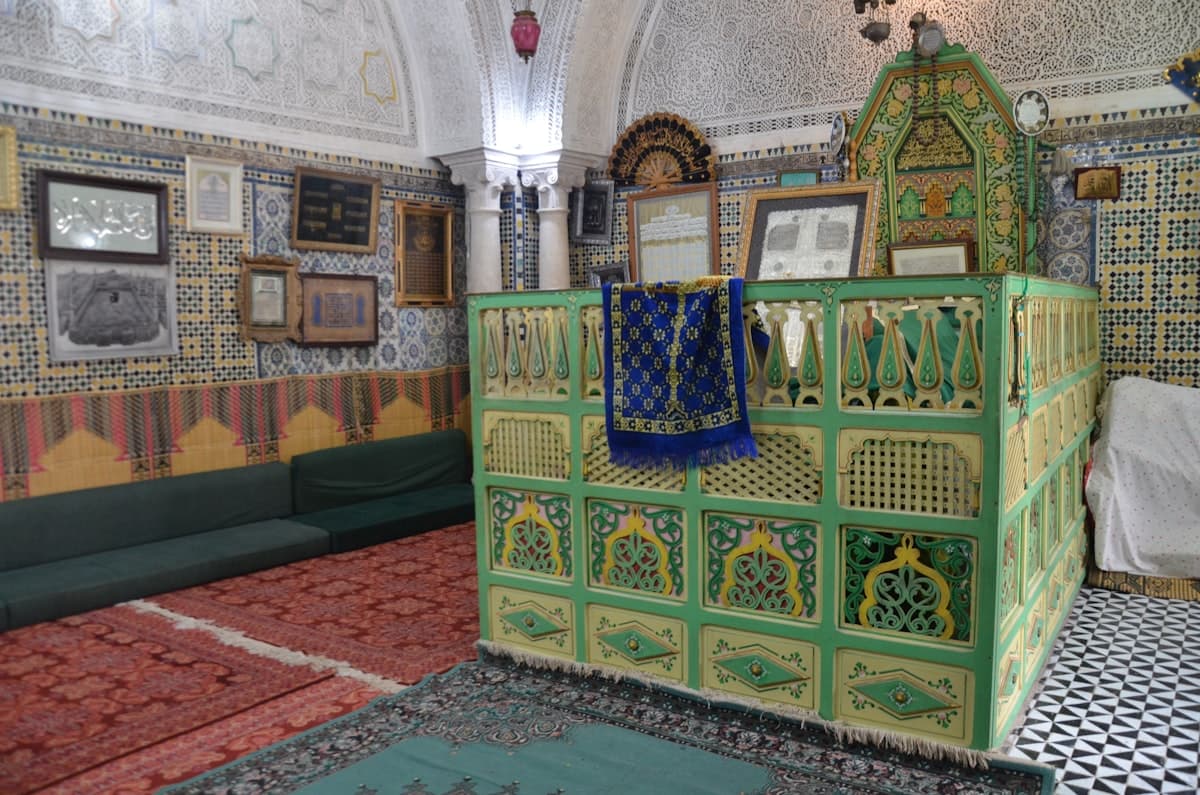
The shrine chamber itself, where al-Dessuqi is buried, is draped in green and gold cloth, hung with votive offerings and certificates from Sufi brotherhoods across Africa and the Arab world. The smell is a compound of rosewater, incense, and the particular mustiness of old stone kept warm by crowds. On Fridays the chamber fills completely, and the recitation of Sufi poetry becomes audible from the courtyard.
One detail most visitors walk past: the walls of the entrance corridor carry framed certificates and letters of affiliation from Burhaniyya lodges in Germany, the United States, and several African countries. The order has been actively present in Europe since the 1970s, with lodges in Hamburg and Vienna that still maintain formal ties to the mother shrine in Dessuq. A thirteenth-century Delta mystic has initiated members in German cities.
The Moulid: Three Times a Year
The word moulid comes from the Arabic for birth, but in Egyptian practice these festivals mark the full spiritual biography of a saint, not just the birthday. Ibrahim al-Dessuqi has three formal moulid celebrations annually, which is unusual. Most Egyptian saints have one. The largest, held in Sha'ban, draws pilgrims who arrive days in advance and sleep in the courtyards and surrounding streets.
The central ritual is the hadra, a Sufi ceremony combining rhythmic chanting, the repetition of divine names, and sometimes physical movement, which in the Burhaniyya tradition can involve deep breathing exercises and controlled swaying. The hadra at Dessuq during moulid runs through the night in multiple locations simultaneously: in the mosque courtyard, in tents erected in surrounding streets, in the lodges of visiting Sufi brotherhoods who set up their own encampments. The sound does not stop between sunset and dawn.
The Egyptian government's Ministry of Religious Endowments manages the logistics of major moulids and provides security and sanitation infrastructure. The moulid at Dessuq is officially recognized and regulated, which means it is neither suppressed nor commercialized in the way a heritage festival might be. It functions as it has functioned for centuries, which is why it remains so legible as a social event. You are watching a city reorganize itself around an act of collective devotion.
One practical note: photography during active dhikr and hadra ceremonies requires sensitivity. The participants are not performing for observers. Ask before pointing a camera at someone in deep spiritual practice. Most people will not object, but many will appreciate being asked.
The Connections
Dessuq sits in Kafr el-Sheikh Governorate, in the western Delta, a region that most Egyptian itineraries ignore completely despite its density of historical significance. Tanta, forty kilometers to the southeast, holds the shrine of Ahmad al-Badawi, another of Egypt's four great Sufi pilgrimage sites. The moulid of al-Badawi in October is one of the largest religious gatherings in Africa, estimated at two to three million attendees. Visiting both shrines in a single Delta circuit gives you a cross-section of Egyptian popular Islam that no museum in Cairo can replicate.
The Delta itself was, in antiquity, the most populated and economically productive part of Egypt. The Pharaonic city of Sais, capital of the 26th Dynasty during the Late Period, stood roughly forty kilometers from where the Dessuq mosque now sits. The Rosetta Stone was found in a fort on the Delta coast. The region's apparent emptiness on modern tourist maps is a recent optical illusion produced by the dominance of Luxor and Aswan in the travel imagination.
The Burhaniyya Sufi order that al-Dessuqi founded expanded aggressively into Sudan during the nineteenth and twentieth centuries. The order is estimated to have between three and six million members in Sudan, making it one of the largest religious organizations in that country. The pilgrims who arrive from Khartoum and Omdurman for the Dessuq moulid are maintaining a connection that is now older than most nation-states.
Common Mistakes
Arriving without understanding the calendar. The shrine is accessible year-round, but if your dates overlap with moulid season and you have not planned for crowds, accommodation, and noise, the experience will feel chaotic rather than illuminating. Conversely, if you deliberately want the moulid and arrive on the wrong week, you will find a quiet provincial mosque. Check the Islamic lunar calendar for the month of Sha'ban and coordinate accordingly.
Treating the shrine as a photography assignment. The Dessuq shrine is a functioning sacred space with a continuous population of pilgrims in states of genuine religious engagement. Coming with a camera as your primary tool will close doors that would otherwise be open. Come as an observer first. The photographs will be better for it.
Skipping the surrounding streets. The blocks immediately around the shrine contain sellers of Sufi books, amulets, votive candles, and the green banners used in hadra ceremonies. These are not tourist shops. They are supply chains for a living ritual tradition. The conversation in these shops, if you speak Arabic, will tell you more about how the order functions globally than any academic text.
Combining with the wrong itinerary. Dessuq does not pair well with Luxor as a single-day addition. It pairs well with Tanta, with a Delta agricultural landscape drive, or with Alexandria as a two-day northern Egypt circuit. The mental register required for a Sufi shrine and the mental register required for Pharaonic monuments are different, and trying to do both in a single day flattens both experiences.
Paying for a local guide who specializes in Pharaonic sites. Guides certified for Luxor or Cairo's Islamic heritage often have limited knowledge of Sufi practice and Delta religious culture. If you want interpretive context here, find a local contact through the mosque administration or visit with someone who has prior knowledge of the Burhaniyya tradition.
The sound and light show in nearby Rashid (Rosetta): If you are doing a northern Delta loop, you may encounter suggestions to attend evening heritage events at some restored sites. They are not worth the detour time or cost. The Dessuq shrine on a Friday night, with the Quran recitation drifting across the courtyard, is the actual experience. Prioritize accordingly.
Assuming non-Muslims cannot enter. Non-Muslim visitors are welcome in the mosque and courtyard of the Dessuq shrine. There is no formal prohibition. Modest dress is required: covered shoulders and legs for everyone, headscarves for women inside the prayer hall. The same rules that apply to any Egyptian mosque apply here.
Practical Tips
Dessuq has limited mid-range accommodation. If you want more options, base yourself in Tanta or Kafr el-Sheikh city and take a microbus on the day. The road between Tanta and Dessuq is well-serviced and the ride takes forty-five minutes to an hour depending on connections.
Friday mornings are the best time for a non-moulid visit. The post-Friday-prayer crowd is large but not overwhelming, the shrine atmosphere is at its most active, and the street life around the mosque is fully operational.
Dress conservatively regardless of season. The Delta in summer is humid and hot, reaching 35 degrees Celsius regularly, but linen trousers and a light long-sleeved shirt are manageable and appropriate. Women should carry a scarf at all times.
Bring cash. Dessuq has ATMs but not reliably in English-interface machines. Withdraw before leaving Tanta or Cairo.
If you read Arabic, the bookshops near the shrine sell texts on Sufi practice and biographies of al-Dessuqi that are not available in translation. Even a rough Arabic reading ability will get you through the pamphlets distributed free inside the mosque, which give a condensed version of the saint's biography and the order's principles.
The Egyptian train network does not serve Dessuq directly. Bus and microbus are the practical options. The Tanta to Dessuq microbus departs from Tanta's main microbus station and costs EGP 15 to 20. Tell the driver or the station staff you want the shrine, and they will know the stop.
Frequently Asked Questions
The Weekly Dispatch
More on Egypt, every Friday.
Cultural depth and places most guides never mention.
No spam. Unsubscribe anytime.