Sultan Hassan Mosque Guide: Cairo's Most Ambitious Building
Built by a sultan who was murdered before its completion, Sultan Hassan Mosque is Cairo's most ambitious medieval structure. Here's what it actually means.
Quick Facts
- Best time to visit
- October through March for cooler temperatures and better light quality on the stone. Arrive before 9am any day to beat tour groups.
- Entrance fee
- EGP 300 (approx $6 USD) for foreign visitors, EGP 150 for foreign students with ISIC card. Ticket includes entry to adjacent Al-Rifa'i Mosque.
- Opening hours
- Daily 8am to 5pm. Friday midday prayer may restrict access to the main prayer hall from approximately 11:30am to 1:30pm.
- How to get there
- Metro to Sadat station, then Uber (EGP 40 to 60) or microbus from Midan Ataba (EGP 5 to 8) to Midan Salah al-Din. Mosque is at the foot of the Citadel hill, a seven-minute walk from the Citadel main gate.
- Time needed
- 1 to 2 hours for Sultan Hassan alone. Half-day of 4 to 5 hours if combining with Al-Rifa'i Mosque and the Citadel complex.
- Cost range
- Under EGP 400 total for transport and entry from central Cairo. Budget EGP 600 to 900 for a half-day including Sultan Hassan, Al-Rifa'i, transport, and a meal in Khalifa.
The man who commissioned the largest mosque in the medieval Islamic world never saw it finished. Sultan Hassan ibn Muhammad ibn Qalawun was assassinated in 1361, two years before the minarets were complete, and the mosque that bears his name was subsequently looted, stripped of its bronze doors by a rival Mamluk, and converted into a military stronghold during at least two separate sieges of the Citadel across the valley. The building that stands today in the shadow of the Citadel in Cairo's Khalifa district is not a monument to piety. It is a monument to what happens when a medieval ruler commands 100,000 square feet of stone be raised in tribute to his own era, then gets removed from history before the scaffolding comes down.
Most visitors to the Sultan Hassan Mosque guide themselves through in under an hour. They photograph the entrance portal, admire the courtyard, and leave. This guide is for the people who want to understand what they are actually standing inside.
Quick Facts
Entrance fee: EGP 300 for foreign visitors (approximately $6 USD), EGP 150 for foreign students with valid ISIC card. Egyptian nationals pay EGP 20.
Opening hours: Daily 8am to 5pm. Friday prayers can temporarily restrict access to the main prayer hall between approximately 11:30am and 1:30pm. Confirm locally as hours shift seasonally.
Best time to visit: October through March, when the heat is manageable and the light on the stone facade has real warmth without the white-out glare of July. Arrive before 9am to have the courtyard largely to yourself.
How to get there: The mosque sits on Midan Salah al-Din at the foot of the Citadel. From Downtown Cairo, take the metro to Sadat station (Line 1 or 2), then a microbus or Uber south toward the Citadel. Uber from Sadat station runs roughly EGP 40 to 60. A microbus from Midan Ataba to the Citadel area costs EGP 5 to 8. Walking from the Citadel entrance gate takes about seven minutes downhill.
Time needed: One to two hours for the mosque alone. Half a day if you combine it with the adjacent Al-Rifa'i Mosque and the Citadel complex above.
Cost range: The mosque itself is accessible for under EGP 400 total including transport from central Cairo. Budget EGP 600 to 900 for a half-day combining Sultan Hassan, Al-Rifa'i, and a meal in the Khalifa neighborhood.
Why This Place Matters
Sultan Hassan was built between 1356 and 1363 during one of the most catastrophic demographic events in recorded history. The Black Death had already killed somewhere between a third and half of Egypt's population by the time construction began. Hassan's reign over Mamluk Egypt was interrupted three times by coups and rivals before he regained the sultanate long enough to commission this building. The architects who designed it reportedly used the depopulated city around them as a source of building material: stone from abandoned houses, possibly granite from older Pharaonic monuments already incorporated into earlier Islamic structures.
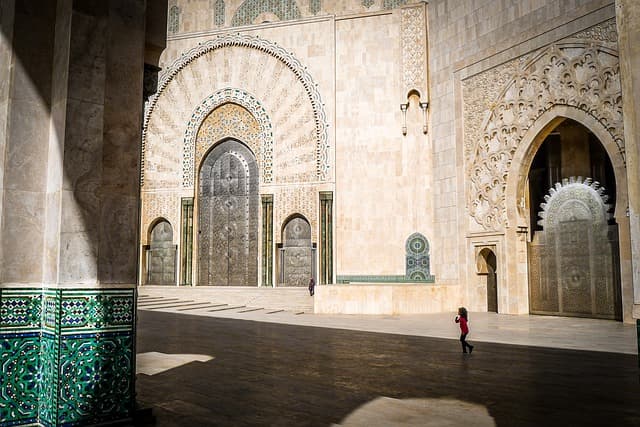
The result was a building at a scale that medieval Cairo had not seen and would not see again. Its entrance portal, at around 38 meters high, is still among the tallest in Islamic architecture. Its four-iwan plan, borrowed from Seljuk Persian tradition and adapted to a specifically Egyptian Sunni context, was designed to function simultaneously as a congregational mosque, a madrasa teaching all four schools of Sunni Islamic law, a mausoleum for the sultan himself, and a neighborhood social institution. This was not unusual in Mamluk Cairo. What was unusual was the size.
Hassan never occupied his own mausoleum. His body was never found after his assassination, likely disposed of to prevent his tomb from becoming a political rallying point. The massive domed chamber behind the qibla wall stands empty of its intended occupant. Two of his sons are buried there instead.
What You Actually See Inside
The entrance corridor is your first indication that this building was designed to make a specific psychological argument. You enter through the portal on the south facade, walk through a bent passageway that cuts off all exterior sound and light within about ten steps, and emerge into a corridor that redirects you twice before delivering you into the courtyard. This was intentional. The transition from the noise of medieval (and modern) Cairo to the interior was meant to feel like crossing a threshold into a different order of reality.
The courtyard is cruciform, organized around a central marble ablution fountain whose wooden kiosk is a later Ottoman addition but sits appropriately enough given the centuries of continuous use. The four iwans, the large vaulted recesses opening off each arm of the cross, are each dedicated to one of the four madhhabs: Hanafi, Maliki, Shafi'i, and Hanbali. Each iwan originally had its own students, teachers, and endowment. The logistical complexity of running a functional university inside a working mosque inside a sultan's mausoleum complex required an administrative infrastructure that would have occupied dozens of full-time staff.
The Qibla Iwan and the Missing Doors
The prayer hall, or qibla iwan, is the largest of the four and faces Mecca. Its mihrab, the niche indicating the direction of prayer, is inlaid with marble in geometric patterns that reward close looking. The marble dado around the lower walls of the entire mosque is similarly precise. Look at the geometric interlocking at the corners. Mamluk craftsmen solving three-dimensional pattern problems in stone, without computers, in the fourteenth century.
The bronze doors that once hung at the entrance to this iwan were removed in the late fourteenth century by Sultan Muayyad Sheikh, who wanted them for his own mosque near Bab Zuweila. They are still there. If you visit the Al-Muayyad Mosque, which you should, you will see Sultan Hassan's doors hanging at the entrance of someone else's building. This kind of architectural cannibalism was standard practice in medieval Cairo, and it is one reason why no single Islamic monument in the city can be understood in isolation.
The Mausoleum Dome
Access to the domed mausoleum chamber is through a door to the right of the qibla iwan. The dome itself, rebuilt after partial collapse, rises above a zone of transition decorated with muqarnas, the honeycomb stalactite vaulting that is one of Islamic architecture's most technically demanding ornamental forms. Natural light enters through windows in the drum of the dome and falls differently at different hours. At around 10am on a clear morning in winter, there is a quality of diffuse gold light in that chamber that has nothing to do with tourism and everything to do with the original builders understanding exactly how their building would be used.
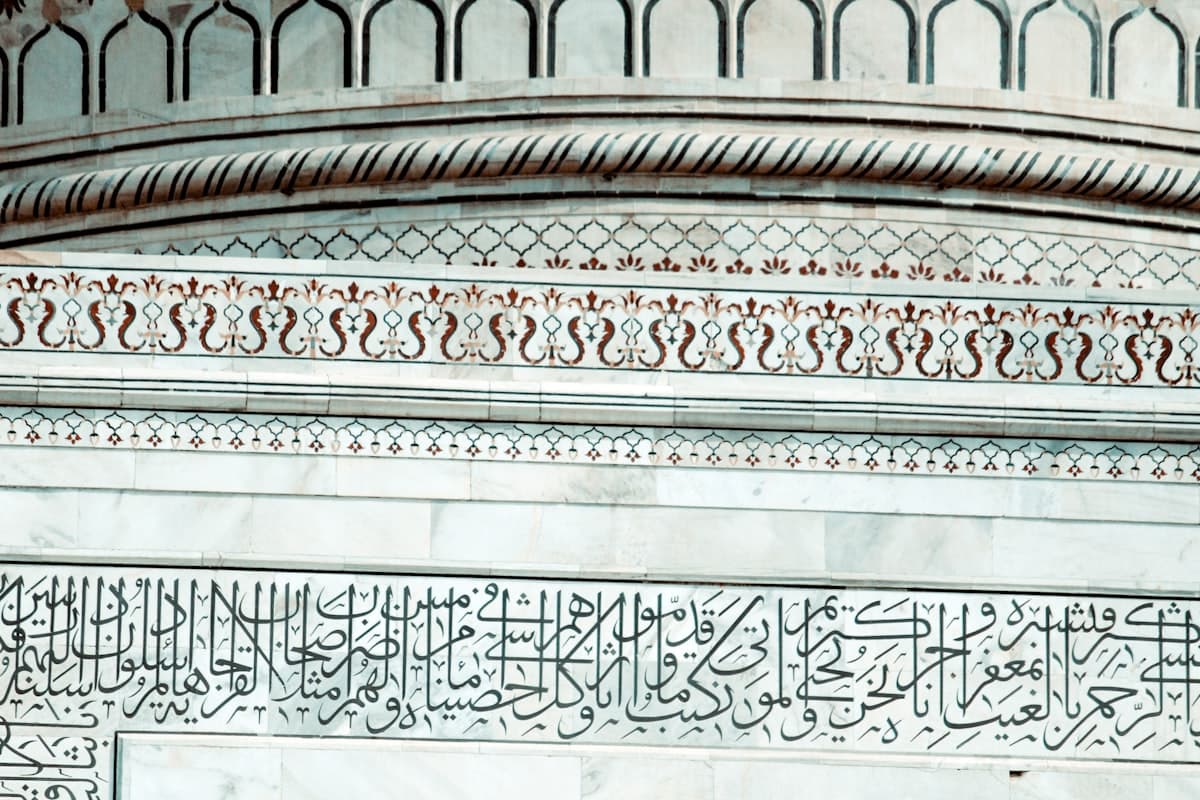
The Quran inscriptions running in bands around the walls of the mausoleum are from Sura Ya-Sin, recited for the dead. The calligraphy is Mamluk thuluth script, and whoever executed it understood that the text would be read from below by people standing in a specific emotional state. The scale of the letters accounts for this viewing distance in a way that feels contemporary even now.
The Connections
Standing at the mausoleum entrance and looking up at the Citadel is a useful exercise in layered Egyptian history. The Citadel was built by Saladin (Salah al-Din al-Ayyubi) in the twelfth century using labor partly drawn from Crusader prisoners, on a spur of the Muqattam Hills that the Fatimid caliphs before him had used as a military observation point, above a city whose street grid still partially follows Pharaonic and Roman-era patterns. Sultan Hassan's mosque is positioned in direct sightline of the Citadel's main gate, which was almost certainly deliberate: this was a sultan announcing his power to anyone looking down from the seat of government.
The Al-Rifa'i Mosque immediately adjacent was built in the late nineteenth and early twentieth century by Khedive Ismail's mother, Princess Khushyar, partly to provide a burial place for the Egyptian royal family and partly to visually complete the medieval streetscape in a way that would impress European visitors. It contains the tombs of King Farouk, the last Egyptian monarch, and Mohammad Reza Shah Pahlavi of Iran, who died in Cairo in 1980 after being refused entry everywhere else. The juxtaposition of a fourteenth-century Mamluk mausoleum with a deposed Persian shah's grave fifty meters away is not a coincidence you will find in most guidebooks.
The neighborhood below both mosques, the Khalifa district, sits over medieval cemeteries that extend south into the City of the Dead, where hundreds of thousands of Cairenes still live among the tombs. The land beneath your feet in this part of Cairo has been consecrated ground, in various religious traditions, for close to two thousand years.
Common Mistakes
Arriving midday in summer. The courtyard is open to the sky and in July becomes genuinely punishing between 11am and 3pm. The stone reflects heat. Bring water regardless of season.
Skipping the side chambers off the main corridor. The four madrasa units opening off the entrance passage contain some of the most intact residential and teaching architecture in medieval Cairo. Most visitors walk past them entirely. Each iwan has subsidiary rooms behind it that were student cells and teaching halls. They are mostly accessible and mostly ignored.
Treating Al-Rifa'i as an afterthought. The combined ticket for Sultan Hassan includes entry to Al-Rifa'i. The two buildings are best understood as a pair, separated by five centuries of history and facing each other across a courtyard that functions as a kind of open-air museum of Egyptian dynastic ambition. Spend at least twenty minutes in Al-Rifa'i.
Missing the exterior at street level. The facade facing Midan Salah al-Din is one of the most sophisticated pieces of Mamluk stone carving in Cairo. The muqarnas hood of the entrance portal, the keel-arched windows along the lower section, and the chess-rook crenellations along the roofline are all worth examining before you go inside.
Arriving during Friday midday prayer without checking times. The mosque is an active place of worship. Friday prayer will restrict tourist access to the prayer hall for ninety minutes to two hours starting around noon. This is not a problem if you plan for it, and a significant inconvenience if you don't.
Ignoring the minaret asymmetry. Sultan Hassan was designed with four minarets, one over each corner of the mausoleum dome. Only two were built. One of the completed minarets partially collapsed in 1360, killing dozens of people gathered below for a prayer service. The sultan had it rebuilt. The missing two minarets are a reminder that even Cairo's most ambitious medieval project was subject to physics, budget, and time.
Not looking up in the entrance passage. The transition corridor has vaulted muqarnas ceilings that most people walk under without raising their eyes. They are extraordinary.
Practical Tips
Dress conservatively. Women should cover shoulders and knees; scarves are available at the entrance for a small fee but bringing your own is easier. Men in shorts will be asked to change or wrap around a borrowed fabric. This is an active mosque, not a museum, and the staff are polite but consistent about this.
The mosque is included on the standard Egyptian Museum tourist circuit, which means tour groups arrive in waves between 9am and 11am. The 8am opening gives you the best chance of an uncrowded first hour. By 11am on any day between October and April, you will be sharing the courtyard with multiple groups.
There is no official audio guide system at Sultan Hassan. Hire a licensed Egyptologist guide through your hotel or through a Cairo-based agency rather than accepting offers from individuals at the gate. The difference in quality is significant, and context matters enormously in a building this layered.
The combined Sultan Hassan and Al-Rifa'i visit works well as a morning half-day, followed by lunch in the Khalifa district before walking north through the medieval city toward Bab Zuweila and the Khan al-Khalili area. This route takes you through a continuous, mostly intact stretch of medieval Cairo that covers about 1.5 kilometers and seven centuries of building history without any gaps.
Frequently Asked Questions
The Weekly Dispatch
More on Egypt, every Friday.
Cultural depth and places most guides never mention.
No spam. Unsubscribe anytime.