The Hanging Church Cairo: A Coptic Guide Worth Reading
The Hanging Church isn't suspended in air. It's suspended in time, built over a Roman gatehouse in Coptic Cairo. Here's what that actually means.
Quick Facts
- Best time to visit
- October to March for comfortable temperatures and good morning light; weekday mornings for minimal crowds
- Entrance fee
- Church free; Coptic Museum EGP 450 (approx $9 USD), students EGP 225
- Opening hours
- Daily 9am to 5pm; closed during Friday and Sunday morning services approx 8am to 11am
- How to get there
- Metro Line 1 to Mar Girgis (EGP 10); taxi from downtown EGP 50 to 80
- Time needed
- 90 minutes minimum for church; 4 to 5 hours for full Coptic compound including museum and synagogue
- Cost range
- Budget EGP 500 to 700 including transport, museum entry, and lunch; mid-range EGP 1,200 to 2,000 with licensed guide
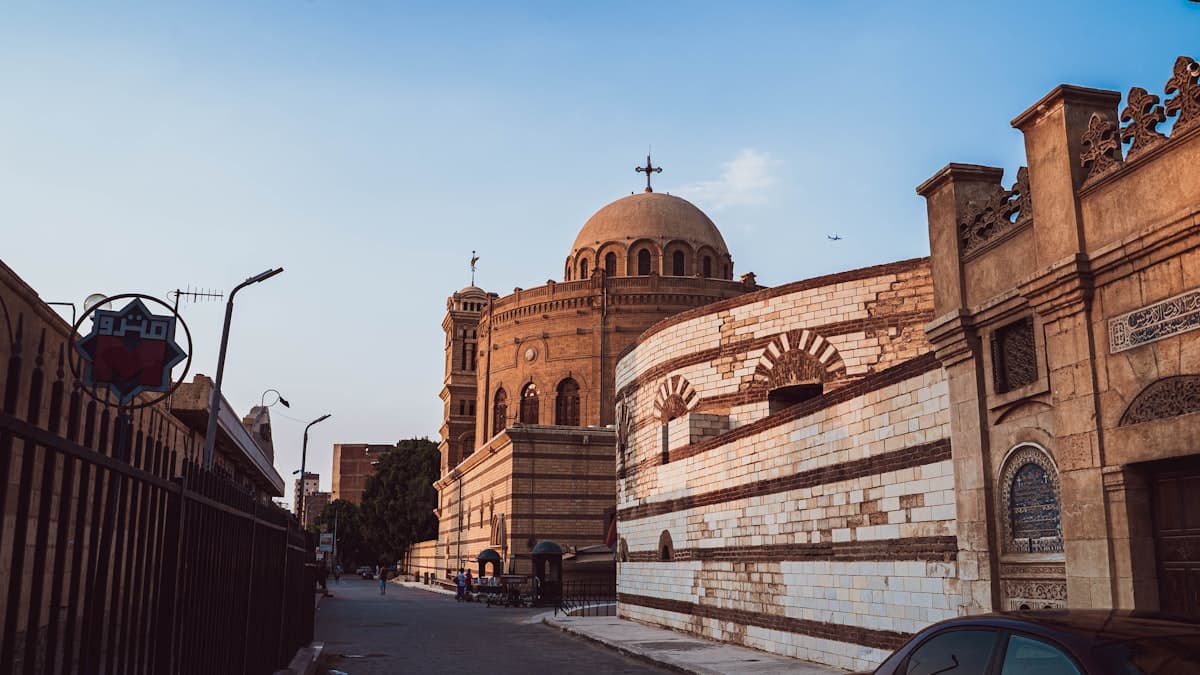
The church does not hang. Not literally. What you're standing on when you enter the Hanging Church, officially named Saint Virgin Mary's Coptic Orthodox Church, is a nave suspended over two towers of a Roman fortress gatehouse built in the third century AD. The Romans called the fortress Babylon. The Copts built their church on top of it sometime in the seventh century, possibly earlier. The wooden floor beneath your feet is, depending on where you step, twenty to thirty feet above the original Roman pavement. That's what hanging means here: a Christian community literally elevated itself over the ruins of imperial power and worshipped for fourteen centuries in that position.
Most visitors come to Coptic Cairo because it's on the list. They photograph the narrow lane, note that everything is very old, and leave within forty minutes. This guide is for the ones who want to understand what they're looking at.
Quick Facts
Best time to visit: October through March, when the heat is manageable and the light through the upper windows is extraordinary between 9am and 11am. Avoid Coptic Christmas (January 7) and Easter unless you specifically want to witness a liturgical service, which requires patience and appropriate dress.
Entrance fee: Free for the church itself. The Coptic Museum next door charges EGP 450 for non-Egyptian adults (approximately $9 USD at current rates), EGP 225 for students with valid ID. The museum is not optional if you want context.
Opening hours: Daily 9am to 5pm. Friday and Sunday mornings the church closes during services, typically from 8am to 11am. Come early on weekdays.
How to get there: The Mar Girgis metro station on Line 1 (the red line) deposits you at the entrance to the Coptic compound. A metro ticket costs EGP 10. A taxi from Downtown Cairo runs EGP 50 to 80 depending on traffic and your negotiating. Don't take a taxi that offers to wait: the Coptic quarter rewards wandering, not scheduling.
Time needed: Two hours minimum for the Hanging Church alone if you read the inscriptions. Four hours if you add the Coptic Museum. A full morning if you include Ben Ezra Synagogue, the Church of St. Sergius and Bacchus, and the Church of St. Barbara, all within walking distance.
Cost range: The Coptic quarter itself costs almost nothing. Budget EGP 500 to 700 for entrance fees, a good lunch nearby, and transport. Mid-range EGP 1,200 to 2,000 if you add a licensed guide, which for this site is genuinely worth it.
Why This Place Matters
The Hanging Church Cairo Coptic guide industry tends to start with the church and stop there. That's the wrong frame. To understand the church, you need to understand the compound it sits within, and to understand the compound, you need to understand what Egypt was in the first centuries of Christianity.
Egypt was not a late convert. Alexandria, the city where I was born and where I spent my first eight years watching the Mediterranean, was arguably the most intellectually sophisticated Christian community in the ancient world. The Catechetical School of Alexandria, founded around 190 AD, produced theologians who shaped doctrine that billions of people still follow. The Coptic church traces its founding to Mark the Evangelist, traditionally believed to have arrived in Alexandria around 42 AD, making it one of the oldest continuously practicing Christian communities on earth.
The fortress at Babylon, built by Emperor Diocletian to control river traffic and tax the grain supply, became the seed of what is now Coptic Cairo. When the Arab general Amr ibn al-As conquered Egypt in 641 AD, he camped outside Babylon rather than sack it. He found a working Christian city within the Roman walls and largely left it functioning. The Hanging Church, in this context, is not a relic of a defeated civilization. It is evidence of a negotiated survival across three empires, Roman, Byzantine, and Islamic, over more than a thousand years.
The church received its current form largely in the seventh century, with major restorations in the tenth and eleventh centuries. Twenty-three patriarchs of the Coptic church were consecrated here. The seat of the Coptic patriarchate remained in the Hanging Church from the fourth to the eleventh century, before moving to Alexandria and eventually to Cairo's Abbasiya district. If you are standing in the nave and feel the weight of institutional continuity pressing down on you from the ceiling, that's not imagination. That's fourteen centuries of governance, faith, and survival condensed into painted wood and Nubian sandstone.
What You Will Actually See
The entrance is up a staircase of twenty-nine steps, which is the first architectural signal that you're entering something that was built to be above something else. At the top, a vestibule gives way to the nave, and the nave will probably surprise you. It is not dark and cave-like. The upper windows admit a particular quality of Egyptian morning light, diffuse and warm, that makes the icons glow rather than flicker.
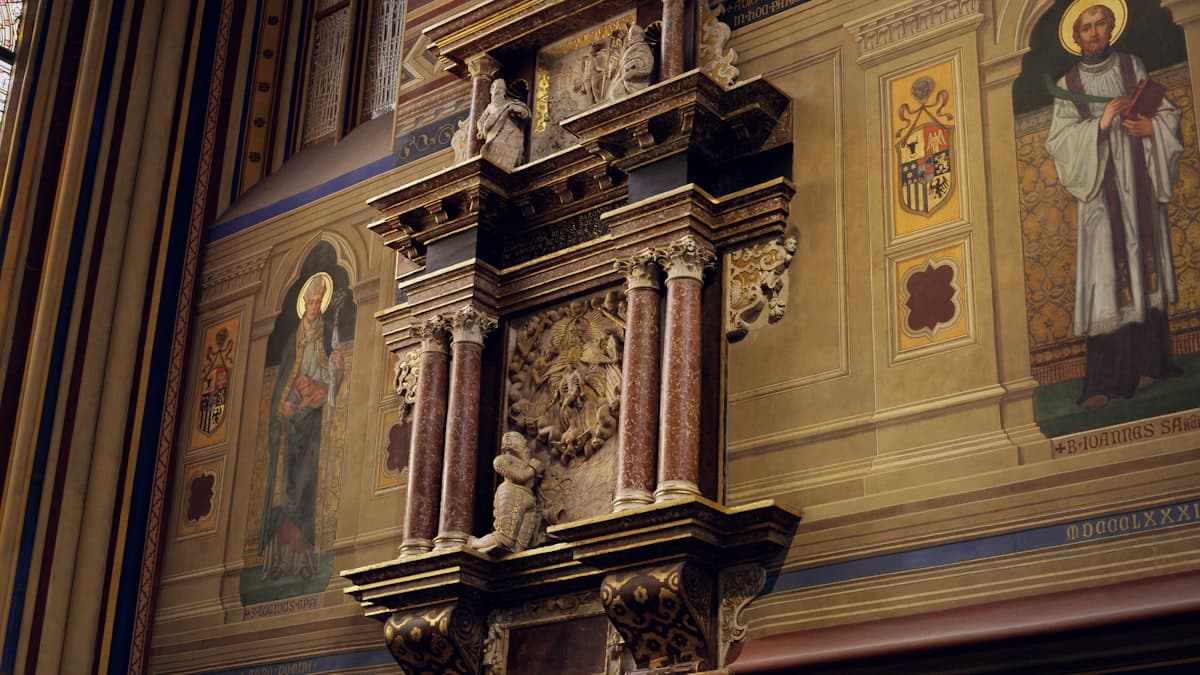
The church is divided into three aisles by columns topped with alternating black and white marble capitals. These columns were not made for this church. Look at them carefully. They were salvaged, likely from earlier Roman or pharaonic structures, a practice so common in late antique and early medieval Egypt that archaeologists have a word for it: spolia. The church is, literally and materially, assembled from the ruins of other civilizations.
The pulpit is the thing that stops most people, when they actually stop. It stands on fifteen columns representing Christ and his apostles, though the Judas column, by tradition, is slightly shorter than the others. The pulpit dates to the eleventh century and is made from white marble with inlaid panels of dark stone forming geometric patterns that will remind you, if you've spent time in Islamic Cairo, of the decorative vocabulary developing simultaneously in Fatimid mosques half a kilometer away. These two artistic traditions were not sealed from each other. They were in conversation.
The iconostasis, the wooden screen separating the nave from the sanctuary, dates to the twelfth and thirteenth centuries and is inlaid with ivory crosses. Behind it, three sanctuaries correspond to different dedications. The central sanctuary honors the Virgin Mary. The right sanctuary honors John the Baptist. The left is dedicated to St. George, which in Egypt means something specific: St. George was adopted by both Copts and Muslims as a protective figure, and his feast is observed in some form in both communities.
The Icons Nobody Reads
The church contains icons spanning the sixth through nineteenth centuries, and most visitors walk past them as decoration. That's a significant loss. The oldest icons here, some painted on wood in the encaustic technique used before the advent of tempera, represent a direct continuity with the portrait tradition of Roman Egypt. If you have seen the Fayum mummy portraits, those extraordinary Roman-era burial paintings discovered in the Fayum oasis, you are looking at the stylistic ancestors of the oldest Coptic icons. The large eyes, the frontal gaze, the gold ground: these are not Byzantine imports. They evolved in Egypt from Roman funerary art into Christian devotional art over three centuries.
There is an icon of the Virgin and Child here that some scholars date to the sixth century. If that attribution holds, it is among the oldest surviving Christian icons in the world in continuous liturgical use. It is hung in a side chapel that most visitors walk through without pausing.
The Connections
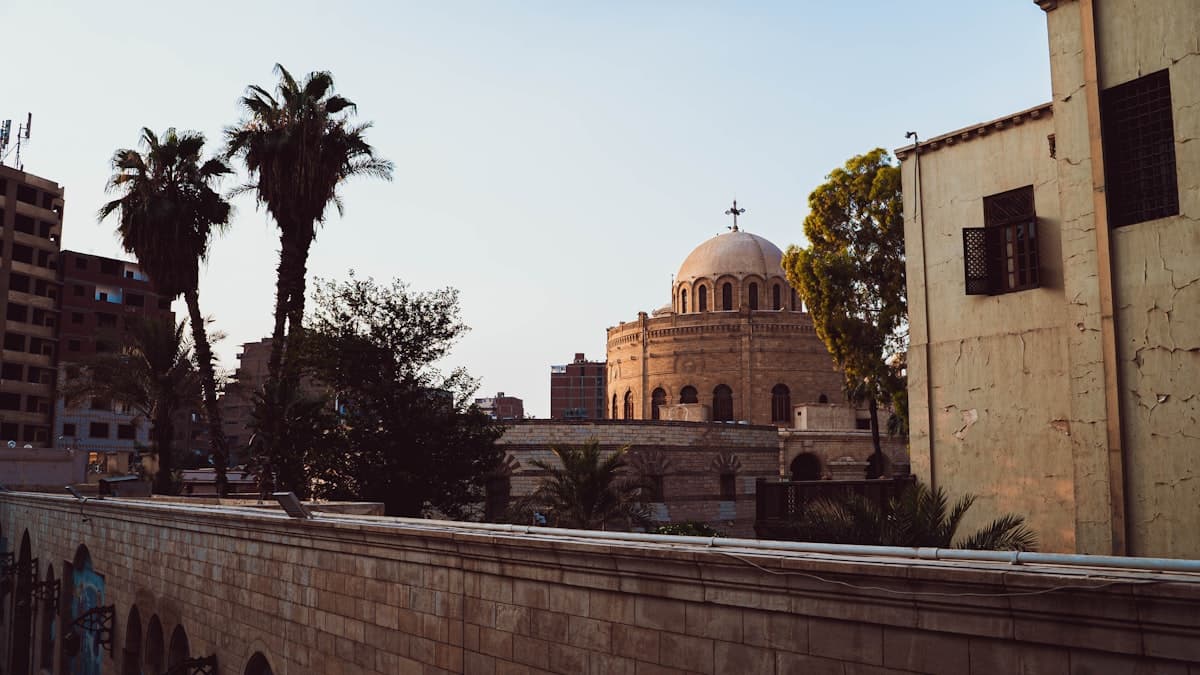
Coptic Cairo sits above a Roman fortress. The Roman fortress was built, in part, using stone quarried from earlier pharaonic structures along the Nile. When Amr ibn al-As established his new Islamic capital, Fustat, immediately north of the fortress in 641 AD, he did not destroy what was inside the walls. He absorbed it. The oldest mosque in Africa, the Mosque of Amr ibn al-As, sits less than 400 meters from the Hanging Church. On a still morning, the Coptic bells and the Islamic call to prayer have overlapped in this small pocket of Old Cairo for thirteen centuries.
The Ben Ezra Synagogue, a five-minute walk from the Hanging Church, adds another layer. It was originally a Coptic church sold to the Jewish community in the ninth century. In its geniza, the room used to store worn-out sacred texts, a collection of 300,000 manuscript fragments was discovered in the nineteenth century, now known as the Cairo Geniza. Those fragments, currently held in Cambridge, New York, and elsewhere, document the social, commercial, and religious life of medieval Jewish communities across the Mediterranean and Middle East. The room that held them is accessible and unremarkable. The documents that came from it rewrote medieval history.
The Coptic Museum, which you should treat as part of the same visit, holds textiles, manuscripts, and carved stonework that bridge the pharaonic and Christian periods directly. There is a frieze in the museum showing the god Horus as a child being suckled by the goddess Isis, carved in the second century AD. Directly beside it hangs a third-century Coptic textile showing the Virgin nursing the infant Christ in an almost identical compositional arrangement. This was not plagiarism. It was continuity: a community reaching for familiar visual language to express a new theological content.
Common Mistakes
Arriving at the wrong time on a Sunday. Sunday services run late into the morning, and the nave is closed to tourists during liturgy. The crowd outside can be large, the wait unpredictable. Come on a Tuesday or Wednesday if you want the place to yourself.
Skipping the Coptic Museum. The church makes far more sense with the museum's context behind you. Do the museum first, then the church, not the reverse.
Mistaking the tourist entrance for the full site. The narrow lane running through the Coptic compound connects multiple churches, a convent, a synagogue, and the museum. Many visitors enter, see the Hanging Church, and exit the same way without realizing the compound extends in both directions.
Photographing during prayer. Services happen throughout the day, not just on Sunday mornings. If you hear chanting and see worshippers seated, put the camera down. This is an active parish, not a heritage site in the European sense.
Assuming the souvenirs are authentic. The shops lining the approach to the compound sell Coptic cross pendants, icons, and papyrus prints. The papyrus is almost certainly banana leaf. The icons are mass-produced in China. If you want a genuinely hand-painted Coptic icon, ask at the church office about local artisans or visit the icon painting school in Old Cairo.
Not looking at the floor. The wooden floor over the Roman gatehouse is original in sections. There are glass panels in the nave floor revealing the Roman structure below. Most visitors walk over them without looking down.
Treating it as a half-hour stop. The Hanging Church Coptic Cairo experience cannot be meaningfully experienced in less than ninety minutes. If your itinerary has this as a forty-minute stop before the Egyptian Museum, you are not visiting the church. You are visiting the idea of it.
Practical Tips
Dress covers shoulders and knees, non-negotiably. Scarves are available at the entrance but they're uncomfortable and unnecessary if you plan ahead. Women do not need to cover their hair inside Coptic churches, which sometimes surprises visitors accustomed to mosque visits.
A licensed Egyptologist guide with Coptic specialization changes the visit entirely. The Egyptian Tourist Authority maintains a register of licensed guides; rates for a half-day private tour run EGP 800 to 1,500, and the investment is significant for a site this layered. Ask specifically for someone with Coptic expertise, not just general Cairo experience.
The Mar Girgis metro is the correct approach. Surface traffic around Old Cairo is genuinely terrible, and parking is nearly impossible. The metro drops you at the compound entrance in under twenty minutes from Tahrir Square.
Bring water. The compound has no reliable cafe, and the heat inside the stone lanes is real from April through October. The coffee from the small kiosk near the museum entrance is drinkable but not worth a special trip.
If you visit on Coptic Christmas (January 7) or Easter (date varies by the Coptic calendar), expect services running for hours, large crowds of Egyptian families, and a genuinely different atmosphere. This is worth experiencing once, but not for a first visit when you're trying to understand the architecture and history. Come back for the feast after you've understood the church in quiet.
Frequently Asked Questions
The Weekly Dispatch
More on Egypt, every Friday.
Cultural depth and places most guides never mention.
No spam. Unsubscribe anytime.