Wadi Natrun Monasteries Guide: Egypt's Living Desert Faith
Four working monasteries in the Western Desert have outlasted empires, invasions, and centuries of silence. Your complete Wadi Natrun monasteries guide.
Quick Facts
- Best time to visit
- October to March. Winter temperatures in the valley are comfortable and the desert light is clear. Summer temperatures regularly exceed 40°C with minimal shade at any of the monasteries.
- Entrance fee
- Free entry to all four monasteries. Donations are welcomed. Deir Abu Makar requires advance permission and is not open to casual visitors.
- Opening hours
- Generally Saturday to Thursday, approximately 9am to 5pm. Hours vary by monastery and are subject to Coptic liturgical calendar closures. Confirm by phone before visiting, especially on or near Coptic fasting periods.
- How to get there
- Microbus from Cairo's Turgoman station to Wadi Natrun junction: EGP 35 to 50 (under $2 USD). Local taxi from junction to monasteries and back: EGP 150 to 250 (approx $5 to $8 USD). Private car from Cairo for the day: EGP 1,200 to 1,800 (approx $38 to $58 USD). Drive time from Cairo: approximately 1.5 hours.
- Time needed
- Half day for two monasteries, full day for three or four. Add 30 minutes per monastery if you intend to attend any portion of a prayer service or explore the shops.
- Cost range
- Budget EGP 400 to 600 (microbus plus local taxi plus water and snacks). Mid-range EGP 1,200 to 2,000 with private driver from Cairo and lunch at the highway rest stop.
The monks didn't choose Wadi Natrun for its beauty. They chose it because it was brutal. Fourth-century Christian hermits fled here from Roman persecution and later from the noise of a Roman world that had, ironically, converted to Christianity. The desert was the point. The emptiness was the discipline.
What you find today, roughly 100 kilometers northwest of Cairo on the Alexandria Desert Road, is something rarer than any Pharaonic ruin: four monasteries that have been continuously occupied for roughly 1,600 years. The Library of Alexandria is gone. The great temple complexes are manned by guards and gift shops. But Deir Anba Bishoi, Deir Abu Makar, Deir El-Suryan, and Deir El-Baramos still house working monks who wake before dawn, pray in languages that trace directly back to ancient Egyptian, and grow their own food in the same depression where natron salt was once harvested to mummify pharaohs.
That last point is not a coincidence. The Coptic church preserves a linguistic and spiritual thread that runs unbroken from the ancient Egyptians. The Coptic language, still used in liturgy, is the final form of the ancient Egyptian language, written in Greek script. When a monk at Wadi Natrun chants a psalm, the vowel sounds are closer to what a scribe in the court of Ramesses II spoke than to anything in modern Arabic.
Quick Facts
Best time to visit: October through March, when desert temperatures are manageable. Summer heat can push above 40°C in the valley, and the monasteries have limited shade.
Entrance fees: Free entry to all four monasteries. Donations are welcome and appreciated at each. There are no formal ticket booths.
Opening hours: Generally open Saturday through Thursday, approximately 9am to 5pm, with closures during Coptic fasting periods and religious festivals. Deir Abu Makar requires advance written or phone permission and is often closed to casual visitors. Check before you go.
How to get there: Microbuses from Cairo's Turgoman (Wust El-Balad) bus station run toward Alexandria and can drop you at the Wadi Natrun rest stop on the desert road, roughly EGP 35 to 50 (under $2 USD). From the highway junction, a local taxi to the monasteries costs EGP 150 to 250 (approximately $5 to $8 USD) for a round trip with waiting time. Renting a private car from Cairo for the day runs EGP 1,200 to 1,800 (around $38 to $58 USD) and is far more practical if you want to visit two or three monasteries in one day. There is no reliable public transport that goes directly to the monastery complex.
Time needed: A half day covers two monasteries comfortably. A full day with a patient driver allows you to visit all four, though Deir Abu Makar requires separate arrangement.
Cost range: Budget EGP 400 to 600 for transport and a simple meal. Mid-range EGP 1,200 to 2,000 if hiring a private driver from Cairo with lunch included.
Why This Place Matters
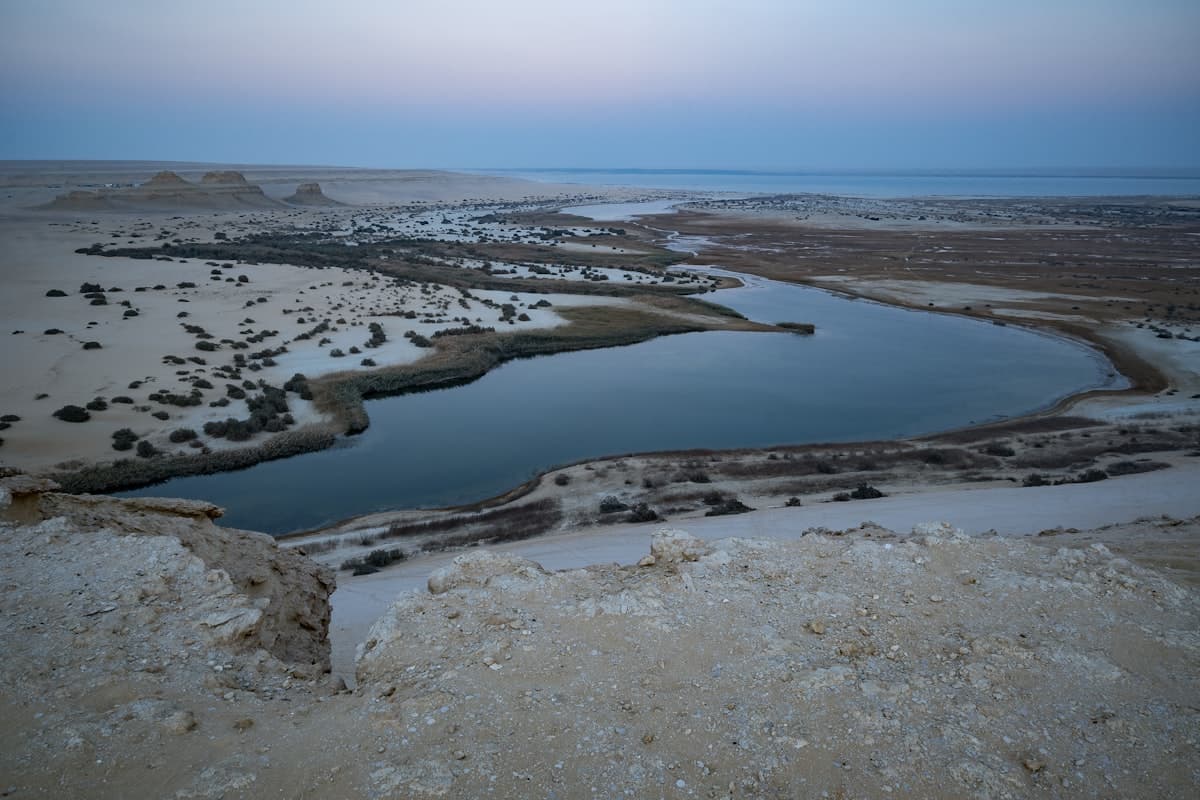
Before there were monasteries here, there was an industry. Wadi Natrun, the Valley of Natron, was ancient Egypt's primary source of natron, the sodium carbonate salt compound that embalmers packed into bodies to desiccate them during mummification. The valley is below sea level, and seasonal lakes deposit mineral-rich salt on their shores. Every mummy you have ever seen in a museum, from Tutankhamun to the nameless priest in the Cairo Museum's animal mummy room, was likely preserved with salt from this valley.
The transition from mummification site to Christian monastery is not as strange as it sounds. The hermits who settled here in the third and fourth centuries were Egyptian. They brought with them Egyptian ideas about death, resurrection, the preservation of the body, and the relationship between the physical and the divine. The Coptic cross, if you look at the looped ankh at its root, makes this continuity visible. Christianity did not replace Egyptian religion here so much as absorb and redirect it.
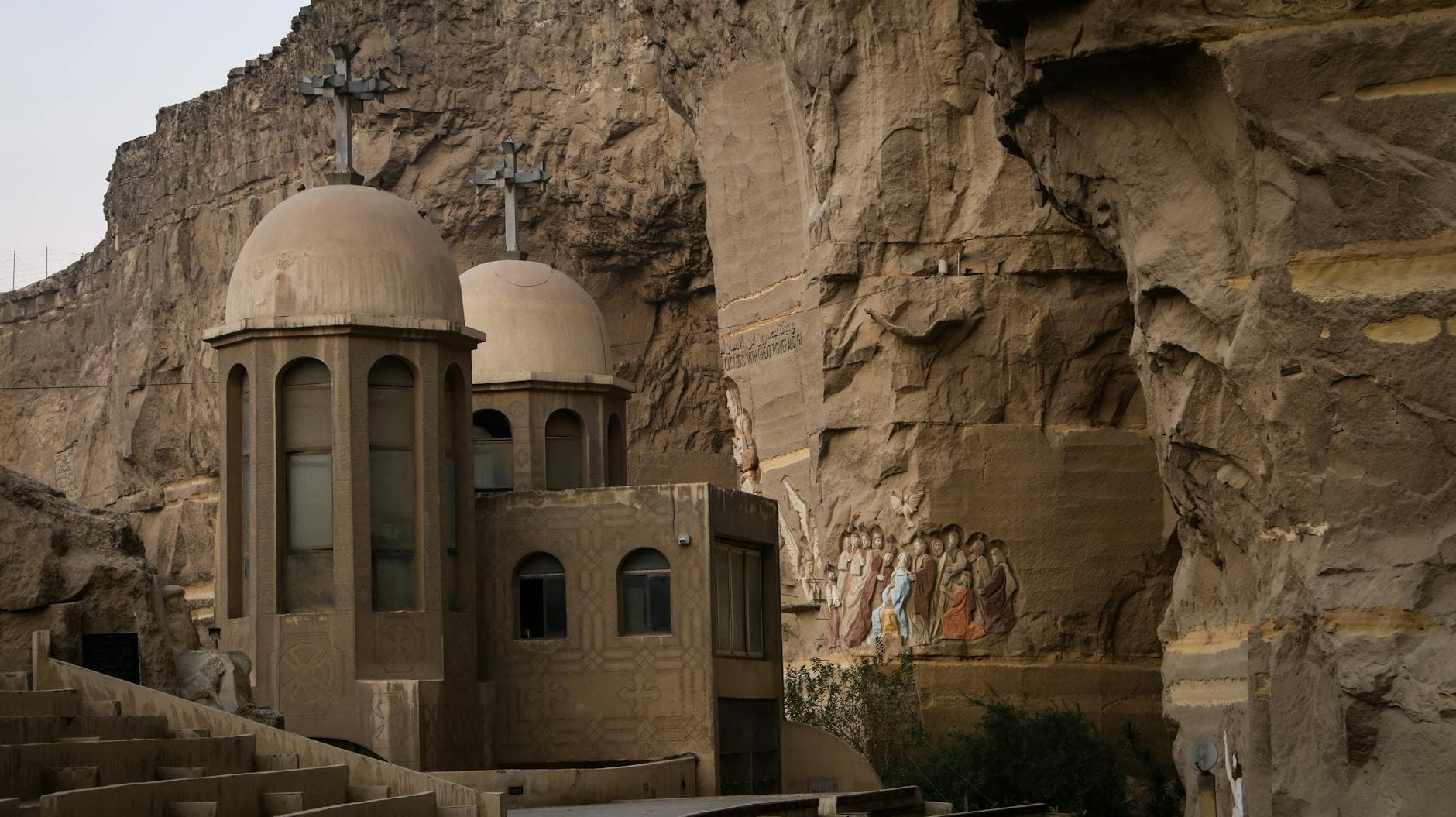
The four monasteries that survive from the original dozens founded in Wadi Natrun do so partly because of geography. The desert protected them from the casual vandal and slowed the advance of invaders. But they also survived because of their institutional intelligence. The Coptic Pope is elected from among the monks of Wadi Natrun. Pope Shenouda III, who led the Coptic church for over 40 years until his death in 2012, was exiled here by Anwar Sadat in 1981, living in his cave-cell at Deir Anba Bishoi while Sadat was assassinated two months later. The monastery kept him; the desert returned him.
What You'll See: The Four Monasteries
Deir Anba Bishoi
This is the most visited monastery and the one where Pope Shenouda III is buried. The tomb is a place of active pilgrimage, often covered in flowers, with Coptic families sitting in quiet prayer around it. The monastery holds what it claims is the body of St. Bishoi himself, the fourth-century monk who founded it, preserved in a wooden casket within the main church. There is also a tradition here that St. Bishoi once washed the feet of Jesus Christ, who appeared to him as a poor pilgrim. The icon depicting this scene appears throughout the church.
The keep tower here, the qasr, is a feature you'll see at all the Wadi Natrun monasteries. These were built from the ninth century onward, after Bedouin raids destroyed much of what the early monks had built. The monks would retreat into the tower, pull up the drawbridge, and wait. The keeps are functional architecture built from desert panic, and they are some of the finest examples of early medieval fortification in North Africa.
Deir El-Suryan
This is the monastery that will stop you. In the sanctuary, there is an inlaid wooden door from the tenth century that is considered one of the finest examples of Coptic craftsmanship in existence. The ivory and ebony panels tell biblical scenes in a visual language that mixes Egyptian, Syrian, and Byzantine influences into something entirely its own.
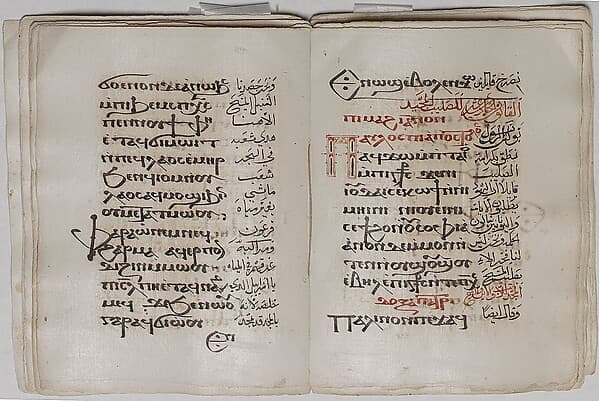
The name translates as the Monastery of the Syrians, because in the eighth century Syrian monks purchased it after the Coptic community temporarily abandoned it. They brought with them manuscripts, among them some of the oldest Syriac texts anywhere in the world. Researchers from the British Library and Cambridge have been working here for years. In 2018, multispectral imaging of the library's manuscripts revealed texts underneath other texts, palimpsests where monks had scraped and reused parchment, leaving ghost layers of lost knowledge. They found portions of a lost text by Galen, the Roman physician, hiding under a Syriac Christian hymnal.
Deir El-Baramos
The oldest of the four, built, according to Coptic tradition, on the site where two Roman princes, Maximus and Dometius, came to the desert to live as hermits under the guidance of the monk St. Macarius in the fourth century. Their father, Emperor Valentinian, reportedly came looking for them and found them nearly dead from fasting. The word Baramos is likely derived from the Coptic for "the Romans."
This monastery is quieter, less touristed, and architecturally more austere. The monks here have a reputation for academic seriousness. The library holds Coptic manuscripts that date to the ninth century. The atmosphere is different from Bishoi, less crowded, more internally focused. If you want to understand what the early monastic impulse actually felt like, this is the monastery to sit in.
Deir Abu Makar
The most restricted and in many ways the most significant. Forty-nine of the Coptic popes are buried here, a line of institutional memory that stretches from the fifth century to the present. Visiting requires advance permission, usually arranged by letter or through a Coptic contact, and access is not guaranteed. If you have connections within the Coptic community, use them. The monastery has been the political heart of Egyptian Christianity for more than fifteen centuries.
The Connections
The Wadi Natrun monasteries sit in a web of relationships that spans Egyptian history in ways that most visitors never consider.
The natron harvested from these lakes was traded throughout the ancient Mediterranean, not just for mummification but for glassmaking, textile processing, and medicine. Roman merchants knew this valley. Jewish merchants from Alexandria knew it. The caravans that moved salt from the depression also moved information, and the early monks who settled here were not isolated from the commercial world they claimed to have rejected. Some of the earliest monastic writings show a sophisticated awareness of economic and political events in Alexandria and Constantinople.
The Islamic conquest of Egypt in the seventh century did not destroy the monasteries, but it transformed their relationship to power. The Coptic church became a subordinate institution within an Islamic state, a position it has occupied in different forms ever since. The monks who built the defensive keeps in the ninth century were responding to a changed political reality, not to abstract spiritual danger. Those towers are made of historical grief.
In Cairo, the Hanging Church in Old Cairo (Al-Muallaqah) and the Coptic Museum in Coptic Cairo are the urban counterparts to Wadi Natrun. Visiting both together creates a complete picture of Coptic civilization: the desert preserved the spiritual core, and the city preserved the institutional and artistic record. The Coptic Museum holds pieces that were moved from Wadi Natrun for safekeeping during various periods of instability. What the desert monastery protected in its keep, the city museum now displays in climate-controlled rooms.
Common Mistakes
Assuming any day is a good day. The monasteries observe a complex calendar of Coptic fasts and feasts. During Holy Week before Coptic Easter and during Advent, some areas are closed to visitors or the atmosphere is intensely devotional. This isn't a bad thing to witness, but you should know what you're walking into. Check the Coptic calendar before you go.
Going without a driver who waits. The monasteries are several kilometers apart. Visitors who assume they can walk between them or find taxis waiting outside learn this lesson in the heat. Arrange a driver who stays with you for the full day.
Photographing without asking. Photography rules vary by monastery and by location within each monastery. Inside churches, photography is often restricted or entirely forbidden. Monks may be willing to talk but deeply resistant to being photographed. Always ask. The refusal is not rudeness.
Treating it as a ruin. This is an active religious community. Men and women may be directed to different areas. Shoulders and knees should be covered. There are no lockers for luggage; bring what you need and leave bulky bags in the car.
Underestimating Deir Abu Makar. Showing up at the gate of Deir Abu Makar without prior arrangement and expecting to be admitted is a very common mistake. You will be turned away. Permission must be sought in advance through the monastery's administration or through the Coptic Patriarchate in Cairo.
Missing the agricultural reality. The monasteries are largely self-sustaining farming operations. Dairy products, dates, and preserved foods made by the monks are often sold at small shops near the entrance. These are worth buying, both for quality and for the fact that the money goes directly to the community. Most visitors walk past these shops without stopping.
Going only for the architecture. The architecture is significant, but the living practice is the point. If you are there at prayer time (roughly 3am for the night office, but also at dawn and at specific daylight hours), ask politely whether guests may observe. The experience of hearing Coptic liturgy chanted in a stone church in the desert, in a language descended from the speech of ancient Egyptians, is not something that can be substituted by any photograph.
Practical Tips
Leave Cairo by 8am at the latest to give yourself a full day. The drive takes approximately one and a half hours depending on traffic leaving the city. The Alexandria Desert Road is fast but requires attention: large trucks move quickly, and the desert has a way of making distances look shorter than they are.
Bring water for the full day, at least two liters per person. The monastery shops often sell water and soft drinks, but supplies can run low during busy weekend periods when large Coptic families visit from Cairo and Alexandria.
Friday and Saturday are the busiest days. Sunday is quieter than you'd expect, because the most devout Coptic families have already attended church. Midweek visits between October and March offer the most meditative experience.
The Wadi Natrun rest stop on the desert highway has food vendors and basic restaurants. Eat before you reach the monasteries or bring your own food. There is no formal restaurant at any of the four monasteries, though simple refreshments may be offered.
If you speak Arabic and approach the monks with genuine curiosity rather than tourist efficiency, the conversations that open up are extraordinary. Many of the monks are highly educated, having left careers in medicine, engineering, and academia for the monastic life. They are not naive about the world they left behind. The monk who shows you the tenth-century ivory door at Deir El-Suryan may have written his doctoral thesis on Byzantine art history. This happens more often than you'd think.
Frequently Asked Questions
The Weekly Dispatch
More on Egypt, every Friday.
Cultural depth and places most guides never mention.
No spam. Unsubscribe anytime.