White Desert Egypt Guide: Chalk, Silence, and Deep Time
The White Desert isn't Mars. It's older. A complete White Desert Egypt guide covering what the formations are, how to get there, and what most visitors miss.
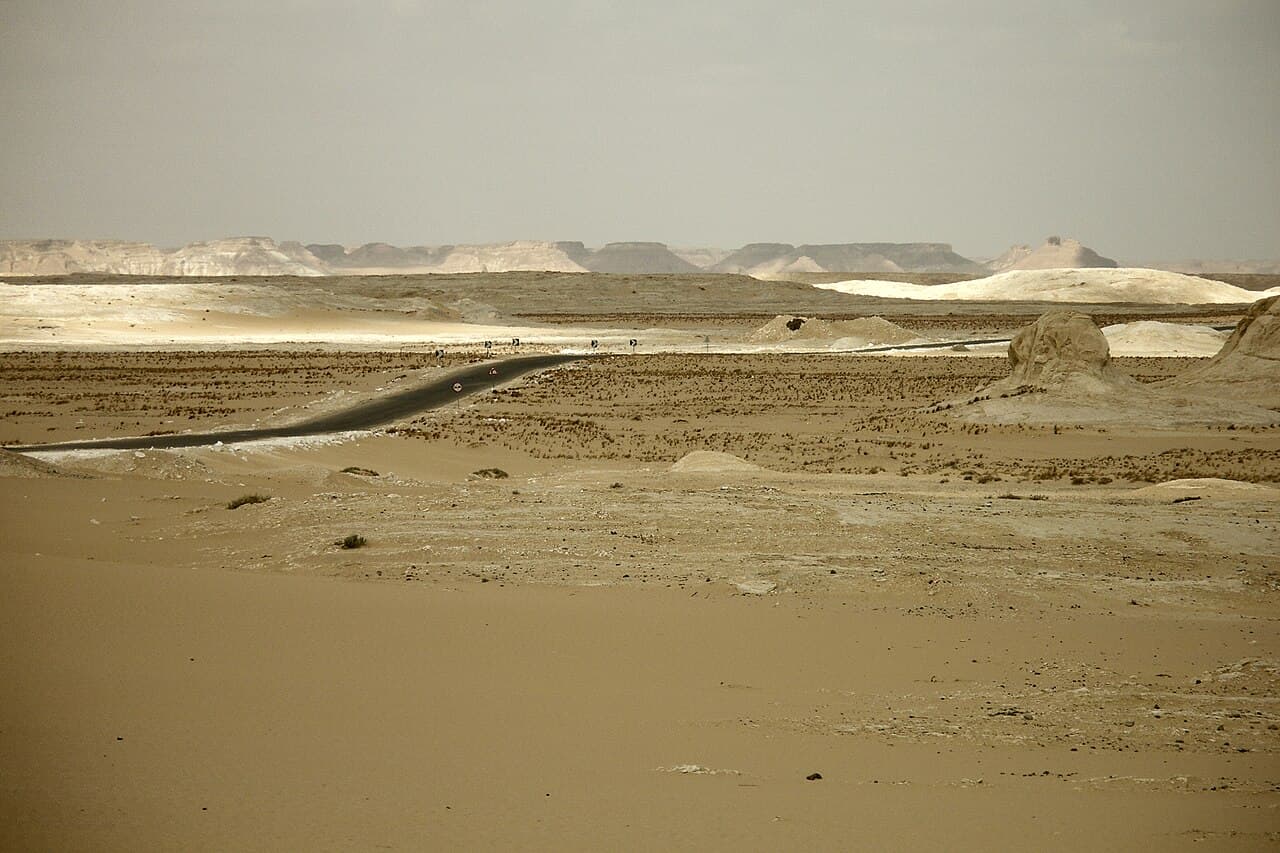
Quick Facts
- Best time to visit
- October to March. November and December are ideal: cool days, cold nights, no rain. Avoid May through August due to dangerous heat.
- Entrance fee
- Approximately EGP 50 per person plus EGP 100 per vehicle (roughly $1.50 and $3 USD). Usually included in tour package prices from Bahariya.
- Opening hours
- Checkpoint open roughly 7am to 5pm. Overnight camping permitted inside the park.
- How to get there
- Bus from Cairo Turgoman station to Bahariya: EGP 100 to EGP 150, 4 to 5 hours. Private car from Cairo: EGP 1,200 to EGP 2,000 one way. From Bahariya, 4WD tour required: EGP 1,500 to EGP 3,000 per person including guide and meals.
- Time needed
- Minimum one night in the desert. Two full days recommended if combining with Bahariya museum visits and the Agabat formations area.
- Cost range
- Budget group overnight from Bahariya: EGP 1,500 to EGP 2,000 per person. Private overnight tour: EGP 3,000 to EGP 5,000 per person. Add EGP 200 to EGP 300 return bus fare from Cairo.
The chalk formations of Egypt's White Desert are not the result of wind erosion. They are the seafloor of a Cretaceous ocean that covered this part of North Africa roughly 80 million years ago. The white rock you will sleep under, photograph, and run your hands across was once sediment settling onto the bottom of the Tethys Sea. The sea retreated. The limestone hardened. Wind did the carving. What remains is a graveyard of marine organisms turned to chalk, standing in the middle of the Sahara like something that forgot to become desert.
Most visitors arrive knowing none of this. They come for photographs that look like another planet. They leave without understanding that the planet they were standing on was, by any reasonable measure, an alien world.
Quick Facts
Best time to visit: October through March, when daytime temperatures stay below 25°C and nights are cold but survivable. Summer temperatures exceed 45°C and make camping dangerous without serious preparation.
Entrance fees: White Desert National Park charges approximately EGP 50 per person (roughly $1 USD) at the checkpoint, plus a vehicle fee of around EGP 100. Bahariya Oasis tour operators include these fees in package prices, which typically run EGP 1,500 to EGP 3,000 per person (approximately $30 to $60 USD) for a one-night overnight camping trip from Bahariya, including 4WD transport, guide, and meals.
How to get there: From Cairo, take a bus or private car to Bahariya Oasis (approximately 370 km, 4 to 5 hours). Bus tickets from Turgoman station cost around EGP 100 to EGP 150 one way. From Bahariya, you cannot enter the White Desert without a 4WD vehicle and a licensed guide. Day trips and overnight tours depart from Bahariya town; expect to pay EGP 800 to EGP 1,200 for a shared day trip or EGP 1,500 to EGP 3,000 for a private overnight tour per person depending on group size.
Opening hours: The national park has no fixed hours, but the checkpoint operates roughly from 7am to 5pm. Overnight camping is permitted and common.
Time needed: Minimum one night. A single day visit gives you the formations but misses the point entirely. The desert at night, with no light pollution and temperatures that drop fast, is a different experience from the desert at noon.
Cost range: Budget travelers on group tours: EGP 1,500 to EGP 2,000 per person for an overnight. Mid-range private tours: EGP 3,000 to EGP 5,000 per person. Add EGP 100 to EGP 150 each way for the Cairo bus.
Why This Place Matters
The White Desert sits within Bahariya and Farafra depressions, part of the chain of oases that runs through Egypt's Western Desert. These oases were not marginal backwaters in ancient history. They were trade and caravan corridors that connected sub-Saharan Africa to the Mediterranean, Libya to the Nile Valley. Alexander the Great passed through this region on his way to consult the oracle at Siwa in 331 BCE. The oases supplied his army with water.
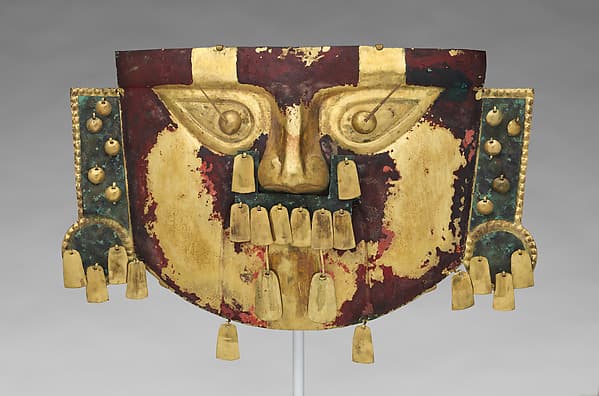
Barhariya Oasis itself yielded one of the most significant archaeological discoveries of the late twentieth century: the Valley of the Golden Mummies, uncovered in 1996 when a guard's donkey stumbled into an underground shaft. The site contained more than 250 Greco-Roman mummies, many covered in gilded cartonnage, dating to between the 1st century BCE and the 4th century CE. Excavations are still ongoing. Bahariya's small museum holds some of these mummies and is worth an hour of your time before you head into the desert.
The oasis settlements also produced wine during the Pharaonic period. Amphorae stamped with Bahariya provenance have been found in the Nile Valley, indicating that this desert region was an agricultural exporter to the most densely populated corridor in the ancient world. The date palms you see as you drive through town are the descendants of an agricultural tradition that is at least 3,000 years old.
What You Will Actually See
The White Desert National Park covers approximately 3,010 square kilometers. Within it, the landscape shifts in distinct phases. The Black Desert, closer to Bahariya, is volcanic. Dark dolerite pebbles cover orange dunes like scattered coal. Drivers often stop here briefly before continuing south toward the white chalk country.
Crystal Mountain appears next, a ridge of quartz and calcite that sits directly beside the road. It is not technically a mountain. It is a small outcrop, roughly 30 meters across, embedded with crystite crystals that catch light strangely. Most tour guides present it as a spectacle. It is actually a curiosity worth ten minutes of your attention, not an hour.
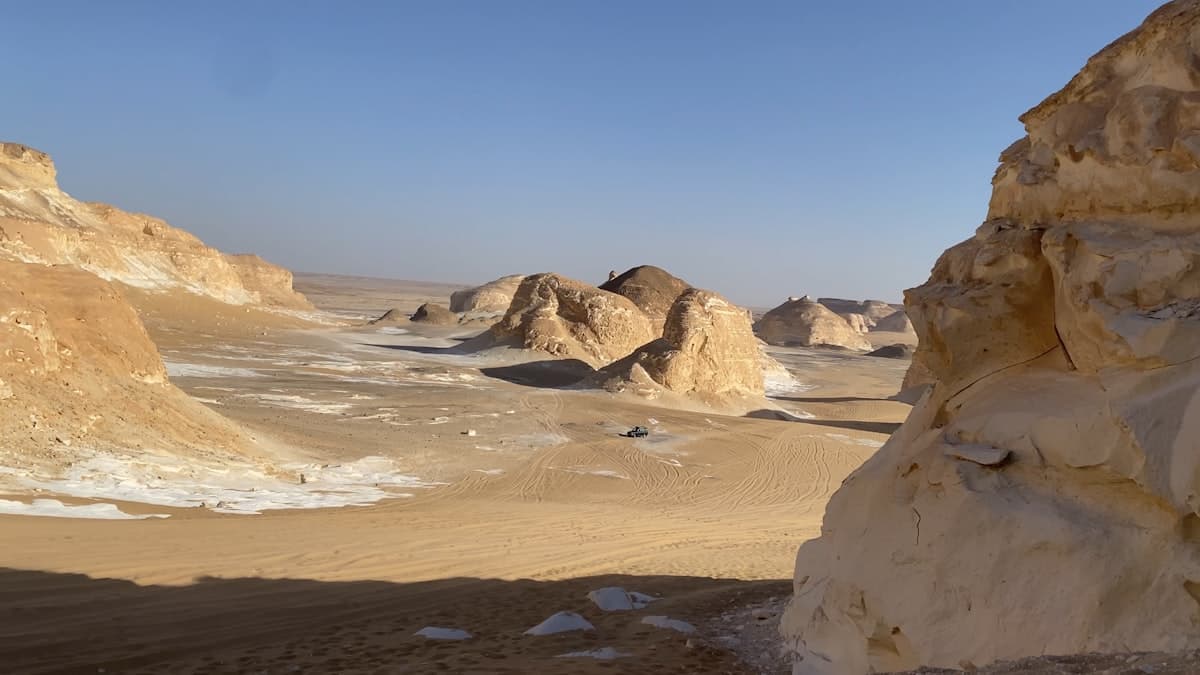
The white formations begin after the Black Desert transition and intensify as you move deeper into the national park. They come in two broad types. Inselbergs are the larger table-like structures, some reaching 10 to 15 meters, remnants of harder limestone that resisted erosion. Mushroom formations are the smaller pedestaled shapes, created because wind-carried sand erodes the soft base faster than the harder cap above. The famous chicken and rabbit shapes that appear in every photograph of this place are among these pedestaled forms.
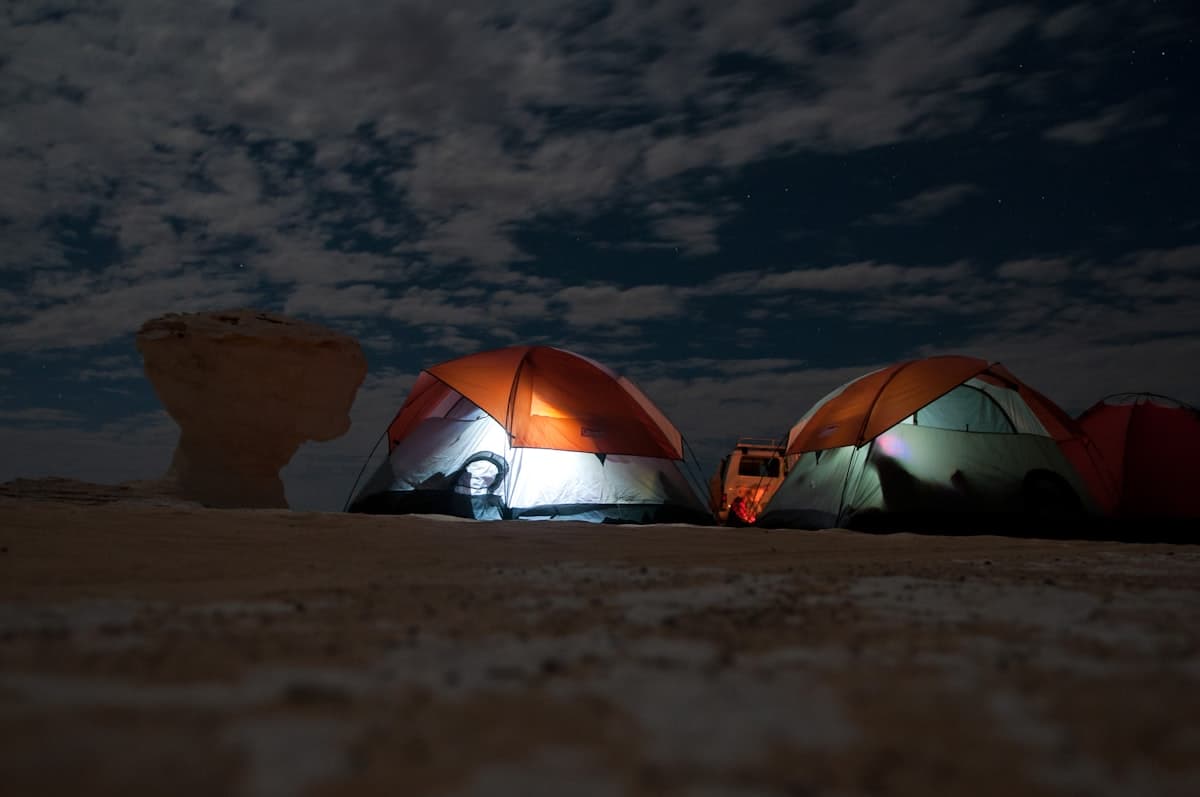
What changes everything is light. At 6am, the chalk turns pink then gold before settling into white. At noon, it is almost painful to look at without sunglasses. At dusk, it goes orange, then gray, then disappears into darkness. At night, the formations become shadows around a fire, and the silence is not the romantic silence of poetry. It is actual absence of sound, the kind that makes you aware of your own heartbeat.
What Most Visitors Miss
Fossils. The chalk underfoot contains marine fossils that are 80 million years old and completely accessible to anyone who looks down. Sea urchins, bivalves, and occasional shark teeth turn up on the desert surface with no excavation required. Your guide may or may not know this or mention it. Ask specifically.
The Agabat area, in the eastern section of the park, contains formations that are denser and more dramatic than the most photographed spots near the main camping areas. Fewer tours go there because the drive is longer. If you are booking a private tour, request Agabat specifically.
The fauna is also underreported. White Desert National Park contains fennec foxes, sand cats, Dorcas gazelles, and monitor lizards. You are unlikely to see any of them during the day. But guides who camp regularly know where to look at dusk and dawn. Ask before dark.
The Connections
The Western Desert oases exist in a relationship with the Nile Valley that most visitors never think about. When central authority in Egypt collapsed, as it did repeatedly during the Intermediate Periods of Pharaonic history, the oases became refuges and power bases. The Libyan groups who eventually established the 22nd and 23rd Dynasties around 945 BCE came through this desert corridor. Sheshonq I, the pharaoh who sacked Jerusalem and is mentioned by name in the Bible as Shishak, was of Libyan origin, his ancestors part of the desert movement into the Nile Valley.
During the Roman period, Bahariya was administered as part of a distinct oasis province with its own legal and tax structures. The Coptic Christian community that established itself here in the early centuries CE was not isolated from the broader Egyptian church. Monasteries were connected to the desert theology that shaped Christian asceticism globally. Saint Anthony, whose monastery in the Eastern Desert is still functioning after 1,700 years, was part of the same tradition of desert withdrawal that made the Western Desert oases significant to early Christianity.
The modern road you travel from Cairo to Bahariya follows a route that existed in some form for thousands of years. The tarmac is 20th century. The logic of the route is ancient.
Common Mistakes
Booking the cheapest tour without asking questions. The difference between a good guide and a poor one is not the price of the formations. It is whether someone can read the desert, knows where to camp for wind protection, understands how to handle a vehicle stuck in soft sand, and can identify what you are looking at. Ask specifically: how many years have they been guiding, do they have a first aid kit, what is the emergency protocol if someone is injured in the park.
Underestimating the cold. October nights in the White Desert can drop to 5°C. December and January nights sometimes approach freezing. Travelers from warm climates who pack only for daytime desert conditions end up miserable by 9pm. Bring a proper sleeping bag rated to at least 0°C, regardless of what season you visit.
Visiting only in the middle of the day. If your tour arrives at the formations at 11am and leaves by 3pm, you have seen the least interesting version of this landscape. The case for overnight camping is not romantic. It is purely practical: dawn and dusk are when the formations are worth looking at.
Ignoring Bahariya entirely. Most people treat the oasis town as a logistics stop. The Valley of the Golden Mummies museum, the antiquities museum with its Pharaonic and Greco-Roman collections, and the 26th Dynasty tombs of Bannentiu and Zed-Amun-ef-ankh are all in or near Bahariya town. The tombs contain painted scenes that are almost never crowded and are not significantly promoted by the Egyptian tourism establishment. They should take an hour of your itinerary.
Leaving litter. This sounds obvious. It is not. The White Desert camping areas have visible trash problems because camping culture in Egypt does not yet have strong leave-no-trace norms. Your guide should carry all waste out. If they do not, that tells you something.
Going without a guide at all. Some experienced desert travelers attempt to self-drive the White Desert in a 4WD. The road to the main formation areas is identifiable. The problem is soft sand, which can swallow a vehicle within minutes, and the total absence of phone signal across most of the park. Rescues happen. They are expensive and embarrassing and occasionally fatal.
Skipping the Black Desert and Crystal Mountain because they seem minor. They are minor. But the transition from volcanic black to chalk white is part of the geological story, and understanding the sequence makes the white formations more legible when you arrive.
Practical Tips
Book your Bahariya tour before arriving in Bahariya. The town has a handful of established operators. Peter's Camp, run by a family that has been guiding the desert for decades, has a reliable reputation. Safari Egypt and Oasis Desert Camp also operate regularly. Prices are negotiable, especially in low season or for larger groups.
Carry more water than you think necessary: a minimum of 3 liters per person per day, more in spring and autumn. Guides will carry cooking water, but your personal hydration is your responsibility.
The White Desert Egypt guide logistics work best when you allocate two full days: one day driving from Cairo to Bahariya with the museum visit, overnight in the desert, second day returning to Cairo. Three days allows the Agabat area and potentially Farafra Oasis to the south.
Cash only. Bahariya has ATMs but they are unreliable. Withdraw in Cairo before departure.
For photography, a wide-angle lens is useful for the large formations, but the detail work, fossils, crystal structures, and small mushroom pedestals, rewards a macro or standard lens. The best light windows are 6am to 8am and 4pm to 6pm.
Tell someone in Cairo your itinerary and your expected return date. This is not overcaution. It is the minimum reasonable protocol for desert travel in a region with no reliable communications infrastructure.
Frequently Asked Questions
The Weekly Dispatch
More on Egypt, every Friday.
Cultural depth and places most guides never mention.
No spam. Unsubscribe anytime.