Cleopatra's Alexandria: A Historical Guide to Egypt's Lost City
Cleopatra's palace lies 6 meters underwater off Alexandria's eastern harbor. The city above ground is not a ruin. It is a palimpsest. Here is how to read it.

Quick Facts
- Best time to visit
- October to April. Mediterranean humidity drops, temperatures sit between 14C and 22C, and the winter light on the harbor is clear rather than hazy. Summer is humid and can exceed 35C.
- Entrance fee
- Catacombs of Kom el-Shoqafa: EGP 180 (approx $3.60 USD). Pompey's Pillar: EGP 100 (approx $2 USD). Greco-Roman Museum: EGP 200 (approx $4 USD). Bibliotheca Alexandrina public areas free, exhibitions EGP 30 to 80.
- Opening hours
- Most archaeological sites daily 9am to 5pm. Bibliotheca Alexandrina Sunday to Thursday 10am to 7pm, Friday to Saturday 12pm to 4pm. Confirm Catacombs closing time by phone in summer.
- How to get there
- High-speed train from Cairo Ramses Station to Alexandria Misr Station: EGP 120 to 250, approximately 2 hours. Shared taxi from Cairo Mounib terminal: EGP 80, approximately 3 hours. Within Alexandria, taxis rarely exceed EGP 50 for cross-city travel. Corniche tram: EGP 3.
- Time needed
- Two full days minimum. One day for eastern harbor area, Bibliotheca, and Greco-Roman Museum. Second day for Kom el-Shoqafa, Pompey's Pillar, Anfushi district, and the old Jewish quarter.
- Cost range
- Budget EGP 600 to 900 per day including accommodation. Mid-range EGP 1,800 to 3,000 per day. Cecil Hotel rooms from EGP 2,500 per night.
Quick Facts
Best time to visit: October to April, when Mediterranean humidity drops and the light on the Corniche turns the color of old brass. Summer is genuinely uncomfortable, not pleasantly warm.
Entrance fees: Catacombs of Kom el-Shoqafa: EGP 180 (approx $3.60 USD), students EGP 90 Pompey's Pillar complex: EGP 100 (approx $2 USD) Greco-Roman Museum (reopened after 17-year renovation): EGP 200 (approx $4 USD) Underwater Archaeology diving permit (via Alexandria Dive Center): from EGP 2,500 (approx $50 USD) Bibliotheca Alexandrina: Free to enter public areas; exhibitions EGP 30-80 (approx $0.60-$1.60 USD)
Opening hours: Most sites open daily 9am to 5pm. The Catacombs close earlier in summer; confirm by phone before a late afternoon visit. Bibliotheca Alexandrina: Sunday to Thursday 10am to 7pm, Friday to Saturday 12pm to 4pm.
How to get there: From Cairo, the Spanish-built high-speed train from Ramses Station reaches Misr Alexandria station in 2 hours, roughly EGP 120 to EGP 250 depending on class. Shared taxis from Cairo's Mounib terminal cost around EGP 80 and take 3 hours. Within Alexandria, metered taxis are cheap and mostly reliable; a cross-city ride rarely exceeds EGP 50. The tram still runs along the Corniche for EGP 3, which is worth doing once purely for atmosphere.
Time needed: Two full days minimum to do Alexandria justice. One day for the eastern harbor area, Bibliotheca, and the Greco-Roman Museum. A second day for Kom el-Shoqafa, Pompey's Pillar, the Montaza gardens, and a walk through the old Jewish quarter.
Cost range: Budget EGP 600 to 900 per day including accommodation in the center. Mid-range EGP 1,800 to 3,000 per day.
---
Why This Place Matters
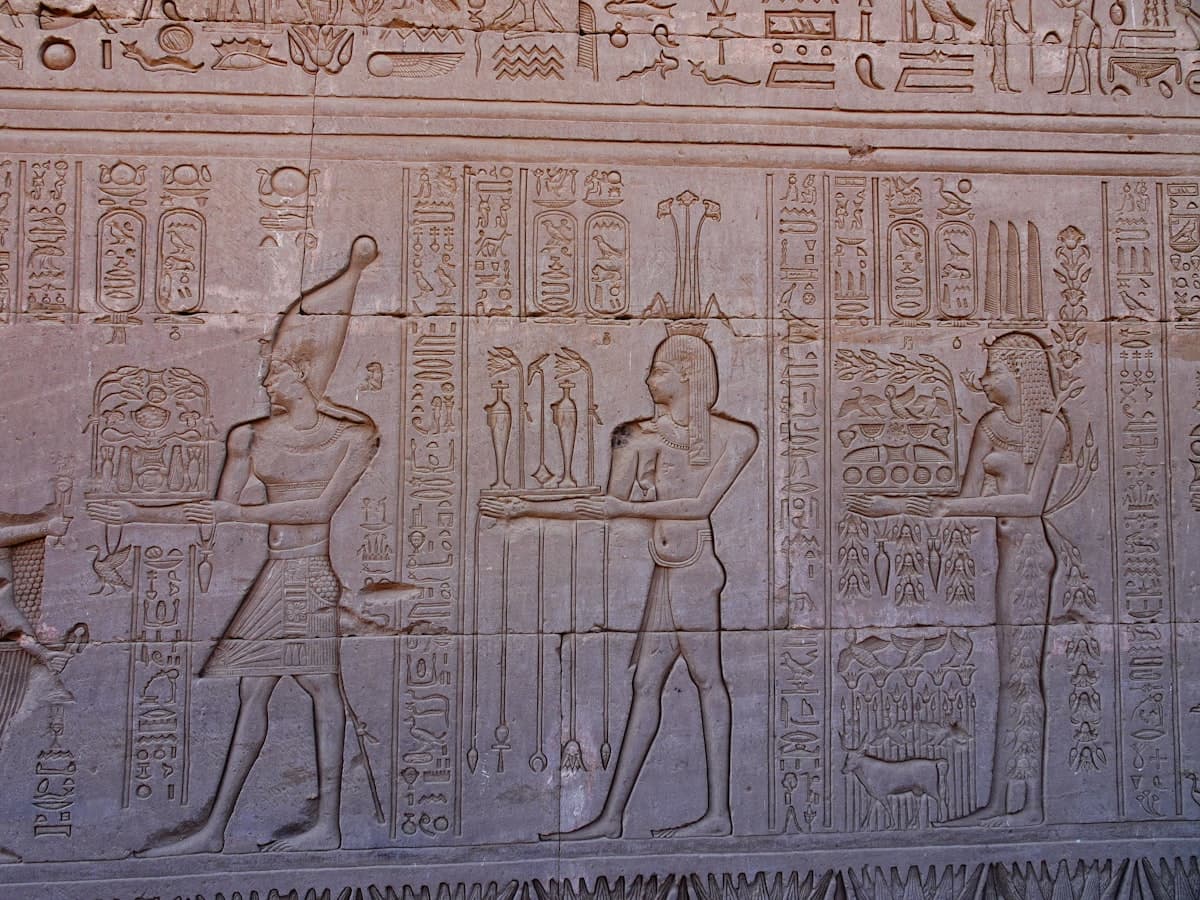
Alexandria was founded in 331 BC by a Macedonian king who never saw it finished. Alexander laid out the street grid himself, oriented to catch the Mediterranean breeze, then left for Persia and died without returning. The city that rose in his absence became, within a century, the largest city in the Western world, home to perhaps 500,000 people, a royal library holding an estimated 700,000 scrolls, and a lighthouse visible 50 kilometers out to sea. Rome, at the same period, was still a provincial town by comparison.
Cleopatra VII, the woman at the center of this historical guide to Alexandria, is the only member of her dynasty who bothered to learn Egyptian. The Ptolemies ruled Egypt for nearly 300 years and conducted all official business in Greek. Cleopatra spoke nine languages, presented herself to Egyptians as a new Isis, and to Romans as a philosopher-queen. She was 39 when she died in 30 BC, and the city she governed has spent the two millennia since quietly erasing the physical evidence of her existence.
The reason is geology. Ancient Alexandria sits roughly 6 to 8 meters below the current street level and partially below the harbor waters due to a combination of seismic activity, rising sea levels, and the relentless weight of fourteen successive civilizations building on top of each other. French underwater archaeologist Franck Goddio located the submerged royal quarter in 1996 and has been excavating it ever since. Sphinxes, columns, and what is likely the floor plan of Cleopatra's palace have been mapped on the seafloor of the eastern harbor, visible to divers and documented in extraordinary detail, but not yet raised.
This is the essential thing to understand before you arrive: the Alexandria of Cleopatra is not a site you visit. It is a city you learn to read at an angle.
---
The Catacombs of Kom el-Shoqafa: Where Three Religions Shared the Dead
The most important single site in Alexandria has nothing to do with the famous queen and almost nobody outside Egypt knows its name. The Catacombs of Kom el-Shoqafa, discovered accidentally in 1900 when a donkey fell through the ground into the upper chamber, represent the last moment in history when Pharaonic, Greek, and Roman religious iconography were treated as genuinely interchangeable. A carving inside shows Anubis, the jackal-headed Egyptian god of the dead, wearing Roman legionary armor. Directly beside him stands Thoth in a toga. The burial niches were cut in the Roman style, decorated in the Egyptian style, and inscribed in Greek. The people buried here around the 2nd century AD were neither confused nor syncretistic in any theoretical sense. They were Alexandrians, which was its own category of human being.
You descend a spiral staircase cut into limestone, passing the large Triclinium, a banquet hall where families would gather to share a meal with the deceased on festival days, a custom that ran continuously from Pharaonic practice through Coptic Christianity into modern Egyptian death culture. The smell underground is cool and mineral, like a cellar full of old books. The painted reliefs retain color in places, particularly in the innermost chamber where the humidity is lower. Go on a weekday morning and you may have the lower levels to yourself. Go on a Friday afternoon and you will be shoulder to shoulder.
The Catacombs are, without qualification, the most layered and intellectually interesting site in Alexandria. They are also, with equal certainty, poorly lit and badly signed. Bring a small torch and do not expect interpretive panels to do the heavy lifting.
---
Pompey's Pillar, the Library Site, and the Serapeum
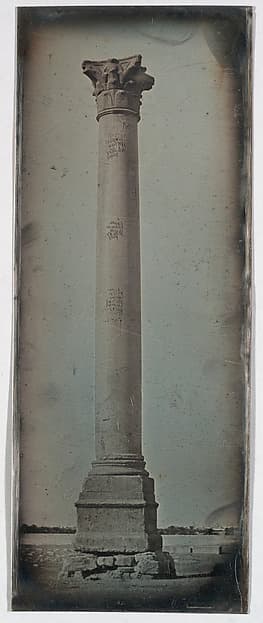
The 30-meter granite column that Alexandrians have called Pompey's Pillar since the Crusades was never connected to Pompey. It was erected in 297 AD in honor of the emperor Diocletian, who suppressed a revolt in Alexandria with particular brutality, reportedly declaring that the slaughter would continue until the blood reached his horse's knees. The horse apparently stumbled and knelt early, which Diocletian took as a divine signal to stop. Alexandrians erected a column in his honor anyway, which tells you something about the ancient city's relationship with imperial power.
The pillar stands in what was once the precinct of the Serapeum, the great temple of Serapis built by Ptolemy III. Serapis was a deliberately synthetic deity, invented by the Ptolemies to bridge Greek and Egyptian religious sensibilities, combining elements of Osiris, Apis the bull, and Zeus. The theology was political and worked remarkably well for several centuries. The Serapeum was destroyed by a Christian mob in 391 AD on orders from the Patriarch Theophilus, which is also when a significant portion of the Alexandrian library's remaining holdings are believed to have been lost. The famous burning of the Library is almost certainly not a single event but a series of losses across several centuries: Julius Caesar's fire in the harbor in 48 BC, the violence of the 3rd-century crisis, and the destruction of the Serapeum branch collection in 391 AD.
What you see at Pompey's Pillar today is a mostly empty site with scattered sphinxes, underground galleries that once held the sacred Apis bulls, and the column itself rising improbably from the rubble. It costs almost nothing to enter and is largely ignored by tour groups. Spend an hour here before the Catacombs. The combination, covering Roman Alexandria's relationship with its Pharaonic inheritance, is genuinely coherent as a half-day.
---
The Bibliotheca Alexandrina and What It Is Actually For
The new library opened in 2002 and was immediately, almost universally, described as a symbol of Alexandria's revival. This is not wrong but it is incomplete. The Bibliotheca Alexandrina's real function is as a working research institution with an extraordinary manuscript digitization program, one of the most significant in the Arab world. It holds an estimated 50,000 manuscripts and has digitized over 5 million pages of historical documents. It also houses a planetarium, four museums including a permanent antiquities collection containing pieces removed from the underwater excavations, and an institute dedicated to the study of the ancient library itself.
For the Cleopatra-focused visitor, the most relevant part is the antiquities museum in the basement, which contains actual objects from the Greco-Roman and Ptolemaic periods that were retrieved from the harbor and the surrounding area. You will see granite statues of Ptolemaic queens, some of whom may be Cleopatra VII herself since positive identification remains contested. The curators are often more willing to discuss this ambiguity than the labels suggest.
The architecture by Norwegian firm Snohetta is worth 20 minutes of looking: a tilted disc of Aswan granite inscribed with 120 ancient scripts, partially submerged toward the sea. It is not subtle. It is not meant to be.
---
The Connections: Alexandria Across 2,000 Years
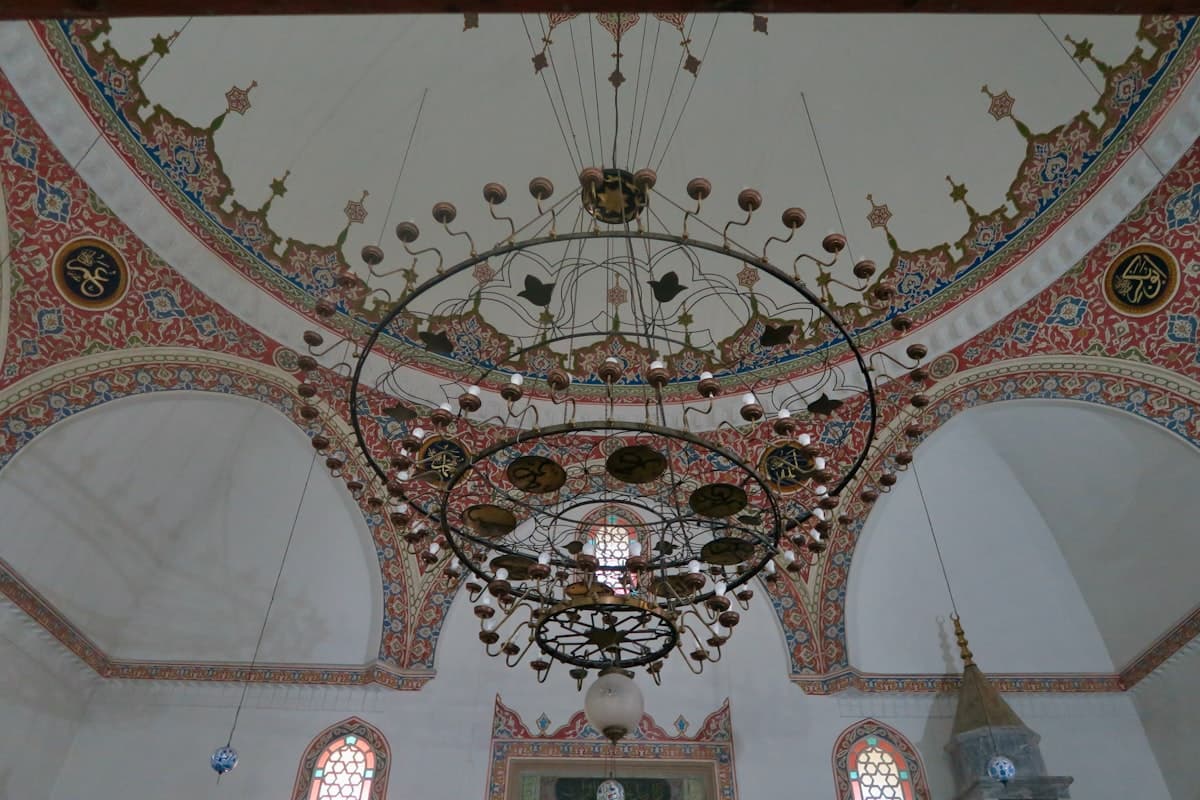
The mosque of Abu al-Abbas al-Mursi, which anchors the western end of the Corniche near the old harbor, sits on ground that was part of the ancient Rhakotis quarter, the Egyptian neighborhood that existed in Alexandria before Alexander arrived. The mosque was built in the 18th century over a 13th-century structure, which was itself built over Byzantine and earlier foundations. Abu al-Abbas al-Mursi was a 13th-century Andalusian Sufi scholar who settled in Alexandria after fleeing the fall of Muslim Spain. His tomb inside the mosque is still actively visited by fishermen before they go to sea, a practice with a continuity of devotional geography that reaches back to the sailors who prayed to Isis at this same harbor edge.
The Coptic connection is less obvious but equally present. The evangelist Mark is said to have brought Christianity to Alexandria around 42 AD, making the Coptic church one of the oldest continuous Christian institutions in the world, predating the Roman church in its current form. The Coptic cathedral of St. Mark in the Anfushi district stands approximately 800 meters from where ancient tradition places Mark's martyrdom. When you see Coptic liturgy that incorporates ancient Egyptian symbols, the eye of Horus appearing in iconographic positions later occupied by the all-seeing eye of God, you are watching a 2,000-year translation project that began in exactly this city.
Alexandria also produced, almost incidentally, two of the most consequential intellectual legacies in Western history: the Septuagint, the Greek translation of the Hebrew scriptures commissioned by Ptolemy II around 250 BC, which became the Old Testament used by early Christians across the Roman world; and Euclid's Elements, written in Alexandria around 300 BC, which remained the primary mathematics textbook in European universities until the 19th century.
---
Common Mistakes
Spending all your time on the Corniche waterfront and calling it Alexandria. The seafront is pleasant and the views toward the fort are real, but the layers of the city are inland. Most of what matters is a 10-minute taxi ride from the water.
Visiting the Qaitbay Citadel as a Cleopatra-related site. The 15th-century Mamluk fortress is historically interesting in its own right, built by Sultan Qaitbay using stones from the ruins of the ancient Pharos lighthouse. But it has no direct connection to the Ptolemaic period and is frequently sold to visitors as part of a Cleopatra itinerary. The lighthouse stones are real; the Cleopatra connection is tourism narrative, not history.
Skipping the Greco-Roman Museum because it recently reopened and reviews are scarce. The museum, closed for renovation from 2005 to 2023, holds the actual material culture of the period you came to understand. Mummy portraits, Ptolemaic coinage including coins bearing what may be Cleopatra's actual face, and objects that no other institution in Egypt holds. It is not large. It is essential.
Booking a snorkeling tour marketed as a Cleopatra palace dive without checking credentials. Several operators offer underwater tours of the submerged royal quarter. The reputable ones operate in coordination with Franck Goddio's institute and the Egyptian authorities. The unreputable ones take your EGP 2,500 and show you harbor sediment. Ask specifically whether the operator is licensed by the Supreme Council of Antiquities for underwater archaeology access before paying anything.
The horse carriage rides along the Corniche. They cost EGP 150 to 300 for 20 minutes, the horses are in poor condition, and the route tells you nothing about Alexandria that a 10-minute walk would not. Skip them without guilt.
Attempting Alexandria as a single-day trip from Cairo. Tour operators sell this aggressively. You will see Pompey's Pillar and the new library and eat a seafood lunch on the Corniche and feel vaguely that you have done something. You have not done Alexandria. Two nights is the minimum for the city to begin revealing itself.
Ignoring the Jewish quarter around the Eliyahu Hanavi synagogue. Alexandria was home to one of the largest Jewish communities in the world until the 1950s. The synagogue, built in 1850 on a site used for Jewish worship for centuries, is open for visits on request. The neighborhood around it, now predominantly Muslim, still contains architectural traces of one of the most cosmopolitan communities the Mediterranean has produced. It is not on most itineraries. It should be.
---
Practical Tips
Alexandria's seafood is among the best in Egypt and the restaurants along the Corniche near the Fish Market area are legitimate rather than tourist-inflated. A grilled sea bass with tahini and bread costs EGP 180 to 250 at a mid-range place. The fish is caught the same morning. This is not incidental: eating well in Alexandria is part of understanding the city's relationship with its Mediterranean identity, which is distinct from its Nile-valley Egyptian identity in ways worth sitting with.
The city is navigable on foot between the Corniche and the downtown grid, but the distances are deceptive on a map. Carry water. In summer, start before 9am and finish outdoor sites by noon.
For accommodation, the Cecil Hotel on Midan Saad Zaghloul is the historically resonant choice: Somerset Maugham, Winston Churchill, and various British intelligence officers stayed here during World War Two when Alexandria was the strategic center of the North African campaign. The rooms have been renovated and the atmosphere is intact. Expect to pay EGP 2,500 to 4,000 per night. Budget travelers do well in the guesthouses clustered around the Raml tram station.
Photography inside the Catacombs is officially prohibited, then tolerated for a tip to the guards. Budget EGP 20 to 50 if you want to photograph the reliefs. This is one of those Egyptian arrangements that requires neither moral outrage nor feigned surprise.
Frequently Asked Questions
The Weekly Dispatch
More on Egypt, every Friday.
Cultural depth and places most guides never mention.
No spam. Unsubscribe anytime.