Fatimid Cairo, Al-Azhar, and the City Built to Convert the World
Al-Azhar was founded in 970 AD not as a university but as a Shia missionary school. Today it is Sunni Islam's most influential institution. The whole city holds that kind of contradiction.

Quick Facts
- Best time to visit
- October through March. Summer heat in the dense medieval lanes is severe, and the stone buildings offer limited shade. Morning visits before 10am are cooler year-round.
- Entrance fee
- Al-Azhar Mosque: free. Al-Hakim Mosque: free. Bab al-Futuh and Bab al-Nasr gates: EGP 100 combined (approx $2 USD). Museum of Islamic Art: EGP 200 (approx $4 USD) for foreigners, EGP 20 for Egyptians.
- Opening hours
- Al-Azhar Mosque: daily 9am to 10pm, closed to non-Muslim visitors during Friday prayers (approx 11:30am to 1pm). Museum of Islamic Art: Tuesday to Sunday 9am to 5pm, closed Monday. Fatimid gates: daylight hours.
- How to get there
- Metro Line 1 to Al-Azhar station, then 10-minute walk. Taxi from Downtown Cairo: EGP 40 to 70. Uber similar. Taxi from Zamalek: EGP 80 to 120.
- Time needed
- Al-Azhar alone: 1 hour minimum. Full Fatimid axis walk including Al-Hakim and gates: 3 to 4 hours. Full day if combining with Museum of Islamic Art.
- Cost range
- Budget day EGP 300 to 500 covering entry fees, transport, and street food. Mid-range EGP 800 to 1,200 adding a sit-down lunch and museum entry.
Quick Facts
Best time to visit: October through March. The medieval lanes of Islamic Cairo are merciless in July heat, and the stone holds warmth long after sunset.
Entrance fees: Al-Azhar Mosque: free for worshippers and visitors. Al-Hakim Mosque: free. Bab al-Futuh and Bab al-Nasr (the Fatimid gates): EGP 100 combined (approx $2 USD). The nearby Museum of Islamic Art: EGP 200 (approx $4 USD) for foreigners, one of the most undervisited collections in Africa.
Opening hours: Al-Azhar Mosque is open daily from 9am to 10pm, closed during Friday prayer for non-Muslim visitors (roughly 11:30am to 1pm). The Islamic gates are accessible during daylight hours.
How to get there: The Cairo Metro Line 1 stops at Al-Azhar station, a short walk north through the Khan el-Khalili bazaar. Taxi from Downtown Cairo costs EGP 40 to 70. Uber runs roughly the same. From Zamalek, budget EGP 80 to 120 by taxi.
Time needed: Al-Azhar Mosque alone deserves an hour. The full Fatimid axis from Bab Zuweila to Bab al-Futuh, including Al-Hakim Mosque and the gates, takes three to four hours at a thoughtful pace. Combine with the Museum of Islamic Art for a full day.
Cost range: Budget EGP 300 to 500 for entry fees and transport. Add EGP 80 to 150 for lunch at a local fuul and ta'meya shop near the mosque.
---
The Fatimid dynasty invaded Egypt in 970 AD, and within a year they had founded a new capital, a mosque-university, and a plan to convert the entire Sunni Muslim world to Shia Islam. They failed at the conversion. They succeeded at everything else. The city they built, al-Qahira, meaning "The Victorious" or, more ominously, named for the planet Mars rising on the night of its founding, is what you now call Cairo. The mosque they founded, Al-Azhar, became the most influential Islamic institution on earth. The particular irony is that it did so as a Sunni institution, having been converted away from its original Shia purpose within two centuries of its construction.
This is what Fatimid Cairo offers that most visitors do not expect: not just old buildings, but a city built on a specific argument about who should lead the Muslim world, and the archaeological evidence of what happens when that argument is lost.
---
Why This Place Matters
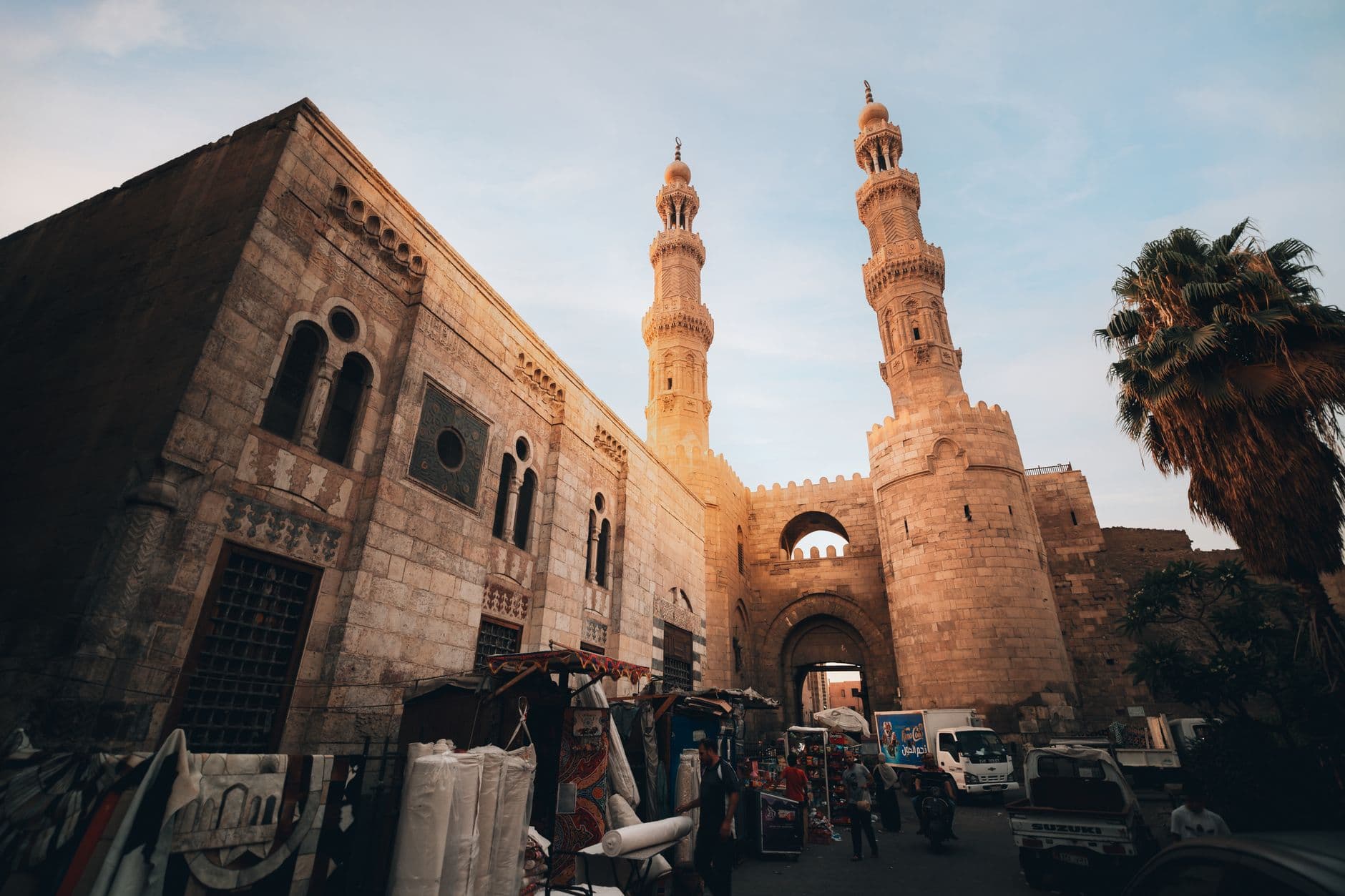
Most visitors to Islamic Cairo arrive with a vague sense that the medieval city is old and atmospheric. Both are true. But the specificity matters more.
The Fatimids were Ismaili Shia Muslims who traced their lineage directly to Fatima, daughter of the Prophet Muhammad, and claimed the Caliphate on that basis. When their general Jawhar al-Siqilli marched into Egypt from Tunisia, he was not simply conquering territory. He was establishing a rival seat of Islamic authority to challenge the Abbasid Caliph in Baghdad. Al-Qahira was built as a royal city, walled and restricted to the Fatimid court and army. The Egyptians themselves lived in Fustat, the older settlement to the south.
The city's founding involved what might be the most elaborate act of astrological planning in medieval architecture. Court astronomers calculated an auspicious moment to break ground. The signal was to be ropes with bells attached: when the bells rang, workers would strike their tools simultaneously. According to the medieval historian al-Maqrizi, a raven landed on the ropes and set the bells ringing prematurely, at a moment when Mars, al-Qahir, was in the ascendant. The astronomers called it a sign, and the city's name was set. You can believe the story or not. The city is still here.
Al-Azhar, completed in 972 AD, predates Oxford University by approximately 184 years, making it the oldest continuously operating university in the world, though scholars debate whether its early form qualifies as a university by modern standards. It awarded no formal degrees in its first century. What it did was install Shia doctrine into the Egyptian religious establishment through the systematic training of preachers, a project that ended abruptly in 1171 when Saladin, the great Sunni general, took control of Egypt and ordered Al-Azhar converted to Sunni practice.
Saladin's method was efficient and complete. He had the Fatimid Caliph's name removed from the Friday prayers, replaced by the Abbasid Caliph's name. He relocated the Fatimid royal treasures. He abolished the Shia call to prayer. He did not destroy Al-Azhar. He simply changed what it taught. The physical building survived. The institution survived. The ideology it was built to serve did not.
---
What You Will Actually See: The Mosque of Al-Azhar
You enter Al-Azhar through the Gate of the Barbers, a Mamluk addition from the 15th century where students traditionally had their heads shaved on enrollment. The gate sets up the institution's layered nature immediately: Fatimid core, Mamluk expansion, Ottoman minarets added later, a modern madrasa wing added in the 20th century. The building is not a single object from a single era. It is a palimpsest.
The oldest surviving part is the prayer hall, where original Fatimid columns were taken from earlier structures, some of them Pharaonic, some Roman. This was standard medieval practice in Egypt: stone moved from monument to monument across centuries, acquiring new meanings with each relocation. Run your hand along a column in the prayer hall and you may be touching stone that was shaped under a completely different civilization's religious purposes.
The courtyard is where the sensory experience concentrates. In the early morning, before tourists and students crowd it, the light enters from the eastern arcade at a low angle and the stone turns from grey to amber. Students from sub-Saharan Africa, Southeast Asia, and Central Asia sit in circles around individual sheikhs, the traditional teaching method unchanged in its basic form since the 10th century. The smell is cool stone, old wood, and occasionally the particular sweetness of oud incense drifting from a side corridor.
Do not skip the museum annex on the mosque's eastern side. It holds Quranic manuscripts, Fatimid woodwork, and architectural fragments that explain what was lost in the various renovations. Entry is often free with mosque admission, and it is almost always empty.
---
The Fatimid City Itself: Walking the Axis
Al-Azhar is the most famous Fatimid monument, but the city it anchored survives in outline. The main north-south spine of al-Qahira, now called Sharia al-Muizz li-Din Allah (Street of al-Muizz, the Fatimid caliph who ordered the invasion of Egypt), still follows the exact route of the original royal processional way. Walk it from south to north and you walk the same line that Fatimid caliphs rode on ceremonial processions.
At the northern end, the gates of Bab al-Futuh and Bab al-Nasr, both completed in 1087 by the Armenian general and vizier Badr al-Jamali, are among the best-preserved medieval Islamic fortifications anywhere in the world. Badr al-Jamali brought Armenian and possibly Byzantine stonemasons from Syria to build them, and the construction technique, with its Frankish-influenced vaulting inside the towers, reveals the cosmopolitanism of Fatimid Cairo at its height. You can climb inside the towers of Bab al-Nasr. The graffiti on the interior walls includes inscriptions left by Napoleonic soldiers in 1798, which means you are looking at layers: Fatimid masonry inscribed by French invaders above Arabic carved by medieval visitors. Nobody points this out.
The Mosque of al-Hakim, at the northern end of al-Muizz, is dedicated to the Fatimid caliph who is arguably the most controversial ruler in Egyptian Islamic history. Al-Hakim bi-Amr Allah, who ruled from 996 to 1021, ordered the destruction of the Church of the Holy Sepulchre in Jerusalem, banned chess, prohibited women from leaving their homes or having shoes made for them, ordered dogs killed because their barking disturbed him, and, near the end of his reign, allowed his followers to claim he was divine. He then rode his donkey into the Muqattam Hills one night and was never seen again. The Druze religious community, concentrated today in Lebanon, Syria, and Israel, still regards him as the incarnation of God. The mosque that bears his name was restored in the 1980s by the Dawoodi Bohra, a Shia Muslim community based largely in India, who spent their own money rebuilding a monument to their faith's history in a country that had moved on entirely from the ideology it represents.
---
The Connections: What This Place Shares With the Rest of Egypt
The Fatimid layer of Cairo rests on and draws from everything that came before it.
The street pattern of al-Qahira overlays the grid of a Roman military camp, the ancient city of Babylon in Egypt, whose ruins survive a few kilometers south at Coptic Cairo. Some of the foundation stones of Fatimid walls came from quarried Pharaonic monuments. The Mosque of Amr ibn al-As, Egypt's first mosque, built in 641 AD in Fustat, is directly south and predates the Fatimid city by three centuries. Visiting them in sequence gives you the complete arc of Egypt's Islamic history in a single afternoon.
The Fatimid period also produced the original Khan el-Khalili bazaar area, though the current structures are largely Mamluk and later. The Mamluk sultans who followed Saladin and displaced Fatimid architecture with their own mosques and madrasas were often converting or building over Fatimid structures. The relationship between what survives and what was replaced tells you more about the power struggles of medieval Islamic Cairo than any single building can.
The Museum of Islamic Art on Bur Said Street, a fifteen-minute walk from Al-Azhar, holds the most important collection of Fatimid objects outside of archaeological storage: carved ivory, luster-painted ceramics, rock crystal ewers of such technical refinement that medieval European kings traded for them as relics. One rock crystal ewer from the Fatimid treasury eventually made it into the treasury of Saint Mark's Basilica in Venice, where it still is. Cairo made it. Venice has it. This is not an unusual story in Egyptian cultural history.
---
Common Mistakes
Arriving at Al-Azhar on a Friday midday and expecting entry. The mosque closes to non-Muslim visitors during Friday prayers, typically from around 11:30am to 1:00pm. Plan around this or plan to wait outside in full sun.
Skipping al-Hakim Mosque because it looks incomplete. The mosque was used as a stable by Crusader prisoners in the 12th century, as a warehouse by Saladin, and as a prison by the Mamluks. The fact that it looks rough is the historical record, not a restoration failure. The interior contains some of the oldest surviving Fatimid stone inscriptions in Cairo. Go.
Paying a guide outside Al-Azhar who promises insider access. There is no insider access. The mosque is open, free, and self-navigable. Unofficial guides at the gate typically charge EGP 200 to 500 for a circuit you can do alone in the same time with a basic map.
The sound and light show in Islamic Cairo, when it operates. It costs EGP 300 and narrates a cartoon version of history at a volume that prevents you from hearing the actual muezzin. Skip it. Stand in the courtyard of Al-Azhar at dusk when the call to prayer comes from six different minarets at staggered intervals. That is free and it is the real thing.
Ignoring the Museum of Islamic Art. Every tour group walks past it to get to the bazaar. The Fatimid and Mamluk collections inside are world-class by any standard and the galleries are almost always quiet. Two hours here will reframe everything you see in the streets outside.
Wearing sandals to the gates of Bab al-Futuh or Bab al-Nasr. The stone steps inside the towers are uneven and steep. Closed shoes matter if you intend to climb.
Treating the Khan el-Khalili bazaar as the destination rather than the detour. The bazaar is fine for a coffee at Café El Fishawy, which has operated continuously since 1773. It is not fine for understanding Fatimid Cairo. The bazaar is a later, commercial overlay. The city underneath it is the point.
---
Practical Tips
Dress conservatively. For women, a scarf for the head is required inside Al-Azhar and is worth bringing for all mosque visits in the area. Loose trousers or a long skirt for everyone. Shoes come off at the mosque entrance; slip-ons save time.
The best time to walk Sharia al-Muizz is either early morning, before 9am when the street is quiet and shopkeepers are setting up, or after 4pm when the light softens and the street fills with Cairenes rather than tour groups. Midday is crowded and hot for most of the year.
Do not accept the first offer for anything in the Khan el-Khalili adjacent shops. If you want to buy, 40 percent of the opening price is a reasonable starting point for negotiation in most cases.
For food: the area around Al-Azhar has excellent fuul and ta'meya at street stalls for EGP 20 to 50 per sandwich. For a sit-down meal, Naguib Mahfouz Café inside the bazaar is comfortable if slightly tourist-priced. The Nobel laureate Naguib Mahfouz, who set several novels in these streets, was stabbed outside a café near here in 1994 by an extremist who had not read his books but had heard they were offensive. He survived and lived another twelve years. The neighborhood contains that kind of density of story per square meter.
If you want to understand the Fatimid founding of Cairo in a single morning: start at the Museum of Islamic Art, walk north through Khan el-Khalili to Al-Azhar for the 9am opening, continue up al-Muizz to Al-Hakim Mosque, and end at the northern gates before noon. You will have walked the length of a medieval city built to change the world, and you will understand why it did, and why it didn't, in exactly the way its founders intended.
Frequently Asked Questions
The Weekly Dispatch
More on Egypt, every Friday.
Cultural depth and places most guides never mention.
No spam. Unsubscribe anytime.