Jewish Alexandria: Egypt's Lost Community and Its Synagogues
At its peak, Alexandria had 80,000 Jewish residents and 50 synagogues. Today, fewer than ten Jews live in the city. The buildings are still there.

Quick Facts
- Best time to visit
- October through April. Mediterranean winters are mild with excellent light. Summer is humid and access coordination is more difficult.
- Entrance fee
- Eliyahu Hanavi Synagogue: free entry with coordination, donation of EGP 200 to 400 (approx $4 to $8 USD) appropriate. Chatby Cemetery: small coordination fee, approximately EGP 100 to 200.
- Opening hours
- Eliyahu Hanavi: Saturday mornings 9am to 11am most reliable; other days by appointment only. Chatby Cemetery: variable, coordination required in advance.
- How to get there
- Train from Cairo Ramses Station to Alexandria Misr Station: EGP 60 to 120 second class (approx $1.20 to $2.50 USD), 2.5 hours. Taxi from Misr Station to synagogue: EGP 40 to 60. Private car from Cairo: EGP 900 to 1,400.
- Time needed
- Full day minimum. Synagogue alone: 1.5 to 2 hours. Adding Chatby Cemetery and a coastal walk: 6 to 7 hours total.
- Cost range
- Budget EGP 600 to 900 per day including transport and meals. Mid-range EGP 1,800 to 3,000 including a comfortable hotel and restaurant lunch.
At its peak in the 1940s, Alexandria had roughly 80,000 Jewish residents, fifty functioning synagogues, and a Jewish community that had existed, in various forms, for over 2,300 years. Today, estimates place the number of Jews living in Alexandria at fewer than ten. Most are elderly women. The last rabbi left decades ago. The buildings are still there.
This is not a story about absence. It is a story about one of the longest Jewish diasporas in history, a community that survived Ptolemaic pharaohs, Roman persecutors, Arab conquerors, Ottoman administrators, and European colonizers, only to dissolve within a single generation after 1948. Understanding what happened to Jewish Alexandria tells you more about the twentieth century than almost any monument in Egypt.
Quick Facts
Best time to visit: October through April. Alexandria's Mediterranean winters are mild and the sea light is extraordinary. Summer is humid, crowded with Egyptian holidaymakers, and the synagogues are more likely to have restricted access.
Entrance fees: The Eliyahu Hanavi Synagogue (also spelled Eliahou Hanavi) is technically free to enter with advance coordination, though a donation is expected and appropriate. Some visits are arranged through the Jewish community office. Budget EGP 200 to 400 (approx $4 to $8 USD) in tips and donations across multiple sites.
Opening hours: The Eliyahu Hanavi Synagogue on Nabi Daniel Street is the only one with semi-regular access. It is generally open Saturday mornings when a caretaker is present, and by appointment on other days. Hours are not fixed. Arrive between 9am and 11am.
How to get there: From Cairo, take the Khedive-era rail line from Ramses Station to Misr Station Alexandria (EGP 60 to 120 second class, approximately $1.20 to $2.50 USD, journey 2.5 hours). From Misr Station, the synagogue is a 15-minute taxi ride (EGP 40 to 60). Alternatively, a private car from Cairo costs EGP 900 to 1,400 depending on the service.
Time needed: Allow a full day. The synagogue itself takes one to two hours. Combining it with the Jewish cemetery in Chatby, the site of the ancient Alexandrian Jewish quarter, and the coastal walk along the Corniche makes for a coherent six to seven hour itinerary.
Cost range: Budget EGP 600 to 900 per day in Alexandria. Mid-range EGP 1,800 to 3,000, including a decent lunch near the seafront.
Why This Place Matters
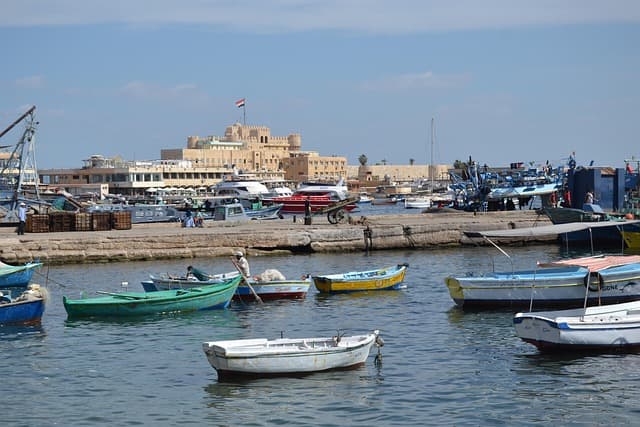
The Jewish community of Alexandria is not a modern story interrupted by politics. It begins around 332 BCE, when Alexander the Great founded the city and reportedly invited Jewish settlers into one of the city's five designated districts from the very first year of its existence. By the first century CE, the Jewish philosopher Philo of Alexandria, who tried to reconcile Jewish theology with Greek philosophy, was writing here. His work would later influence Christian theology more than almost any other non-Christian thinker.
The famous Letter of Aristeas, written in Alexandria around 200 BCE, describes seventy-two Jewish scholars being brought to the island of Pharos to translate the Torah into Greek. That translation, the Septuagint, became the Bible of early Christianity. It was produced in Alexandria, by Alexandrian Jews, for a Jewish community that had largely adopted Greek as its primary language. The Septuagint is still the canonical Old Testament of the Eastern Orthodox Church. Its origins are 400 meters from where you will have lunch.
The community endured a catastrophic pogrom under the Roman Emperor Caracalla in 215 CE, was suppressed under the later Byzantine Christian emperors, and revived under Arab rule after 641 CE. The Fatimid caliphs, who founded Cairo and built Al-Azhar, were generally tolerant administrators. The Jewish quarter of medieval Alexandria sat near what is now the Anfushi neighborhood, close to the Eastern Harbor. Almost nothing physical survives from those centuries, but the continuity of community does.
The real flowering came in the nineteenth and early twentieth centuries. Under Muhammad Ali and his successors, Alexandria reopened as a cosmopolitan Mediterranean port. Sephardic Jews expelled from Spain in 1492 had settled across the Ottoman Empire, and many arrived in Alexandria over subsequent centuries. In the 1800s, they were joined by Jews from Greece, Italy, France, Iraq, and Yemen. The community became, by the 1920s, genuinely multilingual: Judeo-Spanish, Arabic, French, Italian, and Greek were all spoken within the same extended families. The poets, merchants, lawyers, and cotton brokers who made up this community were not visitors to Alexandria. They were Alexandrians.
The Eliyahu Hanavi Synagogue: What You Will Actually See
The Eliyahu Hanavi Synagogue on Nabi Daniel Street is the physical center of what remains of Jewish Alexandria, and it is one of the most undervisited significant buildings in all of Egypt. The street itself carries a clue: Nabi Daniel means Prophet Daniel in Arabic. An old tradition holds that Daniel, the biblical prophet, is buried somewhere beneath this street. Nobody has confirmed this. Nobody has definitively ruled it out.
The current synagogue building dates to 1354, though it was substantially rebuilt and expanded in the nineteenth century. What you walk into is a vast, high-ceilinged hall with Italian marble columns, a women's gallery running around three sides, brass chandeliers, and an Ark of the Covenant carved in dark wood that somehow survived everything. The floor is covered in geometric tilework. The walls are cool even in summer. The scale surprises everyone: this is not a modest community chapel but a building designed to hold thousands.
At Rosh Hashanah in the early twentieth century, it did hold thousands. The synagogue registered 10,000 worshippers on the high holy days as recently as the 1940s. When you stand inside it now, with perhaps three other visitors and one elderly caretaker, that scale becomes its own kind of historical document.
The caretaker, if you are fortunate enough to encounter the long-serving Magda Haroun, who for years led the tiny remaining community, may speak to you in French-accented Arabic about her childhood in Alexandria, about her decision to stay when others left, about what it means to maintain a building for a community that no longer exists to fill it. That conversation is worth more than any plaque.
Look closely at the memorial plaques on the walls. They are in Hebrew, French, Arabic, and Italian. The dead recorded there span the Napoleonic period to the 1960s. They are a compressed archive of a world that was functioning, prosperous, and culturally confident until, very suddenly, it was not.
The Chatby Cemetery and the Scattered Traces
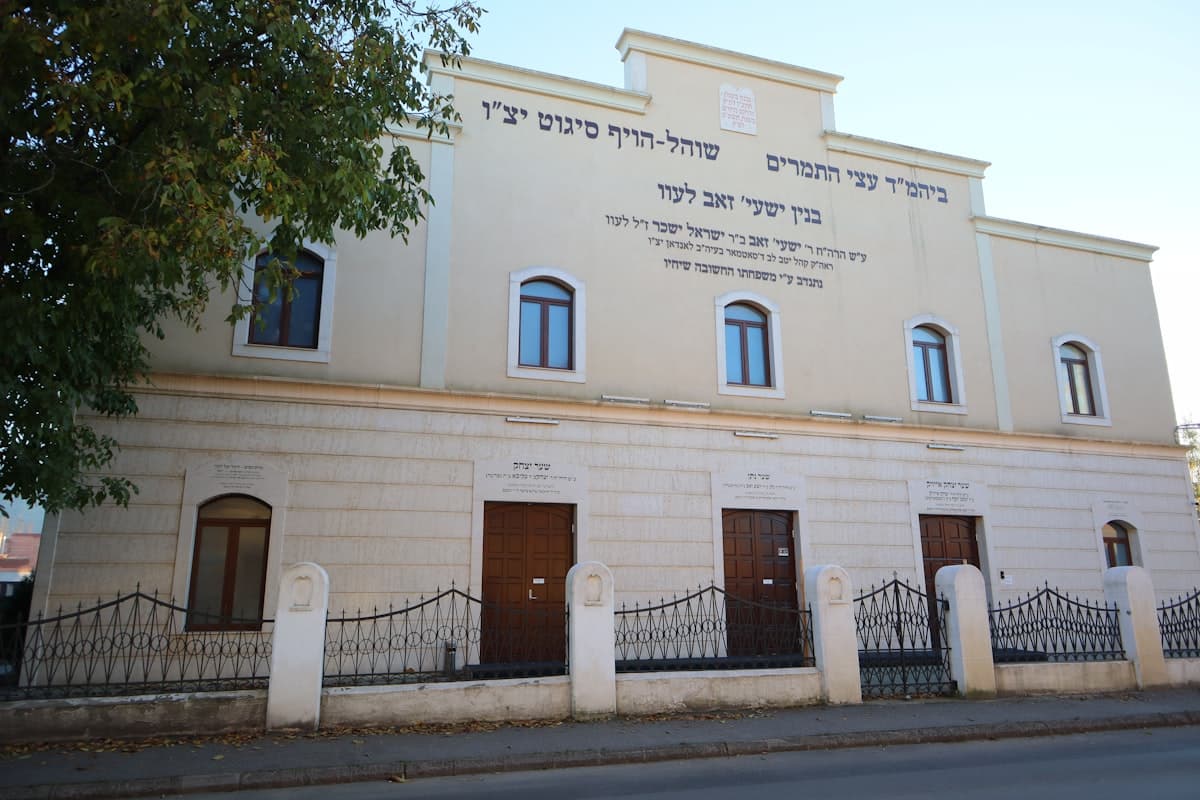
Three kilometers east along the waterfront, the Jewish Cemetery of Alexandria at Chatby is the oldest Jewish cemetery still standing in Egypt, with graves dating to the first century CE. The Roman-era tombs here are roughly contemporary with the destruction of the Second Temple in Jerusalem. Jews fleeing or migrating from Roman Palestine passed through Alexandria at exactly the period when many of these graves were dug. The cemetery is irregular, overgrown in places, and tends to require coordination to enter. The Egyptian government has periodically funded restoration work. The results are uneven but the intention is real.
The nineteenth-century section of the cemetery contains the elaborate tombs of the cotton families: the Mosseri family, the Cattaoui family, the Qattawi family. These names appear throughout the diplomatic and financial history of Egypt. Youssef Aslan Cattaoui Pasha was the president of the Egyptian Jewish community, a close associate of the Khedive, and a man who considered himself unambiguously Egyptian. His family had been in Egypt for generations. The tombstones in Chatby are cut from Italian marble, inscribed in French, and positioned three minutes' walk from the Mediterranean. They are not the graves of people who considered themselves temporary residents.
The other surviving synagogue worth noting is the Mosseiri Synagogue in the Moharrem Bey neighborhood, though it has been closed for years and access is rare. The building is structurally intact but the interior is inaccessible to most visitors. Several smaller synagogues across the city have been converted to other uses, including at least one that became a parking structure.
The Connections: One Community, Three Millennia of Egyptian History
The Nabi Daniel Street location of the Eliyahu Hanavi Synagogue is not arbitrary. Ptolemy I, who ruled Egypt after Alexander and whose family built the Library of Alexandria and the Pharos lighthouse, settled Jewish soldiers and traders in exactly this part of the ancient city. The street runs along what was one of the main axes of Ptolemaic Alexandria, the so-called L7 district in the ancient grid. When the Arab general Amr ibn al-As took Alexandria in 641 CE, he noted the presence of a large Jewish population in his letters. The Ottoman traveler Evliya Celebi, passing through in the seventeenth century, counted multiple functioning synagogues. The continuity across conquerors, religions, and regimes is the actual story.
The connection to Coptic Alexandria is equally direct. The Coptic Orthodox community and the Jewish community of Alexandria share an origin: both are pre-Islamic communities that negotiated their survival under a long series of rulers. The Coptic Orthodox Cathedral of Saint Mark in Alexandria stands roughly two kilometers from Eliyahu Hanavi. Both communities trace their presence in this city to the first century CE. Both shrank catastrophically in the twentieth century, though for different reasons and at different rates. Walking between them in a single afternoon compresses 2,000 years of minority religious experience in Egypt into a geographic distance you can cover on foot.
The events of 1948 and 1956 accelerated the departure of most of Alexandria's Jews. The 1952 revolution, the 1956 Suez Crisis, and the subsequent nationalizations made the position of foreign-passport-holding Jewish families legally and financially untenable. By 1967, the community had gone from 80,000 to roughly 2,500. By 1979, fewer than 200 remained.
Common Mistakes
Showing up without coordination. The Eliyahu Hanavi Synagogue is not a museum with fixed hours and a ticket window. Contact the Israelite Community of Alexandria in advance. Turning up on a random Tuesday afternoon and finding a locked door is the most common outcome for unprepared visitors.
Treating the synagogue as a photo opportunity rather than an active religious site. Services still occur, rarely. The building is maintained by people for whom it is genuinely sacred space. Ask before photographing anything, especially the Ark.
Skipping the cemetery. Most visitors to Jewish Alexandria limit themselves to Eliyahu Hanavi, which takes perhaps ninety minutes. The Chatby Cemetery adds a dimension the synagogue cannot provide: the full chronological sweep of the community, from Roman-era graves to twentieth-century family tombs. It is logistically awkward but worth the effort.
Taking a generic Alexandria day trip. Travel agents in Cairo routinely bundle Alexandria into a single-day itinerary that includes Pompey's Pillar, the Catacombs of Kom el-Shoqafa, the Bibliotheca Alexandrina, and a seafood lunch. That itinerary leaves no time for anything requiring coordination or reflection. If Jewish Alexandria is your purpose, make it your purpose. Do not share the day with a Roman column.
The sound and light show at any Alexandria site, including the Bibliotheca Alexandrina's evening programming. These productions cost between EGP 250 and 400 and deliver generic historical narration that will tell you less than thirty minutes of independent reading. Skip them without guilt.
Expecting the government tourist infrastructure to help you. The Egyptian Ministry of Tourism has made genuine efforts to restore Eliyahu Hanavi, but Jewish Alexandria is not a marketed attraction. There are no official guided tours, no multilingual brochures, no visitor center. Come with your own preparation.
Confusing emotional response with historical understanding. Visiting these sites can produce a powerful sense of loss. That response is legitimate. But Jewish Alexandria was not simply destroyed. It migrated, under enormous pressure, to Israel, France, Brazil, the United States, and elsewhere. The descendants of Alexandrian Jewish families are numerous, scattered, and in some cases in active communication with the caretakers of the sites described here. The community is diaspora, not extinct.
Practical Tips
Contact the Egyptian Jewish Community's representative office before your trip. Magda Haroun, who served as president of the community for years, has been the key point of contact for researchers and visitors. Her name appears in the international press and she is reachable through the community's known contacts. A polite email explaining your interest, sent two to three weeks before arrival, significantly increases your chance of a meaningful visit.
Bring a French speaker if you can. French remains the language of the older Alexandrian Jewish community, though Arabic works for most practical interactions with caretakers.
The walk along the Corniche from near the synagogue to the Chatby area takes about forty-five minutes at a slow pace and is worth doing on foot. The Mediterranean light on the harbor in the morning hours, roughly 8am to 10am, gives you an understanding of why people called this city beautiful for two millennia.
Alexandria's train connections from Cairo are frequent and reliable. The Egyptian National Railways runs express services several times daily from Ramses Station. This is by far the best way to arrive: it deposits you at Misr Station in the center of the city, and the train journey itself, through the Delta farmland, is a pleasure.
Do not book accommodation on the Corniche hotels marketed to Egyptian summer tourists. They are overpriced for what they deliver. Small boutique hotels in the Raml Station neighborhood put you closer to the historical sites and in a part of the city that still retains some of the layered, cosmopolitan texture that made Alexandria what it was.
Frequently Asked Questions
The Weekly Dispatch
More on Egypt, every Friday.
Cultural depth and places most guides never mention.
No spam. Unsubscribe anytime.