Mohamed Ali Mosque: Albanian History Inside Cairo's Citadel
An Albanian soldier from Ottoman Macedonia built Egypt's most recognizable skyline. The mosque he left behind contains a clock that has never worked, sent by a king who got an obelisk in return.

Audio Guide: Mohamed Ali Mosque: Albanian History Inside Cairo's Citadel
Quick Facts
- Best time to visit
- October to April for cooler temperatures. Weekday mornings between 8am and 11am for smallest crowds. Avoid Friday midday due to prayers.
- Entrance fee
- EGP 450 (approx. $9 USD) covers the full Citadel complex including the mosque, Gawhara Palace, and Military Museum. No student discount currently available for foreign visitors.
- Opening hours
- Daily 8am to 5pm. Mosque closed to tourists during Friday prayers, approximately 11:30am to 1:30pm.
- How to get there
- Uber or Careem from Downtown Cairo: EGP 60 to 100. Metro Line 1 to Sayyida Zeinab station, then microbus or taxi for EGP 5 to 15. Street taxis: agree price before entry, expect EGP 60 to 80 from central areas.
- Time needed
- 2 to 3 hours for mosque plus terrace and Gawhara Palace. Full half-day (4 to 5 hours) if exploring the full Citadel complex. Combine with Sultan Hassan Mosque below for a full day in the area.
- Cost range
- Budget EGP 600 to 900 per day including entry, transport, and street food. Mid-range EGP 1,500 to 2,500 adding a licensed guide and a meal in Islamic Cairo.
Quick Facts
Best time to visit: October to April, early morning on weekdays
Entrance fee: EGP 450 (approx. $9 USD) for the Citadel complex, which includes the mosque. No separate mosque ticket.
Opening hours: Daily 8am to 5pm. Friday prayers close the mosque to tourists between approximately 11:30am and 1:30pm. Plan accordingly.
How to get there: Taxi from Downtown Cairo costs EGP 60 to 100. The Cairo Metro does not serve the Citadel directly. Take Line 1 to Sayyida Zeinab station, then a microbus or taxi for the final 2km (EGP 5 to 15). Ride-hailing apps (Uber, Careem) are more reliable for return journeys.
Time needed: 2 to 3 hours for the mosque and its terrace. A full day if you add the Military Museum, the Police Museum, and the Gawhara Palace inside the Citadel walls.
Cost range: Budget EGP 600 to 900 per day combining entry, transport, and street food nearby. Mid-range EGP 1,500 to 2,500 if you add a guide and lunch in Islamic Cairo.
---
The clock on the courtyard wall of the Mohamed Ali Mosque has not worked since the day it arrived. Louis-Philippe of France sent it to Egypt in 1845 as a diplomatic gift. Mohamed Ali sent Paris an obelisk in return. That obelisk now stands in the Place de la Concorde and keeps perfect time, in the sense that it simply stands still, as obelisks do. The clock was either poorly packed, sabotaged in transit, or simply never calibrated. Egyptians have been half-amused by this for nearly 180 years. The broken clock is still there, still stopped, still encased in its ornate French housing in the open courtyard. It is the first thing you should find when you enter the mosque, and almost nobody looks for it.
Why This Place Matters
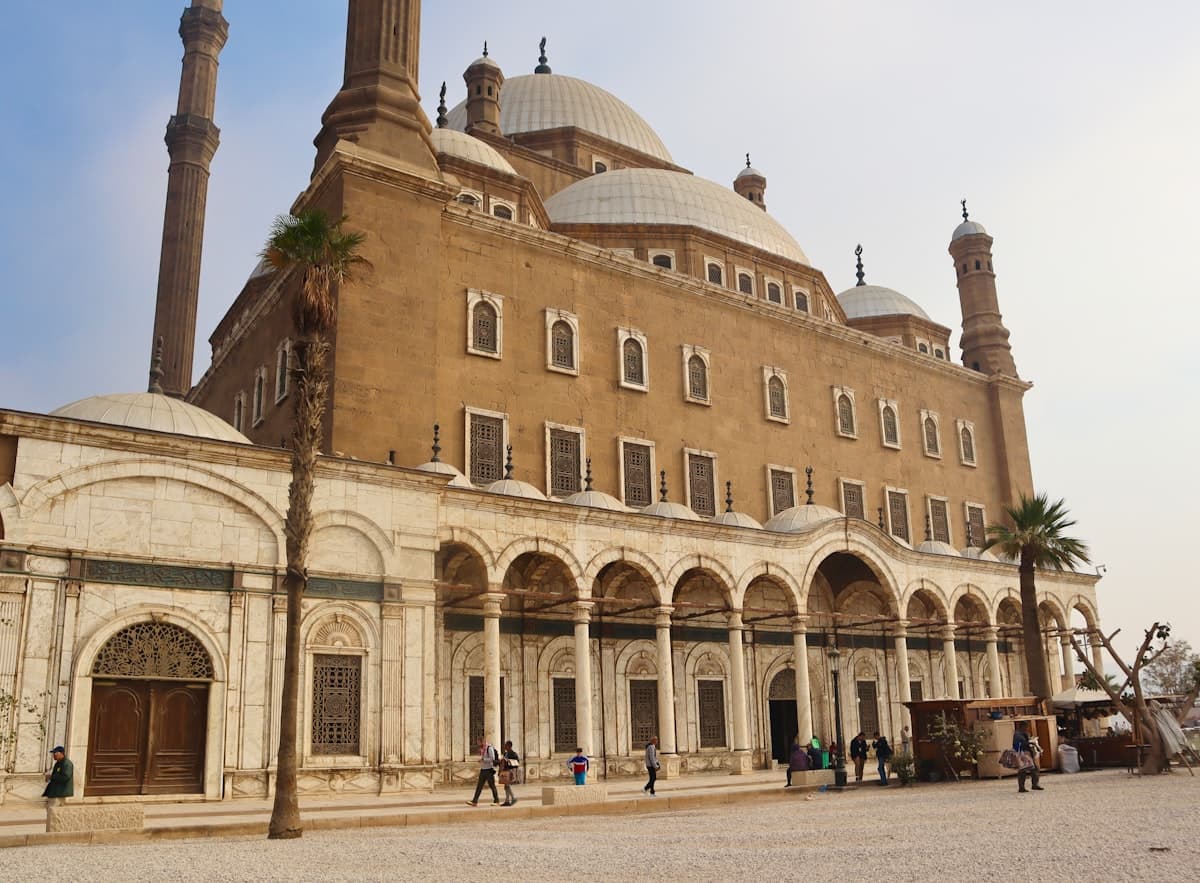
Mohamed Ali Pasha was not Egyptian. He was not Arab. He was born in Kavala, a port city in what is now northern Greece, in 1769, to an Albanian family that had been part of the Ottoman provincial military class for generations. He came to Egypt in 1801 as a low-ranking commander in an Ottoman force sent to expel Napoleon's army. Within four years, he had outmaneuvered the Mamluks, neutralized the Ottoman governor, and gotten the Sultan in Istanbul to recognize him as the Wali of Egypt. He would rule until 1848, and his descendants would rule until 1952.
This Albanian history in Egypt is the essential context for the mosque that bears his name. When Mohamed Ali began construction in 1830, he was not building a place of worship. He was building a dynastic statement. He chose the highest point inside the Citadel of Saladin, a medieval fortress complex that had been the seat of Egyptian power since 1176. He demolished a group of Mamluk structures that had stood there for centuries to clear the ground. Historians still debate how many of those buildings were genuinely derelict and how many were sacrificed for symbolism. The mosque was completed in 1857, nine years after his death.
The architect was a Greek named Yusuf Bushnaq, and the design is explicitly Ottoman, modeled on the Sultan Ahmed Mosque in Istanbul. Mohamed Ali wanted the skyline of Cairo to announce something: that Egypt under his rule was a modern, Mediterranean-facing power, not a backward province. He modernized the army, sent Egyptian students to Paris, built factories, and broke the Mamluk military class so thoroughly that in 1811 he invited their leaders to a banquet at the Citadel and had them massacred on the way out. Between 470 and 500 Mamluks were killed that day on the narrow ramp that still descends from the Citadel's upper gate.
Inside the Mosque: What You Are Actually Looking At
The courtyard you cross before entering the prayer hall is covered in alabaster, which is why the mosque is sometimes called the Alabaster Mosque. The stone came from quarries near Beni Suef, roughly 120km south of Cairo. In direct light it glows with a faint amber warmth. It is also extremely slippery when wet, something the management addresses with thin rubber mats that are ugly and only partially effective.
The interior of the prayer hall is a single large space covered by a central dome 52 meters high, surrounded by four smaller semi-domes. The design creates an effect of suspended weight: the dome appears to float because the transition between the dome and its drum is handled with so many windows that the supporting structure seems to dissolve into light. There are 365 windows in total, one for each day of the year according to the standard explanation, though this is almost certainly a retroactive piece of symbolism rather than an original design intention.
The chandelier system is original and extraordinary. Hundreds of glass globes hang at eye level on circular iron frames, meaning the entire space was historically lit from roughly head height rather than from above. The effect at dusk, when the globes are illuminated, is a complete inversion of what you expect from a domed interior.
Mohamed Ali's tomb is in the prayer hall, enclosed behind a white marble screen to the right as you enter. He died in Alexandria, not in Cairo, and was brought here for burial. The tomb itself is modest for a man who remade Egypt. His dynasty would build more elaborate funerary monuments. He got a marble enclosure and a brass-fitted screen.
The Terrace That Most People Rush Past
Before or after the mosque, go to the northern terrace of the Citadel. This is the reason to arrive at 8am. From this terrace you see the entire geometry of Cairo laid out below you: the minarets of Islamic Cairo in the foreground, the Nile as a flat grey line in the middle distance, and on clear winter mornings, the pyramids of Giza visible on the western horizon as small dark triangles above the haze. Khufu, Khafre, and Menkaure, 25km away and still the largest objects on the western skyline.
This view is why the Citadel was built where it was. Saladin's engineers chose this spur of the Muqattam Hills in the 1170s because it controlled sightlines in every direction. You could see an approaching army from any quarter. The same logic made it the obvious site for Mohamed Ali's mosque: visible from everywhere, impossible to ignore.
The Connections: Four Thousand Years in One View
The ground the Citadel sits on has a longer history than the fortress itself. The Muqattam Hills were quarried for limestone used in Old Kingdom construction, meaning some of the stone in the Giza pyramids came from the same escarpment you are standing on. A medieval aqueduct built by the sultan Baybars in the 13th century to carry water from the Nile to the Citadel still has surviving sections visible in the neighborhood of Fustat below. Fustat itself was the first Islamic capital of Egypt, established in 641 AD, and sits directly on top of a Roman fortress called Babylon, whose walls you can still walk through at the Coptic Museum 3km west.
The neighborhood of Islamic Cairo that spreads north from the Citadel contains the mosque of Sultan Hassan, built between 1356 and 1363 and widely considered the most architecturally significant building in Cairo. It sits almost directly below the terrace of the Mohamed Ali Mosque. The two buildings are separated by 500 years and a complete change of political order, but their relationship is visible in a single glance: the medieval Mamluk mass and the Ottoman-influenced dome in direct conversation across the rooftops.
Mohamed Ali's dynasty also connects this site to the broader 19th century story of Egyptian antiquities leaving Egypt. His grandson Ismail gave away obelisks to the British (now on the Thames Embankment), the Americans (Central Park, New York), and indirectly enabled the conditions under which thousands of objects moved from Egyptian excavations into European museums. The broken French clock in the courtyard is a small, ironic monument to this entire era of exchange.
Common Mistakes
Arriving at midday in summer. The courtyard has no shade and the alabaster reflects heat with remarkable efficiency. Between June and August, temperatures on the courtyard surface exceed 45 degrees Celsius by noon. The mosque is open at 8am. Use those hours.
Paying for a guide at the Citadel gate. Unlicensed guides at the entrance charge EGP 200 to 400 and generally tell you the same things printed on the information boards inside. If you want a proper guide, book one in advance through a licensed agency in Islamic Cairo. The difference in knowledge and honesty is substantial.
Skipping the Gawhara Palace. Inside the Citadel complex, included in your entry ticket, is a 19th-century palace built by Mohamed Ali that contains original Ottoman-era furniture, French decorative objects, and portraits of the Albanian dynasty that ruled Egypt. Almost nobody goes in. It is a quiet, direct encounter with the people behind the mosque, and it takes 45 minutes.
Spending money on the sound and light show. It costs EGP 350, runs in the evening from the Citadel grounds, and narrates Egyptian history at a pace designed for people who have never thought about Egypt before. Everything it tells you is in this article or on the information boards inside the complex. Skip it entirely.
Missing the Massacre Ramp. The narrow passage inside the Citadel's Bab al-Azab gate where the Mamluk massacre occurred in 1811 is not prominently labeled. Ask the guards or look for the steep stone ramp descending from the upper courtyard toward the lower gate. The stones are original. The event that happened there determined the entire subsequent political shape of modern Egypt.
Wearing shoes that slip. The alabaster courtyard and many of the interior floors require you to remove your shoes or wear provided coverings. Socks on alabaster are genuinely hazardous. Bring shoes you can slip on and off easily, and consider grip socks if you have them.
Treating this visit as a standalone. The Mohamed Ali Mosque without the Sultan Hassan Mosque directly below it is half a story. Budget time for both. They are 400 meters apart. Sultan Hassan's interior, specifically its four iwans and central fountain courtyard, represents a completely different architectural logic from the Ottoman dome above, and the contrast makes each building more legible.
Practical Tips
Dress conservatively. The mosque is active. Women are required to cover their hair; scarves are available at the entrance but bringing your own is more comfortable. Men in shorts will be given a wrap. Neither is optional.
Friday morning between 9am and 11am is the best time to photograph the courtyard with minimal crowds. Avoid Friday midday entirely due to prayers.
The Citadel complex is large enough that a bad map will waste an hour. Download the area on Google Maps before you go. Cell signal inside the upper Citadel is unreliable.
The best coffee near the Citadel is at one of the small cafes on Salah Salem Street, not at the tourist facilities inside the complex. The interior cafeteria is expensive and mediocre.
If you are combining the Citadel with Islamic Cairo, the logical order is: Citadel in the morning, then walk or take a short taxi north to Khan el-Khalili and the Al-Azhar area for the afternoon. The two areas are connected historically and geographically, and the walk between them passes through medieval streetscapes that have not changed substantially since the 14th century.
Frequently Asked Questions
The Weekly Dispatch
More on Egypt, every Friday.
Cultural depth and places most guides never mention.
No spam. Unsubscribe anytime.