Upper Egypt Coptic Villages: A Cultural Travel Guide
The Coptic villages of Upper Egypt predate Islam by six centuries and Christianity itself by older roots. This guide goes beyond churches to the living communities behind them.
Quick Facts
- Best time to visit
- October to February. Winter temperatures between 18C and 28C make walking between sites comfortable. Summer heat above 40C is serious and most village churches have no air conditioning.
- Entrance fee
- Most village churches free. Deir el-Muharraq donation EGP 20-50 (under $1 USD). White Monastery EGP 50 (approx $1.60 USD) for non-Coptic visitors. Gabal al-Tayr church free; boat crossing EGP 10-15 per person.
- Opening hours
- Monasteries generally 7am to 5pm daily. Village churches irregular; best visited 9am to noon. Closed or restricted during active liturgy services.
- How to get there
- Train Cairo to Minya: EGP 85-160 second class AC, 3-4 hours. Train Cairo to Sohag: EGP 100-160, 4-5 hours. Local microbus Minya to Qusiya: EGP 15-25. Private driver Minya area full day: EGP 600-900.
- Time needed
- Minimum two full days for the Minya cluster. Add a third day for Sohag and the White and Red Monasteries. A serious visit covering major sites between Minya and Asyut requires four days.
- Cost range
- Budget EGP 700-1,200 per day including transport, accommodation, food, and donations. Mid-range EGP 1,800-2,800 per day with private transport and hotel accommodation in Minya or Sohag.
The monks of Deir el-Muharraq, near Qusiya in Minya Governorate, believe their monastery stands on the exact spot where the Holy Family rested for six months during the Flight into Egypt. That claim sounds like pious legend until you realize the monastery's oldest church, Abu Seifein, is dated by scholars to the fourth century, built on what was almost certainly a pre-Christian cult site dedicated to a local deity. The village around it, Qusqam, has been continuously inhabited since at least the Middle Kingdom. Whatever the theological arguments, something about this place has compelled human devotion for roughly three thousand years. That is not an advertisement. That is just the situation.
The Coptic villages of Upper Egypt are not a footnote to the pharaonic trail. They are a parallel civilization, running alongside it, overlapping it, sometimes built directly from its stone. Most travelers who make it to Luxor or Aswan never encounter them. The ones who do often come away thinking they've found something secret. They haven't. These communities have been here the whole time.
Quick Facts
Best time to visit: October to February. Heat above Minya between June and August is serious: 42C is normal, and many village churches have no climate control.
Entrance fees: Most working monasteries and village churches are free, though donations are expected and genuinely needed. Deir el-Muharraq charges a nominal donation of around EGP 20-50 (under $1 USD). The White Monastery (Deir Anba Shenouda) near Sohag charges EGP 50 (approx $1.60 USD) for non-Coptic visitors. Al-Adhra Church in Gabal al-Tayr charges nothing but the boat crossing.
Opening hours: Monasteries generally open 7am to 5pm daily, closing during prayer services. Village churches keep irregular hours: arrive between 9am and noon for the best chance of finding a caretaker.
How to get there: Trains from Cairo to Minya run roughly every two hours; second-class AC costs around EGP 85-120 (approx $2.75-$4 USD). Minya to Qusiya by microbus costs EGP 15-25. Sohag is reachable by train from Cairo for EGP 100-160. Hiring a driver in Minya for a full-day village circuit runs EGP 600-900. Do not attempt this region without a local contact or a guide who speaks Arabic and knows the roads between villages.
Time needed: Two full days minimum to cover the Minya cluster (Deir el-Muharraq, Gabal al-Tayr, Beni Suef area churches). Add a third day to reach Sohag and the White and Red Monasteries.
Cost range: Budget EGP 700-1,200 per day including transport, food, and donations. Mid-range EGP 1,800-2,800 if using private transport and staying in Minya's better hotels.
Why This Place Matters
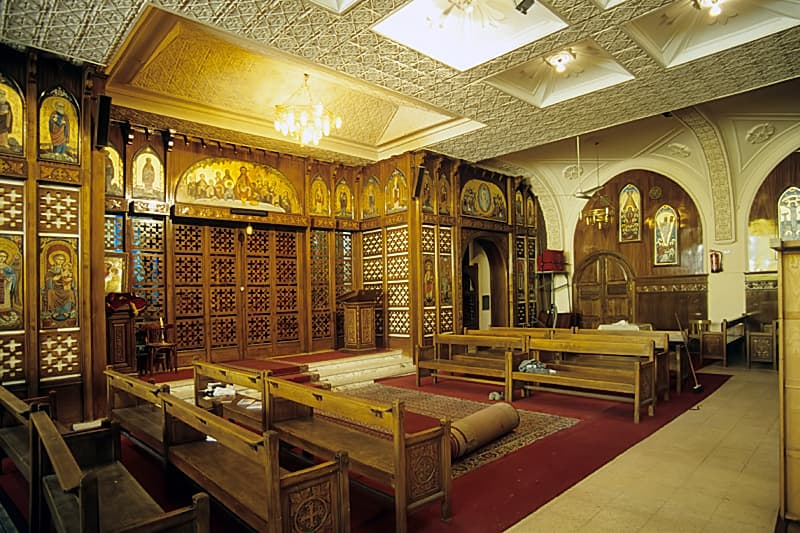
Egyptian Christianity is not a transplant. It grew here, in the Nile Valley, shaped by the same soil and light and administrative logic that shaped the pharaonic world before it. The Coptic script, still used in church liturgy today, is the last living descendant of ancient Egyptian hieroglyphic language: it uses the Greek alphabet plus seven additional letters borrowed directly from Demotic, the cursive script of late-period Egypt. When a Coptic priest in a village church near Asyut chants the liturgy, he is producing sounds closer to ancient Egyptian than anything else currently spoken on earth.
This is the fact that reframes everything. The Copts are not a minority in Egypt. They are, in a meaningful linguistic and cultural sense, the most direct heirs of the civilization tourists come to see. The pharaonic monuments belong to everyone by inheritance, but the Copts carry the language in their throats.
The region between Minya and Sohag, roughly 300 kilometers south of Cairo, contains the highest concentration of early Christian sites in the world outside Jerusalem and Rome. Many of them sit within walking distance of pharaonic sites, sometimes physically integrated with them. The cave churches cut into the cliffs at Gabal al-Tayr were carved into a face of rock that had held Eighteenth Dynasty inscriptions for fifteen centuries before the first hermit arrived. The builders knew what they were doing: sacred topography transfers.
What You Will Actually See
Deir el-Muharraq and the Qusiya Circuit
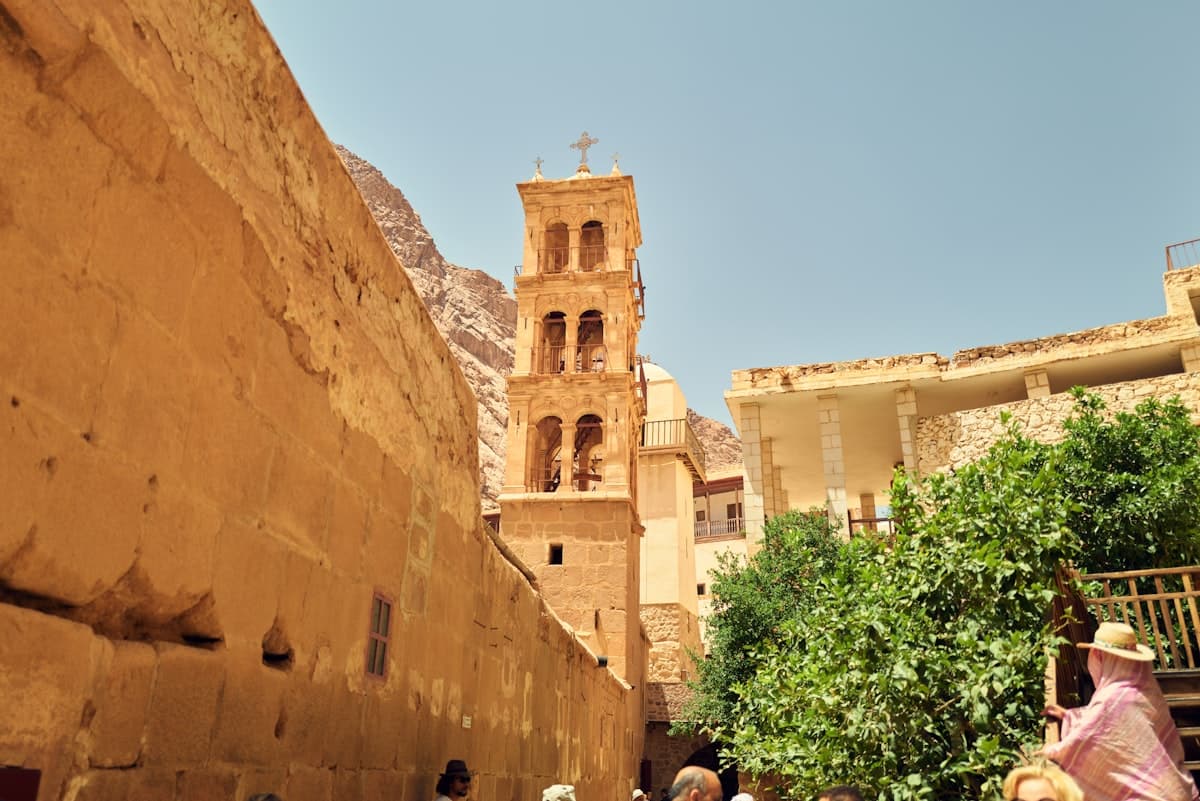
The monastery at Qusiya looks, from the outside, like a small fortress: thick mudbrick walls, minimal windows, a gate that feels like it expects trouble. Inside, the compound holds four churches of different periods layered on top of each other in a way that makes architectural dating nearly impossible. The oldest section, the cave church dedicated to the Virgin, is where the devotional intensity is concentrated. Copts come here from Cairo, from Alexandria, from the diaspora in Australia and Canada. On major feast days, particularly the two-week celebration in late June around the Feast of the Apostles, ten thousand pilgrims camp in the courtyard.
The monk who may show you around will likely speak only Arabic. He will explain, in careful detail, which stone was placed by which patriarch, which lamp oil has been burning uninterrupted since which century. The details will be impossible to verify and completely beside the point. What matters is that someone has been tending this space continuously for sixteen hundred years through Roman persecution, Arab conquest, Fatimid caliphates, Crusades, Ottoman rule, and three different Egyptian republics. The continuity itself is the argument.
Six kilometers from the monastery, the Church of the Virgin at Gabal al-Tayr sits at the top of a limestone cliff above the Nile. You reach it by a small motorboat from the eastern bank, EGP 10-15 per person for the crossing, then climb 166 steps cut into the rock. The cliff face still shows Eighteenth Dynasty quarry marks. The church inside is small, smoke-darkened, and crowded with icons in the flat, frontal Byzantine style that strikes some Western visitors as crude and strikes others as the most direct religious art they've ever seen. The view of the Nile from the entrance is what it is: the green ribbon of cultivation, the desert beginning exactly where the irrigation stops, the opposite bank shimmering in the way that Luxor never quite does because here there are no tourists to observe you observing it.
The White Monastery and Sohag
Deir Anba Shenouda, the White Monastery, stands outside Sohag and contains one of the most significant facts in Egyptian architectural history that most visitors walk past without registering. The outer walls of the monastery are built entirely from blocks quarried from the nearby pharaonic temple of Athribis. The builders in the fifth century did not attempt to disguise this. The blocks still carry partial hieroglyphic inscriptions, cartouches, images of offering. The wall of a Christian monastery is also, simultaneously, a fragment of a demolished temple to Wepwawet, a jackal-headed deity of the dead. The abbot Shenouda, who built this monastery and became one of the most important figures in early Christian theology, almost certainly knew this and almost certainly considered it correct: the old powers had been defeated and their material form was now put to better use.
Shenouda himself was no gentle figure. He ran his monastery with military discipline, expelled monks he considered insufficiently rigorous, and wrote theological polemics in Coptic that circulated from Egypt to Ethiopia to Armenia. He also preserved the Coptic language in written form at a moment when Arabic was displacing everything else. The monastery library once held thousands of his manuscripts. Most are now in European collections: the Bibliothèque nationale in Paris, the British Museum, the Vatican. What's left in Sohag are fragments, but the building stands.
The Red Monastery, Deir Anba Bishoi, is two kilometers from the White and less visited, which makes it more rewarding. The interior paintings, restored in the 1990s and 2000s with funding from the American Research Center in Egypt, are among the finest surviving examples of late antique Christian art in the world. The colors, particularly in the sanctuary apse, are extraordinary in the technical sense: the pigments were ground from minerals found in the Eastern Desert, and they have not faded in fifteen centuries.
The Connections
The Upper Egypt Coptic villages travel guide cannot honestly be written without acknowledging what surrounds them. Asyut, the main city of the region, was one of the most important cult centers in pharaonic Egypt, capital of the jackal god Wepwawet, whose priesthood managed death ritual for the entire southern nome. By the Coptic period, Asyut was already a major center of Christian monasticism: its caves held hundreds of hermits by the third century. By the medieval Islamic period, it was a trading hub on the route between Cairo and Sudan, and its merchants funded mosques and madrasas that still stand in the old city. None of these phases erased the previous one. The modern city of Asyut, chaotic and undervisited by foreign travelers, contains pharaonic tomb complexes, Coptic cave churches, and Ottoman-era architecture within a few square kilometers. The scholarship on how these communities interacted, traded, and occasionally protected each other from state violence is genuinely fascinating and almost entirely absent from tourist literature.
The Nile here was, in the pharaonic period, a different river: slower, broader, subject to flooding patterns that have been altered by the High Dam. The early Christian hermits chose their cliff caves partly because those cliffs put them above flood level. The same cliffs had been used as quarries, tombs, and cult sites for three thousand years before them. The geography imposed a logic that all these civilizations followed independently.
Common Mistakes
Treating this as a day trip from Luxor. Luxor to Sohag is roughly 160 kilometers, Luxor to Minya is 330 kilometers. The roads are serviceable but the logic of the place requires staying in Minya or Sohag overnight. A day trip produces a rushed, superficial experience that does justice to neither the sites nor the communities.
Arriving without an Arabic speaker. English is rare in these villages. Not in the charming, improvise-your-way-through-it sense. Genuinely rare. A guide who speaks Arabic and has relationships with the monastery staff will unlock conversations and spaces that simply are not available to someone pointing at a phrasebook.
Visiting during Coptic feast days without preparation. The monastery at Qusiya during its June festival is extraordinary but genuinely overwhelming: crowds, noise, food vendors, pilgrims sleeping in every available space. If you want quiet access to the churches, visit outside these periods. If you want to witness something that has no parallel in Egyptian tourism, go during the feast and accept the chaos.
Assuming the churches are purely historical. These are working religious sites with active congregations. Dress covers shoulders and knees. Women may be asked to cover their hair in some sanctuaries. Photography during services is not acceptable and in some monasteries is prohibited entirely inside the churches. Ask before raising a camera.
Skipping the village churches in favor of only the famous monasteries. The small, unnamed churches in villages between Qusiya and Asyut, served by single priests with congregations of forty families, are where the actual living tradition is most visible. They require more effort to find and more language to navigate. They are worth it.
Underestimating the logistics between sites. The roads between villages in Minya Governorate range from adequate to genuinely difficult. A driver who knows the area is not a luxury. Microbuses run on the main roads but not the side roads.
Not coordinating with the monastery guesthouses in advance. Deir el-Muharraq and the White Monastery both offer accommodation for visitors, simple and inexpensive, around EGP 150-250 per night including basic meals. These rooms book quickly before feast days and must be arranged by phone, in Arabic, ahead of arrival.
Practical Tips
Minya is the logical base for the northern cluster of sites. The Aton Hotel is adequate at EGP 600-900 per night for a double room and has staff who can help arrange drivers. For Sohag sites, the Sohag Grand Hotel is the most reliable option at a similar price point.
Water and food: carry both. Village shops exist but are not reliable. The monasteries serve food to pilgrims on feast days, but outside those periods the caretaker monks are not a restaurant. A packed lunch from the Minya market costs EGP 50-80 and is better than anything you'll find near most sites.
Security in this region has improved substantially since the incidents of the 2010s, but the governorates of Minya and Asyut historically have checkpoints for foreign travelers. Carry your passport. Be patient with the process. This is not targeting: it is the standard procedure for foreigners traveling outside the tourist zones, and it moves quickly.
For the boat crossing to Gabal al-Tayr, the boats run from roughly 8am to 4pm. The last crossing back from the church is around 3:30pm. Missing it means waiting or swimming, and you should not swim this section of the Nile.
The best general introduction to this material before you go is Gawdat Gabra's edited volume on Coptic monasteries, which is available in English and gives the historical context that no on-site signage will provide. Read it on the train south. You'll arrive knowing what questions to ask.
Frequently Asked Questions
The Weekly Dispatch
More on Egypt, every Friday.
Cultural depth and places most guides never mention.
No spam. Unsubscribe anytime.