Egypt Travel Budget Guide: How Much You Actually Need
A full day in Luxor, including two temple entries, a felucca ride, and dinner, can cost under $20. Most visitors spend three times that without seeing anything extra.

Quick Facts
- Best time to visit
- October through April. November to February is ideal across the whole country. Summer in Upper Egypt (Luxor, Aswan) regularly exceeds 45°C and is genuinely dangerous for outdoor sites.
- Entrance fee
- Varies by site. Giza plateau EGP 540 (approx $11), Egyptian Museum EGP 450 (approx $9), Grand Egyptian Museum EGP 1,000 (approx $20), Valley of the Kings EGP 360 for 3 tombs (approx $7), Karnak EGP 450 (approx $9). Luxor Pass $100 USD covers most sites for multiple days.
- Opening hours
- Most sites daily 6am to 5pm (summer) or 6am to 6pm (winter). Grand Egyptian Museum open daily 9am to 9pm. Individual site hours vary; always confirm on arrival as hours shift seasonally.
- How to get there
- Cairo by international flight from most hubs. Internal: Cairo to Luxor overnight train EGP 400 to 700 (approx $8 to $14), domestic flight EGP 1,500 to 3,000 (approx $30 to $60). Cairo metro EGP 10 flat fare. Uber and Careem cover most cities with base fares around EGP 80 to 150 for central journeys.
- Time needed
- Cairo alone needs 3 to 4 days minimum. Cairo plus Luxor plus Aswan needs 10 to 14 days for an unhurried visit. The full country including Sinai, Siwa Oasis, and the White Desert realistically requires 3 to 4 weeks.
- Cost range
- Budget EGP 800 to 1,200 per day (approx $16 to $24), mid-range EGP 2,500 to 4,500 per day (approx $50 to $90), comfort EGP 7,000 to 15,000 per day (approx $140 to $300). Two-week independent trip covering Cairo, Luxor, and Aswan: EGP 25,000 to 35,000 all-in excluding international flights.
A full day in Luxor, including two temple entries, a felucca ride, and a plate of koshary, can cost under $20. Most visitors spend three times that without seeing anything better. The gap is not luck. It is information. Egypt has one of the widest pricing spreads of any destination in the world: the same Nile view, the same monuments, the same food exists at five different price points depending on which door you walk through, which currency you carry, and whether you booked through a hotel lobby or a local operator. This guide exists to collapse that gap.
Quick Facts
Best time to visit: October through April. Summer temperatures in Luxor and Aswan regularly exceed 45°C (113°F), which makes outdoor sites genuinely dangerous, not just uncomfortable. Cairo is more tolerable year-round but November through February is the sweet spot for the whole country.
Daily budget ranges: Budget traveler: EGP 800 to 1,200 per day (approx $16 to $24 USD) covering a hostel bed, local meals, and one or two site entries Mid-range: EGP 2,500 to 4,500 per day (approx $50 to $90 USD) covering a mid-tier hotel, restaurant meals, private transport, and daily site visits Comfort traveler: EGP 7,000 to 15,000 per day (approx $140 to $300 USD) covering four-star hotels, guided experiences, and Nile cruises
Currency: Egyptian Pound (EGP). As of late 2024, the rate hovers around 48 to 50 EGP per USD following the March 2024 devaluation. Use bank ATMs in major cities. The airport exchange desks offer rates roughly 8 to 10 percent worse.
Getting there: Cairo is the primary hub. Direct flights connect it to most major European cities. Budget carriers including Wizz Air, Ryanair, and Air Arabia serve Cairo regularly. A one-way London to Cairo fare frequently drops below £80 if booked six or more weeks out.
Internal transport costs: Cairo metro, flat fare EGP 10 (under $0.25). Cairo to Luxor overnight train, EGP 400 to 700 in second class (approx $8 to $14). Cairo to Luxor by budget domestic flight, EGP 1,500 to 3,000 (approx $30 to $60) booked directly with EgyptAir or Nile Air.
---
Why the Price Gap Exists and Why It Matters
Egypt introduced a two-tier pricing system for monuments decades ago: Egyptians pay one price, foreigners pay another. After the 2016 and 2024 pound devaluations, the gap widened dramatically. The Giza plateau entrance, for instance, costs EGP 540 for foreigners (approx $11) and EGP 60 for Egyptians. This is not unusual globally, but what is unusual about Egypt is the layering of additional costs that accumulate invisibly on top of the official entry fee.
The standard tour operator markup on a Luxor day trip from a Cairo hotel can reach 400 percent. You pay $120 for something that, arranged independently, costs $28. The monuments are identical. The Egyptologist guide speaking into your earpiece costs more than the flight to get there.
The reason this matters beyond personal finance: the budget you choose determines the Egypt you see. Package tours cluster at Giza, Karnak, the Valley of the Kings, and Luxor Temple. Independent travelers eat koshary at Abou Tarek in Cairo (the restaurant has been operating since 1950 and serves one dish, perfectly), take the overnight train to Luxor, rent a bicycle on the West Bank for EGP 50 a day, and wander into tombs that receive fewer than thirty visitors a week. Both groups are technically in Egypt. They are not having the same experience.
---
Where Your Money Actually Goes: Cairo
Cairo's cost structure rewards anyone willing to move the way Cairenes move.
The metro system covers the city's spine for EGP 10 per journey regardless of distance, which means getting from Maadi to the Egyptian Museum near Tahrir costs the same as one stop. A taxi via Uber or Careem from most central neighborhoods to Giza runs EGP 80 to 120 (approx $1.60 to $2.40). The white-and-black metered taxis cost slightly less but require negotiating a price before you get in, and the negotiation itself is a transaction with its own etiquette.
Food costs almost nothing if you eat where Egyptians eat. A bowl of koshary, Egypt's national dish of rice, lentils, pasta, and spiced tomato sauce, costs EGP 30 to 60 in any local restaurant. A ful and ta'meya breakfast (fava beans and falafel with bread) costs EGP 20 to 40. A full sit-down lunch at a mid-tier restaurant in Zamalek or Heliopolis runs EGP 200 to 400 per person. Western-style brunch cafes in Maadi charge EGP 350 to 600 per person, which is real money in a city where the median monthly income is roughly EGP 4,500.
The Egyptian Museum on Tahrir charges EGP 450 for foreigners (approx $9). The Grand Egyptian Museum at Giza, which opened in stages from 2022 and holds the complete Tutankhamun collection of over 5,000 objects, charges EGP 1,000 for the main galleries (approx $20). That second figure is steep by local standards but represents genuine value: the GEM is the largest archaeological museum in the world by footprint, covering 490,000 square meters, and the Tutankhamun galleries alone contain objects that have never been publicly displayed before.
What is not worth paying for in Cairo: the Nile dinner cruise. Every operator sells them for EGP 800 to 1,500 per person. You get a mediocre buffet, a bellydance performance designed for busloads, and a view of the Nile you could have from any riverside cafe for the price of a tea. The Nile is better experienced from a public felucca booked directly at the dock for EGP 100 to 150 per hour.
---
Where Your Money Actually Goes: Luxor and Aswan
Luxor is the most concentrated ancient site on the planet. Within a 20-kilometer radius, you have Karnak Temple, Luxor Temple, the Valley of the Kings, the Valley of the Queens, the Mortuary Temple of Hatshepsut, Medinet Habu, the Ramesseum, and the Nobles' Tombs. The site entrance fees add up fast.
The Luxor Pass is either excellent value or a waste, depending entirely on your schedule. The standard pass costs $100 USD (paid in dollars only, not pounds, at the Luxor tourist office on the Corniche) and covers most major sites. If you plan to visit Karnak (EGP 450), the Valley of the Kings including three tombs (EGP 360), Luxor Temple (EGP 360), Hatshepsut's temple (EGP 360), and Medinet Habu (EGP 180) over three or four days, the math works. If you are spending a single day in Luxor as part of a longer itinerary, pay individually.
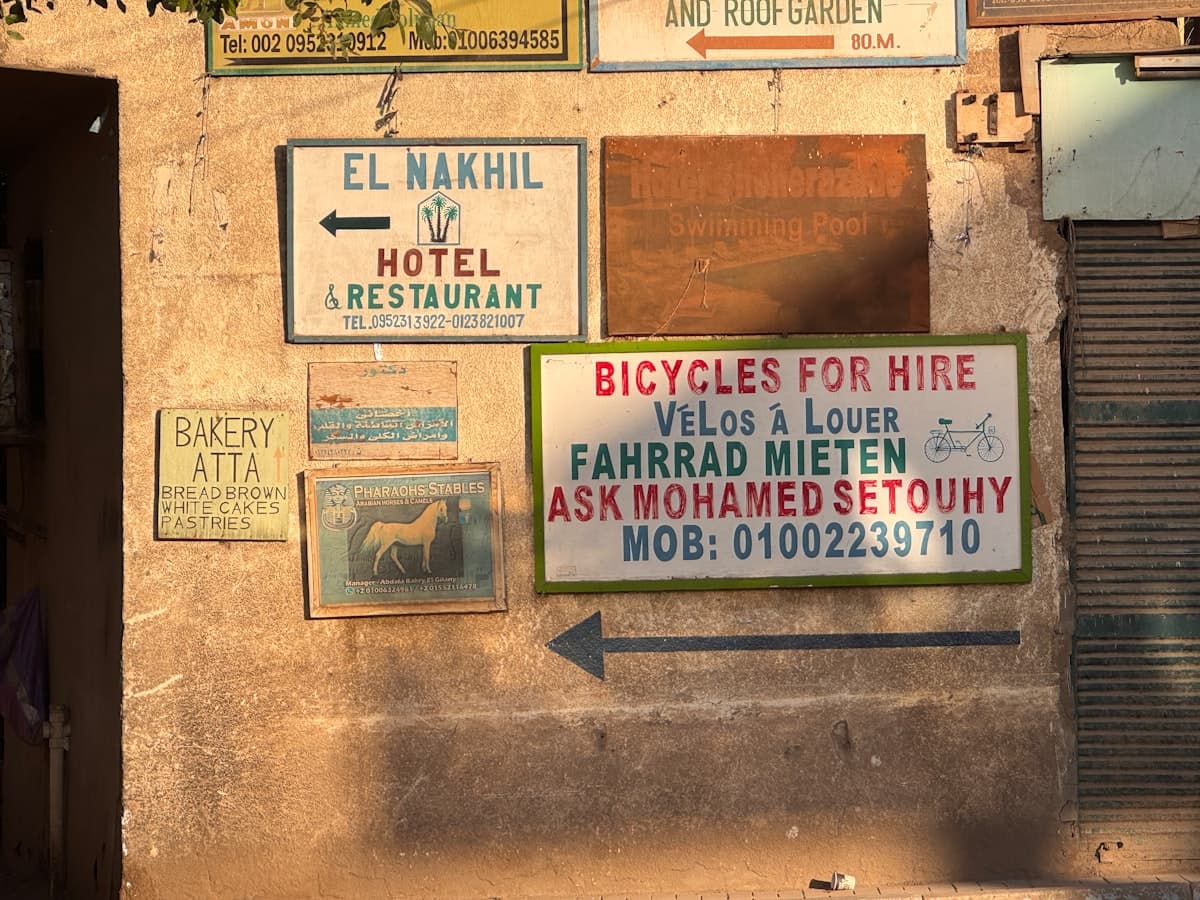
The West Bank bicycle rental model deserves its own mention. You cross the Nile by public ferry for EGP 5, rent a bicycle at the landing for EGP 50 per day, and self-navigate between sites. The Nobles' Tombs, specifically the Tombs of Sennefer and Rekhmire, cost EGP 100 each and receive almost no visitors. Sennefer's tomb ceiling is painted to represent a grapevine canopy. It dates to around 1400 BC and the paint has barely faded. You will likely have it entirely to yourself.
Aswan operates on similar logic. The Nubian village visits that operators sell for $40 per person can be arranged independently by taking a public motor boat across the Nile for EGP 20 and walking into Siou or Koti village directly. The communities are used to independent travelers and will feed you and show you around for the cost of a purchase or a small tip.
Philae Temple, which was dismantled stone by stone and relocated to Agilkia Island between 1972 and 1980 to save it from the rising waters of Lake Nasser, costs EGP 360 to enter plus EGP 200 round-trip for the mandatory motorboat to the island. Book the boat privately at the dock rather than through your hotel and you will pay roughly half that.
---
The Connections: How Egypt's Budget Landscape Reflects Its History
The dual pricing system at Egyptian monuments has a specific origin: it was introduced under the Mubarak government in the 1990s as a mechanism to fund the Supreme Council of Antiquities without raising taxes. The logic was sound. Foreign tourism generated hard currency. Charging foreigners more preserved access for Egyptians. What nobody fully anticipated was the way hotel concierges, tour operators, and informal guides would layer additional fees on top of the official structure until the total cost bore no relationship to the actual experience.
This dynamic echoes something older. Medieval Cairo's Khan el-Khalili bazaar, established in 1382 by the Mamluk emir Djaharks el-Khalili on the site of a Fatimid royal cemetery, operated on exactly the same principle: one price for locals who knew the market, another price for traders and pilgrims who did not. The negotiation was not deception. It was an established social contract. The difference today is that most visitors do not know the contract exists, let alone how to enter it.
The practical consequence: learning to say "kam da?" (how much is that?) in Arabic, and then countering with roughly 40 percent of the opening price, is not just a money-saving tactic. It is the correct way to participate in the commercial culture you came to experience.
---
Common Mistakes That Cost Real Money
Exchanging currency at the airport. The rate at Cairo International Airport exchange desks consistently runs 8 to 12 percent below the interbank rate. Use the ATMs inside the arrivals hall instead. Citibank and Banque Misr ATMs inside the airport give near-market rates with a fixed fee of roughly EGP 30.
Booking Nile cruises through European operators. A four-night cruise between Luxor and Aswan booked through a London or Berlin travel agent typically costs 600 to 900 euros. The exact same boat, sometimes the exact same cabin grade, booked through a Cairo-based operator or directly with the cruise company costs EGP 8,000 to 14,000 (approx $160 to $280). The markup exists purely because the foreign operator takes a commission and assumes you will not look further.
Paying the entrance fee for the sound and light show at Karnak. It costs EGP 450, runs for one hour, and tells you information you will have already absorbed from reading any single good article about the site. The theatrical value is low. The Karnak complex at dawn, when you can enter at 6am before the tour buses arrive, costs the same EGP 450 and offers something the sound and light show cannot: silence, low golden light on the hypostyle hall's 134 columns, and the specific smell of ancient stone warming in the sun. Choose dawn every time.
Underestimating the Luxor Pass break-even calculation. The pass is sold in USD and only refunded in USD, with no exceptions. If the pound continues to shift, the dollar price becomes relatively more expensive. Do the site-by-site math before buying, not after.
Tipping without a framework. Egypt runs on baksheesh. This is not corruption. It is a parallel micro-economy with established rates. A temple guardian who opens a usually-closed inner chamber for you: EGP 50 to 100 is appropriate. A hotel porter carrying two bags: EGP 20 to 30. A restaurant meal: 10 percent of the bill is standard, 15 percent is generous. Ignoring tipping entirely creates genuine hardship for workers earning EGP 1,500 a month. Overtipping (handing out EGP 200 for minor services) distorts local prices for Egyptian visitors.
Buying bottled water at tourist sites. Water sold inside the Giza plateau or at Valley of the Kings entry points costs EGP 30 to 50 per bottle. The same water bought at any kiosk outside the site perimeter costs EGP 10. Bring two liters in. Buy more before you enter.
Taking domestic flights instead of overnight trains. The Cairo to Luxor overnight train in second-class air-conditioned sleeper costs EGP 400 to 700 and takes approximately 10 hours. It saves a hotel night, deposits you in Luxor at 5am (ideal for beating the heat and the crowds), and is a genuinely good experience. The domestic flight takes one hour and costs three to five times more, requires airport transfers at both ends, and puts you in Luxor at the same time but with less money and less sleep.
---
Practical Tips
Carry a mix of EGP and USD. Many Nile cruise operators, some hotels, and the Luxor Pass office deal only in dollars. Egyptian banks and ATMs dispense pounds. Maintain both.
The best time to visit major sites is the first hour after opening. Tour groups from Nile cruise ships typically arrive at Valley of the Kings between 9 and 11am. At 6am, you will share it with almost nobody.
For budget accommodation, Cairo's Downtown and Zamalek neighborhoods both offer hostels in the EGP 350 to 600 per night range for a dorm bed. Luxor's West Bank has family guesthouses around EGP 600 to 900 for a private room. Aswan's Nubian guesthouses on Elephantine Island run EGP 700 to 1,200 for a private room with Nile views and usually include breakfast.
SIM cards at Cairo Airport: a Vodafone Egypt or Orange SIM with 20GB of data costs EGP 200 to 300. Buy one immediately on arrival. Offline maps via Maps.me downloaded for Egypt before you leave home are worth having as backup.
The honest Egypt travel budget calculation, for a two-week trip covering Cairo, Luxor, and Aswan traveling independently: EGP 25,000 to 35,000 all-in (approx $500 to $700 USD) is realistic and comfortable. That includes accommodation, food, transport, and every major site entry. It does not include international flights. Anyone who tells you Egypt requires more than that to do properly is either selling you a package tour or has never moved through the country on their own.
Frequently Asked Questions
The Weekly Dispatch
More on Egypt, every Friday.
Cultural depth and places most guides never mention.
No spam. Unsubscribe anytime.