Egypt Visa Requirements for Americans: What You Need to Know
Americans can buy an Egypt visa at the Cairo airport for $25. Most do. Almost none know there are three other ways, one of which is free.

Quick Facts
- Best time to visit
- October through February for Cairo and Upper Egypt; avoid August heat inland. Sinai diving is good year-round, with clearest visibility March through May.
- Entrance fee
- $25 USD single entry e-visa or visa on arrival; $60 USD multiple entry e-visa; free 15-day stamp for Sinai-only arrivals via Sharm el-Sheikh, Taba, or Nuweiba
- Opening hours
- E-visa portal visa2egypt.gov.eg is available 24 hours; processing takes 3 to 7 business days. Cairo airport visa-on-arrival counter operates around the clock.
- How to get there
- Flights from New York to Cairo run roughly $700 to $1,100 return. EgyptAir flies direct from JFK. Most connections route through Frankfurt, Istanbul, or Doha. Airport taxi to central Cairo costs EGP 150 to 250 (approx $3 to $5 USD) via official metered cabs or pre-booked ride apps.
- Time needed
- Visa application takes 15 minutes online; factor 3 to 7 days for e-visa approval. Visa on arrival at airport averages 20 to 90 minutes depending on season and flight volumes.
- Cost range
- Budget EGP 600 to 900 per day inside Egypt (approx $12 to $18 USD), mid-range EGP 2,000 to 3,500 per day including accommodation. Visa cost is $25 USD on top of travel expenses.
The Part Nobody Tells You Before You Book the Flight
The Egyptian government began issuing e-visas in 2017, two years after a Russian charter plane was bombed over Sinai and international arrivals dropped by nearly 40 percent in twelve months. The e-visa was a deliberate policy response, a signal to travelers that Egypt was lowering its barriers. Seven years later, most Americans still line up at the visa-on-arrival counter at Cairo International Airport, unaware they could have handled this from a couch in Ohio. This guide is not about selling you Egypt. You have already decided to go. It is about making sure the paperwork does not eat the first three hours of the trip you have been planning for years.
Egypt visa requirements for Americans are genuinely simple, which makes the amount of bad information circulating about them almost impressive. Here is what is actually true, what it actually costs, and what happens if you get it wrong.
---
Quick Facts
Visa fee: $25 USD (single entry), $60 USD (multiple entry) via e-visa or on arrival. Some nationalities pay nothing; Americans are not among them.
E-visa processing time: Roughly 3 to 7 business days, occasionally faster.
Visa validity: 90 days from the date of issue.
Maximum stay per entry: 30 days.
Passport validity required: At least 6 months beyond your intended departure from Egypt.
Official e-visa portal: visa2egypt.gov.eg (the only legitimate government site; third-party sites charge $60 to $100 for the same document).
Where to get it: Online before departure, at Cairo International Airport on arrival, at select Egyptian consulates in the US, or, if entering through Sharm el-Sheikh for Sinai only, through a free entry stamp.
Best time to sort this out: At least two weeks before departure.
Cost range on the ground: Budget travelers in Egypt can manage on EGP 600 to 900 per day (roughly $12 to $18 USD at current rates) outside of visa costs. Mid-range Cairo comfort runs EGP 2,000 to 3,500 per day including accommodation and meals.
---
Why the Visa System Works the Way It Does
Egypt has been processing foreign visitors at its borders for longer than most modern nations have existed. The Ottoman-era system of firman, official travel permission granted by the sultan, required foreigners to carry documentation proving their purpose and their sponsor. The British protectorate period from 1882 to 1952 layered colonial bureaucracy over Ottoman administration. The result, after decades of independence-era reforms, is a system that is more functional than its reputation suggests, though that reputation was earned during genuinely chaotic periods.
The 2011 revolution temporarily collapsed tourist infrastructure at border crossings. The 2015 Sinai bombing accelerated the digital visa push. By 2019, when I cycled from Cairo to Aswan along the Nile, the e-visa system was functional but not yet widely known among American travelers. The men at the felucca docks in Luxor still laughed when I mentioned it. Their clients arrived dazed from the visa-on-arrival queue, which during peak season in December can run ninety minutes or longer.
The Egyptian pound devalued significantly against the dollar in 2016 and again in 2022, which means the $25 visa fee has become relatively cheaper in real terms for Americans while becoming more expensive for Egyptians traveling abroad. This context matters because Egypt's tourism economy is acutely sensitive to exchange rates, and the services you purchase once inside the country will feel extremely affordable. The visa is the expensive part, proportionally.
---
Your Four Options, Ranked by Convenience
Option 1: The E-Visa (Recommended)
Go to visa2egypt.gov.eg. Create an account. Upload a passport photo and your passport information page. Pay $25 for single entry or $60 for multiple entry. Receive a PDF. Print it or save it on your phone. Show it at the immigration desk in Cairo. You walk past the queue.
The e-visa is valid for 90 days from issue but permits only a 30-day stay per entry. If you are planning a longer trip, apply for the multiple-entry visa, which allows you to leave and return within that 90-day window. The common mistake is confusing the 90-day validity with the 30-day permitted stay. They are different numbers with different consequences.
One warning that is not prominently displayed on the portal: the e-visa links to your passport number. If you travel on a different passport than the one you used to apply, you will have a problem at immigration. This sounds obvious until you realize how many dual nationals carry two passports and occasionally grab the wrong one.
Option 2: Visa on Arrival
This works. It has always worked. The counter at Cairo International Airport is staffed, the fee is $25 in cash (USD, EUR, or GBP accepted; they will give change in Egyptian pounds at a rate slightly worse than the market rate), and the stamp is placed in your passport while you watch. The problem is not functionality. The problem is that during peak season, December through February and again in August, the queue can consume an hour or more of your life. You will watch your checked bags orbit the carousel without you. You will do this standing under fluorescent lights after an overnight flight from New York.
If you are arriving off-peak or on a connecting flight that has already burned through immigration time, visa on arrival is fine. If you are arriving at 6am in January with 200 other passengers from a Frankfurt hub, the e-visa will feel like the smartest $25 you ever spent.
Option 3: Egyptian Consulate in the US
There are Egyptian consulates in Washington DC, New York, Houston, Chicago, Los Angeles, and San Francisco. You can apply for a visa in person or by mail. Processing takes 3 to 5 business days. The fee is $25 for single entry. This option is useful if you have a passport that cannot be easily replaced (some travelers with limited validity prefer to minimize digital submissions) or if you want the visa physically stamped before departure for peace of mind. It is not necessary for most travelers and adds a logistical step that the e-visa eliminates.
Option 4: The Free Sinai Stamp
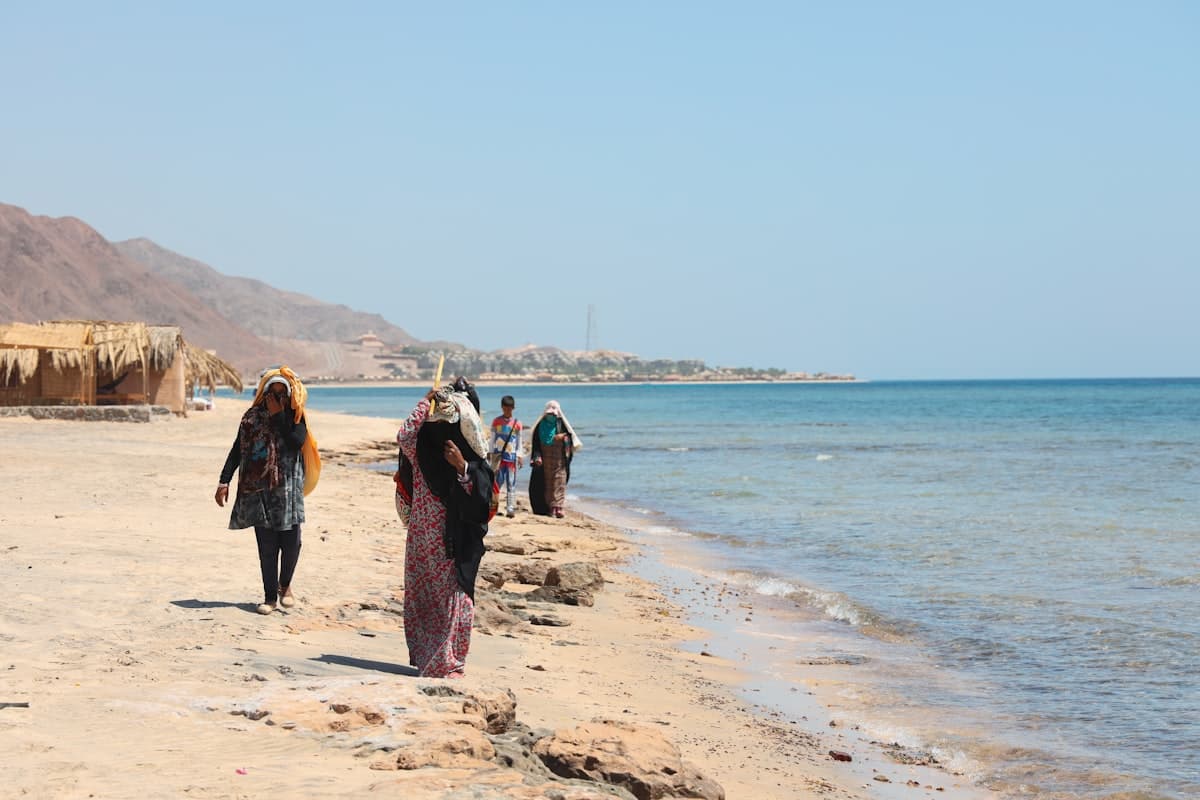
This is the option that surprises most people. If you are entering Egypt exclusively through the port of Nuweiba or the Taba border crossing from Israel or Jordan, or arriving at Sharm el-Sheikh airport, and your travel will remain within the South Sinai governorate, including Sharm el-Sheikh, Dahab, Nuweiba, and Saint Catherine's Monastery, you receive a free entry stamp valid for 15 days. No fee. No application.
The critical constraint: you cannot leave South Sinai with this stamp. If you want to go to Cairo, Luxor, or anywhere else in Egypt, you need a full visa. Travelers who discover this at the Sharm el-Sheikh bus terminal after booking a Cairo flight face a genuinely unpleasant choice between paying for a full visa on the spot or abandoning their plans. The free stamp is legitimate and useful for dive-and-snorkel trips or a Saint Catherine's pilgrimage. It is not a loophole for seeing all of Egypt on the cheap.
---
The Connections: How Egypt's Borders Have Always Been Negotiated
Sinai's special administrative status is not a modern bureaucratic quirk. The peninsula has existed as a threshold space for millennia. The ancient Egyptians considered it the eastern boundary of the known world, calling it Ta-Mefkat, the land of turquoise, and mining its copper and malachite through administrative outposts rather than permanent settlement. The Romans used it as a corridor. The Crusaders built a fortress at Taba that the Ayyubids under Saladin seized in 1170. The Ottomans administered it separately from the Nile Valley. Israel controlled it from 1967 to 1982. Egypt regained full sovereignty under the Camp David Accords, and the final territorial adjustment, the return of Taba itself, did not occur until 1989.
The free Sinai stamp exists partly because the Egyptian government wants to capture dive tourism in the Red Sea without requiring those travelers to navigate the full immigration apparatus. It is a policy that reflects geography as much as bureaucracy. Sinai has always been a place where the rules of the interior did not quite apply.
---
Common Mistakes
Applying through a third-party visa service. This is the biggest one. Search "Egypt e-visa" and you will see sponsored results for companies charging $60 to $120 to submit the same application you can submit yourself in fifteen minutes for $25. They are not scams in the legal sense. They do deliver the visa. They are simply unnecessary, and several of them have been cited for data security concerns given that you are submitting passport information.
Confusing the 90-day validity with the 30-day stay limit. Your e-visa is valid for 90 days from the date of approval, meaning you must enter Egypt within that window. Once inside, you may stay for 30 days per entry. These are different clocks. Plan your trip accordingly.
Assuming the visa can be extended easily. It can be extended, through the Mogamma building on Tahrir Square in Cairo, but this process takes the better part of a full day and involves a queue that will test your commitment to the country. Budget travelers who overstay and pay the fine at departure (currently EGP 150 per day) often discover the fine is cheaper than the extension appointment cost them in time. Neither approach is recommended.
Not printing the e-visa confirmation. Some immigration officers ask to see the printed document, not just the phone screen. Bring a printed copy. The Cairo airport has reliable Wi-Fi, but standing at an immigration desk scrolling through a PDF while the officer waits is not the impression you want to make.
The sound and light show at the Pyramids. This is not a visa mistake, but it costs EGP 300 to 450 (approximately $6 to $9 USD) and tells you nothing you will not learn from a single evening of reading. Skip it. The Pyramids at night without the narration are more affecting anyway, if you can position yourself outside the show perimeter.
Traveling to Egypt on a passport with less than 6 months validity. This will result in boarding denial or immigration rejection. Check your expiration date before you book anything else.
Expecting the e-visa portal to be fast during Egyptian public holidays. The system slows noticeably around Eid al-Fitr and Eid al-Adha when government processing volumes spike. Submit at least two weeks before departure, four weeks if your travel falls near a major Islamic holiday.
---
Practical Notes for the Actual Trip
Once you are through immigration, the practical texture of Egypt changes fast. Cairo International Airport's Terminal 2 has an ATM before customs and immediately after. Use it. The exchange rate at airport currency windows is notably worse than what you will find at any bank in central Cairo or at the Banque Misr branch near the Egyptian Museum.
Egypt visa requirements for Americans do not extend to any special registration once inside the country. You do not need to register with local police as a foreigner, a requirement that existed in an older era and occasionally appears in outdated travel guides. Hotels register your passport details on your behalf as part of check-in, which satisfies Egyptian law.
If you are traveling independently rather than on a package tour, carry a photograph of your visa approval document and passport separately from the original. Egyptian traffic police occasionally conduct document checks on road journeys between governorates, particularly on the desert roads between Cairo and Luxor. Having a photo copy accessible speeds these encounters considerably.
The Coptic quarter of Old Cairo, the Khan el-Khalili bazaar, the Mamluk mosques of the Islamic quarter, the Nilometer on Rhoda Island that has been measuring the river's flood levels since 861 CE: none of these require any additional permit or documentation. You arrive, you enter, you look at something that has survived longer than most civilizations. The visa got you to the door. Everything after that is Egypt's problem to explain and yours to understand.
Frequently Asked Questions
The Weekly Dispatch
More on Egypt, every Friday.
Cultural depth and places most guides never mention.
No spam. Unsubscribe anytime.