Ancient Egyptian Dynasties: A Complete Guide to 3,000 Years
Thirty dynasties ruled Egypt over 3,000 years. Most tourists learn about five. The gaps between them contain the most interesting history.

Quick Facts
- Best time to visit
- October through February. Temperatures in Luxor and Aswan are manageable (20-28 degrees Celsius). July and August regularly exceed 42 degrees Celsius in Upper Egypt, making outdoor sites physically dangerous in the middle of the day.
- Entrance fee
- Varies by site. Giza Plateau EGP 540 (approx $11 USD), Great Pyramid interior EGP 400 extra. Karnak Temple EGP 450 (approx $9 USD). Valley of the Kings EGP 400 base for 3 tombs (approx $8 USD), Tutankhamun's tomb EGP 1,200 extra. Egyptian Museum Cairo EGP 400 (approx $8 USD), Royal Mummies Hall EGP 1,000 extra.
- Opening hours
- Most sites daily 6am to 5pm (winter, October to April), 6am to 6pm (summer). Egyptian Museum closes 5pm year-round. Valley of the Kings closes at 5pm; arrive by 3:30pm minimum to see three tombs properly.
- How to get there
- Cairo is the main entry hub. For Luxor (the New Kingdom and Middle Kingdom center): fly from Cairo (1 hour, from EGP 800 one way) or take the overnight sleeper train (EGP 700-900 for a sleeper berth, 10 hours). For Aswan and Abu Simbel: fly from Cairo (90 minutes) or continue by train from Luxor (3 hours, EGP 70-200 depending on class). Taxis within Luxor to west bank sites cost EGP 100-200 per trip.
- Time needed
- Minimum 10 days to engage seriously with multiple dynastic periods across Cairo, Luxor, and Aswan. Seven days is possible but requires prioritizing. Add 2 days for Abydos (from Luxor) and Saqqara (from Cairo) if serious about pre-New Kingdom periods.
- Cost range
- Budget EGP 800-1,200 per day (hostel accommodation, local food, one or two site entries). Mid-range EGP 2,500-4,500 per day (hotel, restaurant meals, private guide for key sites). A four-night Nile cruise between Luxor and Aswan covering major New Kingdom and Ptolemaic sites runs EGP 8,000-25,000 per person depending on boat quality.
Thirty dynasties. Three thousand years. One continuous civilization that outlasted every empire that tried to swallow it, and most that didn't bother. The standard tour of Egypt introduces you to Ramesses II, maybe Tutankhamun, possibly Cleopatra, and calls it done. What it skips is a Middle Kingdom literary tradition sophisticated enough to produce the world's first recorded love poetry, an Intermediate Period when Egypt fractured into competing city-states and still built temples, and a Late Period when foreign dynasties ruled from Sais and Memphis while Egyptian priests quietly kept the old rites alive. This is not a museum problem. It is an attention economy problem. The famous names crowd out the interesting ones.
This complete guide to the ancient Egyptian dynasties is organized the way Egypt itself was organized: by era, by power center, by what collapsed and why, and by what physical evidence survives and where you can see it right now.
Quick Facts
Scope of the period: circa 3100 BCE (unification under Narmer) to 30 BCE (death of Cleopatra VII and Roman annexation)
Key sites and entrance fees: Giza Plateau (pyramids and Sphinx): EGP 540 for the site, EGP 400 extra to enter the Great Pyramid, approximately $11 and $8 USD respectively Karnak Temple Complex, Luxor: EGP 450 (approx $9 USD) Valley of the Kings, Luxor West Bank: EGP 400 base ticket covers three tombs; EGP 1,200 for Tutankhamun's tomb separately Egyptian Museum, Cairo: EGP 400 general admission (approx $8 USD), EGP 1,000 for Royal Mummies Hall National Museum of Egyptian Civilization (NMEC), Cairo: EGP 200 (approx $4 USD)
Opening hours: Most sites open daily from 6am to 5pm in winter (October to April) and 6am to 6pm in summer. The Egyptian Museum closes at 5pm year-round.
How to get there: Cairo is the entry point for most visitors. Fly into Cairo International Airport; taxis to central Cairo cost EGP 150-250 (approx $3-5 USD). For Luxor, fly direct from Cairo (1 hour, from EGP 800 one way) or take the overnight train (EGP 280-900 depending on class, 10 hours). Aswan is a further 3 hours south by train from Luxor.
Time needed: To engage seriously with the major dynastic periods, plan a minimum of ten days split between Cairo, Luxor, and Aswan. Seven days is survivable but leaves you rushing.
Cost range: Budget EGP 800-1,200 per day including accommodation, food, and one or two sites. Mid-range EGP 2,500-4,500 per day with a private guide (worth every pound for sites like Karnak).
Best time to visit: October through February. Luxor in July hits 42 degrees Celsius regularly, and the Valley of the Kings is not air-conditioned.
Why the Dynasty System Matters (And Where It Came From)
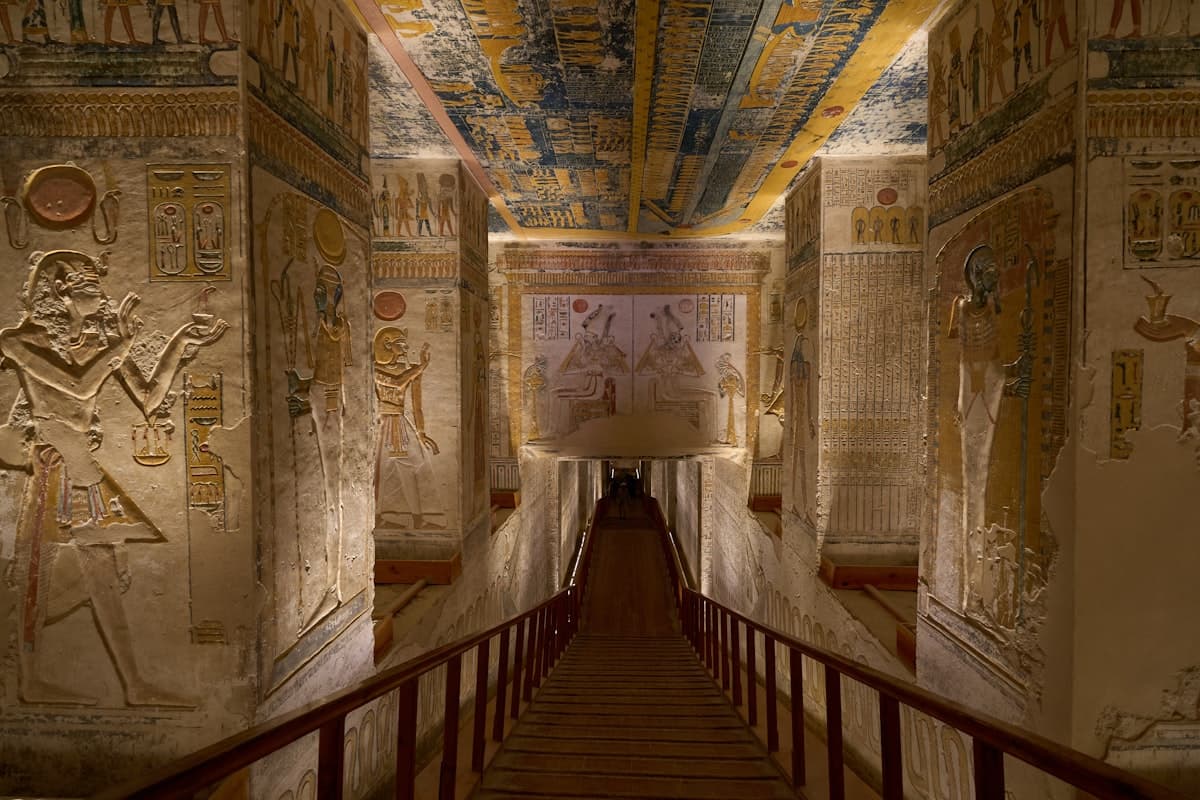
The word "dynasty" as applied to ancient Egypt comes from a single source: Manetho, an Egyptian priest from Sebennytos who wrote a history of Egypt in Greek around 280 BCE. He divided the kings into thirty dynasties (later scholars added a thirty-first). Manetho's original text is lost. We know it only through excerpts quoted by other ancient writers, several of whom disagreed with each other about what Manetho actually said. The organizational framework used by every Egyptologist alive is therefore a third-hand reconstruction of a lost document written by a priest who was working from temple records, oral tradition, and king lists carved in stone.
Those king lists survive and can be visited. The Abydos King List, carved during the reign of Seti I (Dynasty 19, circa 1290 BCE), names 76 kings in sequence. The Turin King List papyrus, now in Turin rather than Cairo because the Italian consul Bernardino Drovetti sold it before Egyptian antiquities law existed, originally listed over 300 rulers with their reign lengths. Neither list is complete and they do not entirely agree.
Modern Egyptologists group the dynasties into broader periods: Predynastic (before unification), Early Dynastic (Dynasties 1-2), Old Kingdom (Dynasties 3-6), three Intermediate Periods when centralized power collapsed, Middle Kingdom (Dynasties 11-12), New Kingdom (Dynasties 18-20), and the Late Period (Dynasties 21-31) ending with Alexander the Great's conquest in 332 BCE and the subsequent Ptolemaic dynasty, which was technically Macedonian Greek but governed as pharaohs and built temples in the Egyptian style.
The Periods That Built What You Will Actually See
Old Kingdom: The Pyramid Age (Dynasties 3-6, circa 2686-2181 BCE)
The Giza pyramids were not the first pyramids. The first was Djoser's Step Pyramid at Saqqara, built by his architect Imhotep around 2650 BCE. Imhotep was so celebrated for his genius that later Egyptians deified him; the Greeks identified him with Asclepius, their god of medicine. He was a commoner who reached the highest office in the land and was worshipped for two thousand years after his death, which is a more remarkable story than any of the kings he served.
The three Giza pyramids were built within roughly eighty years during Dynasty 4: Khufu (called Cheops by the Greeks), then his son Khafre, then his grandson Menkaure. The labor force was not enslaved people. Graffiti discovered in 2010 inside the Worker's Village at Giza shows work gangs gave themselves names like "Friends of Khufu" and "Drunkards of Menkaure." They were fed beef and fish, received medical care (healed fractures have been found in excavated skeletons), and were buried with honor near the pyramid they built.
The Old Kingdom collapsed at the end of Dynasty 6, around 2181 BCE. The cause was probably a combination of factors: a series of low Nile floods producing famine, a weakening of central authority as power devolved to regional governors called nomarchs, and possibly a volcanic event in Iceland that disrupted the monsoons feeding the Ethiopian highlands. Egypt fractured into the First Intermediate Period.
Middle Kingdom: The Classical Age (Dynasties 11-12, circa 2055-1650 BCE)
The Middle Kingdom is the period Egyptians themselves considered the classical era, the way Europeans treated ancient Rome as the model civilization. The literary works produced during Dynasties 11 and 12, including the Story of Sinuhe, a tale of an Egyptian official who flees into exile and longs for home, were still being copied by scribes one thousand years later as exercises in correct language.
Mentuhotep II of Dynasty 11 reunified Egypt from his power base at Thebes (modern Luxor) around 2055 BCE, ending the First Intermediate Period. His mortuary temple at Deir el-Bahri on Luxor's west bank is structurally integrated into the cliff face in a way that directly inspired the later temple of Hatshepsut built immediately beside it. Most visitors walk through Hatshepsut's temple and photograph it at length. Most spend two minutes at Mentuhotep's ruins thirty meters to the left, which is architecturally the more original building.
New Kingdom: The Empire (Dynasties 18-20, circa 1550-1069 BCE)
This is the Egypt most people mean when they say "ancient Egypt." Tutankhamun, Ramesses II, Nefertiti, Akhenaten's monotheist revolution, the Battle of Kadesh, the exodus story (though the evidence for a historical exodus during this period remains contested among scholars). The New Kingdom pharaohs built or massively expanded every major temple in Luxor and Aswan that tourists visit today.
The scale requires numbers. Ramesses II, who reigned for 66 years (circa 1279-1213 BCE) and fathered an estimated 96 sons and 60 daughters, put his cartouche on monuments he did not build, erased the names of predecessors and substituted his own, and constructed Abu Simbel with four seated statues of himself each measuring 20 meters high. He also signed the earliest surviving peace treaty in recorded history with the Hittite king Hattusili III, a copy of which hangs in the United Nations Security Council chamber in New York.
The New Kingdom ended not with a foreign conquest but with internal fracture. By the end of Dynasty 20, the high priests of Amun at Karnak had accumulated enough land and wealth to effectively govern Upper Egypt while pharaohs ruled from the north. Ramesses XI, the last ruler of Dynasty 20, was pharaoh in name but controlled almost nothing.
The Periods That Most Guides Skip
The Intermediate Periods: When Egypt Was Interesting
Three times, centralized pharaonic rule collapsed. The official narrative treats these as dark ages between the shining kingdoms. They were not dark. They were complicated, which is more interesting.
During the Second Intermediate Period (circa 1650-1550 BCE), a people called the Hyksos established a dynasty (Dynasties 15-16) from their capital at Avaris in the Nile Delta. For generations, Egyptian nationalist historiography portrayed the Hyksos as brutal invaders. Recent archaeology at Tell el-Dab'a, the site of ancient Avaris, tells a different story: the Hyksos were likely migrants who had been settling in the Delta for generations before achieving political power, they adopted Egyptian burial customs and religious practices, and their introduction of the horse-drawn chariot, the composite bow, and bronze weapons to Egypt gave the New Kingdom pharaohs who expelled them the tools to build an empire.
The Third Intermediate Period (circa 1069-664 BCE) saw Libya-descended pharaohs of Dynasty 22 ruling from Tanis in the Delta, a simultaneous Dynasty 23 ruling from a different Delta city, Nubian kings of Dynasty 25 ruling all of Egypt from Napata (in modern Sudan), and eventually Assyrian invasions that sacked Memphis and Thebes. Tanis is worth a day trip from Cairo. The royal tombs found there in 1939 by Pierre Montet were intact, comparable in richness to Tutankhamun's tomb, and are almost completely unknown outside specialist circles because Montet made his discovery the same week Germany invaded Poland and the world's press had other priorities.
The Late Period and the Ptolemies: Egypt Absorbed Everyone and Survived
Dynasty 26 (664-525 BCE), called the Saite Period after the Delta city of Sais, represents a deliberate archaism: pharaohs who modeled their art, their titulary, and their building programs on Old Kingdom prototypes, as a conscious assertion of Egyptian identity against foreign pressure. When the Persians conquered Egypt in 525 BCE (Dynasty 27 was Persian), the Egyptian temples continued operating. When Alexander the Great arrived in 332 BCE and was crowned pharaoh at Memphis, he went to consult the oracle of Amun at Siwa, deep in the Western Desert, because legitimacy in Egypt required Egyptian religious authorization.
The Ptolemaic dynasty (305-30 BCE) produced Cleopatra VII, who was not Egyptian by blood (she was Macedonian Greek, as all the Ptolemies were) but was the first member of her dynasty to learn to speak Egyptian. She also spoke Ethiopian, Hebrew, Aramaic, Arabic, Parthian, and Latin. The temples at Dendera and Edfu, two of the best-preserved ancient Egyptian temples in existence, were built almost entirely during the Ptolemaic period. Dendera's ceiling retains traces of its original astronomical painting. Edfu's inner sanctuary still contains the granite naos, the box that once held the statue of Horus, which has been empty for roughly two thousand years.
The Connections: How the Dynasties Live in Modern Egypt
Ancient Egypt did not end in 30 BCE. It continued in modified form through the Roman period (many emperors had themselves depicted as pharaohs on temple walls), through the Coptic period (the word "Copt" derives from the Greek "Aigyptos," itself derived from "Hwt-ka-Ptah," the ancient Egyptian name for Memphis), and into Islamic Egypt, where Pharaonic architectural elements were quarried into mosques and where the agricultural calendar still used by Egyptian farmers until the twentieth century was a direct descendant of the ancient Egyptian civil calendar.
The Ibn Tulun Mosque in Cairo, built in 876 CE, incorporates columns from older structures. The Citadel of Saladin, built on the Muqattam Hills overlooking Cairo, sits above layers of occupation stretching back to the Pharaonic era. The Coptic Museum in Old Cairo contains artifacts that use both hieroglyphic-derived motifs and Christian iconography simultaneously, which is not syncretism but layering: the same population, the same visual vocabulary, a different theological framework.
Common Mistakes
1. Visiting the Valley of the Kings without pre-selecting tombs. The base ticket covers three tombs chosen at the gate. The most visited (and most crowded) are KV62 (Tutankhamun, EGP 1,200 extra, small, stripped, not worth it unless you are completing a ritual), KV9 (Ramesses VI), and KV11 (Ramesses III). Better choices for visual quality and lower crowds: KV57 (Horemheb), KV17 (Seti I, though it requires a separate EGP 1,800 ticket and is worth every pound), and KV43 (Thutmose IV).
2. Skipping Saqqara for Giza. Giza is larger and more famous. Saqqara is more interesting. The Djoser complex is the oldest monumental stone structure on earth. The Mastaba of Ti contains painted reliefs of daily life that tell you more about how ancient Egyptians actually lived than all the royal tomb paintings combined. Budget a full day and hire a licensed guide for EGP 400-600.
3. Booking a Nile cruise without checking which temples it stops at. The standard four-night cruise between Luxor and Aswan covers Karnak, Luxor Temple, Edfu, Kom Ombo, and Philae. This is a good itinerary. Some budget cruises substitute these stops with others or rush them. Read the itinerary before booking, not the star rating.
4. The sound and light show at Karnak. It costs EGP 450, runs 45 minutes, tells you things you will learn by reading the first three sections of this article, and the recorded narration has not been updated in at least fifteen years. The better option is to arrive at Karnak at 6am when the ticket office opens, walk the hypostyle hall in the low horizontal light, and have the place nearly to yourself for the first hour.
5. Treating the Egyptian Museum in Cairo as a single visit. The museum contains over 170,000 objects. The Tutankhamun collection alone fills twelve rooms. Most organized tours spend two hours here total. This is not enough. Either visit twice (the EGP 400 ticket is valid for one day only, so buy a second ticket) or focus your visit: Royal Mummies Hall first, then the Tutankhamun galleries, then the Old Kingdom rooms on the ground floor. Skip the basement entirely unless you are specifically interested in Coptic or Greco-Roman artifacts.
6. Confusing Dynasty numbers with linear progress. Dynasties overlap, co-exist, and sometimes represent competing claimants rather than sequential rulers. Dynasty 17 and Dynasty 15 ruled simultaneously from different cities. Knowing the number tells you roughly when and roughly where, but not always who was actually in charge.
7. Leaving Abydos off the itinerary. Abydos is 160 kilometers north of Luxor, requires either a rented car (EGP 800-1,200 for a day) or an organized group tour, and contains the Temple of Seti I with the finest painted relief work in Egypt, plus the Osireion, a subterranean structure dedicated to Osiris that still partially floods each year, its granite walls rising from dark water exactly as the original builders intended. It sees a fraction of Luxor's crowds. No serious engagement with the ancient Egyptian dynasties is complete without it.
Practical Tips
Hire licensed guides from the Egyptian Tourist Authority registry rather than from touts at the gate. A good guide for Karnak or the Valley of the Kings charges EGP 400-700 for a half day and will show you inscriptions, explain the sequence of construction across dynasties, and translate cartouches on the spot. This is not optional luxury. It is the difference between seeing shapes and understanding a civilization.
Carry cash in Egyptian pounds. Credit cards are accepted at major hotels and some restaurants but not at archaeological site ticket offices, local restaurants, or transport. ATMs are available in Luxor town center and at the airport.
Photography is generally permitted inside temples and at outdoor sites. Inside Valley of the Kings tombs, photography is prohibited and guards enforce this consistently. The ban exists to protect the paintings from flash and humidity introduced by crowds and open camera bags.
Drink water constantly. The calculation in summer is simple: one liter per hour of outdoor activity is not an exaggeration. The dehydration that ends a Luxor day early is preventable.
For serious engagement with the ancient Egyptian dynasties as a complete subject rather than a collection of famous sites, read John Romer's "A History of Ancient Egypt" (two volumes, comprehensive, written for general readers), then use the site visits to check what you have read against what survives. Egypt rewards people who arrive with questions.
Frequently Asked Questions
The Weekly Dispatch
More on Egypt, every Friday.
Cultural depth and places most guides never mention.
No spam. Unsubscribe anytime.