Battle of Ain Jalut: Where Mamluks Stopped the Mongols for Egypt
In 1260, a former slave army stopped the Mongols cold, ending an expansion that had leveled Baghdad. The battlefield is real. Most people drive past it.

Quick Facts
- Best time to visit
- October to April. Cairo winters are mild (15 to 22 degrees Celsius) and the lower sun angle improves light on Mamluk stonework. Summer heat above 35 degrees makes walking the Islamic Cairo street network genuinely difficult.
- Entrance fee
- Sultan Hassan Mosque: EGP 100 (approx $2 USD). Al-Rifai Mosque: EGP 60 (approx $1.25 USD). Cairo Citadel complex: EGP 450 (approx $9 USD). Museum of Islamic Art: EGP 100 (approx $2 USD). Al-Azhar Mosque: free entry, donation customary.
- Opening hours
- Most Islamic Cairo mosques and sites daily 9am to 5pm. Al-Azhar open outside prayer times. Museum of Islamic Art Wednesday to Monday 9am to 5pm, closed Tuesday.
- How to get there
- Metro to Al-Sayeda Zeinab station (EGP 7), then tuk-tuk or 10-minute walk to mosque cluster. Taxi from central Cairo EGP 50 to 80. Uber and Careem available, typically EGP 40 to 60 from Downtown.
- Time needed
- Half day minimum for Sultan Hassan, Al-Rifai, and the Citadel. Full day to include Al-Azhar, the Al-Muizz Street corridor, and the Museum of Islamic Art.
- Cost range
- Budget EGP 400 to 700 per day including entry fees and local transport. Mid-range EGP 1,200 to 2,000 per day including a licensed specialist guide and lunch near the sites.
Quick Facts
Battle site location: Ain Jalut (Ein Harod), Jezreel Valley, northern Palestine (modern Israel). The event is inseparable from Mamluk Cairo, where it was planned, launched, and celebrated.
Best base for Mamluk Cairo context: Islamic Cairo, Egypt
Entrance to Mamluk sites in Cairo: Sultan Hassan Mosque complex, EGP 100 (approx $2 USD); Al-Rifai Mosque, EGP 60 (approx $1.25 USD). Combined ticket occasionally available, ask at the gate.
Opening hours: Most Islamic Cairo sites daily 9am to 5pm. Al-Azhar Mosque open to non-Muslims outside prayer times, no entrance fee but a donation is customary.
How to get there: Cairo's Islamic Quarter is best reached by metro to Al-Sayeda Zeinab station (EGP 7, approx $0.15), then a short tuk-tuk or walk to the mosque cluster. Taxis from central Cairo run EGP 50 to 80.
Time needed: Half day for the Mamluk Cairo sites connected to this story. Full day if you add the Egyptian Museum's Mamluk artifacts.
Cost range: Budget EGP 300 to 600 per day in Islamic Cairo. Mid-range EGP 1,200 to 2,000 per day including a guide.
---
Why This Battle Matters More Than Most People Realize
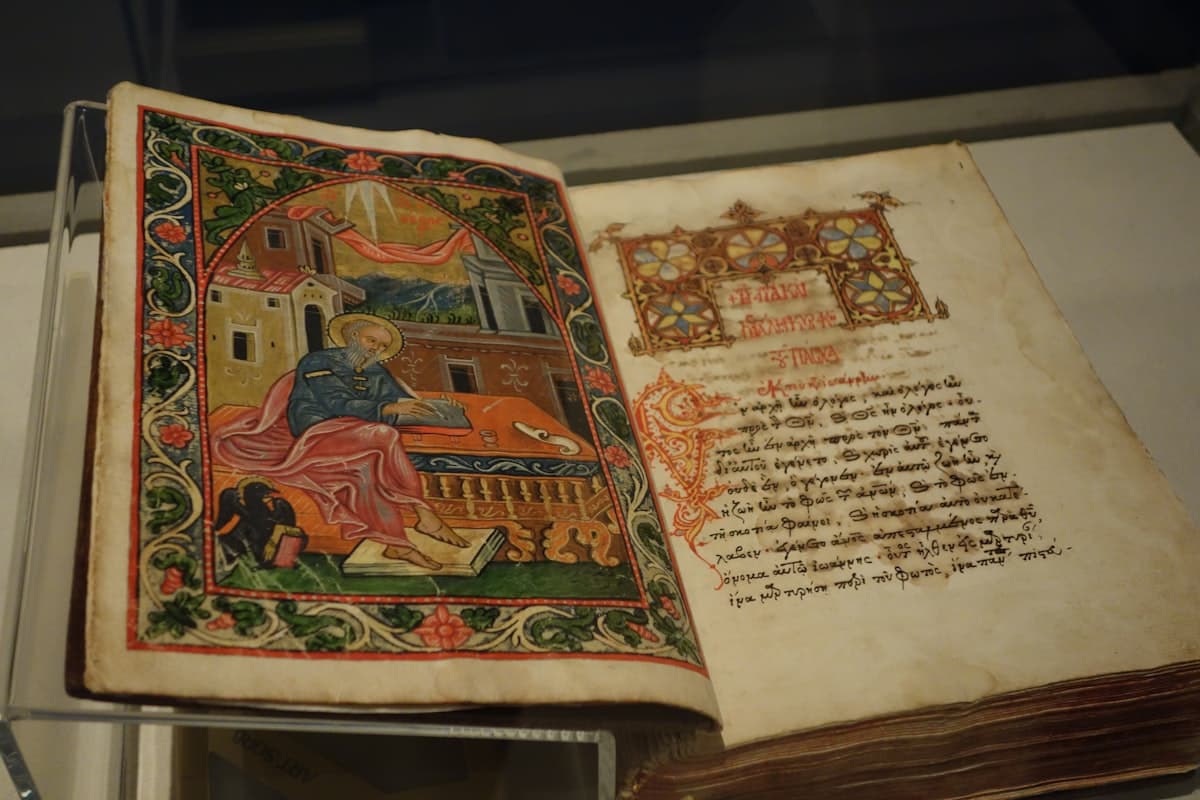
In the summer of 1258, the Mongol army under Hulagu Khan did something that had not happened in five centuries: they sacked Baghdad, executed the Abbasid Caliph Al-Musta'sim by rolling him in a carpet and trampling him with horses (to avoid spilling royal blood, a Mongol custom), and effectively ended the Islamic Golden Age in a single campaign. The House of Wisdom, which held the largest library on earth, was burned. Scholars say the Tigris ran black with ink.
Two years later, a Mongol force advanced toward Egypt. What stopped them was not a great empire or a long-established dynasty. It was the Mamluks: soldiers who had been purchased as children in the markets of the Caucasus, trained as military slaves, and installed as the professional backbone of Ayyubid Egypt. They had already deposed their own sultan in 1250. By 1260 they were Egypt's rulers in everything but name, and it was their commander, Baybars, who met the Mongols at a spring called Ain Jalut in September of that year.
The battle of Ain Jalut and the Mamluks' victory was not, as later romanticized, the moment when an unstoppable force finally met its match. The Mongols at Ain Jalut were a fraction of Hulagu's total force: Hulagu himself had returned east because of a succession dispute, leaving his general Kitbuqa with perhaps 10,000 to 20,000 soldiers. But strategic significance is not always about symmetry of forces. What Ain Jalut ended was Mongol expansion into Africa and into the Maghreb. Cairo remained intact. Al-Azhar survived. Egypt became the refuge and the reconstitution point for Sunni Islamic scholarship, a role it holds in some form to this day.
---
The Mamluk System: Slaves Who Built an Empire
The word mamluk means "one who is owned" in Arabic, which makes the Mamluk Sultanate one of the stranger political experiments in history: a state governed by its own former slaves who continued importing, training, and freeing new slaves to staff their armies and bureaucracies. It was not hereditary in the European sense. Power passed not through bloodlines but through military fraternity, loyalty networks, and, frequently, assassination.
Baybars, who led the charge at Ain Jalut and later became sultan, was a Kipchak Turk from the Pontic steppe. He was sold into slavery around age fourteen, purchased by an Ayyubid emir in Damascus, and trained in the rigorous military curriculum that made Mamluk cavalry the most technically sophisticated in the medieval Islamic world. They practiced mounted archery at full gallop using a scoring system. They had field manuals. The Mamluk cavalry's rate of fire, roughly three arrows per second from horseback, was not matched by European armies for centuries.
Baybars ruled from 1260 to 1277. In that time he retook Crusader castles, reorganized Egypt's postal relay system (the barid) so that messages from Cairo could reach Damascus in four days, and commissioned a new Abbasid Caliph in Cairo to give his regime religious legitimacy after the Baghdad caliphate was extinguished. He was also the sultan who ordered the construction of his own mausoleum in Damascus rather than Cairo, because he spent more of his reign in the field than in a palace.
---
What You Can Actually See in Cairo
You cannot visit Ain Jalut the way you visit Karnak or the Valley of the Kings. The battlefield is a spring in the Jezreel Valley, and today it sits inside modern Israel, marked by a small sign and known locally as Ein Harod. There is no monument to the Mongol defeat there, and no serious interpretive center.
What you can visit is the Cairo that Ain Jalut made possible, the city that Baybars and his successors built when they understood that they were now the central institution of Sunni Islam.
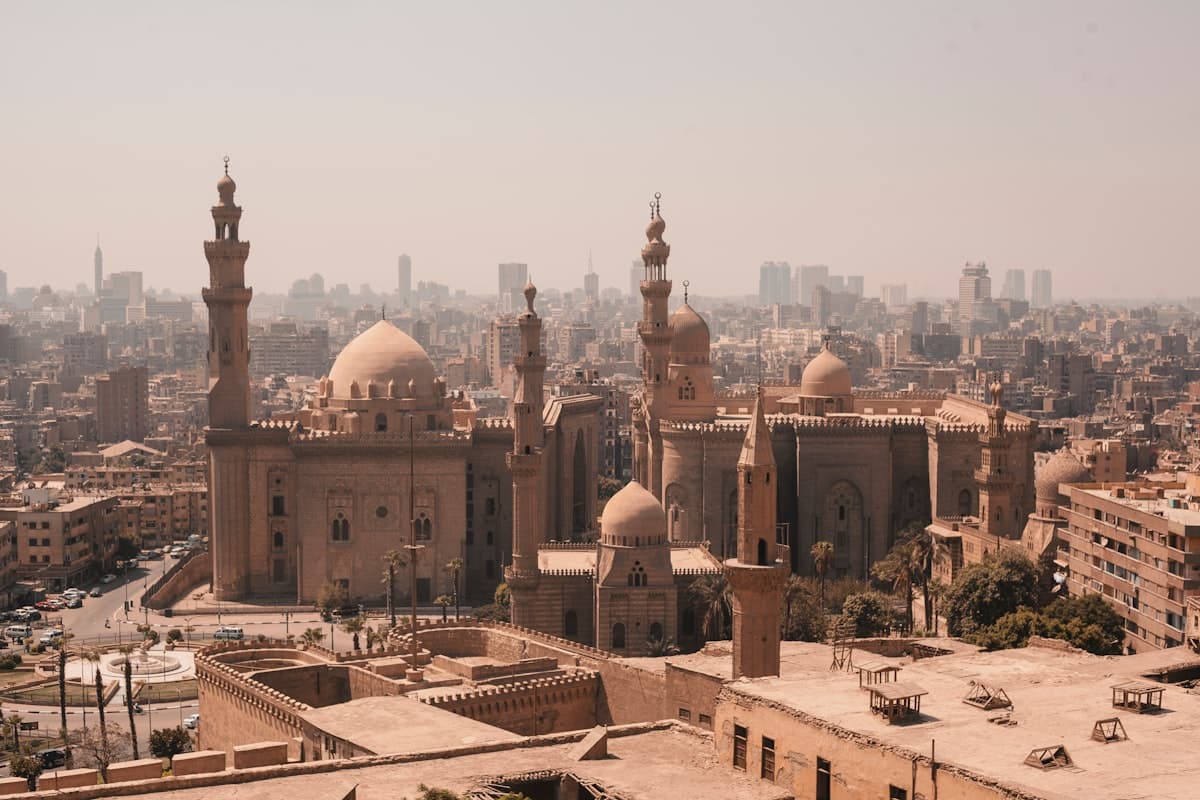
The Sultan Hassan Mosque-Madrasa is the place to start. It was commissioned in 1356, nearly a century after Ain Jalut, by Sultan Hassan ibn Muhammad ibn Qalawun, and it remains one of the most assured pieces of architecture in the Islamic world. The entrance portal is 38 meters tall. The interior courtyard, roughly the size of half a football pitch, was designed to house students from all four Sunni legal schools simultaneously, each in their own riwaq. When you stand in the center of that courtyard at noon and hear the call to prayer from four different directions, you are hearing the institutional legacy of a battle fought three hundred kilometers away.
Behind Sultan Hassan, literally connected to it by the sightline from the Citadel, is Al-Rifai Mosque, completed in 1912, which contains the tombs of Egypt's royal family and, since 1980, the body of Mohammed Reza Shah Pahlavi of Iran, who died in Cairo after being expelled from country after country. Anwar Sadat gave him a state funeral. The juxtaposition of a Mamluk madrasa and a deposed shah's tomb three meters apart is the kind of compressed Egyptian history that the country specializes in.
The Cairo Citadel, begun by Saladin in 1176 and expanded by every ruling dynasty until the nineteenth century, contains the Mosque of Muhammad Ali (completed 1848, its Ottoman dome explicitly modeled on Hagia Sophia) but also, in its lower precinct, the Mosque of Al-Nasir Muhammad, built between 1318 and 1335 by the Mamluk sultan who was the most successful administrator of the post-Ain Jalut state. Al-Nasir Muhammad ruled, was deposed, and ruled again three times. His mosque's minarets were looted for their porcelain tile by Ottoman governors. The empty ceramic sockets are still visible if you look.
---
The Connections: From Ain Jalut to Modern Cairo
The straight line from Ain Jalut to contemporary Egypt is not metaphorical. It runs through specific institutions.
Al-Azhar University, founded by the Fatimids in 970 AD as a Shia institution, was converted to Sunni orthodoxy by Saladin and then became the intellectual center of the Islamic world after the Mongols destroyed Baghdad. Its survival and centrality depend directly on Mamluk Cairo remaining an intact, functioning city. Today Al-Azhar issues fatwas that are cited across forty-five countries. Its rector is appointed by the Egyptian president. The chain of institutional continuity from the post-Ain Jalut period to the present has been interrupted many times but never broken.
The Mamluk urban fabric of Islamic Cairo, the street grid, the sabil-kuttab (fountain-school) combinations on corner buildings, the wikala (merchant inn) model, survived Ottoman conquest in 1517 and French occupation in 1798 and became the model neighborhood that UNESCO designated in 1979. The French scholars who accompanied Napoleon's expedition and produced the Description de l'Egypte spent considerable time documenting Mamluk buildings. Their engravings are still used in restoration projects.
There is also a direct military connection that most visitors to Cairo miss. The Khan el-Khalili bazaar, which every tourist visits and most tourists hate for its aggressive sales tactics, was originally a wikala built in 1382 by Emir Djaharks el-Khalili, the master of horse under Sultan Barquq. Barquq was the first sultan of the Burji (Circassian) Mamluk dynasty, which replaced the Bahri (Turkic) Mamluk dynasty that had won at Ain Jalut. The bazaar is built on the site of the Fatimid royal cemetery. The commerce layered over the graves layered over the older city is a compressed archaeology of who controlled Cairo and when.
---
Common Mistakes
Treating Ain Jalut as a distant abstraction. Most visitors to Islamic Cairo have no idea the Mamluk sites they are walking through exist because a slave army won a specific battle in a specific valley in 1260. Ask your guide to connect the architecture to the geopolitics. If they cannot, you have the wrong guide.
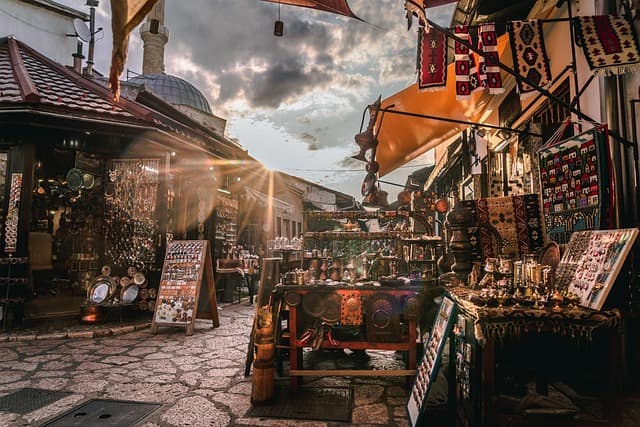
Spending the entire Islamic Cairo visit at Khan el-Khalili. The bazaar is the least interesting part of Islamic Cairo, and it is the part that requires the most energy to survive. Walk through it quickly, buy nothing from anyone who approaches you on the street, and continue to the mosque cluster around Al-Hakim and Al-Azhar.
The Citadel Sound and Light Show costs EGP 250 and runs for 45 minutes. It tells you almost nothing about the Mamluk period and frames Egypt's history almost entirely around Muhammad Ali and his descendants. Skip it entirely and spend that time inside the Al-Nasir Muhammad Mosque at dusk when the light through the stripped minarets is worth standing still for.
Visiting Sultan Hassan Mosque on a Friday midday. It is an active mosque and Friday prayers bring crowds that make architectural contemplation impossible. Saturday morning between 9am and 11am is reliably quiet.
Underestimating the physical layout. Islamic Cairo's major sites are spread across roughly three kilometers. Comfortable shoes are not a courtesy suggestion. The streets between Bab Zuweila and Al-Azhar are uneven, narrow, and blocked periodically by donkey carts. A tuk-tuk is EGP 20 to 30 for short hops and will save you significant time.
Ignoring the Mamluk sabil-kuttab buildings. These combined water fountain and Quran school structures appear on nearly every major Mamluk street corner in Islamic Cairo and most visitors photograph them without understanding what they are. The upper story (the kuttab) provided free education to poor children. The lower story provided free water to anyone passing. They are the Mamluk welfare state in architectural form, and they are usually unlocked and unguarded.
Assuming the Egyptian Museum is the only place to see Mamluk artifacts. The Museum of Islamic Art on Ahmed Maher Square, badly damaged by a car bomb in 2014 and partially reopened since, holds one of the most significant collections of Mamluk metalwork, woodwork, and textiles in the world. Many pieces were moved from mosques that could no longer guarantee their security. Entrance is EGP 100 (approx $2 USD) and the crowds are a fraction of the Egyptian Museum's.
---
Practical Tips
Come to Islamic Cairo early, before 9am if possible. The quality of light on limestone facades before the sun gets high is a different phenomenon from the midday glare. The call to prayer at Fajr and then again at Dhuhr echoing off Mamluk stone is something no recording captures accurately.
Hire a guide who specializes in Islamic Cairo specifically, not a general Egypt guide. The difference in depth is considerable. Expect to pay EGP 500 to 800 for a half-day private guide. The Egyptian Tourist Authority maintains a list of licensed guides; ask for their registration number before booking.
Dress conservatively for all mosque visits. Women need a headscarf for entry; some mosques provide them but the quality is not guaranteed. Men in shorts will be turned away from active mosques. This is not negotiable and it is not unique to Egypt.
The neighborhood around Al-Muizz Street, the main spine of medieval Cairo, has improved significantly in terms of restoration work but remains genuinely impoverished in sections. Keep phones in front pockets, not back pockets. Keep camera straps around your neck, not your wrist. This is ordinary city precaution, not crisis-level security concern.
For the Ain Jalut connection specifically: the best single-volume English-language account of the battle and the Mamluk rise remains Reuven Amitai-Preiss's "Mongols and Mamluks," published by Cambridge University Press. It is academic but readable, and reading the first three chapters before your Cairo visit will transform what you see in every Mamluk building from decoration into argument.
Frequently Asked Questions
The Weekly Dispatch
More on Egypt, every Friday.
Cultural depth and places most guides never mention.
No spam. Unsubscribe anytime.