Coptic Christianity Egypt History Guide: The Full Picture
Coptic Christians have held continuous liturgy in Egypt since 42 AD. Their language is a direct descendant of ancient Egyptian. Most visitors walk past this without realizing it.

Quick Facts
- Best time to visit
- October to March. Cool temperatures make walking between sites in Old Cairo comfortable and the desert monasteries are accessible without heat risk.
- Entrance fee
- Coptic Museum: EGP 200 (approx $4 USD), students EGP 100. Most Old Cairo churches: free entry, donation expected. Wadi Natrun monasteries: free.
- Opening hours
- Coptic Museum daily 9am to 5pm, closed Fridays 11:30am to 1pm. Hanging Church daily 9am to 4pm. Monastery hours vary: typically 9am to 5pm, closed during religious retreats.
- How to get there
- Cairo Metro Line 1 to Mar Girgis station, EGP 10 from Tahrir. Taxi from Downtown Cairo EGP 80 to 120. For Wadi Natrun: West Delta bus from Turgoman station, EGP 35 to 45.
- Time needed
- Half day for Old Cairo churches only. Full day for Old Cairo plus Coptic Museum. Separate full day for Wadi Natrun monasteries.
- Cost range
- Budget EGP 400 to 700 per day including transport, entry fees, and a local meal. Mid-range EGP 1,200 to 2,000 per day with private guide and restaurant lunch.
Quick Facts
Best time to visit: October to March, when Cairo temperatures sit between 15°C and 25°C and the churches are less stifling. Avoid August, when Old Cairo becomes genuinely punishing.
Entrance fees: The Coptic Museum costs EGP 200 (approx $4 USD), students EGP 100. Most individual churches in Old Cairo charge no entry fee, though a donation box is present at each. The Ben Ezra Synagogue, which sits inside the same compound and matters enormously to this story, is free.
Opening hours: The Coptic Museum opens daily 9am to 5pm, closed Fridays 11:30am to 1pm. The Hanging Church opens daily 9am to 4pm. Individual monastery opening hours vary and it is worth calling ahead.
How to get there: Take Cairo Metro Line 1 to Mar Girgis station. The station exits directly into Old Cairo, sometimes called Coptic Cairo. Journey from Tahrir Square costs EGP 10. Taxis from Downtown Cairo run EGP 80 to 120 depending on traffic.
Time needed: Three to four hours for Old Cairo alone. Allow a full day if you want to include the Coptic Museum seriously, the Ben Ezra Synagogue, and the Church of St. Sergius and Bacchus.
Cost range: Budget EGP 400 to 700 per day covering transport, entry, and a meal nearby. Mid-range EGP 1,200 to 2,000 per day with a guide and lunch at a sit-down restaurant.
---
The Coptic language, spoken today only in liturgy, is ancient Egyptian written with Greek letters. When a Coptic priest chants in a Cairo church on a Sunday morning, the phonemes he produces are the same phonemes a temple priest produced at Karnak four thousand years ago. The vocabulary shifted. The grammar evolved. The sound of the language is a direct, unbroken thread. Most visitors to Egypt spend two weeks here and never encounter this fact, because it requires going somewhere other than the Pyramids.
Coptic Christianity is not a minority curiosity appended to Egyptian history. It is the form in which ancient Egyptian religious identity survived the collapse of the Pharaonic system, the Greek occupation, the Roman annexation, and the Islamic conquest. Understanding it changes how you read every other layer of this country.
Why This Place Matters
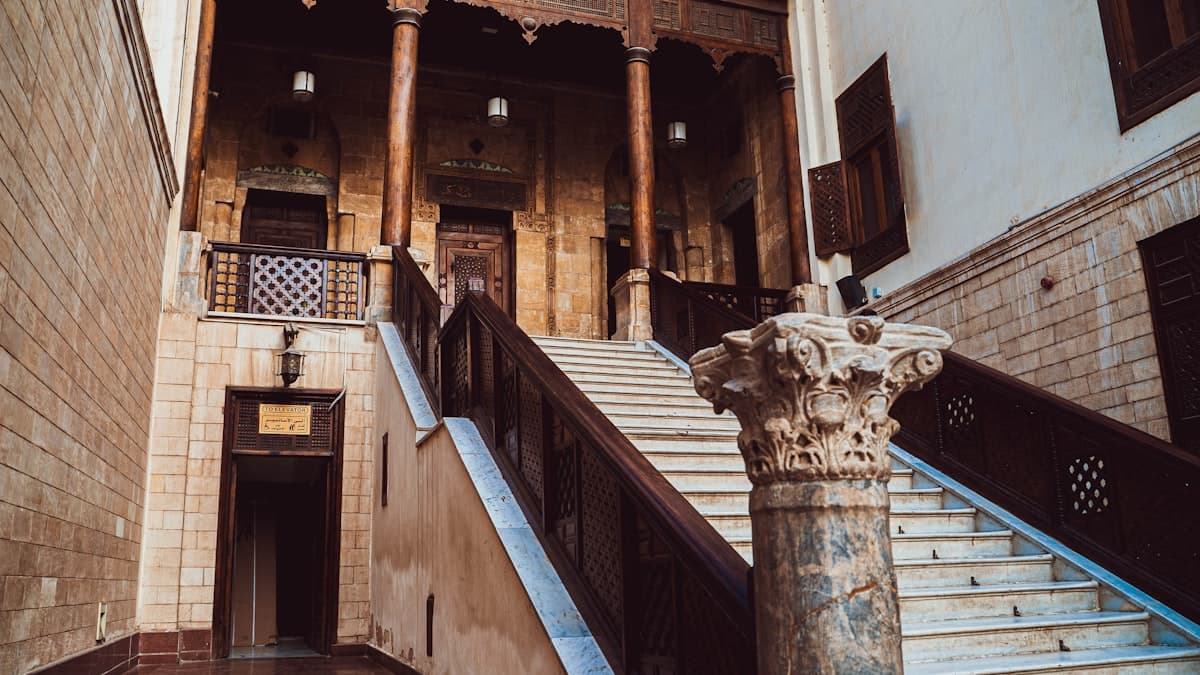
St. Mark the Evangelist arrived in Alexandria in 42 AD, which makes the Coptic Church one of the oldest Christian communities on earth, predating the churches of Rome and Constantinople by decades. This is not a disputed claim. It is documented in early church records and accepted by Catholic, Orthodox, and Protestant historians alike.
The word "Copt" itself is simply a Greek corruption of "Aigyptos," the Greek name for Egypt. For the first six centuries of Christianity, "Copt" meant Egyptian. When the Arab conquest arrived in 641 AD, Egypt's population was overwhelmingly Christian. The transition to an Islamic majority took centuries, not decades, and the Coptic community that survived that transition did not retreat. It transformed.
The monasteries of Wadi Natrun, northwest of Cairo in the desert between the Delta and the Libyan plateau, were founded in the fourth century by hermits following the example of St. Anthony, who withdrew to the Eastern Desert around 270 AD. St. Anthony's Monastery, built near his cave on the Red Sea coast, is the oldest Christian monastery in the world still in active use. It has functioned without interruption for approximately 1,700 years. The monks there will tell you this without drama, as a simple fact of their daily life.
The theological dispute that separated Coptic Christians from Rome and Constantinople in 451 AD at the Council of Chalcedon was not about obscure doctrine for its own sake. It was a dispute about the nature of Christ's humanity and divinity. The Coptic Church held what is called the miaphysite position: that Christ's human and divine natures are united in one nature, inseparably. Rome said two natures. The schism that followed cut Egyptian Christianity off from the Western church for fifteen centuries and shaped everything about how Coptic identity developed, defended itself, and survived.
Old Cairo: What You Will Actually See
Old Cairo, the neighborhood known in Arabic as Masr al-Qadima, sits on top of a Roman fortress called Babylon, which was itself built on the site of an older Persian fortification, which may have stood at the junction of an ancient Pharaonic canal connecting the Nile to the Red Sea. The Hanging Church, one of Cairo's most visited Coptic sites, is suspended above the Water Gate of that Roman fortress. Its nave actually rests on the gate's two towers. You can see the Roman stonework in the basement.
The Hanging Church, officially the Saint Virgin Mary's Coptic Orthodox Church, was first mentioned in written records in the seventh century, though parts of its structure date earlier. Its interior is covered in carved ivory screens, Coptic icons in the rigid, gilded style that connects Eastern Roman art to medieval European painting, and an ambon, a raised pulpit resting on thirteen columns representing Christ and his apostles. One column is slightly darker than the rest. It represents Judas. This is not labeled. Your guide may or may not mention it. Look for it yourself.
The Church of St. Sergius and Bacchus, five minutes' walk from the Hanging Church and largely ignored by tourists who exhaust themselves at the main site, claims to be built over the crypt where the Holy Family rested during their flight into Egypt. Whether or not you hold that claim as historical, the crypt itself is genuinely old, partially below the water table, and accessible via a narrow staircase. The air down there smells of cold stone and candle wax. The church above it dates to the fifth century in its earliest sections.
The Ben Ezra Synagogue inside the same compound deserves specific attention in any Coptic Christianity history guide, not because it is Coptic but because it belonged to the Jewish community that coexisted in this neighborhood for over a millennium. In its geniza, a storage room for worn religious documents, scholars discovered in the nineteenth century more than 300,000 manuscript fragments covering Jewish, Islamic, and Coptic life in medieval Cairo. These fragments, now held in Cambridge, London, and New York, are the single most important source for understanding daily life in medieval Egypt across all three communities.
The Coptic Museum: What Most People Walk Past
The Coptic Museum, founded in 1910 by Marcus Simaika Pasha, holds the world's largest collection of Coptic art and artifacts. This is not a qualification. There is nowhere else on earth with a comparable collection. What surprises most visitors is how much the objects inside look like things they have already seen in other parts of Egypt.
The textile fragments show ankh symbols repurposed as Christian crosses. The funerary stelae shift, panel by panel across two centuries, from hieroglyphs to Demotic script to Coptic text to Greek. You can walk through the linguistic history of Egypt in a single corridor. The falcon-headed Horus becomes Christ the Good Shepherd in ivory carvings that archaeologists spent decades arguing about because the iconography is genuinely ambiguous.
The most important object in the museum is probably the Nag Hammadi Codices, or rather the display telling you where they are. The codices themselves, thirteen leather-bound books discovered by farmers near Nag Hammadi in Upper Egypt in 1945, contain Gnostic gospels including the Gospel of Thomas, texts that predate and diverge from the canonical New Testament, and were buried in the fourth century, probably to hide them from ecclesiastical authorities. The originals are now in the Coptic Museum but kept in controlled storage. What you will see is exhibition material. It is still worth your full attention because the story of their discovery, a farmer breaking open a sealed jar and finding ancient books, is one of the most important archaeological events of the twentieth century.
The Connections
The Desert Fathers, the fourth-century hermits who withdrew to the Egyptian desert and essentially invented Christian monasticism, created a model that spread from Egypt across the Byzantine Empire into Ireland, Scotland, and eventually the whole of Western European monasticism. The Benedictine Rule, which governed European monastic life for over a thousand years, drew directly on the sayings of the Desert Fathers compiled in a text called the Apophthegmata Patrum. When you visit a Benedictine abbey in France or a medieval monastery in England, you are looking at an institution whose intellectual origins trace back to Egyptian desert hermits in the third century.
The Coptic cross, with its distinctive circle connecting the four arms, has been interpreted by some scholars as a Christianized ankh. The ankh was the Egyptian hieroglyph for life. The transition was not random. Early Egyptian Christians were repurposing existing sacred symbols for a new theology, which is exactly what the builders of Islamic Cairo would later do with Pharaonic and Roman stones. Nothing in Egypt is built from scratch. Every layer borrows from the one beneath.
The Fatimid caliphs who built medieval Cairo in the tenth century employed Coptic architects and craftsmen. The carved wooden ceilings in several Fatimid mosques in old Cairo were made by Coptic woodworkers using techniques developed in Coptic church interiors. The geometric patterns differ. The hands that made them were from the same workshops.
Common Mistakes
Spending the whole time in the Hanging Church and calling it done. The Hanging Church is the most photographed site in Old Cairo for a reason, but the Church of St. Sergius and Bacchus is older in its foundational sections, smaller, and almost never crowded. The crypt is what you actually came for.
Taking a guided group tour of Old Cairo. Groups move at the pace of the slowest member, stop where the guide stops, and rarely enter the Coptic Museum for more than thirty minutes. The museum alone warrants ninety minutes minimum. Go independently and hire a private guide at the museum entrance if you want context.
Skipping Wadi Natrun. Most Egypt itineraries do not include it. This is a failure of ambition. The monasteries of St. Macarius, St. Bishoy, and the Syrians are functioning monastic communities that have operated continuously since the fourth century. They sit in the desert two hours from Cairo. You can visit on a day trip. The monks will receive you. This is not a museum.
The sound and light show at any Coptic site. There are occasional theatrical productions tied to Coptic feast days that can be worth attending. The generic sound and light format, borrowed from Pharaonic sites, is not. Skip it.
Visiting during Coptic Christmas or Easter week without understanding what that means. Coptic Christmas falls on January 7th and Easter follows the Julian calendar, often differing from Western Easter by several weeks. These are the best times to understand Coptic Christianity as a living practice, with processions, all-night vigils, and full churches. They are not the best times to visit as a quiet observer of architecture. Decide which you want.
Assuming everything is open on Fridays. The Coptic Museum closes during Friday prayer hours. Individual churches may be conducting services. Arrive early or plan for a Sunday morning when the neighborhood is genuinely alive with worshippers.
Buying the coffee-table Coptic art books at the museum shop without first reading the labels inside the museum. The books are expensive by Egyptian standards, EGP 350 to 600, and they reproduce objects whose context is lost without having seen the museum first. Walk the collection, take notes, then decide what to buy.
Practical Tips
Dress conservatively at every site. Shoulders and knees covered for both men and women. This is not optional in active churches and you will be asked to leave or given a wrap at the door if you arrive underprepared.
Coptic services are conducted in a mixture of Coptic and Arabic. If you want to attend a liturgy, the Sunday morning service at the Hanging Church begins at 8am and runs approximately two hours. Arrive by 7:30am to find a seat before the congregation fills the space.
The neighborhood around Mar Girgis Metro station has improved significantly in recent years but pickpocketing remains a consideration on crowded Sundays. Use a front-worn bag.
For the monasteries outside Cairo: Wadi Natrun monasteries are accessible by taking a West Delta bus from Cairo's Turgoman station, roughly EGP 35 to 45 each way, then a local taxi to whichever monastery you are visiting. Men can enter all four monasteries freely. Women are welcome at St. Bishoy and the Syrian Monastery but should confirm current visiting policies by calling ahead, as rules shift during Lenten periods.
St. Anthony's Monastery on the Red Sea coast requires a day trip from Hurghada or Ain Sokhna, approximately three hours each way. Entry is free. The cave of St. Anthony is a forty-five minute hike above the monastery and is one of the more physically demanding and spiritually charged places in Egypt that almost no tourist visits. Bring water.
Frequently Asked Questions
The Weekly Dispatch
More on Egypt, every Friday.
Cultural depth and places most guides never mention.
No spam. Unsubscribe anytime.