Coptic Christianity Egypt History Guide: The Full Story
Coptic Christians have existed in Egypt longer than Islam, longer than the Arab conquest, longer than Byzantium. Their liturgy still contains words Jesus likely spoke. Here is where to find it.

Quick Facts
- Best time to visit
- October to March for comfortable temperatures. Coptic Christmas on January 7 is atmospheric but crowded. Mondays and Tuesdays are the quietest days in Old Cairo.
- Entrance fee
- Coptic Museum: EGP 200 (approx $4 USD), students EGP 100. Most Old Cairo churches free. Wadi Natrun monasteries free with donation expected.
- Opening hours
- Coptic Museum: daily 9am to 5pm. Old Cairo churches: generally 9am to 4pm, varies by feast days. Wadi Natrun monasteries: Friday and Sunday mornings only.
- How to get there
- Metro Line 1 to Mar Girgis station, EGP 7 (under $1 USD). Taxi from Downtown Cairo EGP 50 to 80. Wadi Natrun: bus from Turgoman station EGP 25 one way, or private car EGP 400 to 600 return.
- Time needed
- Coptic Museum plus Old Cairo churches: full day minimum. Add Wadi Natrun as a separate day trip requiring 6 to 8 hours including travel.
- Cost range
- Budget EGP 400 to 700 per day including transport, meals, and museum entry. Mid-range EGP 1,200 to 2,000 per day with private transport and sit-down meals.
Quick Facts
Best time to visit: October to March, when Cairo's heat is manageable and the churches are less crowded. Coptic Christmas falls on January 7 and is worth timing a trip around if you can handle the crowds at the Hanging Church.
Entrance fees: The Coptic Museum costs EGP 200 (approx $4 USD), students EGP 100. Most churches in Old Cairo (Coptic Cairo district) are free to enter. The Church of St. Sergius and Bacchus, which sits above the crypt where the Holy Family is believed to have sheltered, is free.
Opening hours: The Coptic Museum opens daily 9am to 5pm. Most Old Cairo churches open 9am to 4pm, though hours vary by feast day and priestly schedule. Arrive before 11am to avoid tour groups.
How to get there: Take Cairo Metro Line 1 to Mar Girgis station (EGP 7, under $1 USD). You will exit directly into Coptic Cairo. Taxis from Downtown cost EGP 50 to 80 depending on traffic and your negotiating patience.
Time needed: The Coptic Museum alone warrants three hours. Add two more for the surrounding churches and the Roman towers. A full day covers everything including lunch at one of the simple fuul and ta'ameya spots near the station.
Cost range: Budget EGP 400 to 700 per day, mid-range EGP 1,200 to 2,000 per day including meals and private transport.
---
The Coptic language, which you will hear chanted in any Coptic church in Egypt, is the last surviving form of the ancient Egyptian language spoken by the pharaohs. It is written in Greek letters with a few characters borrowed from Demotic script, and it has been in continuous liturgical use since the third century. When a Coptic priest sings in Alexandria or Assiut or Cairo today, the sounds in that room are closer to what Thutmose III's scribes would have recognized than anything else on earth. This is not metaphor. It is phonology.
Most visitors to Egypt spend zero minutes thinking about this. They have come for the pharaohs or the mosques, and Coptic Egypt gets a polite half-day in Old Cairo before the boat to Luxor. That is a significant miscalculation, and this guide is an attempt to correct it.
Why Coptic Christianity Matters to Understanding Egypt
Coptic Christianity arrived in Egypt in approximately 42 AD, according to tradition carried by the Evangelist Mark, who founded the church in Alexandria and was martyred there in 68 AD. The Coptic Church is therefore older than the Roman Catholic Church, older than any formal Christian institution in Europe, and older than the Council of Nicaea, which in 325 AD tried to standardize a Christianity that Coptic theologians had already been debating for three centuries.
Egyptian Christians developed some of the most consequential ideas in Christian history. Monasticism, the practice of withdrawing from society to pursue spiritual discipline, was invented in the Egyptian desert. Saint Anthony the Great, an Egyptian Copt from the village of Coma near Beni Suef, retreated into the Eastern Desert around 270 AD and his example generated an entire tradition of Christian asceticism that spread to Syria, Palestine, Europe, and Ireland. The monastery he inspired, Saint Anthony's Monastery in the Red Sea mountains, is still occupied today and claims to be the oldest continuously inhabited Christian monastery on earth.
The split that defined Coptic Christianity forever came in 451 AD at the Council of Chalcedon. The council declared that Christ had two natures, divine and human, existing without confusion in one person. The Coptic Church rejected this formulation, insisting that Christ had one unified nature. This theological difference, called the Miaphysite position, caused the Coptic Church to separate from Rome and Constantinople permanently. The consequence was that when Arab armies arrived in 641 AD, many Egyptian Christians viewed them not as conquerors but as a relief from Byzantine religious persecution. The Copts had been fined, tortured, and exiled for their theology. The early Arab rulers, at least initially, left them alone to worship.
The Monasteries That Changed Christianity
Before you spend time in Cairo's Coptic churches, consider that the most important surviving Coptic Christianity sites in Egypt are not in Cairo at all. Wadi Natrun, a shallow depression in the Western Desert roughly 110 kilometers northwest of Cairo, contains four functioning monasteries that were established in the fourth century. Saint Bishoy Monastery, Baramous Monastery, Anba Macarius Monastery, and Abu Makar Monastery together housed thousands of monks at their peak in the fifth century, when the Egyptian desert was arguably the most intellectually active Christian community on earth.
The theology produced here was read in Antioch, Rome, and Constantinople. The desert fathers at Wadi Natrun corresponded with Jerome, influenced Augustine, and shaped the spiritual exercises that became the foundation of medieval European monasticism. When scholars talk about the transmission of Greek philosophy into Christian theology, the Egyptian desert monasteries are a critical node in that network, and they are consistently ignored by tourists who think of Christianity as a European religion that arrived in Egypt from somewhere else. The direction was opposite.
Getting to Wadi Natrun requires a private car or a bus from Cairo's Turgoman station (EGP 25 one way). The monasteries are open to visitors on Friday and Sunday mornings. Dress conservatively. Photography inside is often restricted, and monks do not always have time to serve as guides. The walls of Saint Bishoy contain frescoes from the medieval period and a well that pilgrims have used for fifteen centuries.
Old Cairo: What You Are Actually Walking Through
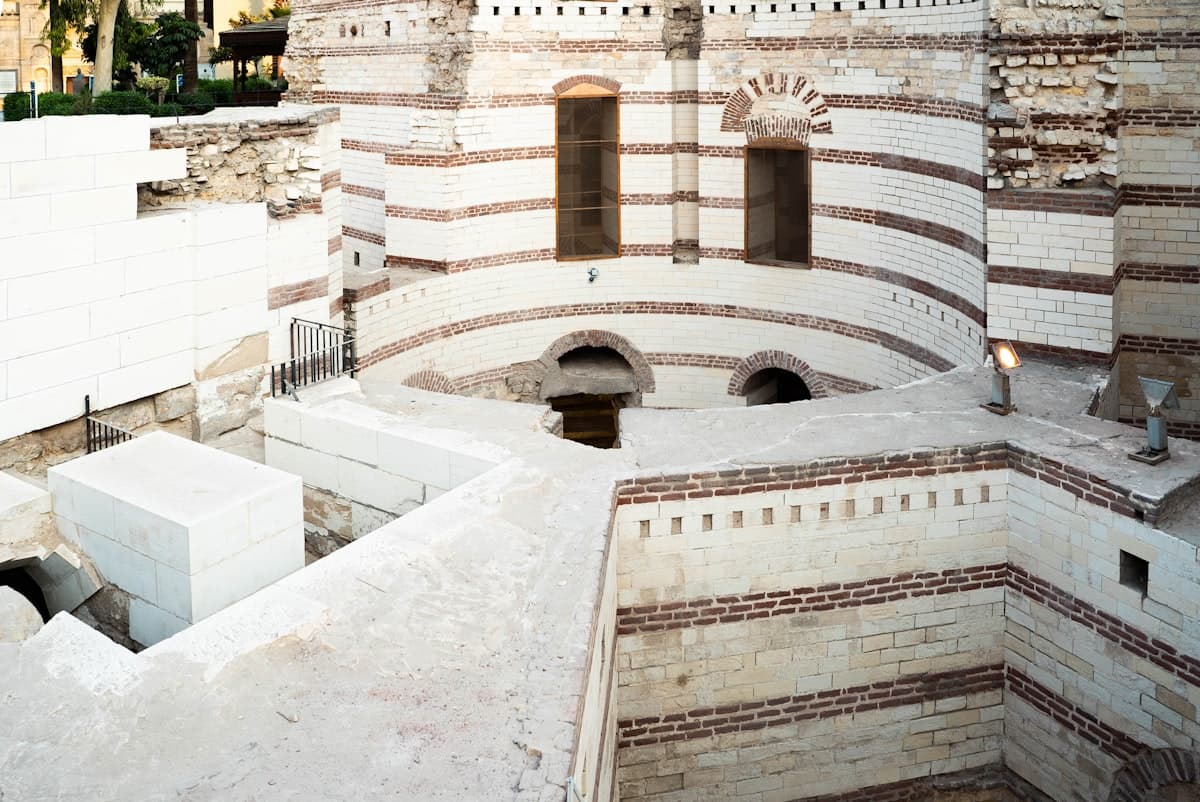
Coptic Cairo, the district you reach via the Mar Girgis metro station, sits inside a Roman fortress called Babylon. The Romans built it in the first century AD to control the Nile crossing and the entrance to the canal connecting the Nile to the Red Sea. The two massive circular towers at the entrance to the Coptic district are Roman construction, and they contain, between them, one of the world's undervisited museums.
The Coptic Museum, founded in 1908 by Marcus Simaika, holds the world's largest collection of Coptic art. Its inventory includes textiles, icons, manuscripts, carved ivory, and stonework spanning four centuries of Christian Egypt. The most important object in the collection is arguably the Nag Hammadi Codices, or rather the display materials related to them. The original codices, discovered in 1945 by a farmer near Luxor who was digging for fertilizer, are Gnostic texts in Coptic script that include the Gospel of Thomas, a collection of 114 sayings attributed to Jesus that were not included in the canonical New Testament. The farmer's name was Muhammad Ali al-Samman. The irony of a Muslim farmer unearthing early Christian scripture is very Egyptian.
The Hanging Church, officially the Church of the Virgin Mary, is the most visited Coptic site in Cairo and possibly slightly overrated as a result. It is genuinely old, with parts of the current structure dating to the seventh century, and its nave is suspended over a gatehouse of the Babylon fortress, hence the name. But it is almost always crowded, the interior is partially under restoration, and the adjacent Church of St. Sergius and Bacchus is more atmospheric and less photographed. Saint Sergius predates the Hanging Church and sits over a crypt that Egyptian tradition holds sheltered the Holy Family during their flight into Egypt. Whether or not you hold that tradition, the crypt itself is ancient, the air in it is cool even in August, and almost no one is ever there.
The Liturgy and What It Preserves
If your visit to Coptic Christianity Egypt history coincides with a Sunday or a feast day, attend a liturgy. This is not a performance and you are not entitled to photograph it, but you may be permitted to stand quietly at the back. What you will hear is a liturgy that has not substantially changed since the fifth century. The prayers follow a pattern codified by Saint Basil of Caesarea and Saint Mark himself. The music, called Coptic chant, is an oral tradition passed from generation to generation without written musical notation until the twentieth century, meaning that what survived did so entirely through human memory and communal practice across fourteen centuries of Arab rule, Crusader disruption, Ottoman administration, and colonial modernity.
Ethnomusicologists have argued, based on analyses of melodic patterns, that Coptic chant preserves musical structures from pre-Christian Egypt, that the tonal patterns connect to ancient Egyptian music in ways that Greek and Roman music do not. This remains contested. But standing in a Coptic church in Cairo on a Friday morning, listening to deacons chant in a language that is simultaneously ancient Egyptian and early Christian, the claim does not feel implausible.
The Connections: How Coptic Egypt Links Everything Else
The street that runs through Coptic Cairo, Sharia Mar Girgis, sits roughly on the line of the ancient canal that the Pharaoh Necho II began digging in the seventh century BC to link the Nile to the Red Sea, a project that Darius the Great of Persia actually completed. That canal ran through what would become Babylon fortress, past the site of the current Coptic Museum, and into the desert. The Fatimid caliphs later used remnants of it. The Mamluk sultan Baybars, who was born a Cuman Turkic slave in the Pontic steppe, repaired sections of it in the thirteenth century as part of a military logistics network connecting Cairo to the Sinai.
The Ben Ezra Synagogue, which sits inside the Coptic district, stored in its geniza, a depository for worn sacred texts, approximately 300,000 manuscript fragments that were discovered in 1896 by two Scottish sisters, Agnes Lewis and Margaret Gibson. Those manuscripts, now known as the Cairo Geniza collection and held mostly at Cambridge University, contain the most complete record of Jewish daily life in the medieval Mediterranean world, correspondence, contracts, shopping lists, and philosophical treatises in Arabic, Hebrew, and Judeo-Arabic. A Jewish document archive, found in a Coptic district, inside a Roman fortress, near a Pharaonic canal, analyzed by Scottish Presbyterians, is now the primary source for understanding medieval Islamic commercial life in Cairo. Egypt consistently refuses to sort itself into clean categories.
Common Mistakes
Spending all your time at the Hanging Church. It is the most famous Coptic site in Cairo and therefore the most crowded. The Church of St. Sergius and Bacchus, thirty meters away, is older in its foundations, quieter, and contains the crypt that gives it genuine archaeological significance. Spend equal time at both.
Skipping Wadi Natrun entirely. The Cairo Coptic district is the visible, convenient version of Coptic Christianity. The Wadi Natrun monasteries are where the tradition was actually forged. If you have any serious interest in early Christian history, a day trip there is not optional.
Visiting on a Wednesday or Thursday. Coptic Cairo is quietest on Monday and Tuesday. By Thursday it starts filling with tour groups whose Friday schedules include the pyramids, Old Cairo, and Khan el-Khalili in a single day, which should tell you something about the depth of those itineraries.
Buying the overpriced Coptic icons near the museum entrance. The tourist-facing icon shops sell machine-printed icons on wood for EGP 300 to 600. Genuine handpainted Coptic icons, produced by church workshops in Shubra and elsewhere, are available at specific church supply shops for comparable prices and are worth the fifteen-minute taxi ride to find them. Ask at the museum desk.
Treating the Coptic Museum visit as a quick stop. The textile collection alone, which includes fourth and fifth century tapestries woven with Christian imagery that evolved directly from Pharaonic weaving traditions, requires an hour to properly examine. The museum is small enough that visitors rush through it in forty minutes. That is not enough time to see what is actually there.
Taking the sound and light show at the pyramids as a valid substitute for historical reading. This applies broadly: no sound and light show in Egypt tells you anything you could not learn faster and more accurately from a single good article. They cost EGP 300 to 500 and replace history with melodrama. Skip them uniformly.
Assuming the Coptic community is a relic. Approximately ten to twelve percent of Egypt's population is Coptic Christian, between ten and thirteen million people. The community has active churches in every Egyptian governorate, produces engineers, doctors, and government ministers, and argues internally about theology, politics, and the role of the church in public life with the same passion and complexity as any living religious tradition. The ancient sites are more interesting when you understand that the tradition using them is not finished.
Practical Tips
Dress conservatively for all Coptic sites, which means covered shoulders and knees for both men and women. The Coptic Museum does not enforce this strictly, but the churches do, and the monks at Wadi Natrun definitely do. Carry a lightweight scarf.
The Mar Girgis metro station is the most efficient entry point. The walk from the station into the fortress takes about three minutes. There are no useful signs inside the district, but the space is small enough that you cannot meaningfully get lost.
Coptic feast days and Christmas (January 7 by the Julian calendar) bring large, loud, genuinely moving celebrations to the Hanging Church and surrounding streets. If you want to witness living religious practice rather than ancient architecture, come then. If you want quiet contemplation of history, avoid them.
Free guides attach themselves to visitors near the museum entrance and expect payment at the end. Some are knowledgeable and worth EGP 100 to 150 for an hour. Most are not. Decide in the first sixty seconds of conversation whether this person knows something you do not.
Carry water. The district has limited shade and no reliable cafes inside the fortress walls. The small restaurants near the metro exit serve basic Egyptian food at fair prices. Eat there before going in, not after, when you will be too tired to enjoy it.
Frequently Asked Questions
The Weekly Dispatch
More on Egypt, every Friday.
Cultural depth and places most guides never mention.
No spam. Unsubscribe anytime.