Coptic Christianity in Egypt: The Complete History Guide
Egypt's Coptic Christians trace their faith to 42 AD, making their church older than Rome's. Most tourists walk past their oldest monuments without knowing what they're seeing.

Quick Facts
- Best time to visit
- October to April for comfortable temperatures. January 7th for Coptic Christmas services. Avoid August when Cairo heat makes extended walking difficult.
- Entrance fee
- Coptic Museum EGP 300 (approx $6 USD), students EGP 150. Hanging Church free. Church of Abu Serga free. Ben Ezra Synagogue EGP 100 (approx $2 USD).
- Opening hours
- Coptic Museum daily 9am to 5pm. Main churches approximately 8am to 4pm daily. Friday mornings can restrict access near adjacent mosque.
- How to get there
- Metro Line 1 to Mar Girgis station, EGP 10, approx 12 minutes from Tahrir Square. Taxi from central Cairo EGP 60 to 100 depending on traffic.
- Time needed
- Minimum 4 hours for museum and main churches. Full day if combining with a Coptic liturgy, the cemetery, and lunch near the compound.
- Cost range
- Budget EGP 400 to 600 per day including Metro, entrance fees, and lunch. Mid-range EGP 800 to 1,200 with a licensed Coptic heritage guide.
The word "Copt" does not mean Christian. It comes from the Greek Aigyptos, meaning Egyptian, which itself derived from the ancient name for Memphis, Hwt-Ka-Ptah, House of the Soul of Ptah. When Arab armies arrived in 641 AD, they called the people they found Qibt. The people who converted became Arab Muslims. The people who did not kept the name. Copts are not a minority faith that arrived in Egypt. They are Egypt, continued.
Quick Facts
Best time to visit: October to April, when Cairo temperatures stay below 30°C and the churches of Old Cairo can be explored without wilting. Coptic Christmas falls on January 7th and Coptic Easter follows a different calendar from Western Easter. If you visit during either, expect crowds at churches but also candlelit processions and liturgical music you will not otherwise hear.
Key entrance fees: The Hanging Church (Al-Moallaqa) is free. The Coptic Museum costs EGP 300 (approx $6 USD), students EGP 150. Ben Ezra Synagogue, inside the same compound, is EGP 100 (approx $2 USD). The Church of St. Sergius and Bacchus (Abu Serga), traditionally built over the cave where the Holy Family sheltered, is free but accepts donations.
Opening hours: The Coptic Museum opens daily 9am to 5pm. Most churches in Old Cairo open from around 8am to 4pm. Friday mornings can affect access near the mosque at Amr ibn al-As next door.
How to get there: The Metro is the only sensible answer. Take Line 1 to Mar Girgis station. The station exit opens almost directly into the Roman fortress walls of Babylon, inside which most of Coptic Cairo sits. Taxi from central Cairo costs EGP 60 to 100 depending on traffic and your negotiating patience. The Metro costs EGP 10.
Time needed: Half a day for the museum and the main churches. A full day if you want to sit in a service, walk through the Coptic cemetery, and eat at one of the small restaurants near the compound. Do not rush the museum. It is genuinely one of the best collections in Cairo.
Cost range: Budget EGP 400 to 600 for the day including entrance fees, Metro, and lunch. Mid-range EGP 800 to 1,200 if you add a guide.
Why This Place Matters
Most people arrive in Egypt thinking of it as an Islamic country with Pharaonic ruins underneath. The Coptic layer gets compressed into an afternoon. This is a serious historical mistake.
Christianity arrived in Alexandria in approximately 42 AD, brought by Mark the Evangelist, who is buried, according to Coptic tradition, in Alexandria. That makes the Coptic church older than the churches of Rome, Constantinople, and Antioch as established Christian communities. Egypt was a Christian majority country for roughly three centuries before Islam arrived. The monasteries at Wadi Natrun, 110 kilometers northwest of Cairo, were founded in the 4th century and have operated continuously ever since. They are not ruins. Monks live and pray there today, using liturgical practices that would be recognizable to a Christian from the year 400.
The liturgical language of Coptic Christianity is a direct descendant of the language spoken by the people who built the temples at Karnak. Coptic script uses Greek letters supplemented by seven additional characters derived from Demotic, the cursive form of ancient Egyptian hieroglyphics. When a Coptic priest chants during Mass, the sounds in that chant connect to a linguistic tradition older than the New Testament. Jean-François Champollion, who decoded the Rosetta Stone in 1822, used his knowledge of Coptic as a critical key, because Coptic preserved the vowel sounds that hieroglyphics never wrote down.
What You Will Actually See in Old Cairo
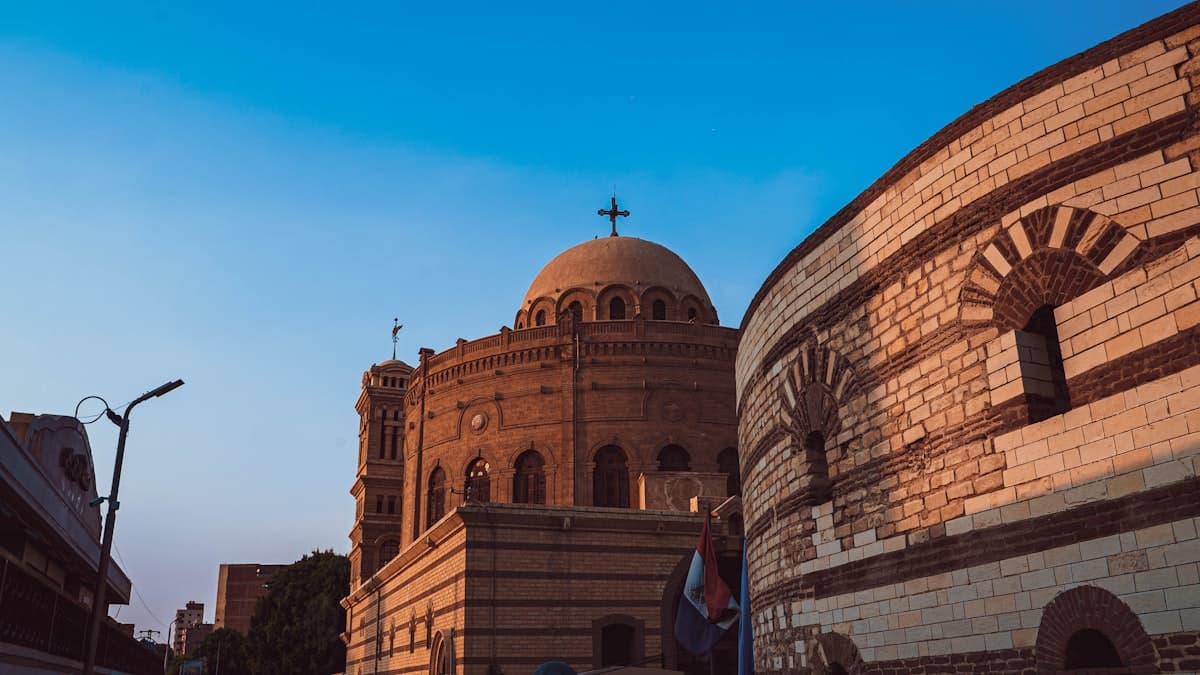
The fortress of Babylon, built by the Romans in the 1st century BC and expanded under Emperor Diocletian around 300 AD, is the frame around everything in Coptic Cairo. You enter through two round towers that are clearly Roman military architecture. What happens inside those walls over the following centuries is one of the strangest continuities in urban history.
The Hanging Church, Al-Moallaqa, meaning the Suspended One, sits literally on top of two of the Roman towers. It has been a church since at least the 4th century, possibly earlier. The nave is suspended on wooden beams above the gatehouse passage. Twenty-nine ivory and ebony panels in the altar screen date to the 13th century. The church's dedication is to the Virgin Mary. Coptic Christianity's reverence for the Virgin is intense and specific: Egypt is the country the Holy Family fled to from Herod, according to Matthew's Gospel, and Coptic tradition maps an entire route of their journey through the Nile Delta and into Upper Egypt, with chapels and shrines marking each stop. The country takes this seriously. State television in Egypt airs documentaries about the Holy Family's route.
The Church of St. Sergius and Bacchus, a few minutes' walk inside the compound, dates in its current form to the 5th century, though sections are older. Below the nave, accessible by a staircase, is a small crypt that floods seasonally from the Nile water table. This crypt is where tradition holds the Holy Family stayed. Standing in it, with the smell of damp stone and old incense and the sound of Cairo entirely muffled by the weight of 1,600 years of architecture above you, is one of the more disorienting experiences available in this city.
The Ben Ezra Synagogue, inside the same Roman compound, is where the Cairo Geniza was discovered in 1896. A Geniza is a storage room for worn-out sacred texts, since Jewish law prohibits destroying documents that contain the name of God. This particular room had not been cleared since roughly the 11th century. When Solomon Schechter of Cambridge University examined it, he found approximately 300,000 manuscript fragments: letters, legal documents, marriage contracts, shopping lists, philosophical texts, and fragments of previously unknown works by Maimonides. The Cairo Geniza is now distributed across libraries in Cambridge, New York, Philadelphia, and elsewhere, and it remains one of the most important documentary archives for medieval Mediterranean life ever discovered. The synagogue is quiet and carefully maintained. Very few visitors understand what happened in that room.
The Coptic Museum and What It Actually Contains
The Coptic Museum opened in 1910 under the patronage of Boutros Ghali Pasha, the Egyptian Prime Minister who was assassinated that same year. It was the first museum in Egypt dedicated to Christian heritage, and it remains the largest collection of Coptic art in the world, holding over 16,000 objects.
The most important thing to understand before entering is that Coptic art is not a break from Pharaonic Egypt. It is a continuation of it. The museum's collection traces exactly how Egyptian artists working in the 3rd and 4th centuries adapted their existing visual vocabulary to Christian subjects. The ankh, the ancient Egyptian symbol for life, became the Coptic cross. The image of Isis nursing Horus, one of the most repeated images in all of ancient Egyptian art, visually and iconographically influenced early images of the Virgin nursing the Christ child. Scholars debate the precise relationship, but the visual echo is not coincidental and the museum places the evidence in front of you.
The textile collection alone is worth the entrance fee. Coptic weavers produced wool and linen tapestries of extraordinary technical complexity between the 4th and 12th centuries. Figures of saints, angels, and biblical scenes rendered in deep reds, greens, and blues sit alongside purely geometric patterns that would look entirely at home in an Islamic context. The reason is that the same Egyptian craftsmen were weaving for both religious communities, and they carried their visual logic across the boundary.
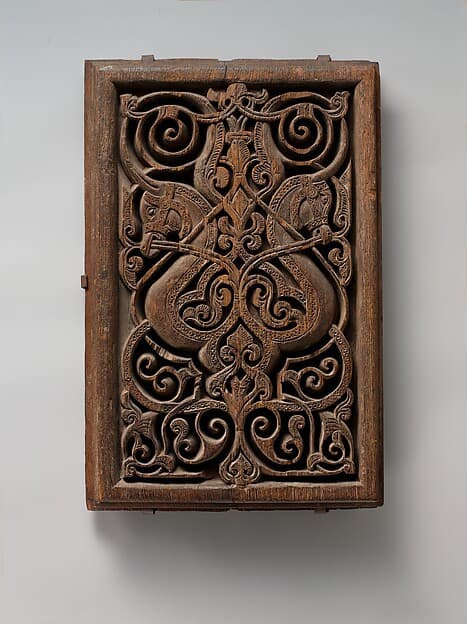
Spend time in the wooden artifacts room. The carved wooden panels from the 5th and 6th centuries show vine scrolls, hunting scenes, and architectural details that connect directly to the late antique Mediterranean world. Egypt in this period was a global cultural crossroads, and the museum makes that visible.
The Connections
Nothing in Coptic Cairo exists in isolation from the rest of Egyptian history, and the area around Mar Girgis station makes this unusually legible.
The Mosque of Amr ibn al-As, a five minute walk from the Coptic compound, was built in 642 AD, one year after the Arab conquest of Egypt. It is the oldest mosque in Africa. Amr ibn al-As made his military headquarters in the Roman fortress of Babylon, the same structure that frames the Coptic churches. He did not destroy the churches. The early Islamic administration of Egypt was largely staffed by Coptic Christians, who were the literate administrative class and who understood how to run the irrigation systems that fed the country. The Arabic word for the administrative office, diwan, entered Islamic bureaucratic vocabulary through Coptic Egypt.
The monasteries of Wadi Natrun, founded by St. Macarius and St. Bishoy in the 4th century, had a direct influence on Western monasticism through John Cassian, a monk who visited Egypt around 385 AD and brought the Egyptian system of monastic rules back to southern France. The Rule of St. Benedict, which shaped virtually all of Western Christian monasticism, drew explicitly on Cassian's Egyptian-derived writings. The desert fathers of Egypt, whose sayings are collected in the Apophthegmata Patrum, were the intellectual ancestors of Thomas Merton and every contemplative tradition in European Christianity.
In Upper Egypt, the White Monastery near Sohag, founded by St. Shenoute around 400 AD, was once home to over 2,000 monks and functioned as the largest library in Christian Egypt. Shenoute was the writer who standardized Coptic as a literary language. The White Monastery's church still stands and still holds services. The community at its peak was larger than most medieval European cities.
Common Mistakes
Treating Old Cairo as a half-morning. The compound and museum together contain more historically significant material per square meter than almost anywhere else in Cairo. People who rush through in two hours are skimming the surface of something that took fifteen centuries to build up. Budget at least four hours.
Skipping the crypt of Abu Serga because it looks like a small side chapel. The crypt is the reason the church exists. It is also one of the few places in Cairo where you are genuinely standing in a space that was constructed before the Arab conquest. The acoustics and atmosphere are unlike anything above ground.
Taking a private taxi instead of the Metro. Traffic in the area around Old Cairo can turn a twenty-minute journey into an hour. The Metro to Mar Girgis takes twelve minutes from Tahrir Square, costs EGP 10, and deposits you at the entrance. There is no argument for the taxi.
Paying for the Coptic Cairo sound and light show, if a guide recommends it. It exists, it costs money, and it tells you a version of this history that strips out everything interesting. The Coptic Museum has an excellent audioguide. Use that instead.
Missing the Coptic Cemetery adjacent to the compound. It is rarely mentioned in guides. It contains elaborate 19th and early 20th century funerary sculpture from wealthy Coptic families, and it is a quietly extraordinary place. It is also free and usually empty.
Visiting on a Sunday morning expecting easy access to the churches. Services are held and the churches become genuinely crowded with worshippers. This is actually worth experiencing once for the liturgical chanting and the incense, but if you want quiet contemplative access, come on a weekday morning.
Assuming the Coptic community is purely a historical subject. Coptic Christians constitute between 10 and 15 percent of Egypt's current population, somewhere between 10 and 15 million people. They are the largest Christian community in the Middle East. Their relationship with Egypt's Muslim majority is complex, historically deep, and not reducible to any simple narrative about persecution or harmony. Ask a Copt about it. They will tell you something more specific and more honest than anything written in a tourist summary.
Practical Tips
Dress modestly for the churches: covered shoulders and knees for both men and women. This is not negotiable and it is respected, not merely performed. You will be asked to cover up if you arrive without doing so, and a scarf or light layer in your bag solves the problem immediately.
The Coptic Museum shop is one of the better museum shops in Cairo for reproductions of manuscript pages and textile patterns. Prices are fixed and reasonable.
If you want to attend a Coptic liturgy, the Hanging Church holds services on Friday and Sunday mornings beginning around 8am. The liturgy is in Coptic and Arabic and lasts between two and three hours. You do not need to participate or understand the language. Sitting quietly at the back is entirely acceptable and the music, sustained drone harmonics over a rhythmic percussion, is unlike anything else you will hear in Egypt.
For the monasteries at Wadi Natrun, hire a driver or take a service taxi from Turgoman station. The journey takes about 90 minutes. The monasteries of Anba Bishoy and Deir el-Suriani are the most accessible and both welcome visitors. Call ahead if possible: monastic schedules and guest policies change. The monks at Anba Bishoy speak English and are used to visitors. Bring water and food as facilities outside the monastery walls are minimal.
Frequently Asked Questions
The Weekly Dispatch
More on Egypt, every Friday.
Cultural depth and places most guides never mention.
No spam. Unsubscribe anytime.