Early Christians in Egypt: A Coptic History Guide
Christianity reached Egypt before it reached Rome. The Coptic Church traces its founding to 42 AD, making it older than most of Europe's oldest cathedrals. Here is what that actually looks like on the ground.

Quick Facts
- Best time to visit
- October through April for comfortable temperatures. January 7th (Coptic Christmas) adds atmosphere but also crowds to Old Cairo churches.
- Entrance fee
- Coptic Museum: EGP 200 (approx $4 USD), students EGP 100. Churches within Babylon compound: free. Ben Ezra Synagogue: free.
- Opening hours
- Coptic Museum: daily 9am to 5pm. Babylon compound churches: generally 9am to 4pm, with variations during Coptic holy periods.
- How to get there
- Metro Line 1 to Mar Girgis station, EGP 7, direct entrance to compound. Taxi from Tahrir Square EGP 60 to 100.
- Time needed
- Coptic Museum alone: 2 hours minimum. Full Babylon compound including three churches and synagogue: half day. Adding Amr ibn al-As Mosque and Fustat ruins: full day.
- Cost range
- Budget EGP 400 to 700 per day self-guided. Adding a Coptic specialist guide: EGP 500 to 800 extra for a half-day session.
Quick Facts
Best time to visit: October through April, when Cairo temperatures sit between 15 and 25 degrees Celsius. The Coptic Christmas pilgrimage to the Church of Abu Sarga in Old Cairo falls on January 7th and is worth planning around if crowds do not deter you.
Entrance fees: The Coptic Museum in Old Cairo charges EGP 200 (approx $4 USD) for adults, EGP 100 for students. Individual churches within the Roman fortress of Babylon are free to enter. The Ben Ezra Synagogue, which shares the compound, is also free.
Opening hours: The Coptic Museum opens daily from 9am to 5pm. The churches within Babylon compound are generally open from 9am to 4pm, though hours shift during Coptic holidays and Lent. Arrive before noon to avoid tour groups.
How to get there: The Cairo Metro Line 1 stops at Mar Girgis station, which deposits you directly at the fortress entrance. Fare is EGP 7. From Tahrir Square, the ride takes eight minutes. Taxis from central Cairo cost EGP 60 to 100 depending on traffic.
Time needed: The Coptic Museum alone requires two hours if you are reading anything. The full compound, including three churches and the synagogue, takes a half day. Combining with the nearby Amr ibn al-As Mosque and the Fustat archaeological site makes a full day.
Cost range: Budget EGP 400 to 700 per day if self-guided. Adding a licensed Coptic studies guide, which I would recommend here more than almost anywhere else in Cairo, costs EGP 500 to 800 for a half-day session.
---
Why This Place Matters
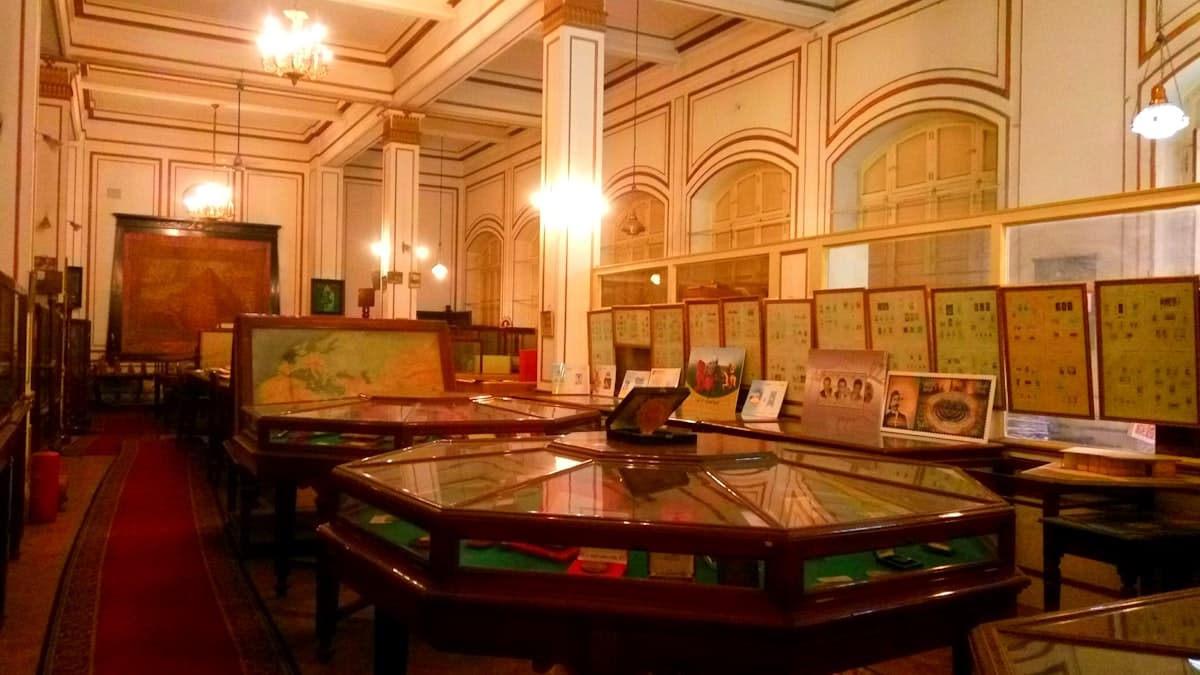
The Gospel of Mark arrived in Alexandria in approximately 42 AD. The Roman emperor Nero had not yet begun his persecutions. The Colosseum had not been built. Most of what we now call Western Christianity did not yet exist. Egypt's early Christians, the founders of what became the Coptic Orthodox Church, were interpreting scripture and developing theological doctrine while the rest of the Mediterranean world was still debating whether this movement would survive at all.
This is not a minor footnote. The word "monk" comes from the Greek monachos, meaning one who lives alone, and the institution of Christian monasticism was invented in Egypt, not in Europe. Anthony of Thebes, an Egyptian farmer's son from Middle Egypt, withdrew into the desert around 270 AD and established the model of solitary religious life that would eventually give the world Benedictines, Cistercians, Trappists, and the entire tradition of Western monasticism. When European pilgrims in the 4th century wanted to learn how to live a Christian life, they came to Egypt.
The early Christians in Egypt Coptic history represents something most visitors overlook entirely: a continuous thread of Christian practice that has never been broken. The Coptic Church did not begin as a Protestant reformation, a Catholic offshoot, or a colonial transplant. It is the original.
---
What Survives in Old Cairo
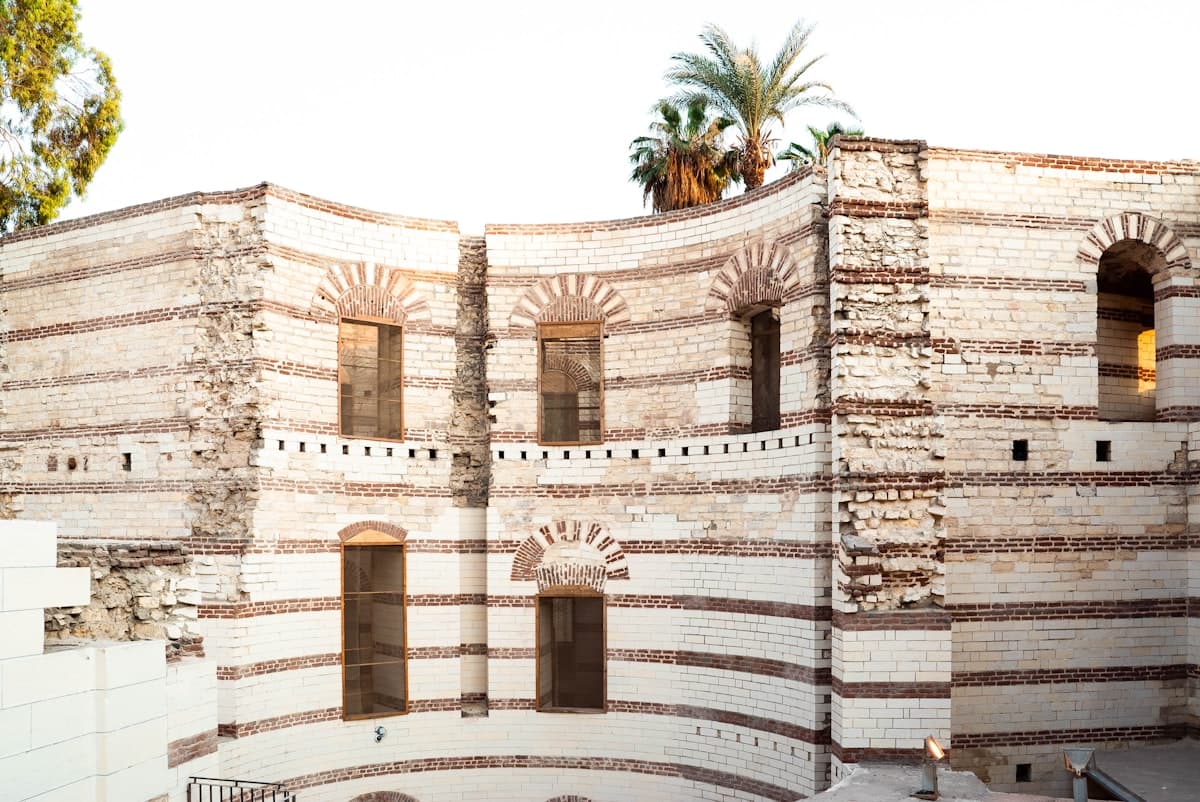
The Roman fortress of Babylon, built around 30 BC as a river customs post and later expanded under Trajan, sits at a level roughly nine meters below modern Cairo's street grade. You descend to it. This compression of time is physical: you are walking down into the 1st century.
The Hanging Church, al-Mu'allaqa in Arabic, meaning the suspended one, sits atop two towers of the fortress gate. Its nave is suspended over a passage between the towers, which is why you can see through the floor grates to the Roman stonework below. The church has been a place of continuous Christian worship since at least the 3rd century, making it older than the construction of St. Peter's Basilica in Rome by roughly eleven hundred years. Its pulpit, supported by thirteen columns representing Christ and the twelve apostles, dates to the 11th century and is one of the most sophisticated pieces of Fatimid-era inlaid woodwork in Cairo.
The Church of Abu Sarga, Saint Sergius, is built over a crypt where the Holy Family is traditionally believed to have sheltered during their flight into Egypt. The historicity of this is impossible to verify, but the fact that Egyptian Christians were venerating this site by the 4th century tells you something about how rapidly and deeply the early faith embedded itself into the local geography. The Coptic tradition of sites associated with the Holy Family Flight is extensive: there are over two dozen locations across Egypt where the family is said to have stopped, creating what is effectively the world's oldest Christian pilgrimage route.
The Ben Ezra Synagogue, sitting inside the same compound, opens a different chapter. A cache of documents discovered here in 1896, the Cairo Geniza, contained over 300,000 manuscript fragments, including letters, legal documents, and religious texts spanning from the 6th to the 19th century. The Geniza documents rewrote scholarly understanding of medieval Mediterranean trade, Jewish life in Egypt, and interfaith coexistence in ways that historians are still processing.
---
The Coptic Museum: What You Will Walk Past
The Coptic Museum houses the world's largest collection of Coptic art, roughly 16,000 objects across two main buildings. Most visitors walk through it in forty-five minutes and remember the textiles. This is a mistake.
The section that warrants the most time is the collection of Nag Hammadi manuscripts. In December 1945, a farmer named Muhammad Ali al-Samman was digging for fertilizer near the town of Nag Hammadi in Upper Egypt when his mattock struck a sealed clay jar. Inside were thirteen leather-bound papyrus books, written in Coptic, containing 52 texts, including the Gospel of Thomas, the Gospel of Philip, and the Gospel of Truth. These were Gnostic Christian texts, probably hidden by monks from the nearby Pachomian monastery of Chenoboskion around 390 AD when the church was moving against heterodox writings. They sat in the jar for roughly 1,560 years. The Coptic Museum holds the originals, and you can walk past them in a glass case that receives about as much attention as a posted bus schedule.
The textile galleries are genuinely worth your time for a different reason. Coptic weavers developed a technique of tapestry weaving into linen ground cloth that produced some of the most technically accomplished fabric of the ancient world. The designs move seamlessly between Greco-Roman mythology, Pharaonic motifs, and early Christian iconography, sometimes within a single piece. A Coptic tunic fragment from the 4th century might show Dionysus in one panel and a cross in another, because the people who made it did not experience those as contradictions. Egypt's early Christians absorbed and transformed the visual culture around them rather than erasing it.
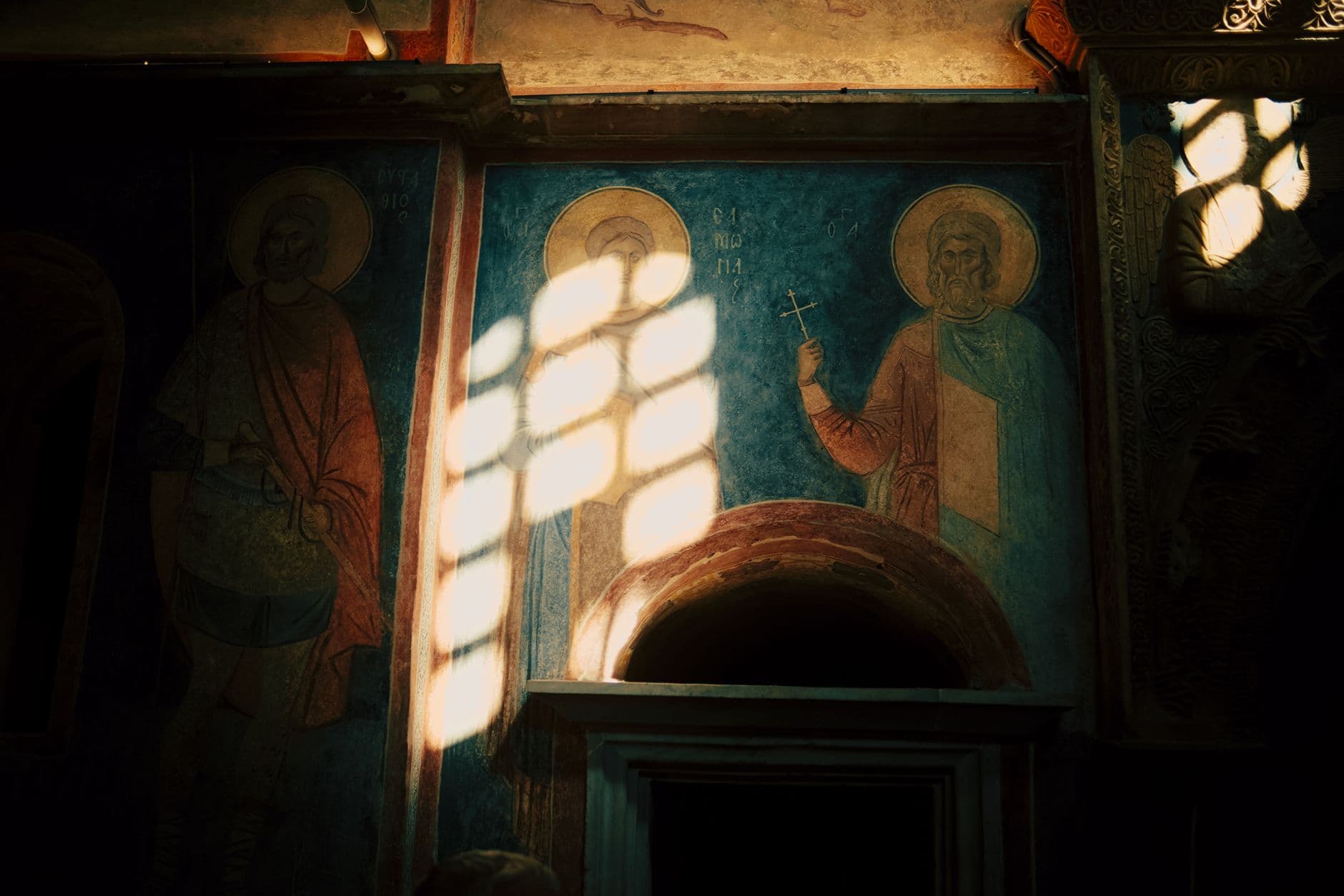
The Old Testament figure in the crypt of the Church of Abu Sarga is painted in a style that would be immediately recognizable to anyone who has spent time looking at Pharaonic tomb paintings. The continuity is not accidental.
---
The Connections
The Coptic history of Egypt does not sit in a separate compartment from Islamic Egypt or Pharaonic Egypt. It is layered into the same geography, often the same buildings.
The Monastery of Saint Simeon in Aswan, visible from the Nile on the west bank, was built in the 7th century and enlarged in the 10th. It could house 300 monks and had stabling for 300 camels, which tells you it was functioning as a caravan station as much as a religious community. Saladin ordered it destroyed in 1173 to prevent it from being used as a military position by a Crusader ally. The ruins stand now, enormous and largely unvisited, across the river from the Aga Khan Mausoleum.
The great Monastery of Saint Anthony in the Eastern Desert, founded in the 4th century, is the oldest Christian monastery in continuous operation in the world. The frescos inside its church, restored between 1999 and 2002 by the American Research Center in Egypt, date from the 13th century and show a stylistic sophistication that art historians did not expect to find this far outside the major cities. The monastery sits 334 kilometers from Cairo, in a canyon in the Red Sea Mountains, and requires a full day's travel. It is worth it.
The Pharaonic connection runs through language. Coptic is the last stage of the ancient Egyptian language, written in Greek letters with six additional characters borrowed from Demotic script. When you hear Coptic sung in a Coptic Orthodox liturgy, you are hearing a form of the language spoken by the builders of the Pyramids, filtered through three thousand years of change but genetically continuous. The language is now essentially liturgical only, which makes attending a Coptic mass one of the stranger and more affecting experiences available in Egypt.
In the early Christian Egypt Coptic history context, the theological contributions are also significant beyond Egypt's borders. The Council of Nicaea in 325 AD, which produced the Nicene Creed still recited in most Christian denominations, was shaped substantially by the Alexandrian theologian Athanasius, who argued successfully for the full divinity of Christ against the Arian position. The Coptic Church later broke with Rome and Constantinople at the Council of Chalcedon in 451 AD, over a single Greek word, whether Christ had one nature or two. That schism, 1,570 years old, has never been formally healed.
---
Common Mistakes
Skipping the Coptic Museum to spend more time in the churches. The churches are beautiful, but the museum holds the intellectual argument for why Coptic Christianity matters globally. Without the museum, you have aesthetics without context.
Coming on a Friday or Sunday. Friday is the main prayer day for the surrounding Muslim neighborhood; Sunday is the Coptic sabbath. Both days bring crowds to the compound from mid-morning onward. Saturday between 9am and noon is the clearest window.
Hiring a general Cairo tour guide rather than a Coptic specialist. The compound is small enough that most general guides cover it in thirty minutes with surface-level commentary. A Coptic studies specialist, bookable through the Coptic Museum's visitor services office, changes the experience entirely.
Taking the multi-site "Christian Cairo" day tour offered by most hotels. This typically covers the Hanging Church, Abu Sarga, and the Ben Ezra Synagogue in ninety minutes and then moves you to Khan el-Khalili for shopping. It is a logistical convenience that trades understanding for efficiency. Allocate a half day for the compound alone.
The Coptic Cairo sound and light experience offered occasionally in Old Cairo. It costs EGP 250 and uses projected animation on the fortress walls to tell a compressed version of Coptic history. It adds nothing that thirty minutes of reading does not provide. The money is better spent on a guided entry to the Coptic Museum.
Ignoring the monastery circuit in favor of Cairo sites only. If you have genuine interest in early Christians Egypt Coptic history, seeing only Old Cairo is like visiting Rome and skipping the catacombs. Saint Anthony's Monastery and the Wadi Natrun monasteries north of Cairo are not difficult trips and represent living communities, not museums.
Assuming all Coptic sites welcome non-Christian visitors freely. Most do, enthusiastically, but some areas within active monasteries are restricted. Dress modestly, shoulders and knees covered, and ask before photographing monks or nuns. This is not a rule enforced by signs. It is a matter of basic conduct in a working religious community.
---
Practical Tips
The Metro to Mar Girgis is genuinely the best way to arrive. The station exit deposits you at the top of a staircase that looks directly down into the Roman fortress, and the view reorients your sense of Cairo's depth immediately.
Bring water and wear flat shoes. The compound's stone floors and the descent into the Roman-level churches involve uneven surfaces that become slick when wet.
The Coptic Museum's garden, between the two main buildings, is one of the quieter spots in central Cairo and largely ignored by visitors. Sit there for ten minutes before entering the second building.
If you want to attend a Coptic liturgy, the Hanging Church holds services on Friday and Sunday mornings from roughly 8am. Non-Orthodox visitors are welcome to observe from designated areas. The sung liturgy in Coptic and Arabic lasts approximately two hours.
For the monastery visits, Saint Anthony's requires an overnight stay to experience it properly. The monastery operates guesthouses for religious visitors; secular travelers should arrange accommodation in the coastal town of Ain Sokhna and drive the remaining distance. Wadi Natrun's four monasteries, Anba Bishoy, Deir es-Suriani, Baramos, and Makarios, are a two-hour drive from Cairo off the Desert Road and can be visited in a single long day.
Frequently Asked Questions
The Weekly Dispatch
More on Egypt, every Friday.
Cultural depth and places most guides never mention.
No spam. Unsubscribe anytime.