Fatimid Cairo, Al-Azhar and the City Built to Outlast Empires
Al-Azhar has been teaching continuously since 970 AD, making it older than Oxford, Bologna, and every university in the Americas combined. And it started as a political gambit.

Quick Facts
- Best time to visit
- October to March for comfortable walking temperatures. Ramadan evenings are atmospheric but crowded. Avoid Friday midday.
- Entrance fee
- Al-Azhar Mosque: free. Museum of Islamic Art: EGP 200 (approx $4 USD), students EGP 100. City gates and most street monuments: free (small tip to caretaker to climb walls, EGP 20 to 30).
- Opening hours
- Al-Azhar Mosque daily 9am to 9pm, closed to tourists during Friday midday prayer. Museum of Islamic Art Saturday to Thursday 9am to 5pm, closed Friday.
- How to get there
- Metro Line 1 to Ataba station (EGP 10), then 15-minute walk east. Microbus from Tahrir toward al-Azhar (EGP 5). Taxi or Uber from downtown EGP 40 to 70.
- Time needed
- Half day for core circuit. Full day if including Museum of Islamic Art and unhurried time in the mosque.
- Cost range
- Budget EGP 200 to 400 per person for the full circuit including transport, museum entry, tea, and food from the market.
Quick Facts
Best time to visit: October to March, when the air in the old city is cool enough to walk for hours. Ramadan evenings are extraordinary if you can handle the crowds.
Entrance fees: Al-Azhar Mosque is free. The Khan el-Khalili area costs nothing to enter. The Fatimid Cairo walking circuit, including the Mosque of al-Hakim and the city walls at Bab al-Futuh and Bab al-Nasr, is free. The nearby Museum of Islamic Art charges EGP 200 (approx $4 USD), students EGP 100. Some restored Mamluk buildings accessed via the Aga Khan Trust for Culture charge EGP 100 to 150 per site.
Opening hours: Al-Azhar Mosque is open daily 9am to 9pm, closed during Friday prayer midday. The Museum of Islamic Art opens Saturday to Thursday 9am to 5pm, closed Friday. City gates Bab al-Futuh and Bab al-Nasr can be climbed during daylight hours with a small tip to the caretaker.
How to get there: Take the Cairo Metro Line 1 to Ataba station (EGP 10, approx $0.20), then walk 15 minutes east through the market, or take a microbus from Tahrir Square toward al-Azhar for EGP 5. Taxis from downtown run EGP 40 to 70 depending on traffic. Uber is reliable from most hotels.
Time needed: Half a day covers the core circuit. A full day if you include the Museum of Islamic Art and linger in the mosque courtyard after morning prayer.
Cost range: Budget EGP 200 to 400 per person for this circuit including transport, tea, and snacks from the souq.
---
Why This Place Matters
The Fatimid general Jawhar al-Siqilli broke ground on a new royal city north of the existing Egyptian capital Fustat on the night of August 5, 969 AD. The exact moment was chosen by court astrologers who were watching the planet Mars, which Arabs called al-Qahir, the Conqueror. A bell system was rigged to signal the laborers when the stars aligned. A raven landed on the rope before the astrologers gave the signal, the bell rang too early, and the city was founded under Mars anyway. Cairo, al-Qahira, was named for the planet that interrupted the ceremony.
This is not mythology. It is the founding account recorded by the medieval Egyptian historian al-Maqrizi, who was meticulous enough to note the specific night and the bird. And it tells you something important about the Fatimid project: this was a dynasty that understood the power of spectacle, timing, and symbolism. They were Ismaili Shia Muslims ruling a majority Sunni population in a land that had been Christian less than four centuries earlier and Pharaonic for three thousand years before that. They needed a city that announced their legitimacy in stone.
Within a year of founding al-Qahira, Jawhar began construction of al-Azhar Mosque. The name means the resplendent, likely a reference to Fatima al-Zahra, daughter of the Prophet Muhammad, from whom the Fatimid caliphs claimed descent. By 988 AD, al-Azhar had added systematic religious instruction to its functions. It has been teaching continuously ever since, making it the oldest continuously operating university on earth, predating the University of Bologna by over a century.
The Fatimid Cairo founding and Al-Azhar history are inseparable from a larger argument the dynasty was making: that legitimate Islamic rule ran through the line of Ali and Fatima, not through the Sunni Abbasid caliphs in Baghdad. Al-Azhar was the institutional expression of that argument, built in the heart of a purpose-built capital city, on land that had no prior significance whatsoever. This was not a mosque added to an existing sacred site. It was a declaration planted in empty ground.
---
What You Are Actually Walking Through
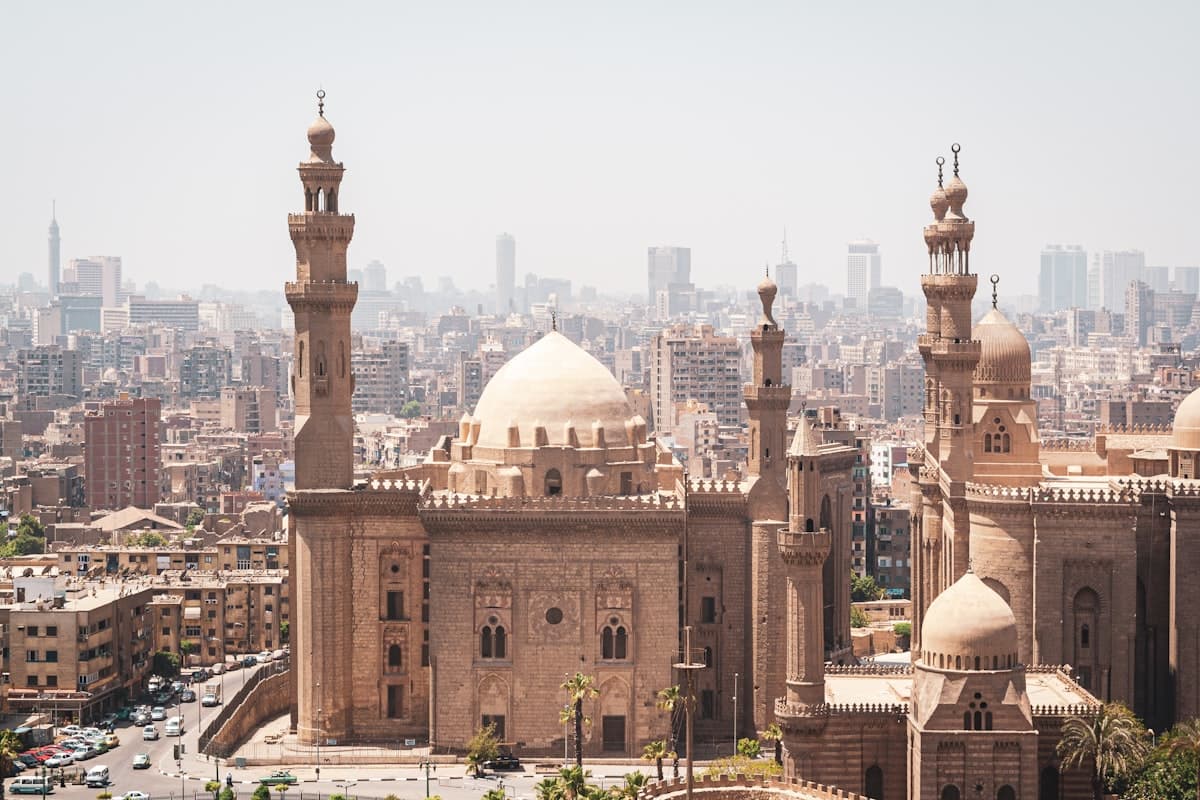
Modern al-Qahira, the Fatimid city, is roughly bounded by the city gates Bab al-Futuh and Bab al-Nasr to the north, Bab Zuwayla to the south, and the ruins of the eastern and western palaces in between. The two main palaces are gone, replaced by the Khan el-Khalili market and the Qalawun complex, but the street plan is almost entirely Fatimid. The road you walk from Bab al-Futuh south to Bab Zuwayla, known now as al-Muizz Street, was the ceremonial spine of the original city. Processions moved along it. The caliph's treasure was displayed there during festivals. You are walking a royal axis that is over a thousand years old.
Al-Azhar itself is older in its bones than it appears. The mosque has been expanded, modified, and added to by every subsequent dynasty: the Mamluks added three minarets between the fourteenth and sixteenth centuries, the Ottomans added a portico, and Khedive Abbas II funded a new facade in the early twentieth century. What you see is a palimpsest. The original Fatimid structure survives in the mihrab and in parts of the arcade around the central courtyard, if you know where to look. Ask a guide specifically about the Fatimid keel arches, which are distinct from the rounded Mamluk arches added later. Most visitors walk through the entire mosque without understanding that they are looking at six different centuries simultaneously.
Remove your shoes at the entrance, leave them in the rack rather than carrying them, and walk directly into the central courtyard. Sit for ten minutes. The quality of light in that courtyard at around 9am, when it hits the pale stone of the arcade at an oblique angle, is specific to this place in a way that photographs do not capture. The sound is specific too: students still come here to memorize Quranic text, and the low murmur of recitation from the inner halls is not ambient decoration. It is the same sound this building has made for over a thousand years.
---
The Human Stories Behind the Stones
Jawhar al-Siqilli, the general who built this city and this mosque, was not Arab and was not born Muslim. He was a Greek or Slavic slave, most likely from Sicily, who rose through the Fatimid military to become the dynasty's greatest commander. He conquered Egypt for the Fatimid caliph al-Muizz li-Din Allah in 969 AD without a major battle, partly through military skill and partly because he promised the existing population of Fustat that their property, their faith, and their legal rights would be respected. He kept that promise. The Sunni and Coptic populations of Egypt were not persecuted under the early Fatimids. Al-Azhar itself only became an explicitly Sunni institution after Saladin dismantled the Fatimid caliphate in 1171 AD and switched the Friday prayer to invoke the Sunni Abbasid caliph instead.
That transition is one of the strangest moments in Al-Azhar's long history. The mosque had been founded as a Shia institution to propagate Ismaili doctrine. Saladin, who was Kurdish and Sunni and had come to Egypt as a military deputy of the Zengid sultan of Syria, effectively repurposed the most important religious institution in the country by changing the words spoken aloud during prayer. He did not demolish al-Azhar. He did not expel its scholars. He simply stopped paying its stipends for a while, let it fall quiet, and allowed it to reopen on different theological terms. The building survived. The institution survived. The doctrine was replaced. This is how durable institutions actually work.
The Fatimid city walls at Bab al-Futuh and Bab al-Nasr, which you can climb for a small consideration to the caretaker, were built not by the Fatimids themselves but by an Armenian general named Badr al-Jamali in 1087 AD. He was the Fatimid caliph's military strongman during a period of famine and civil war so severe that the caliphs' own household servants were reportedly sold to pay debts. Badr al-Jamali brought Armenian stonemasons with him from Syria, which is why the construction technique of the northern gates is closer to Byzantine military architecture than to anything else in Egypt. You can see the difference in the stone-cutting if you look at the gate towers closely. The Fatimid Cairo founding and Al-Azhar history exist within this constant negotiation between different peoples, skills, and agendas.
---
The Connections: Nothing Here Exists Alone
The site of al-Azhar Mosque sits close to the former eastern Fatimid palace, which occupied an area now covered by the Khan el-Khalili market. The Khan was built in 1382 by a Mamluk emir named Jarkas al-Khalili, who demolished the Fatimid royal tombs to do it. The Mamluk sultans who followed the Fatimids and preceded the Ottomans were themselves almost entirely former slaves, mostly Circassian and Turkic, who had been purchased as boys and trained as soldiers. The Qalawun complex just north of Khan el-Khalili, one of the finest pieces of medieval architecture in Cairo, was built by a sultan who had been bought as a slave for 1,000 dinars and named after the Arabic word for that sum.
Two hundred meters north of al-Azhar, the Mosque of al-Hakim bi-Amr Allah stands at the junction of al-Muizz Street and the city wall. Al-Hakim was the Fatimid caliph who commissioned it and who remains one of the most disputed figures in medieval Islamic history: he banned women from leaving their homes, ordered the destruction of the Church of the Holy Sepulchre in Jerusalem in 1009 AD, and then disappeared one night in 1021 AD, possibly murdered, possibly gone into hiding. The Druze religious community, which now numbers several million people across Lebanon, Syria, and Israel, regard al-Hakim as a divine figure whose disappearance was a concealment rather than a death. They still await his return. The mosque that bears his name was restored by the Bohra Ismaili community of India in the 1980s and is now in better structural condition than almost any other medieval mosque in Cairo, which is either admirable or architecturally jarring depending on your view.
---
Common Mistakes
1. Treating al-Azhar as a photo stop. You are legally allowed to enter the mosque as a non-Muslim. You are expected to dress modestly: knees and shoulders covered, women should bring a headscarf. If you arrive, photograph the courtyard, and leave in fifteen minutes, you have missed the point entirely. Sit. Watch. The institution around you has outlasted the Byzantine Empire, the Crusades, the Mongol invasions, Ottoman rule, French occupation, British occupation, and multiple republican governments. That fact deserves more than a quarter of an hour.
2. Hiring a guide at the mosque entrance. The men who approach tourists at the al-Azhar entrance offering guided tours are almost never affiliated with the mosque and are often working toward a commission at a papyrus shop or perfume store. Book a licensed Egyptologist guide through your hotel or through a reputable agency before you arrive. The difference in quality is not subtle.
3. Going to the sound and light show at the Citadel instead of spending an evening in the Fatimid district. The sound and light show costs EGP 450 and tells you nothing you cannot learn in twenty minutes of reading. An evening walking al-Muizz Street from Bab al-Futuh south to Bab Zuwayla after the heat breaks, stopping for tea at one of the ahwas near the Qalawun complex, costs almost nothing and is the actual experience of Cairo that people remember for years.
4. Skipping the Museum of Islamic Art. Most visitors to Fatimid Cairo never enter it. This is a serious mistake. The museum on Ahmed Maher Square, a ten-minute walk west of al-Azhar, contains the finest collection of Fatimid decorative art in the world: carved ivory panels from the Fatimid palaces, rock crystal ewers, and Quranic manuscripts that were produced in the same decades that al-Azhar was being built. It was damaged by a car bombing in 2014 and reopened after restoration. Budget an hour minimum.
5. Visiting on a Friday midday. Al-Azhar closes the outer sections to tourists during Friday prayer, the streets around Khan el-Khalili become very crowded, and the combination of heat and density makes the experience genuinely unpleasant. Friday morning before 11am or Friday afternoon after 3pm works. Any weekday morning is better still.
6. Underestimating the distance between sites. The Fatimid city is walkable but not compact. Bab al-Futuh to Bab Zuwayla is about 1.2 kilometers on al-Muizz Street alone, and the Museum of Islamic Art adds another twenty-minute walk each way. Wear shoes built for uneven stone and accept that you will sweat.
7. Confusing the old city with the tourist bazaar. Khan el-Khalili is fine for tea and a look around, but the shops selling alabaster pyramids and cotton kaftans are not the point of coming to Fatimid Cairo. The point is the mosque, the gates, the street plan, and the layers of human decision-making compressed into a square kilometer of medieval city. Do not let the souvenir market convince you that is what you came for.
---
Practical Tips
Wear layers in winter: the mosque courtyard is open to the sky and can be cold in December and January before 10am. In summer, arrive before 9am or after 4pm. The stone in these buildings holds heat, and by early afternoon in July the interior of any enclosed space in the old city becomes genuinely uncomfortable.
Women will be offered an abaya (a long robe) to wear over their clothes at the entrance to al-Azhar if they are not already covered. The robes are free and clean. Bringing your own scarf is simpler and more comfortable.
The streets immediately around Khan el-Khalili have aggressive touts. A firm, calm "la, shukran" (no, thank you) without eye contact is the appropriate response. Do not apologize, do not explain, and do not stop walking. This is not unfriendliness; it is the local protocol for declining.
If you want to climb Bab al-Futuh or Bab al-Nasr and walk along the top of the Fatimid walls, find the caretaker on the inside of the gate. A tip of EGP 20 to 30 is standard. The view north from Bab al-Nasr toward the City of the Dead is one of the better urban panoramas in Cairo and is seen by almost no tourists.
For the most specific and least generic experience of the Fatimid district, arrive at al-Azhar for the morning prayer just after sunrise, sit in the courtyard until the students settle into their study circles, then walk north up al-Muizz Street to Bab al-Futuh while the market stalls are still setting up. The city in that hour is operating for itself, not for visitors.
Frequently Asked Questions
The Weekly Dispatch
More on Egypt, every Friday.
Cultural depth and places most guides never mention.
No spam. Unsubscribe anytime.