Fatimid Cairo, Al-Azhar, and the City Built to Outlast Its Founders
Al-Azhar is the world's oldest continuously operating university. It was built in 970 AD not as a school, but as a Shia propaganda machine. The story got complicated.

Quick Facts
- Best time to visit
- October through March. Spring and autumn mornings are ideal. Avoid July and August before 9am or after 5pm unless you are acclimated to Cairo summers.
- Entrance fee
- Al-Azhar Mosque: free. Fatimid gates (Bab Zuweila, Bab al-Futuh, Bab al-Nasr): EGP 100 each (approx $2 USD) or cluster ticket EGP 300 (approx $6 USD). Museum of Islamic Art: EGP 200 (approx $4 USD), students EGP 100.
- Opening hours
- Al-Azhar Mosque: daily 9am to 9pm, closed Friday 11:30am to 1pm. Fatimid gates: daily 9am to 5pm. Museum of Islamic Art: Tuesday to Sunday 9am to 5pm, closed Monday.
- How to get there
- Metro Line 1 to Ataba (EGP 10), then 15-minute walk east. Taxi or Uber from Downtown Cairo: EGP 40 to 70. No direct bus from central tourist areas.
- Time needed
- 3 to 4 hours for core Fatimid circuit. Full day if adding Museum of Islamic Art and Tentmakers' Bazaar.
- Cost range
- Self-guided day including transport, entry fees, street food lunch, and tea: EGP 400 to 600 (approx $8 to $12 USD).
Quick Facts
Best time to visit: October through March, when the air in the narrow alleys of Islamic Cairo is cool enough to actually stop and look upward. Summer visits are possible but brutal by 10am.
Entrance fees: Al-Azhar Mosque is free. The nearby Fatimid gates (Bab Zuweila, Bab al-Futuh, Bab al-Nasr) cost EGP 100 each (approx $2 USD) or combined with other Islamic monuments on a EGP 300 (approx $6 USD) cluster ticket. The Museum of Islamic Art, the essential companion to any Fatimid walk, costs EGP 200 (approx $4 USD).
Opening hours: Al-Azhar Mosque is open daily from 9am to 9pm, closed during Friday prayer (approximately 11:30am to 1pm). The Fatimid gates are open daily 9am to 5pm. The Museum of Islamic Art is open Tuesday through Sunday, 9am to 5pm.
How to get there: Cairo Metro Line 1 to Ataba (EGP 10, approx $0.20), then a 15-minute walk east along Al-Azhar Street. Taxis from Downtown Cairo should cost EGP 30 to 50 (approx $0.60 to $1 USD) via meter or negotiation. Uber tends to run EGP 40 to 70 from Tahrir Square.
Time needed: Half a day for the core Fatimid circuit (Al-Azhar, Al-Hakim Mosque, the three gates). A full day if you add the Tentmakers' Bazaar, the Museum of Islamic Art, and Bab Zuweila's minaret climb.
Cost range: EGP 400 to 600 for a self-guided day including transport, entry fees, lunch at a local fuul shop, and tea.
---
The Fatimid generals who marched into Egypt in 969 AD brought a mandate from their caliph in Tunisia: build a city that would make Sunni Baghdad obsolete. They named it Al-Qahira, "The Victorious," after the planet Mars, which was rising as their astrologers consulted the stars for an auspicious founding moment. A cat reportedly walked across the surveyor's ropes before the official signal, triggering construction prematurely. Cairo, in other words, began with a mistake. It never quite recovered from the habit of beginning things badly and making them work anyway.
Why This Place Matters
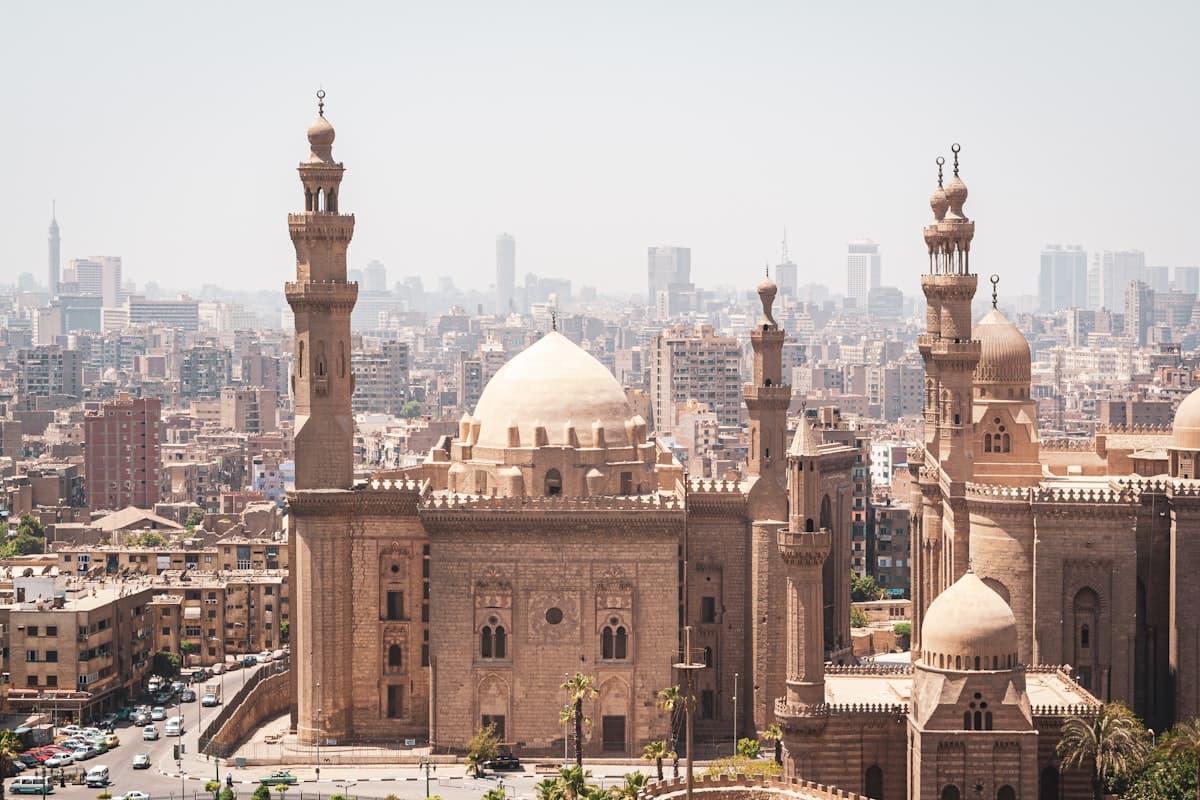
To understand what the Fatimids built, you need to understand what they were trying to prove. They were Ismaili Shia Muslims, a minority sect claiming direct descent from the Prophet through his daughter Fatima, hence the dynasty's name. Their rivals, the Abbasid caliphs in Baghdad, were Sunni and controlled the symbolic heart of the Islamic world. The Fatimids needed a counter-capital, a city so visually powerful and institutionally deep that it would pull Islamic intellectual gravity westward.
Al-Azhar was the instrument of that project. Founded in 970 AD, just one year after the city itself, it was the world's first degree-granting institution, predating the University of Bologna by more than a century. But its founding curriculum was not general scholarship. It was Ismaili theology, taught in a mosque specifically designed to propagate a minority interpretation of Islam to a majority-Sunni population. The name itself, Al-Azhar, is almost certainly a reference to Fatima Al-Zahra, the Prophet's daughter and the Fatimids' ideological cornerstone.
The experiment lasted less than two centuries. In 1171, Saladin abolished the Fatimid caliphate, converted Egypt back to Sunni Islam, and erased Shia prayer from Al-Azhar's rituals overnight. In a detail that still astonishes historians of religion, he did not tear the mosque down. He simply redirected it. Al-Azhar became the intellectual spine of Sunni scholarship and has remained so for 850 years since. The institution built as a Shia weapon became, and remains, the most influential Sunni institution on earth. Its fatwas are followed by roughly a billion people.
What You Are Actually Walking Through
The Mosque of Al-Azhar
Step through the Gate of the Barbers, so named because students traditionally had their heads shaved in its shadow, and the first thing you register is not architecture. It is quiet. This is a functioning mosque, a working university, a place where men have been memorizing the Quran continuously since 970 AD. The courtyard's oldest section, the central sanctuary with its five naves, is original Fatimid construction. Look at the stucco medallions in the prayer hall ceiling. They predate the Crusades.
What most visitors miss: the mosque has been expanded seven times by seven different rulers, each adding a minaret or a madrasa to stamp their own dynasty onto the building. The result is an accidental museum of Islamic architectural ambition. The Aqbaghawiyya madrasa, added in 1340, contains a tomb that is one of the finest examples of Mamluk woodwork in Egypt, a carved cedarwood screen of such precision that its maker's name was recorded: a craftsman known only as Ibn al-Suyufi. No other Mamluk craftsman in Cairo received that distinction.
Leave your shoes at the entrance (there are staff who will watch them for a tip of EGP 5 to 10). Do not rush the courtyard. The light in the early morning, before the tour groups arrive, falls across the ablution fountain in a way that makes the whole space feel provisional and enormous at once.
The Fatimid Gates and the Wall That Defined the City
The Fatimids built their capital as a walled royal city, off-limits to the general public. The population of Fustat, the earlier Arab settlement to the south, could look at Al-Qahira's walls but not enter. The gates that survive, Bab al-Futuh (Gate of Conquests) and Bab al-Nasr (Gate of Victory) to the north, and Bab Zuweila to the south, were built not by the original Fatimid founders but by their Armenian general-vizier, Badr al-Jamali, in 1087. He imported stonemasons from Syria and Armenia, which is why the construction technique, with its hidden passages, arrow slits, and interlocking stone bonding, looks nothing like anything else in Egypt at the time. It looks like a Byzantine fortress because the men who built it had studied Byzantine fortresses.
Bab Zuweila is the most rewarding of the three. Climb to the top via the narrow internal staircase (steep, uneven, no handrail: wear appropriate shoes) and you stand inside the twin minarets of the Mosque of Mu'ayyad, added in 1420 by the Mamluk sultan who could not afford to build his mosque its own minarets and simply planted them on the Fatimid gate beneath. From up here, the medieval street plan of Cairo is legible in a way it never is from street level. The spine of Al-Muizz Street runs directly below you, following the exact route of the Fatimid royal processional way. It has not moved in a thousand years.
The gate also has a darker association. For centuries it was the city's principal execution site. The Ottoman governor Khayr Bey hung the body of the last independent Mamluk sultan, Tuman Bay, from this gate in 1517 after his defeat. It is said Tuman Bay was hanged three times because the rope kept breaking.
Al-Muizz Street and What the Fatimids Left Behind
The two-kilometer stretch of Al-Muizz Li-Din Allah Street running between Bab al-Futuh and Bab Zuweila contains the highest concentration of medieval Islamic monuments in the world. UNESCO said so in 1979 when it designated the area. What UNESCO did not specify, and what matters more, is that you are not walking through a preserved district. You are walking through a lived city that happens to be medieval.
The Fatimid layer is there if you know to look for it. The Mosque of Al-Hakim, at the northern end near Bab al-Futuh, was begun by the Caliph Al-Aziz in 990 and completed by his son Al-Hakim bi-Amr Allah in 1013. Al-Hakim is one of the most singular figures in Islamic history: a caliph who banned the sale of women's shoes to prevent women from leaving the house, ordered the slaughter of all dogs in Cairo because their barking disturbed him, and was almost certainly the founder of the Druze religion, whose adherents in Lebanon and Syria still consider him divine. He disappeared one night in 1021, walking alone in the Muqattam hills. His body was never found.
The mosque named for him sat in disrepair for centuries and was used variously as a prison for Crusader captives, a stable for Napoleon's horses, and a school. In the 1980s, the Dawoodi Bohra community, an Ismaili Shia sect based in India who consider themselves the true inheritors of Fatimid Islam, funded its complete restoration. They did a meticulous job and the result is now the cleanest, least atmospheric medieval mosque in Cairo. Worth seeing for the scale. Do not expect spiritual texture.
The Connections
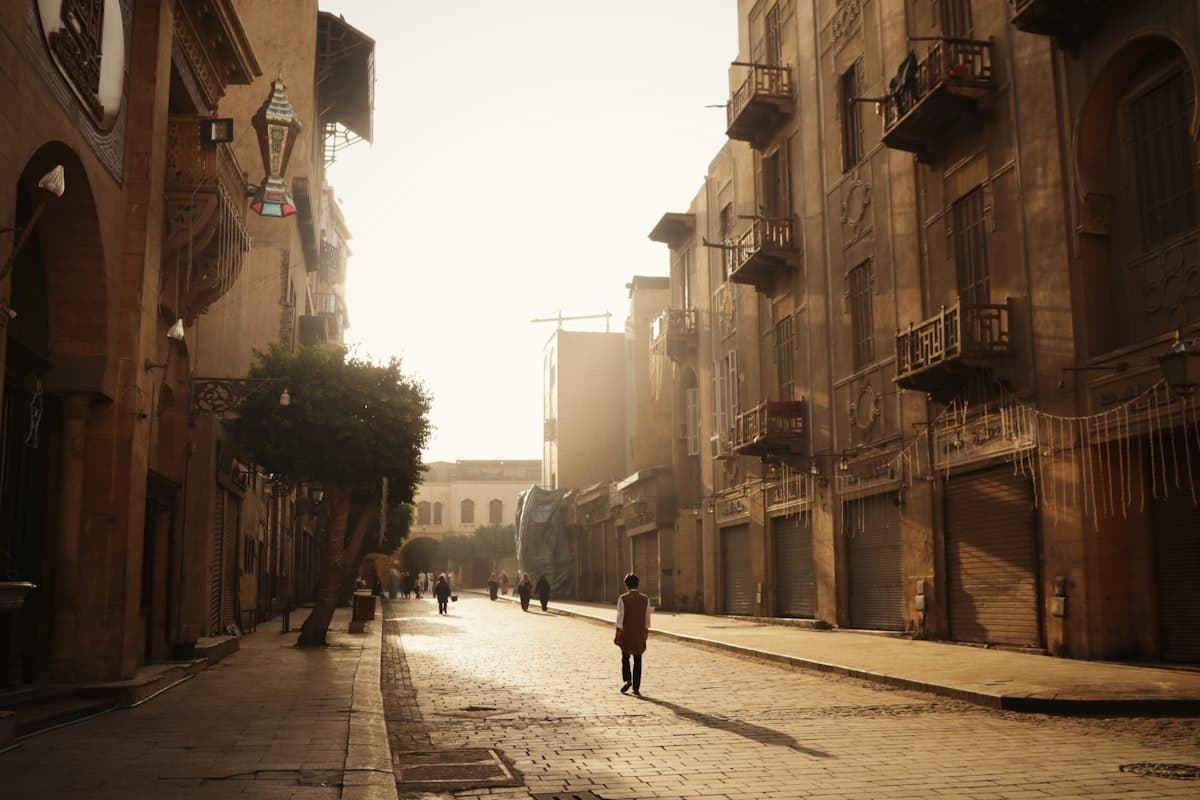
Nothing in Fatimid Cairo exists in isolation, and the connections across time are where the real history lives.
The ground beneath Al-Azhar Street follows the route of an ancient Nile branch called the Canal of the Commander of the Faithful, a waterway used in Pharaonic times and still flowing when the Fatimids built over it. The street floods during heavy rain for the same reason it has always flooded: the water has nowhere else to go.
Saladin, who ended Fatimid rule and rerouted Al-Azhar toward Sunni scholarship, was himself Kurdish, not Arab or Egyptian. He built the Cairo Citadel one kilometer to the southeast as his administrative center, deliberately placing it outside the Fatimid city to signal discontinuity. But he kept the Fatimid street plan, the Fatimid markets, and the Fatimid population in place. Cairo absorbed its conquerors and continued.
The Mamluk sultans who followed Saladin's dynasty were themselves enslaved Circassians and Turks, purchased as children and trained as soldiers. They built the finest architecture in Islamic Cairo, funding their construction projects with revenues from the spice trade that passed through Egypt from East Africa and India to Europe. When Vasco da Gama found the sea route to India in 1498, he destroyed that revenue stream within a generation and the Mamluk building program stopped almost immediately. The Ottoman conquest of 1517 finished what the Portuguese started.
Al-Azhar survived all of it. It survived Saladin's confessional revolution, the Mongol destruction of Baghdad in 1258 (which made Cairo the default capital of the Arab world overnight), the Ottoman administrative reorganization, Napoleon's occupation, and British colonialism. It currently enrolls approximately 500,000 students across Egypt and 100 countries abroad.
Common Mistakes
Starting with Khan el-Khalili. Every tour itinerary in existence sends you to the bazaar first, where you will spend ninety minutes being offered papyrus and alabaster before you have any context for where you are. Start at Bab al-Futuh, walk south down Al-Muizz Street, and arrive at Khan el-Khalili having already understood what city you are standing in.
Visiting Al-Hakim Mosque expecting atmosphere. The Bohra restoration is technically impressive and historically meaningful, but the mosque now feels like a replica. If your time is limited, prioritize the interior of Bab Zuweila or the Mosque of Al-Mu'ayyad next door, which is genuinely medieval and genuinely undervisited.
Skipping the Museum of Islamic Art. This is the most important Islamic art museum in the world outside of the Istanbul museums, and almost no tourists go. It contains Fatimid woodwork, Mamluk metalwork, and Coptic textiles in the same building, making the argument for Cairo's layered civilization more powerfully than any walking tour. The collection was severely damaged in the 2014 car bombing outside the Cairo Security Directorate next door. The restoration took years and is now complete.
Paying for a guide outside Al-Azhar. Unofficial guides at the mosque entrance will offer their services for EGP 100 to 200 and tell you things you can read on any sign. Buy Doris Behrens-Abouseif's "Cairo of the Mamluks" before you arrive. It is available at the AUC bookstore in Zamalek for roughly EGP 500 and will tell you more than any unlicensed tour.
Visiting on a Friday morning. Al-Azhar closes for Friday prayer and the streets around it become impossible with foot traffic. Friday afternoon is fine. Friday morning is a tangle.
Paying for the Al-Azhar Park overlook without walking the Ayyubid Wall. The park, restored by the Aga Khan Trust, is pleasant. The EGP 50 entry is reasonable. But the real find is the section of Saladin's original city wall that runs along its western edge, excavated during the park's construction and now walkable. Most visitors sit in the cafe and miss it entirely.
Trying to see the Fatimid quarter and Coptic Cairo in the same half-day. They are not far apart in distance, but the cognitive and physical demand of both is genuinely exhausting. They deserve separate mornings.
Practical Tips
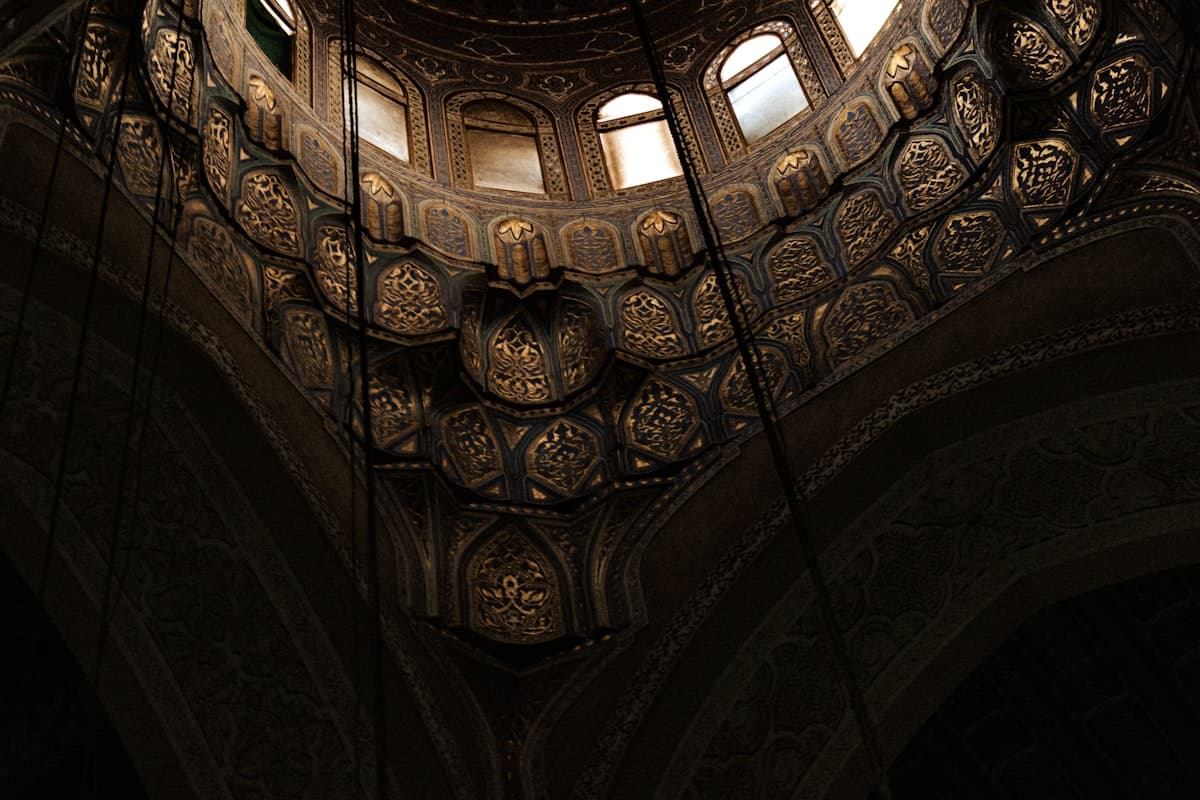
Dress conservatively. This is not a suggestion made for tourists' comfort but a matter of basic respect in a neighborhood where people live and pray. Women should bring a scarf for mosque interiors. Sleeveless shirts and shorts will generate friction that slows your day.
The best hour in Al-Muizz Street is 8am on any weekday, before the school groups and the tour buses. The worst hour is 11am to 2pm on weekends. If you arrive and it is already crowded, retreat to the side streets: Sharia al-Khayamiyya (the Tentmakers' Bazaar, south of Bab Zuweila) is almost always quiet and contains craftsmen doing work that is genuinely centuries old in technique.
Water and food: the neighborhood has fuul and taamiya carts that open at 7am and are finished by 10. Eat there. The sit-down restaurants on Al-Muizz Street itself are priced for tourists and are mediocre. Walk one block in either direction.
Bring cash. The ticket sellers at the Fatimid gates occasionally claim their card machines are broken regardless of their actual status. EGP 300 in small notes covers everything.
If you have a single afternoon and cannot do the full circuit, go to Al-Azhar Mosque first, walk to Bab Zuweila and climb it, then stand at the top and decide whether you have time for Al-Muizz Street before the light goes. In winter, the golden hour on those minarets is worth organizing your entire day around.
Frequently Asked Questions
The Weekly Dispatch
More on Egypt, every Friday.
Cultural depth and places most guides never mention.
No spam. Unsubscribe anytime.