Greco-Roman Alexandria: Egypt's Lost Capital Explained
Alexandria was once the largest city on earth. Almost none of it survives above ground. What does survive will rewrite what you thought you knew about Egypt.

Quick Facts
- Best time to visit
- October to April. Mediterranean climate makes summer humid and crowded with Egyptian domestic tourists. October and March offer mild temperatures with minimal crowds.
- Entrance fee
- Greco-Roman Museum EGP 200 (approx $4 USD); Catacombs of Kom el-Shoqafa EGP 180 (approx $3.50 USD); Pompey's Pillar and Serapeum EGP 100 (approx $2 USD); harbor archaeology boat tour EGP 800 to 1,200 per person
- Opening hours
- Most sites daily 9am to 5pm. Greco-Roman Museum closed Mondays. Catacombs last entry 4pm, close 4:30pm.
- How to get there
- Train from Cairo Misr Station to Alexandria: 2 hours, EGP 150 to 300. Microbus from Sidi Gaber or Misr train stations to Pompey's Pillar: EGP 5. Uber or Careem taxis across central Alexandria: EGP 40 to 80 per trip.
- Time needed
- One full day minimum for Museum, Catacombs, and Serapeum. Two days recommended to add harbor boat tour. Three days for comprehensive coverage including Coptic and Islamic Alexandria connections.
- Cost range
- Budget EGP 600 to 900 per day including hostel, local food, and site fees. Mid-range EGP 1,800 to 3,000 per day with Corniche hotel and specialist guide.
Nearly everything you have come to see in Alexandria is underground, or gone. The ancient city that held the world's greatest library, that housed the tomb of Alexander the Great, that produced Euclid's geometry and Eratosthenes' measurement of the earth's circumference, accurate to within 2%, lies beneath a modern Mediterranean city of five million people. Archaeologists have excavated perhaps 2% of ancient Alexandria. The rest is under apartment blocks, under the sea, under the harbor where Cleopatra's royal quarter sank in a series of earthquakes beginning in the 4th century CE. What remains above ground is fragmentary, undervisited, and more interesting than almost anyone tells you.
Quick Facts
Best time to visit: October to April. Alexandria's Mediterranean climate means summer (June to August) is humid and crowded with Egyptian vacationers from Cairo. Spring and autumn give you cooler temperatures and smaller crowds at the archaeological sites.
Key entrance fees: Greco-Roman Museum: EGP 200 (approx $4 USD), students EGP 100. Reopened after 17 years of renovation in 2023. Catacombs of Kom el-Shoqafa: EGP 180 (approx $3.50 USD), students EGP 90 Pompey's Pillar and Serapeum site: EGP 100 (approx $2 USD) Royal Jewelry Museum (for context on the later Ptolemaic continuity): EGP 100 Underwater archaeology boat tour (Alexandria harbor): approximately EGP 800 to 1,200 per person through licensed operators
Opening hours: Most sites open daily 9am to 5pm. The Greco-Roman Museum closes Mondays. The Catacombs close at 4:30pm; arrive no later than 3:30pm.
Getting there: Alexandria is 225km from Cairo. The Spanish-built high-speed rail (launched 2023 on existing lines with upgraded rolling stock) takes approximately 2 hours from Cairo's Misr Station; tickets run EGP 150 to 300 depending on class. Microbuses from the Sidi Gaber or Misr train stations reach Pompey's Pillar for EGP 5. Taxis across central Alexandria should cost EGP 40 to 80 per trip; use Uber or Careem for fixed pricing.
Time needed: One full day for the Greco-Roman Museum, Catacombs, and Pompey's Pillar. Two days if you add the harbor boat tour and the Royal Jewelry Museum. Serious archaeology interests warrant three days.
Cost range: Budget EGP 600 to 900 per day (hostel, local restaurants, site fees). Mid-range EGP 1,800 to 3,000 per day (hotel on the Corniche, sit-down meals, private guide).
Why This Place Matters
Alexandria was founded in 331 BCE by Alexander the Great, who drew the city plan himself in barley flour on the ground because he had no chalk. He then left and never returned. He died in Babylon eight years later at 32, and his body was brought back to Alexandria, where it was displayed in a glass coffin for six centuries before disappearing from the historical record entirely. No one knows where Alexander's tomb is. It is likely under Alexandria. This is the central fact about Greco-Roman Alexandria: the city that shaped Western civilization more than any other single place is almost entirely lost.
What Alexandria represented was not merely political power but the first deliberate attempt to synthesize human knowledge. The Mouseion, the institution attached to the Great Library, was history's first research university. It employed Archimedes, Eratosthenes, Euclid, and Hero of Alexandria, the inventor of the first steam engine, built in the 1st century CE and used to open temple doors automatically. None of these institutions survive. The Library was not destroyed in a single dramatic fire. It declined across three centuries through funding cuts, political neglect, and the gradual transfer of its scrolls to Rome. The final blow was probably the decree of Theophilus, Bishop of Alexandria, who ordered the Serapeum complex demolished in 391 CE.
What makes Alexandria essential for understanding Egypt is that it represents the pivot point: the moment when Pharaonic civilization absorbed Greek rulership and produced something entirely new. The Ptolemies, the Greek dynasty that ruled Egypt for 275 years after Alexander, did not simply conquer Egypt. They became Egyptians. Ptolemy III was the first pharaoh since Ramesses II to campaign successfully beyond Egypt's borders. Cleopatra VII, the last of the Ptolemies, was the first of her dynasty to learn to speak Egyptian. She also spoke nine other languages. When she died in 30 BCE and Rome absorbed Egypt, the Ptolemaic synthesis she embodied, Greek philosophy, Egyptian religion, Jewish scholarship, and Persian administrative structure, became the intellectual foundation of Christianity, Neoplatonism, and eventually Islam.
What You Will Actually See: The Catacombs of Kom el-Shoqafa
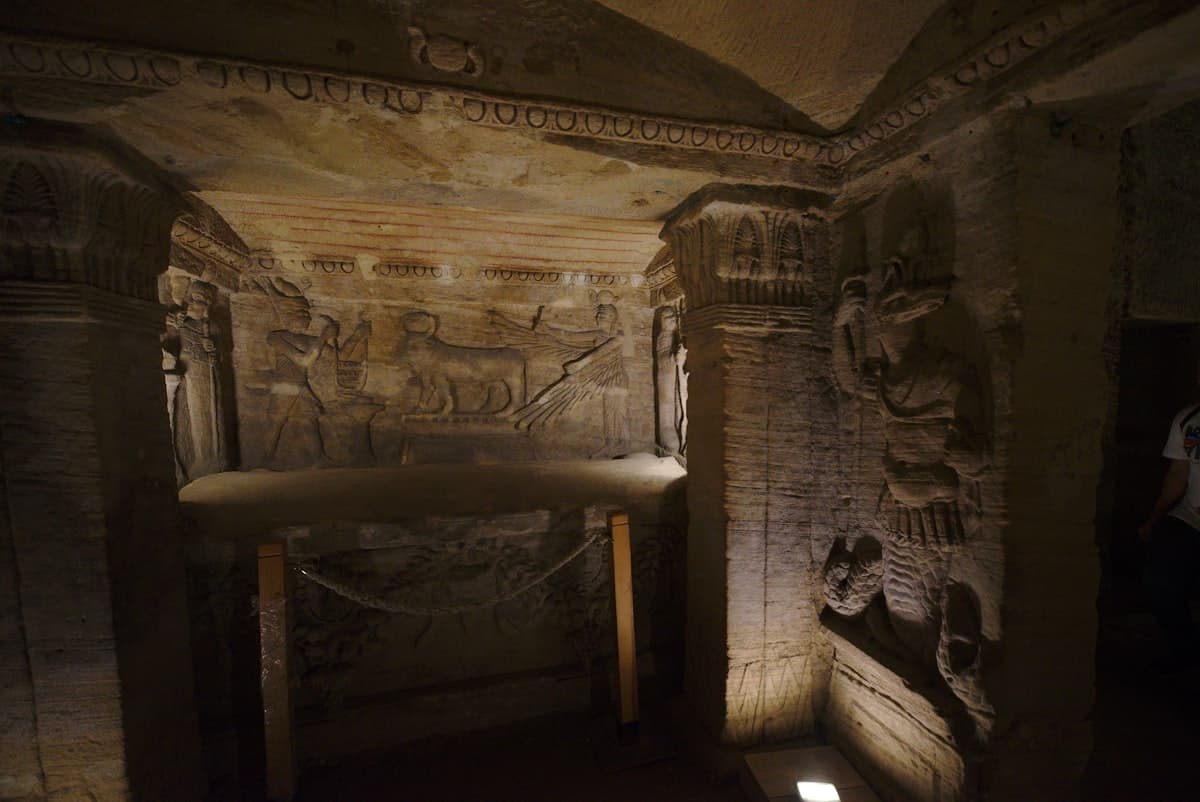
The Catacombs were discovered in 1900 when a donkey fell through the ground. What the donkey revealed is the most important example of syncretic art in the ancient world: a Roman-era burial complex, built in the 2nd century CE, decorated with imagery that is simultaneously Egyptian, Greek, and Roman, not as a mixture but as a genuine fusion where Anubis wears Roman armor and holds a Greek caduceus.
You descend a spiral staircase cut through rock, past a shaft that was used to lower bodies and amphorae of funeral offerings, to three levels of burial chambers. The lowest level floods seasonally and is closed to visitors. The second level contains the main tomb chamber, the Triclinium, a banquet hall where families ate with their dead, and the central burial suite with its sculpted facade. Look at the facade carefully: the figures are Egyptian gods rendered with Greek artistic conventions, wearing Roman dress. The falcon-headed Horus carries a Roman shield. The cobras on the cornice wear Roman military helmets. This was not the work of confused craftsmen. This was a deliberate theological statement by a community that had absorbed three civilizations and saw no contradiction in them.
The catacombs eventually held hundreds of bodies in loculi, small niches carved into the walls, many sealed with plaster. The complex was a family tomb that was expanded into a communal necropolis. This happened all across Alexandria: private wealth created the infrastructure, and community need expanded it. The city produced everything collectively.
What You Will Actually See: Pompey's Pillar and the Serapeum
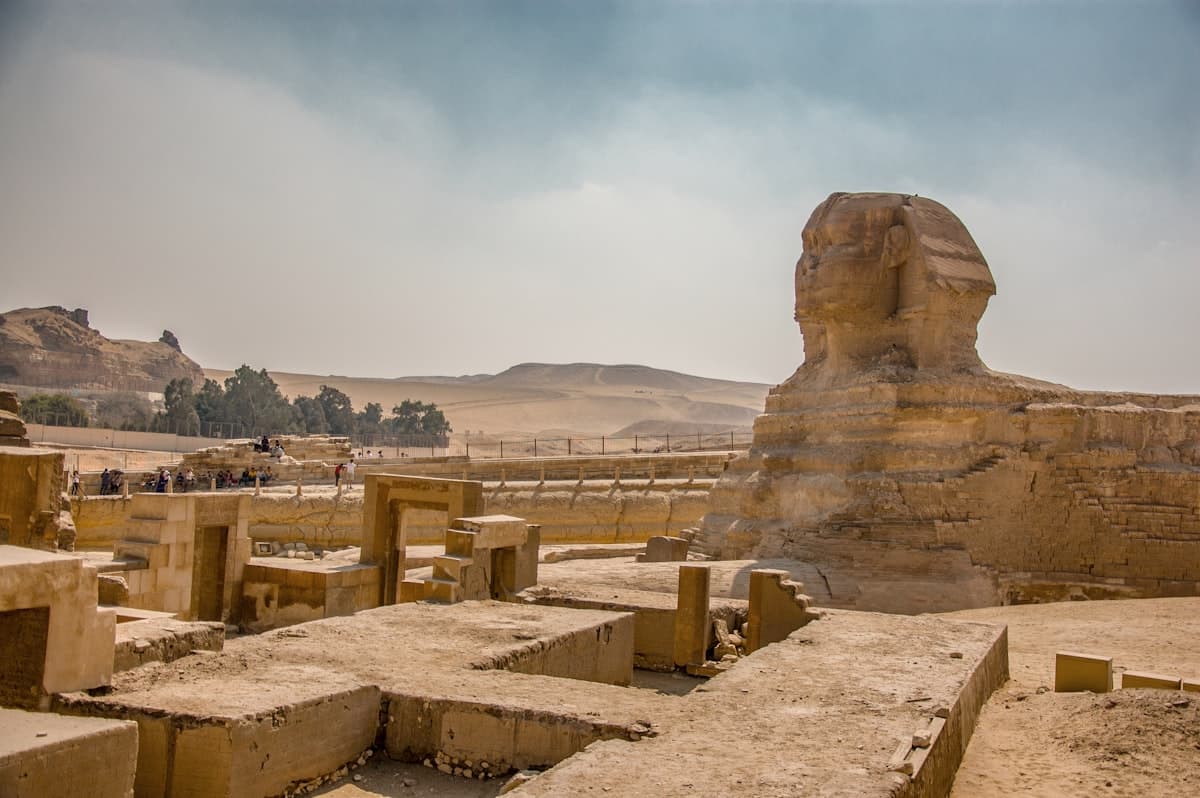
Pompey's Pillar has nothing to do with Pompey. It was erected in 297 CE to honor the Emperor Diocletian, who put down an Alexandrian revolt with considerable violence and then commemorated himself with a 27-meter column of Aswan red granite, the largest monolithic column in the ancient world outside of Rome. Medieval Crusaders assumed any large column in Alexandria must commemorate Pompey, who was murdered here in 48 BCE, and the name stuck.
The pillar stands on a low plateau that is the remains of the Serapeum, the great temple of Serapis, Alexandria's invented deity. Serapis was created by Ptolemy I as a deliberate theological hybrid: a Greek-looking god with the attributes of Osiris, Apis, Zeus, and Asclepius combined. The goal was a deity that both Greek settlers and Egyptian subjects could worship. It worked. The cult of Serapis spread across the Mediterranean world and was still active in Roman Britain. The temple that housed his cult in Alexandria was so large that ancient sources describe the approach as a climb up 100 steps, with the statue of Serapis visible from ships in the harbor. Theophilus had it demolished in 391 CE. What you see now are foundation cuts in the rock, some underground tunnel networks, and the pillar standing alone above the ruins. Two sphinxes, one limestone and one black granite, survive on the site. The limestone sphinx is Ptolemaic; the black granite one predates the Greeks.
The most interesting thing on the site is not the pillar. It is the underground galleries where sacred Apis bulls were buried before the Serapeum was converted to their final resting place. You can walk these galleries. Most tourists photograph the pillar from the gate and leave.
The Connections: Alexandria Across Three Religions
Alexandria produced the Septuagint, the Greek translation of the Hebrew Bible, commissioned by Ptolemy II around 250 BCE and completed by 72 Jewish scholars working in separate cells on the island of Pharos who all produced identical translations, according to legend. This translation is what allowed Christianity to spread through the Greek-speaking world. The New Testament was written in Greek partly because Alexandrian Jewish culture had made Greek the language of Jewish intellectual life.
The city's Christian community was among the earliest and most theologically active. The Catechetical School of Alexandria, founded around 190 CE, produced Origen and Clement, theologians whose work shaped the doctrine of the Trinity and the allegorical interpretation of scripture. Cyril of Alexandria, the bishop who orchestrated the murder of the philosopher Hypatia in 415 CE, was simultaneously defending Coptic Christianity against Byzantine imperial theology. Hypatia was not killed because she was a woman or a pagan scholar. She was killed because she was an ally of the Roman prefect Orestes, who was in political conflict with Cyril. Her death was urban factional politics expressed through religious violence, a pattern Alexandria repeated across centuries.
When Arab forces under Amr ibn al-As took Alexandria in 641 CE without significant resistance, a city that had been Greek, Roman, Jewish, Christian, and Neoplatonist became part of the Islamic world. The city's intellectual tradition did not simply end. Arab scholars translating Greek texts in Baghdad in the 9th century were often working from Alexandrian manuscripts that had been preserved in Syrian monasteries. The Greek mathematics and astronomy that entered Islamic scholarship and eventually returned to medieval Europe as algebra and algorithm passed through Alexandria on its way there.
Today you can stand in the Coptic Church of Saint Mark in the Anfushi district, which claims to sit above the site where Mark the Evangelist was martyred in 68 CE, walk twenty minutes to the El-Mursi Abul Abbas mosque complex, the most important Islamic site in Alexandria, built over and around earlier structures on what was once the royal harbor zone, and then take a taxi to the Greco-Roman Museum to see the material culture that predates both. Three religions, three architectural traditions, the same city, the same ground.
Common Mistakes
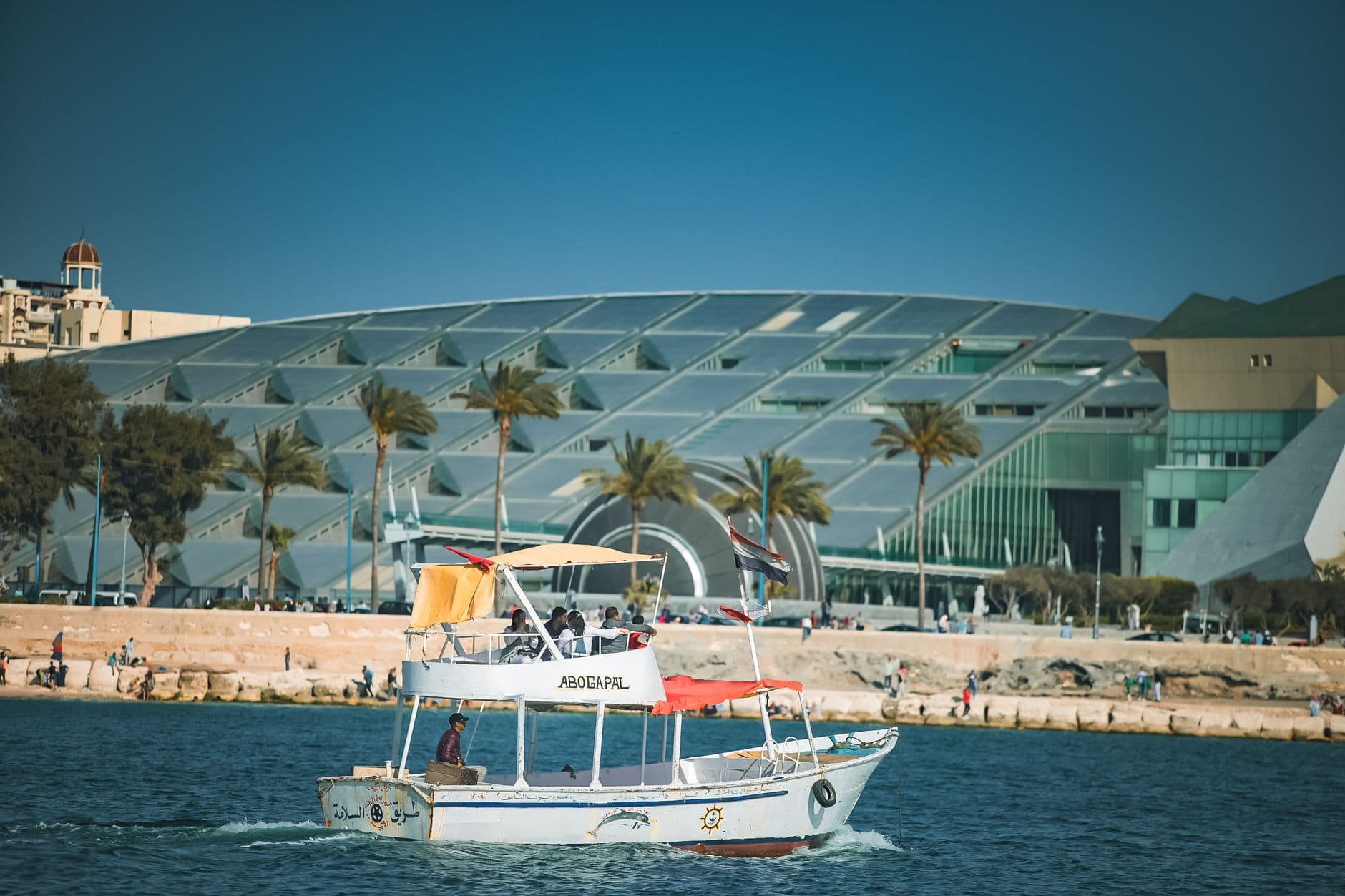
Spending your first morning at the Bibliotheca Alexandrina. The modern library, opened in 2002, is architecturally interesting and culturally significant as an institution, but it contains almost nothing about ancient Alexandria beyond a small antiquities museum in the basement. If you have one day and you are spending it at the new library, you are seeing the symbol of the ancient library, not its history. Go to the Greco-Roman Museum first.
Skipping the Greco-Roman Museum because it just reopened and you have not heard much about it. This museum reopened after 17 years of renovation and holds 40,000 objects including the only known portrait sculpture confirmed to depict Cleopatra VII, several genuine royal mummies, and one of the finest collections of Tanagra figurines outside Athens. It is not yet on the mainstream tourist circuit, which means you will have it largely to yourself.
Taking the standard tour operator package that combines Alexandria and Cairo in one day. You cannot do this properly. The transfer alone takes four hours round trip, leaving you perhaps five hours in the city, which is enough to see Pompey's Pillar and eat lunch and nothing else. Alexandria requires an overnight stay.
Going on a Friday morning. Many sites run reduced hours or are effectively inaccessible due to Friday prayer crowds in the surrounding streets. Saturday morning is the practical alternative.
Paying for a professional underwater archaeology boat tour without verifying the operator's license. The harbor contains genuinely extraordinary submerged ruins from Cleopatra's royal quarter, the ancient Pharos lighthouse foundations, and sunken statuary. But unlicensed operators run basic glass-bottom boats that show you murky water and charge the same price. Ask specifically for operators certified by the Supreme Council of Antiquities to run the approved harbor archaeology route.
The Citadel of Qaitbay. Skip it unless you are specifically interested in Mamluk military architecture. The citadel was built in 1477 CE on the site of the Pharos lighthouse, using stones from the lighthouse itself, which had collapsed in an earthquake in 1303 CE. The Pharos was one of the Seven Wonders of the ancient world. The citadel is a competent medieval fortification with a mediocre museum inside and entrance fees of EGP 150 for views of the harbor you can get from the Corniche for free. The fact that it was built from lighthouse stones is the most interesting thing about it, and you now know that without going inside.
Arriving at the Catacombs after 3:30pm. They close early and the ticket office stops selling at 4pm. The catacombs require at least 90 minutes to visit properly.
Practical Tips
Hire a licensed Egyptologist guide specifically for Greco-Roman Alexandria rather than a general Alexandria guide. The distinction matters because the syncretic religious iconography in the Catacombs and the Serapeum site is genuinely complex and a generalist guide will tell you the basics. Expect to pay EGP 600 to 1,000 for a half-day specialist guide. The Egyptian Tourist Authority maintains a list of licensed guides; ask your hotel to recommend someone who specifies Greco-Roman period expertise.
The Corniche walk between the Bibliotheca Alexandrina and the Anfushi fishing port takes about 40 minutes and shows you the city's relationship to the Mediterranean in a way that contextualizes everything you have seen underground. Do it in the late afternoon when Alexandrians are out and the light is coastal and particular.
Alexandria's seafood is genuinely excellent and not expensive by comparison with Cairo tourist restaurants. Kadoura restaurant on the Corniche serves grilled fish by weight at roughly EGP 180 to 300 per person including sides. This is not a recommendation born of sentiment. The fish comes off boats you can see from the window.
Bring a flashlight or ensure your phone torch works before entering the Catacombs. The electric lighting in the deeper sections is inadequate for seeing detail in the carved reliefs. The guards will not tell you this.
If you read one thing before visiting, make it Strabo's description of Alexandria written during his stay in the city around 25 BCE. It is available in translation online and tells you exactly what the city looked like when it was intact: the royal quarter covering a quarter of the city's land area, the street grid, the Pharos. Reading it in Alexandria while standing on ground that Strabo walked is a specific kind of historical vertigo that no guidebook can replicate.
Frequently Asked Questions
The Weekly Dispatch
More on Egypt, every Friday.
Cultural depth and places most guides never mention.
No spam. Unsubscribe anytime.