Greco-Roman Alexandria: History Guide to a Lost City
Alexandria once held the world's largest library and a lighthouse taller than a 40-story building. Both are gone. What remains is stranger and better than the myth.

Quick Facts
- Best time to visit
- October to April. The Mediterranean climate keeps summers humid and crowded. October and March offer the clearest light and manageable visitor numbers.
- Entrance fee
- Pompey's Pillar and Serapeum: EGP 180 (approx $3.50 USD). Catacombs of Kom el-Shoqafa: EGP 180 (approx $3.50 USD). Greco-Roman Museum: EGP 200 (approx $4 USD) when open. National Museum of Alexandria: EGP 200 (approx $4 USD).
- Opening hours
- Pompey's Pillar: Daily 8am to 4pm. Catacombs: Daily 9am to 4pm. National Museum: Tuesday to Sunday 9am to 5pm. Greco-Roman Museum: Check current status before visiting.
- How to get there
- From Cairo: Spanish train from Ramses Station, approximately 2 hours 10 minutes, from EGP 90 second class. From Alexandria's Sidi Gaber or Misr stations, taxis to the Serapeum district cost EGP 40 to 60. Uber operates in Alexandria and is often cheaper than negotiated taxis.
- Time needed
- Minimum two full days for the major Greco-Roman sites. Three days if including the Bibliotheca Alexandrina, National Museum, and the Montazah Palace gardens (which contain Ptolemaic-era artifacts in its small museum).
- Cost range
- Budget EGP 600 to 1,000 per day including basic accommodation. Mid-range EGP 1,800 to 3,000 per day with a seafront hotel and licensed guide.
At its peak, Alexandria was not the second city of Egypt. It was the second city of Rome, ahead of Antioch, ahead of Carthage, behind only Rome itself. A population of perhaps 500,000 people lived here in the first century BCE, making it one of the most densely inhabited places on the planet at that time. The city's founder, Alexander the Great, visited once, approved the site, and left. He never saw what it became.
This is the problem with Alexandria's Greco-Roman history: the most important things are gone, and what remains requires imagination. But that imagination is worth supplying. The city that Ptolemy I built after Alexander's death in 323 BCE was a deliberate act of political theatre, a Greek city planted on African soil, designed to be the intellectual and commercial capital of the Mediterranean world. It succeeded beyond any reasonable expectation. And then, across roughly seven centuries, it dissolved.
What the Greco-Roman Egypt Alexandria history trail offers today is a combination of excavated fragments, a genuinely world-class museum, a few monumental survivals, and the strange pleasure of walking streets that sit directly above a buried city nobody has fully mapped.
Quick Facts
Best time to visit: October through April. Alexandria's Mediterranean climate means summer (June to August) is humid and crowded with Egyptian holidaymakers. Winter light is clear and the streets are manageable.
Greco-Roman Museum: Currently undergoing renovation. Check status before visiting. When open: EGP 200 (approx $4 USD). Hours have historically been 9am to 5pm, closed Mondays.
Pompey's Pillar and Serapeum: EGP 180 (approx $3.50 USD). Daily 8am to 4pm.
Catacombs of Kom el-Shoqafa: EGP 180 (approx $3.50 USD). Daily 9am to 4pm. No photography permitted in the lower chambers.
Royal Jewelry Museum (often skipped, should not be): EGP 100 (approx $2 USD). Tuesday to Sunday 9am to 5pm.
Getting there: From Cairo, the air-conditioned Spanish train takes 2 hours 10 minutes from Ramses Station, from EGP 90 second class. Taxis within Alexandria run EGP 30 to 80 for most central journeys. The sites cluster into two areas: the Serapeum district in the west and the old royal quarter along the Corniche and eastern harbor.
Time needed: Two full days minimum to cover the major Greco-Roman sites with any seriousness. Three days if you want to also visit the Bibliotheca Alexandrina and the National Museum of Alexandria.
Cost range: Budget EGP 600 to 1,000 per day including accommodation in a decent mid-range hotel. Mid-range EGP 1,800 to 3,000 per day.
Why This Place Matters
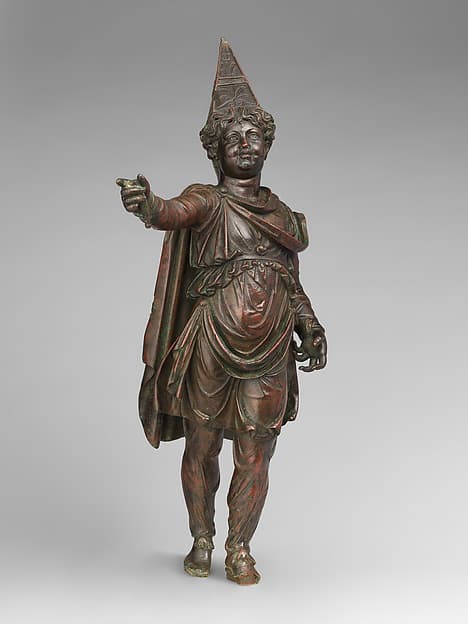
The city Alexander chose in 331 BCE was not empty. The village of Rhakotis sat on the limestone ridge between Lake Mareotis and the sea, populated mostly by Egyptian fishermen and a small garrison. Ptolemy I and his architects laid a Greek grid city over and around it. The Egyptian quarter survived, absorbed, and eventually outlasted almost everything the Greeks built above it.
The Ptolemaic dynasty that followed Alexander ruled Egypt for 275 years, longer than the United States has existed as a country. They were Macedonian Greeks who never fully learned Egyptian, yet they funded the construction of temples in the Egyptian style at Edfu, Kom Ombo, and Dendera. They presented themselves as pharaohs to their Egyptian subjects and as Hellenistic kings to their Greek ones. The result was not a compromise but a synthesis, and Alexandria was its laboratory.
The Library, which most visitors come here to imagine, was not a single building but an institution, part of the Mouseion, a state-funded research center attached to the royal palace complex. At its height it held somewhere between 400,000 and 700,000 papyrus scrolls. It did not burn in a single dramatic fire. It declined over centuries as royal funding dried up, as papyrus became scarce, as scholars moved elsewhere. Julius Caesar's fire in the harbor in 48 BCE probably destroyed a warehouse of books awaiting export, not the Library itself. The Library as an institution survived at least into the third century CE. The gradual death is a less satisfying story than the fire, but it is closer to the truth.
The Serapeum District: What Pompey's Pillar Is Actually About
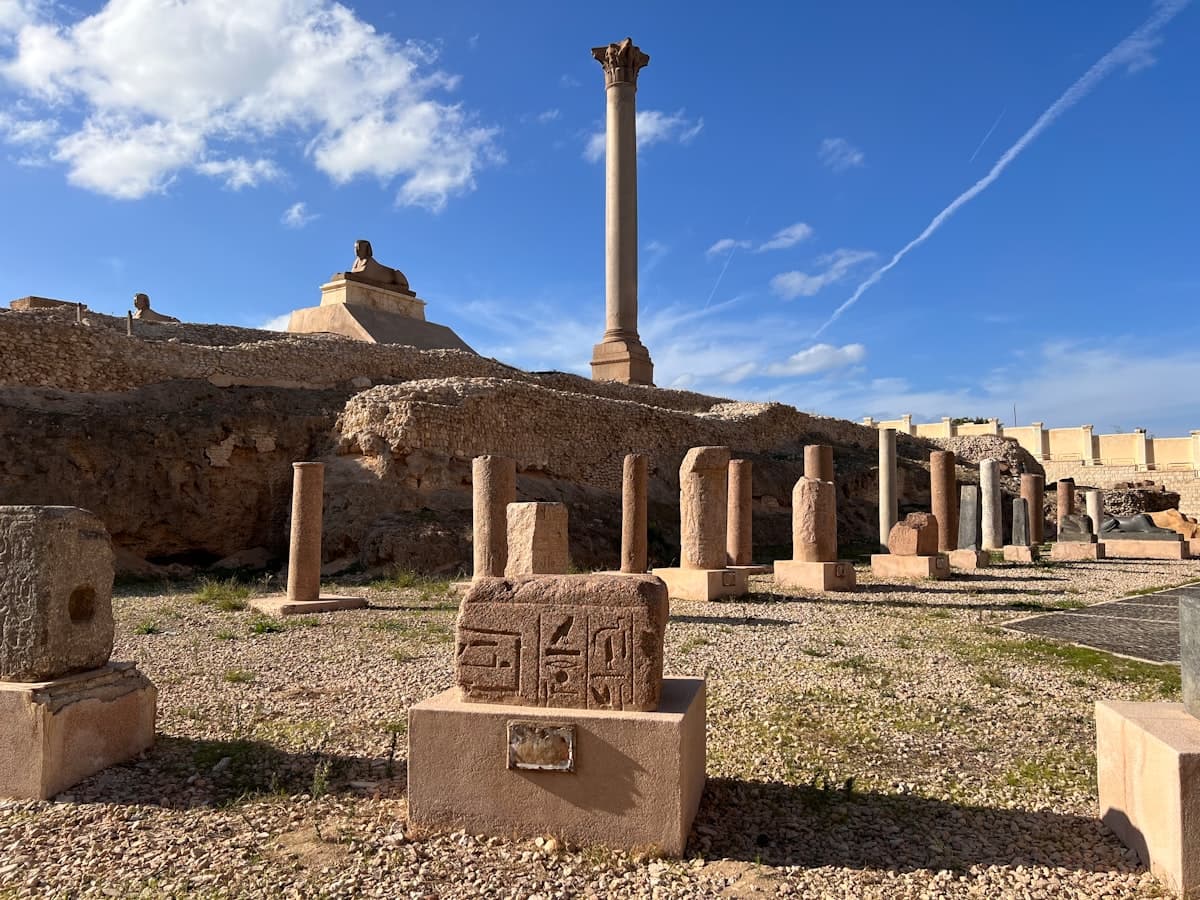
Every guide will tell you that Pompey's Pillar has nothing to do with Pompey. The Roman general was murdered nearby in 48 BCE, but the pillar was erected in 297 CE in honor of the Emperor Diocletian, who suppressed a revolt in Alexandria and then, apparently, fed the starving population from imperial stores. The inscription survives. The attribution to Pompey came from medieval Crusaders who needed a landmark to attach to a famous name.
What matters more is what the pillar stood inside. The Serapeum was the great temple of Serapis, a deity invented by Ptolemy I specifically to bridge Egyptian and Greek religious sensibilities. Serapis combined aspects of Osiris and Apis with the Greek gods Zeus and Asclepius. The temple was one of the largest in the ancient world. In 391 CE, the Christian Bishop Theophilus, backed by an imperial edict from Theodosius I, led a crowd that destroyed it. The destruction of the Serapeum is one of the most documented acts of religious violence in late antiquity. The pillar survived because it was too large to pull down.
Below the surface, accessible via stairs cut into the hillside, are the underground galleries where the sacred Apis bulls were kept in Ptolemaic times. The galleries are largely empty now but the scale is disorienting: you are standing in a room that held living animals considered divine, below a temple that no longer exists, in a city that has been rebuilt seventeen times over.
The sphinx statues flanking the pillar are worth stopping at. They are Egyptian in style but have blank, schematic faces that suggest Greek workshop influence. This is what the Greco-Roman synthesis looked like in stone: Egyptian form, Greek hand, neither quite fully realized.
The Catacombs of Kom el-Shoqafa: The Most Honest Monument in Egypt
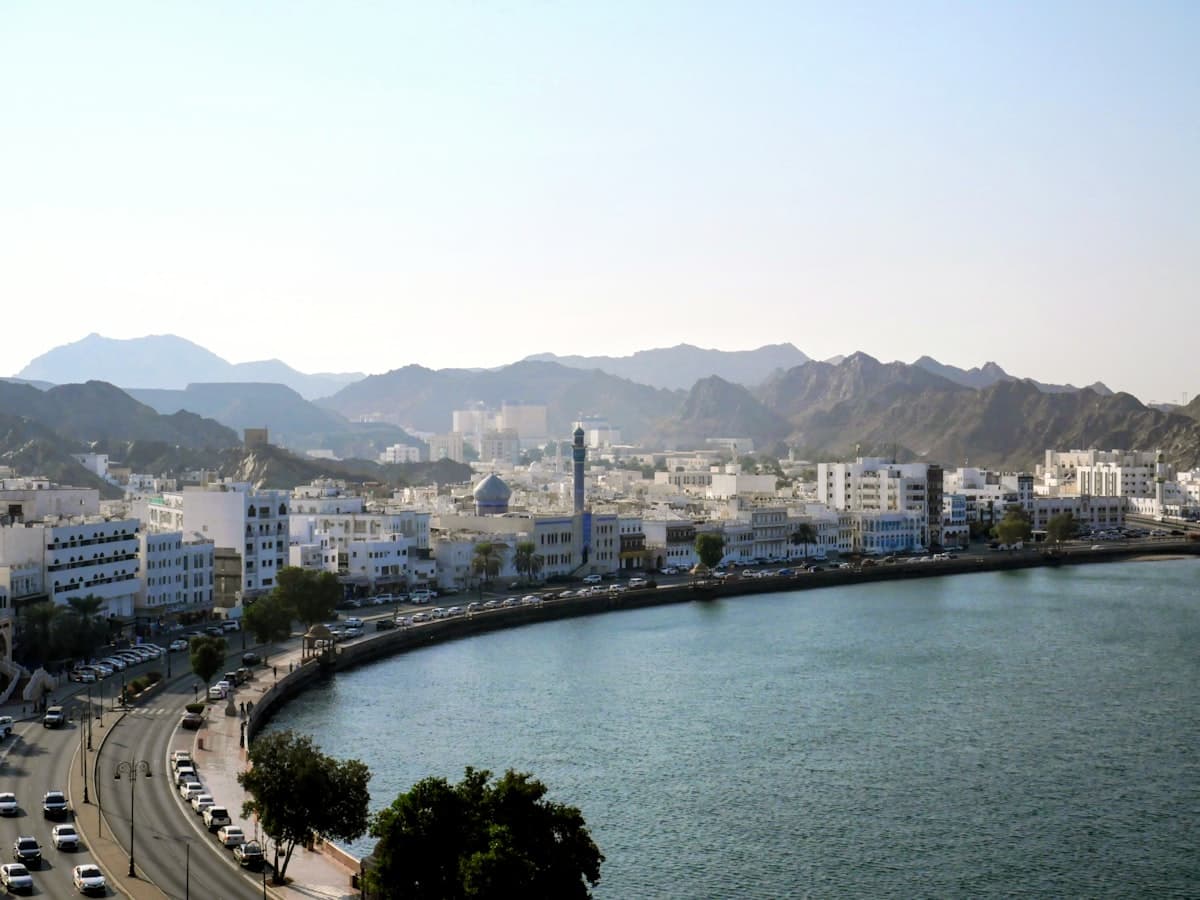
Of all the Greco-Roman sites in Alexandria, the Catacombs of Kom el-Shoqafa are the ones that will stay with you. They were discovered in 1900 when a donkey fell through the ground into the upper chamber. They date to the second century CE, the height of Roman Egypt, and they were used continuously until the fourth century.
The decoration is the thing. Egyptian gods are carved in the Egyptian style, facing forward in the rigid register that defined three thousand years of pharaonic art. But they are wearing Roman armor. Anubis, the jackal-headed god of embalming, is shown with a Roman soldier's cuirass and carries a caduceus borrowed from Hermes. The dead were buried in stone loculi cut horizontally into the rock in the Roman manner, wrapped in the Egyptian manner, presided over by gods depicted in a style that belonged to neither tradition and both simultaneously.
This was not confusion. This was a community of people who had been living at the intersection of three civilizations for four hundred years and had developed their own visual language for death. The catacombs were almost certainly used by a single wealthy family and their dependents, not by the general public. The family's identity is unknown.
The lowest level, the Hall of Caracalla, is only partially accessible. Human and horse bones were found here in the nineteenth century, possibly connected to a massacre ordered by the Emperor Caracalla in 215 CE after Alexandrians mocked him publicly. Caracalla had his soldiers kill an unspecified number of young men in the city. The ancient sources differ on whether it was thousands or tens of thousands. Alexandria had always had an opinion about its rulers, and its rulers had always found this inconvenient.
The Connections: How Alexandria Links the Ancient World
The temple of Serapis was not simply a Ptolemaic invention. Its cult spread across the entire Roman Mediterranean, reaching as far as Roman Britain, where a dedication to Serapis was found in York dating to the third century CE. A Macedonian ruler's synthetic deity worshipped by a Roman officer in northern England is a measure of how far Alexandria's cultural influence actually traveled.
The Coptic connection is direct and underappreciated. Saint Mark is traditionally said to have brought Christianity to Alexandria around 42 CE. The Coptic Church, still centered in Cairo and Alexandria today, is therefore one of the oldest Christian institutions on earth, predating the Roman church in its current form. The Catechetical School of Alexandria, operating by the second century CE, was where Christian theology was first systematized in philosophical terms, using the Greek intellectual tools that Alexandria had spent three centuries accumulating. Clement of Alexandria and Origen, both active here, shaped Christian doctrine in ways that the Council of Nicaea in 325 CE would later codify. When you visit a Coptic church anywhere in Egypt, you are standing in the downstream consequence of Ptolemaic Alexandria's investment in Greek philosophy.
The Islamic connection is equally direct. When Amr ibn al-As captured Alexandria in 641 CE, he wrote to the Caliph Umar describing a city with four thousand palaces, four thousand baths, and forty thousand Jews paying tribute. These numbers are almost certainly exaggerated. The city he found was a late antique Christian city, not the Ptolemaic metropolis. The ancient Library was already gone. But the intellectual infrastructure, the habit of synthesis, the multilingual scholarly culture, passed into the early Islamic world through Alexandria's remaining scholars and institutions. The translation movement that gave medieval Europe its Aristotle ran partly through Alexandria.
Common Mistakes
Treating the Greco-Roman Museum as an afterthought. When it is open after its ongoing renovation, this museum is the essential Greco-Roman Egypt Alexandria history experience. The objects recovered from the city's submerged royal quarter, including portrait statues of Ptolemaic queens and papyrus fragments with original Greek text, cannot be seen anywhere else. Budget two hours minimum.
Visiting Pompey's Pillar as your only western site. The pillar alone takes twenty minutes. The underground Apis galleries and the site's relationship to the destroyed Serapeum are the actual content. Read about the Serapeum before you arrive or you will leave confused.
Skipping the Catacombs because they sound like a minor attraction. The Catacombs of Kom el-Shoqafa were listed by Egyptologist Ahmed Fakhry as one of the most important archaeological discoveries in Egypt. They are not minor. They are the clearest physical evidence of Greco-Roman-Egyptian religious syncretism that exists anywhere.
Taking the harbor boat tours advertised near the Citadel of Qaitbay. The tours promise views of the sunken royal quarter and submerged Lighthouse foundations. Visibility in Alexandria's harbor is effectively zero. You will see murky water and pay EGP 150 for the privilege. The National Museum of Alexandria has underwater photographs that show you more than you would see in person.
Paying for a guide at the major sites without vetting them first. Unlicensed guides at the Serapeum and Catacombs frequently invent connections and dates. Ask for a license. Better: hire a licensed Egyptologist guide through your hotel or through the Egyptian Tourist Authority office on the Corniche for a full-day fee of roughly EGP 800 to 1,200.
Assuming the eastern harbor area is purely modern. The Silsileh peninsula, now occupied by the Bibliotheca Alexandrina and the Silsileh promontory, was the site of the Ptolemaic royal quarter. The palace, the Mouseion, and the Library all stood somewhere in this area. You are walking over them. The Bibliotheca's own archaeological park, which most visitors ignore entirely, contains exposed Roman-period foundations and a small but serious collection of artifacts found on-site.
Believing the sound and light show at Pompey's Pillar is worth EGP 250. It is not. The narration is generic, the lighting changes are slow, and nothing in the show tells you anything this article does not cover more accurately. Spend the money on dinner at one of the old Greek-era restaurants along the seafront instead.
Practical Tips
Alexandria's sites are spread across a city of five million people. Budget for taxis and do not assume sites are walkable from each other. The Serapeum and Catacombs are close together in the western Karmouz district, roughly twenty minutes by taxi from the Corniche. Plan to visit both in a single morning.
The light in Alexandria is different from Cairo and different from Upper Egypt. It comes off the Mediterranean with a diffuse, silver quality that makes midday photography flat. Early morning at the Corniche, when the harbor traffic is beginning and the light is still low and directional, is the time to be outside with a camera.
Friday mornings before noon, many sites operate with reduced staff. Arrive at opening time if you want the catacombs to yourself. They become genuinely claustrophobic with more than fifteen people in the lower chambers.
Bring water. The Serapeum site has no shade and Alexandria in late spring can reach 35 degrees Celsius with humidity. The catacombs are cool underground but the approach is exposed.
For serious Greco-Roman Egypt Alexandria history research, the library of the Bibliotheca Alexandrina is open to visitors and holds a substantial collection of English-language scholarship on Ptolemaic and Roman Alexandria. The basement level contains a replica of some of the ancient Library's cataloguing system. It is the one tourist feature of the building that is actually intellectually interesting rather than architecturally impressive.
Frequently Asked Questions
The Weekly Dispatch
More on Egypt, every Friday.
Cultural depth and places most guides never mention.
No spam. Unsubscribe anytime.