Greco-Roman Alexandria: The City That Invented the Ancient World
Alexandria once held 700,000 scrolls and produced Euclid, Eratosthenes, and Hypatia. Almost nothing survives above ground. The real city is underneath your feet.

Quick Facts
- Best time to visit
- October to April for mild temperatures and manageable crowds. July and August are humid and busy with Egyptian domestic tourism. March and November are ideal.
- Entrance fee
- Catacombs EGP 180 (approx $3.75 USD); Pompey's Pillar site EGP 100 (approx $2 USD); Kom el-Dikka Roman theater EGP 100 (approx $2 USD); Bibliotheca Alexandrina EGP 50-100 depending on access level
- Opening hours
- Most sites 9am-5pm daily. Catacombs last entry 4:30pm. Partial closures at some sites Friday 11:30am-1:30pm for prayer.
- How to get there
- Train from Cairo Ramses Station: EGP 150-250 (approx $3-5 USD), 2 to 2.5 hours on express services. Taxis from Alexandria's Misr Station to Catacombs: EGP 80-120. Uber available throughout the city. City tram: EGP 2-5 per ride.
- Time needed
- Two full days for core Greco-Roman sites. Third day recommended for Islamic Alexandria, Coptic churches, and the Corniche neighborhoods.
- Cost range
- Budget EGP 600-900/day including guesthouse, local transport, and site entry. Mid-range EGP 1,800-3,000/day with seafood meals and a three-star hotel.
At its height, Alexandria was the second-largest city in the Roman Empire, after Rome itself, and home to perhaps 600,000 people. It produced Euclid's geometry, Eratosthenes's calculation of the earth's circumference (accurate to within 2%), and the Septuagint, the Greek translation of the Hebrew Bible that most of Christianity would come to rely on. The Library held an estimated 700,000 scrolls. Today, the Greco-Roman Museum is partially closed for restoration, the catacombs flood seasonally, and the site of the ancient Library is occupied by the Bibliotheca Alexandrina, a 21st-century building that cost $220 million and contains, by the ancient standard, almost nothing. This is not a tragedy you mourn. It is a puzzle you learn to read sideways, in basements, in mosque courtyards, and in the particular angle of light over the Eastern Harbour at dusk.
Quick Facts
Best time to visit: October to April. Alexandria's Mediterranean climate means humid, crowded summers; spring and autumn give you manageable heat and thinner crowds. The city runs cooler than Cairo year-round.
Entrance fees: Catacombs of Kom el-Shoqafa: EGP 180 (approx $3.75 USD), students EGP 90 Pompey's Pillar and Serapeum site: EGP 100 (approx $2 USD) Greco-Roman Museum: Reopening phased; check current status, ticket around EGP 200 when open Bibliotheca Alexandrina: EGP 50 general entry, EGP 100 for museum access (approx $1-2 USD) Royal Jewellery Museum: EGP 200 (approx $4 USD)
Opening hours: Most sites open daily 9am-5pm. Catacombs close at 4:30pm. Fridays see partial closures 11:30am-1:30pm at some sites for prayer.
How to get there: From Cairo, take the Egyptian National Railways train from Ramses Station. Air-conditioned express trains (Spanish Talgo or French turbine) cost EGP 150-250 (approx $3-5 USD) and take 2 to 2.5 hours. Microbuses in Alexandria run EGP 5-10 per trip. Taxis from the main train station (Misr Station, Ramses Square) to the Catacombs cost roughly EGP 80-120.
Time needed: Two full days minimum for the Greco-Roman layer alone. A third day for Islamic and Coptic Alexandria, which most visitors skip entirely and should not.
Cost range: Budget EGP 600-900/day including accommodation, transport, and entry fees. Mid-range EGP 1,800-3,000/day.
---
Why This Place Matters
Alexander the Great founded Alexandria in 331 BC but never lived here. He left almost immediately for Persia and died in Babylon eight years later, aged 32. His body was brought back to Alexandria and entombed somewhere in the city center, probably beneath what is now the intersection of Al-Nabi Daniel Street and Al-Horreya Road. Nobody has found the tomb. Egyptian and foreign archaeologists have been looking for over two centuries.
What his successors, the Ptolemies, built here was something genuinely new: a city designed not as a capital of conquest but as a center of knowledge production. The Mouseion, the research institution attached to the Library, functioned more like a modern university than anything else in the ancient world. Scholars received stipends, free meals, and exemption from taxes. Eratosthenes, who ran the Library around 240 BC, calculated the circumference of the earth using the angle of shadows in two Egyptian cities on the summer solstice. He was off by about 200 kilometers on a circumference of roughly 40,000 km. Archimedes studied here. So did Callimachus, who invented the bibliographic catalog.
This is the context the Greco-Roman Egypt Alexandria history of the city requires: not a story of pharaohs conquered by foreigners, but a story of deliberate intellectual ambition that changed how humans organized knowledge. The tragedy is not that it burned. The tragedy is that we keep forgetting what it was.
---
What Survives: Reading the Layers
The Catacombs of Kom el-Shoqafa
The catacombs were discovered in 1900 when a donkey fell through the ground into the upper chamber. They date to the 2nd century AD and represent the clearest physical evidence of what Alexandrian culture actually was: a place where a Roman might be buried with a Medusa-head shield guarding his Egyptian-style sarcophagus, while Anubis, the jackal-headed god, wears Roman legionary armor. This is not artistic confusion. It is theological fluency. The Alexandrian upper class moved between Greek philosophy, Egyptian religion, and Roman civic ritual the way a modern educated person might move between languages.
Descend three levels underground. The lowest level floods regularly; whether you reach it depends on the season and the water table. The triclinium, a banqueting hall where mourners ate funeral meals, still has its stone benches carved from the rock. The main tomb chamber has niches for three bodies, each framed by columns in a style that is simultaneously Corinthian and pharaonic. No other site in Egypt contains this density of cultural fusion in a single room.
Allow ninety minutes here. The lighting is poor and the humidity is high. Go early before tour groups arrive.
Pompey's Pillar: What the Name Gets Wrong
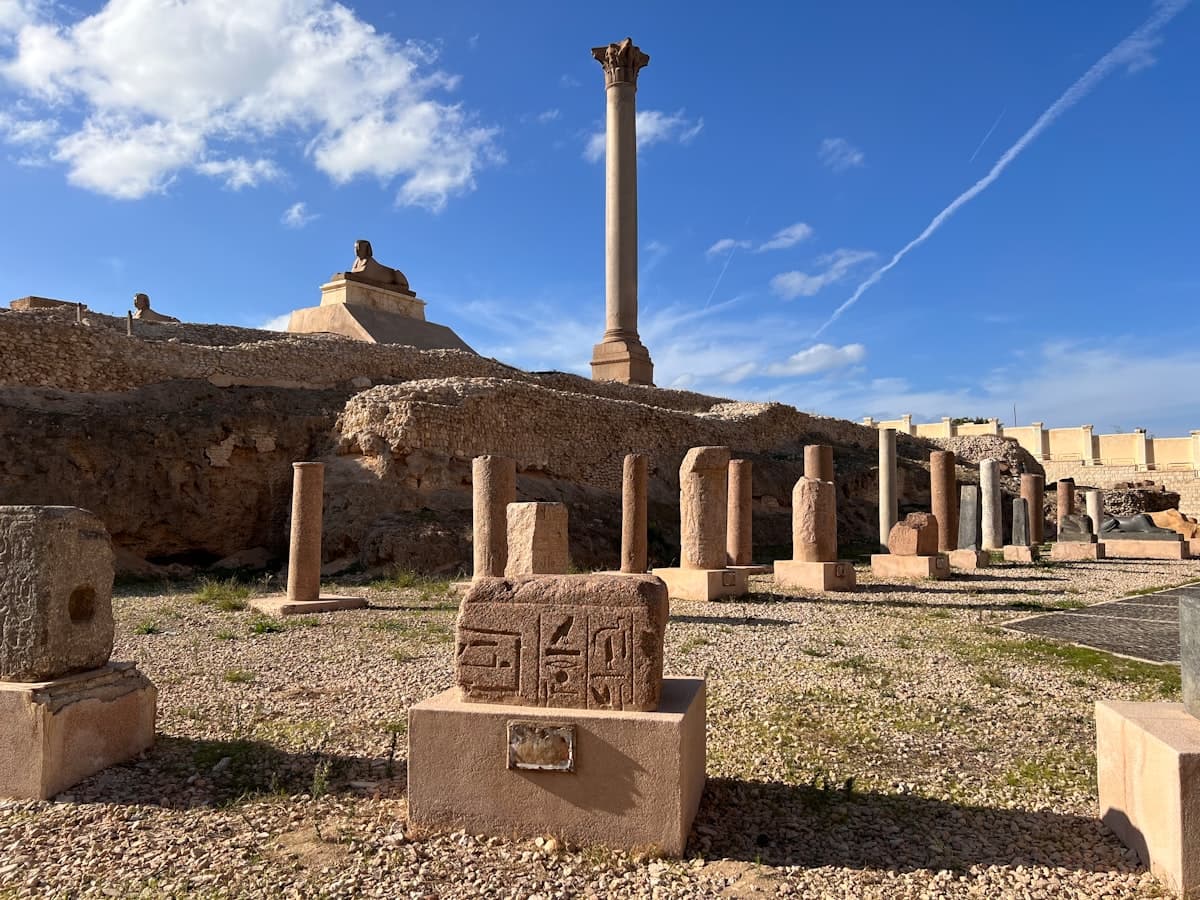
Pompey's Pillar has nothing to do with Pompey. The Roman general Pompey was murdered on an Egyptian beach in 48 BC when he arrived seeking refuge after losing the Battle of Pharsalus to Julius Caesar. The pillar was erected in 297 AD in honor of Emperor Diocletian, who crushed an Alexandrian revolt and then, generously, provided grain to the starving population afterward. Medieval European crusaders, seeing a large Roman column near a port city and knowing Pompey died somewhere in Egypt, connected two unrelated facts and the name stuck.
The pillar is 26.85 meters tall, cut from a single piece of red Aswan granite, and is the largest monolithic column surviving from antiquity outside Rome. It stood in the precinct of the Serapeum, the great temple to Serapis, a deity invented by Ptolemy I specifically to bridge Greek and Egyptian religious sensibilities. The Serapeum was destroyed by a Christian mob in 391 AD, led by the Bishop Theophilus, in one of the ancient world's better-documented acts of religious vandalism. Sphinxes from the temple now sit in the site's open lot, unprotected, next to a small colossus of Ramesses II that was moved here from elsewhere. The juxtaposition is entirely accidental and somehow perfect.
The Greco-Roman Museum
Partially closed for a restoration that began in 2017 and has proceeded slowly, the Greco-Roman Museum houses the best single collection of Alexandrian cultural objects in existence. When sections are accessible, look for the tanagra figurines (small terracotta statuettes of everyday people, not gods), the Apis bull sarcophagus, and the portrait coins of the Ptolemaic queens, who appear on official currency looking nothing like idealized Greek beauties, which historians now read as a deliberate assertion of Egyptian-style divine authority over Hellenistic prettiness.
Check current opening status before visiting. The situation changes.
---
The Human Story Behind the Library
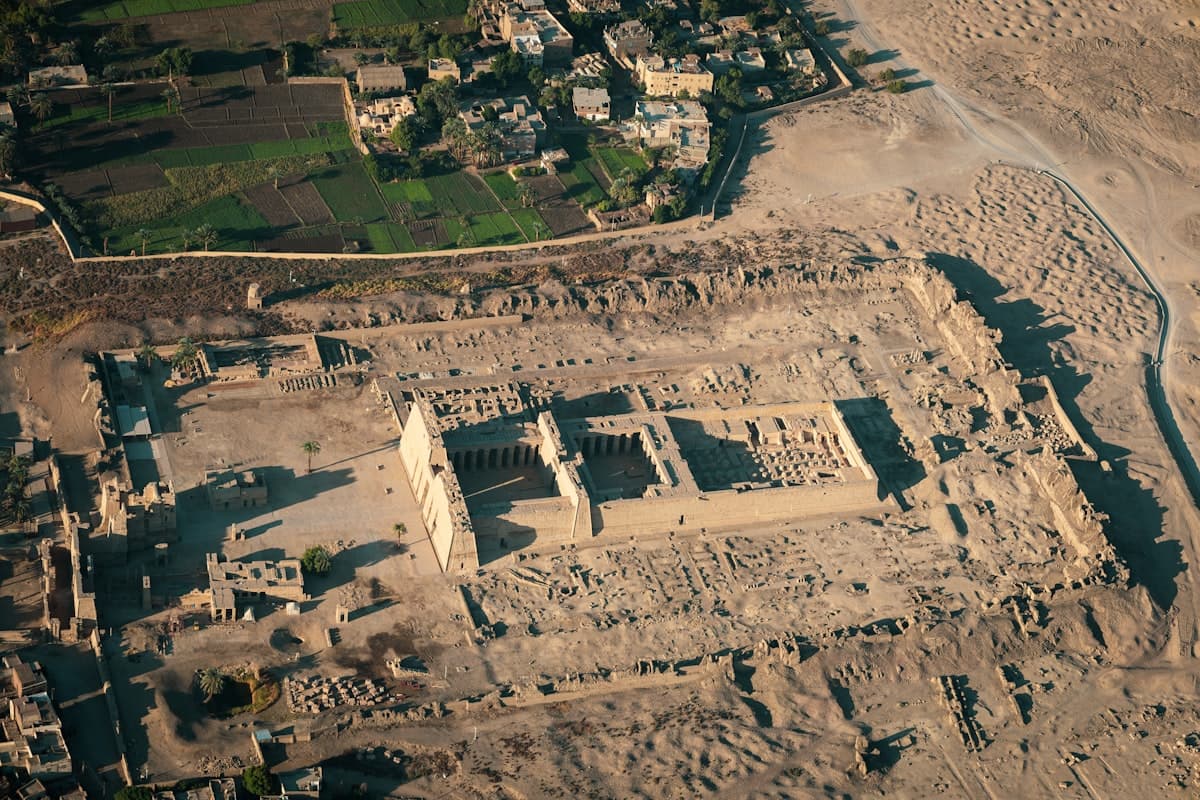
The Library of Alexandria almost certainly did not burn in a single catastrophic fire. The more accurate account, drawn from multiple ancient sources, is that it declined gradually: underfunded, looted incrementally, damaged by Julius Caesar's forces in 48 BC (probably accidentally, when fire spread from ships in the harbor), further weakened under Aurelian in the 270s AD, and largely defunct by the 4th century, long before the Arab conquest of 641 AD that popular mythology blames.
The librarian Hypatia was murdered in 415 AD, not because she worked at the Library, which was already gone, but because she was a Neoplatonist philosopher with significant political influence in a city where the Christian bishop Cyril and the Roman prefect Orestes were fighting for power. A mob dragged her from her carriage, killed her, and burned her body. She was approximately 60 years old. Her murder is often treated as a symbol of reason defeated by fanaticism, which oversimplifies the politics considerably. But it marks the end of a recognizable Alexandrian intellectual tradition that had lasted 600 years.
The Bibliotheca Alexandrina, opened in 2002 on approximately the site of the ancient institution, is worth visiting for its architecture and for the manuscript museum in the basement. Be honest with yourself about what it is: a 21st-century library with a symbolic name. It is not, in any meaningful sense, a continuation of anything ancient. That said, the permanent antiquities museum inside has genuine Greco-Roman objects, and the building's circular reading room is worth thirty minutes of your time.
---
The Connections: What Alexandria Built That Egypt Kept
The city Alexander founded on a sandbar between Lake Mariout and the Mediterranean did not disappear when the Ptolemies ended or when Rome fell. It transformed. The Coptic Church, centered in Alexandria, traces its founding to Saint Mark, who arrived around 49 AD. The Catechetical School of Alexandria, which operated from the 2nd century onward, produced Clement and Origen, theologians whose Greek philosophical training shaped Christian doctrine for centuries. Origen in particular applied Alexandrian textual methods, developed for analyzing Homer, to Biblical exegesis. The Library's techniques outlasted the Library.
When the Arab general Amr ibn al-As took the city in 641 AD, he reportedly wrote to the Caliph Umar describing a city with 4,000 palaces, 4,000 baths, 400 theaters, and 12,000 sellers of fresh vegetables. The numbers are almost certainly exaggerated, but the impulse to catalog, to quantify, to list, feels deeply Alexandrian. The Arab city that grew over the Greek and Roman one kept the grid street plan the Macedonian architect Dinocrates had designed. Portions of that grid are still visible in the modern street pattern around Al-Horreya Road, the ancient Canopic Way.
---
Common Mistakes
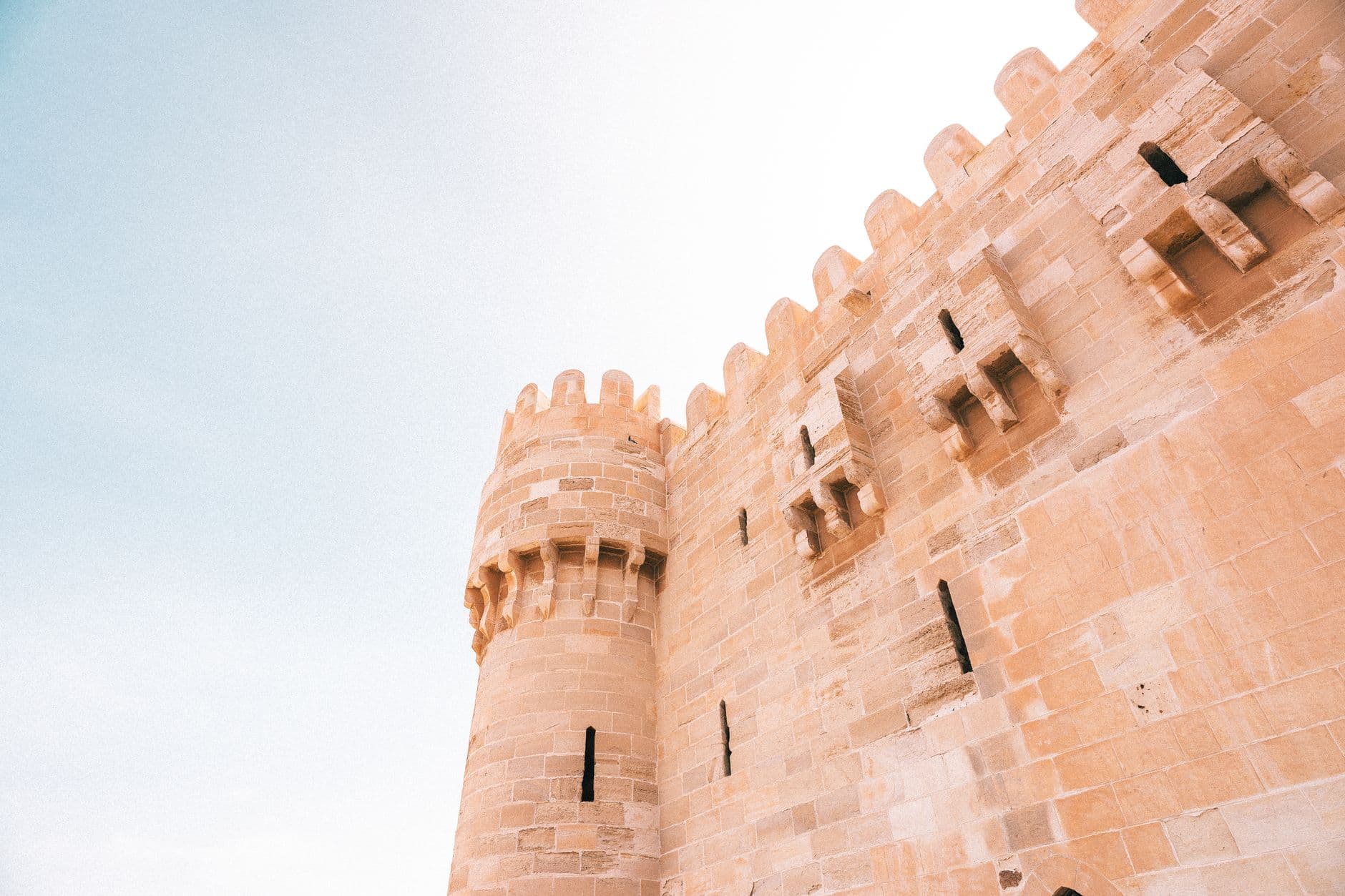
Visiting only the waterfront. The Corniche is pleasant and the Qaitbay Citadel (built in 1480 on the foundations of the ancient Pharos lighthouse, using its stones) is worth an hour. But the Greco-Roman layer lives inland, in Kom el-Shoqafa, in the Serapeum precinct, in the Ottoman and medieval neighborhoods around Al-Attarine Market. Most visitors stay within 500 meters of the sea and miss the actual city.
Booking a day trip from Cairo. A day trip from Cairo leaves you five hours on the ground after travel. You will see Pompey's Pillar, have lunch, and leave. Alexandria requires two nights minimum to make intellectual sense.
Skipping Kom el-Dikka. The Roman theater at Kom el-Dikka, discovered in 1960 during construction of an apartment building, is the only Roman theater excavated in Egypt. It seated around 700 people and had marble seating imported from Greece. Beside it are the remains of Roman baths, lecture halls, and a residential district. Entrance is EGP 100. Most tour itineraries do not include it. This is a failure of tour itineraries.
Paying for the Alexandria Sound and Light Show. It costs EGP 300, runs 45 minutes, covers history you will already know from reading this article, and uses a soundtrack that sounds like it was composed for a 1970s documentary. The EGP 300 is better spent on dinner at a fish restaurant on the harbor.
Underestimating flooding at the Catacombs. The lower levels flood in winter and sometimes in autumn. If seeing all three levels matters to you, visit between April and September and confirm conditions before descending. The upper two levels remain accessible year-round and contain most of the significant art.
Assuming the Greco-Roman Museum is fully open. Call ahead or check recent visitor reports. Arriving to find the main galleries closed is a genuine risk and has been since 2017.
Ignoring Islamic Alexandria. The Attarine Mosque stands on the site of the church where Alexander's body may have been moved in late antiquity. The Al-Mursi Abu'l-Abbas Mosque, completed in 1943 but on a site of continuous Islamic religious use since the 13th century, contains the tomb of a 13th-century Andalusian Sufi saint who came to Alexandria from Murcia. He arrived in 1220 AD. He never left. The city has always done this to people.
---
Practical Tips
Stay in the Gleem or San Stefano neighborhoods for a calmer base, or in the downtown area near Raml Station for proximity to sites. Avoid the cheapest hotels around Misr Station; the neighborhood is loud and the buildings are tired.
Alexandria's tram system is cheap (EGP 2-5 per ride) and slow. It is also one of the few surviving urban tram networks in Africa and worth riding once as an experience. For actual site-hopping, use taxis or Uber.
For food: eat fish. Um El Deeb and El-Farouk near the Eastern Harbour serve fish priced by weight; a full meal with calamari and sea bass runs EGP 400-700 per person. The pastirma (cured spiced meat) sandwiches from the deli counters in the Greek-era buildings near Raml Square are a direct, unbroken line to Alexandria's Mediterranean immigrant food culture. Order one and think about what that means.
Alexandria's humidity means cameras fog when moving between air-conditioned spaces and the open air. Give lenses time to adjust before shooting in the catacombs.
The city is safer and more navigable for solo travelers than Cairo. Street harassment exists but is less intense than in the capital. Women traveling alone should follow standard Egyptian practice: dress modestly at religious sites, move with purpose, and know that the city's coastal culture is generally more relaxed than the Delta interior.
Frequently Asked Questions
The Weekly Dispatch
More on Egypt, every Friday.
Cultural depth and places most guides never mention.
No spam. Unsubscribe anytime.