Greco-Roman Alexandria: The City That Invented the Modern World
Alexandria was once home to 600,000 people and the world's only institution dedicated to total human knowledge. Almost none of it survived. Here is what did.

Quick Facts
- Best time to visit
- October to April. Cool temperatures, lower crowds, and better light for the sites. Avoid July and August when the city is packed with Cairo vacationers and humidity makes outdoor touring uncomfortable.
- Entrance fee
- Catacombs of Kom el-Shoqafa: EGP 180 (approx $3.50 USD). Kom el-Dikka: EGP 150 (approx $3 USD). Pompey's Pillar: EGP 100 (approx $2 USD). Greco-Roman Museum: EGP 200 (approx $4 USD). Students half price at all sites.
- Opening hours
- Most sites daily 8am to 5pm. Catacombs close at 4:30pm. Greco-Roman Museum closed Mondays. Arrive at least 90 minutes before closing.
- How to get there
- From Cairo: Al-Andalus train (Spanish train service) EGP 120 to 300 each way, 2.5 hours, from Ramses to Sidi Gaber Station. Standard intercity rail EGP 55 to 90, 3 hours. From Sidi Gaber, taxis to Catacombs EGP 50 to 80. Ride-hailing apps available throughout the city.
- Time needed
- Minimum two full days for the major Greco-Roman sites. Three days recommended to include the Bibliotheca Alexandrina, Coptic sites, and time to walk the corniche properly.
- Cost range
- Budget EGP 600 to 1,000 per day including accommodation. Mid-range EGP 1,800 to 3,000 per day. All major Greco-Roman sites combined cost under EGP 650 total in entrance fees.
Quick Facts
Best time to visit: October through April. Alexandria's Mediterranean climate means summer (June to August) is humid and crowded with Egyptian vacationers escaping Cairo. Spring and autumn give you cool mornings, low crowds, and the particular grey-blue light that makes the city's seafront feel like a memory of somewhere else.
Key entrance fees: Greco-Roman Museum: EGP 200 (approx $4 USD), students EGP 100 Catacombs of Kom el-Shoqafa: EGP 180 (approx $3.50 USD), students EGP 90 Pompey's Pillar site: EGP 100 (approx $2 USD), students EGP 50 Kom el-Dikka Roman Theatre: EGP 150 (approx $3 USD), students EGP 75 Bibliotheca Alexandrina (modern complex): EGP 70 (approx $1.50 USD), additional fees for museums within
Opening hours: Most sites daily 8am to 5pm. The Greco-Roman Museum closes Mondays. Catacombs of Kom el-Shoqafa close at 4:30pm. Arrive at least 90 minutes before closing.
Getting there: From Cairo, the air-conditioned Spanish train (Al-Andalus service) runs from Ramses Station to Sidi Gaber Station for EGP 120 to 300 depending on class, roughly 2.5 hours. From Sidi Gaber, taxis to the Catacombs cost EGP 50 to 80. The regular intercity rail is EGP 55 to 90 and takes 3 hours but is reliable and comfortable. Flying is not worth it for the distance.
Time needed: Two full days minimum to do the Greco-Roman sites justice. Three days if you want to add the Coptic and Islamic layers of the city.
Cost range: Budget EGP 600 to 1,000 per day including accommodation in central Alexandria. Mid-range EGP 1,800 to 3,000 per day.
---
Why This Place Matters
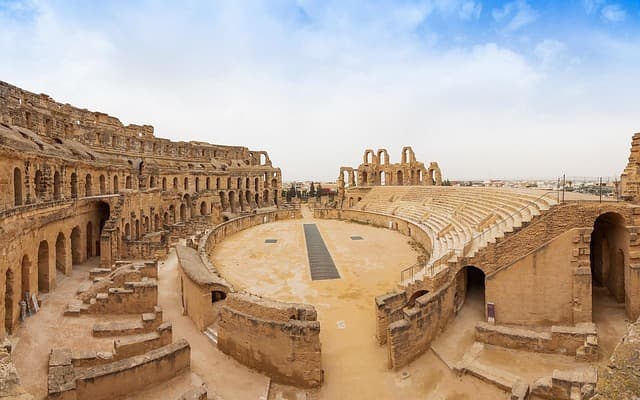
Alexander the Great visited Egypt once, for less than a year, between 332 and 331 BC. He never came back. He died in Babylon at thirty-two. But in those months he walked a stretch of coast between the sea and Lake Mariout and told his architect Deinokrates to build a city there, oriented so that the summer winds would clear the streets of heat. That city became, within a century, the largest city in the world, home to roughly 600,000 people at its peak, larger than Rome was at the time.
This is the paradox at the center of Alexandria's history: the man who made it possible saw almost none of it. The city was built by his successors, the Ptolemies, a dynasty of Macedonian Greeks who ruled Egypt for nearly three hundred years and who, with the possible exception of Cleopatra VII, never learned to speak Egyptian. They were foreigners ruling the world's oldest civilization, and what they built to legitimize that arrangement became the template for how the ancient world organized and transmitted knowledge.
The Mouseion, the institution attached to the Library of Alexandria, was not a library in the modern sense. It was a research institution funded by the state, where scholars received free housing, food, and salaries to think. Eratosthenes calculated the circumference of the earth here in the third century BC and was accurate to within two percent. Herophilus conducted the first systematic human dissections here, establishing the brain (not the heart) as the seat of intelligence, a finding Aristotle had rejected. The Ptolemies reportedly paid enormous sums to borrow scrolls from Athens, copied them, and returned the copies instead of the originals.
Almost nothing physical of that world remains above ground. This is either a tragedy or an invitation to look harder, depending on what kind of traveler you are.
---
The Catacombs of Kom el-Shoqafa: Where Three Worlds Became One
The single most important site for understanding Greco-Roman Egypt is not a temple or a theatre. It is underground, in a residential neighborhood called Kom el-Shoqafa, and it was discovered in 1900 when a donkey fell through the ground.
The catacombs were cut into the rock in the second century AD and used as a private burial complex, probably for a wealthy Alexandrian family that could afford to blend three cosmologies in one tomb. The result is the most complete surviving example of what scholars call syncretic art: the fusion of Egyptian, Greek, and Roman traditions into something that belongs entirely to none of them.
In the central burial chamber, Anubis (the Egyptian god of the dead) appears wearing Roman legionary armor and holding a Greek caduceus. Sobek, the crocodile god, appears as a Roman soldier. The mummification scenes follow Egyptian ritual exactly, but the figures performing them wear Greek clothing. The architectural structure is Roman, with columns and pilasters, but the columns are carved with lotus and papyrus capitals that are purely Egyptian.
This was not confusion or eclecticism for its own sake. By the second century AD, Alexandria had been Greek for three hundred years and Roman for two hundred. The people being buried here were Alexandrians, which meant they were simultaneously all three. The catacombs are not a museum piece about cultural mixing. They are the thing itself.
Bring a light jacket. The catacombs sit roughly 35 meters below street level and are ten degrees cooler than the surface. The descent through the spiral staircase is genuinely narrow and steep. If you have claustrophobia, know this before you go. The site has no air conditioning because it does not need it, and the cool dark interior smells faintly of rock and old water, nothing unpleasant, just specific and ancient.
---
Kom el-Dikka and the Greco-Roman Museum: The Surface Level
Most Greco-Roman Alexandria history guides lead with the Bibliotheca Alexandrina, the modern library built on or near the site of the ancient one. Do not make this mistake. The Bibliotheca is architecturally interesting and contains several good museums, but it tells you about the idea of ancient Alexandria, not the physical reality of it.
Kom el-Dikka is where you feel the physical reality. The site contains the only standing Roman theatre in Egypt, a small but well-preserved odeon with thirteen rows of white marble seats, built in the fourth century AD and capable of holding around 800 people. But the theatre is almost secondary to what else the excavations have revealed: a residential and commercial quarter of the ancient city, with Roman baths, lecture halls, and streets that were occupied continuously from the first century BC into the seventh century AD.
The lecture halls are significant in a way that most visitors miss entirely. These are not temples or civic buildings. They are classrooms, specifically twelve colonnaded halls arranged around a central space, dating to the fifth and sixth centuries AD and believed to be part of the university that Alexandria maintained long after the Library itself had been damaged and dispersed. The philosopher Hypatia, the first well-documented female mathematician, taught in Alexandria in the early fifth century AD. She was killed by a Christian mob in 415 AD, an event that marks, for many historians, the end of classical Alexandrian intellectual life. These halls were in use during her lifetime.
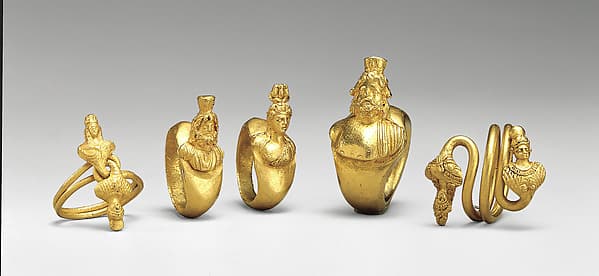
The Greco-Roman Museum, currently partially open after a long renovation, holds the most important objects from the site and from the wider region: coins, statuary, the famous Serapis head, mummies, medical instruments, terracotta figurines of everyday Alexandrian life. The Serapis cult deserves particular attention. The god Serapis was invented by the Ptolemies, specifically by Ptolemy I, as a deity that could be worshipped by both Egyptians and Greeks without either group feeling they had compromised their tradition. Serapis absorbed aspects of Osiris, Zeus, and Dionysus simultaneously. His main temple, the Serapeum, stood on the hill where Pompey's Pillar now stands, and at its height it was considered one of the great sanctuaries of the ancient world.
---
Pompey's Pillar: The Right Name for the Wrong Reason
Pompey's Pillar has nothing to do with Pompey. The 27-meter-tall red Aswan granite column standing on the hill of the old Serapeum was erected in 298 or 299 AD in honor of the Emperor Diocletian, who had recently suppressed a revolt in Alexandria and, in a gesture of magnanimity that impressed the locals, provided emergency grain to the starving city. The base inscription makes this clear in both Greek and Latin.
The column became associated with Pompey through a medieval misunderstanding. Crusaders visiting the city assumed the column marked the tomb of Pompey, who was indeed murdered in Egypt in 48 BC (on the beach at Pelusium, east of modern Port Said, not in Alexandria). The name stuck despite being wrong for over a thousand years.
The site itself includes two sphinx statues in pink granite and the remains of the Serapeum's underground gallery, where sacred Apis bulls were kept and worshipped. Most visitors spend twenty minutes here and leave. The more useful exercise is to stand at the base of the column and look out at the city around it. The hill was the highest point in ancient Alexandria. From here you can see the bay, the outline of the modern city over the ancient one, and, if you know where to look, the approximate footprint of a city that once held more books than any place on earth.
---
The Connections: Alexandria as a Living Palimpsest
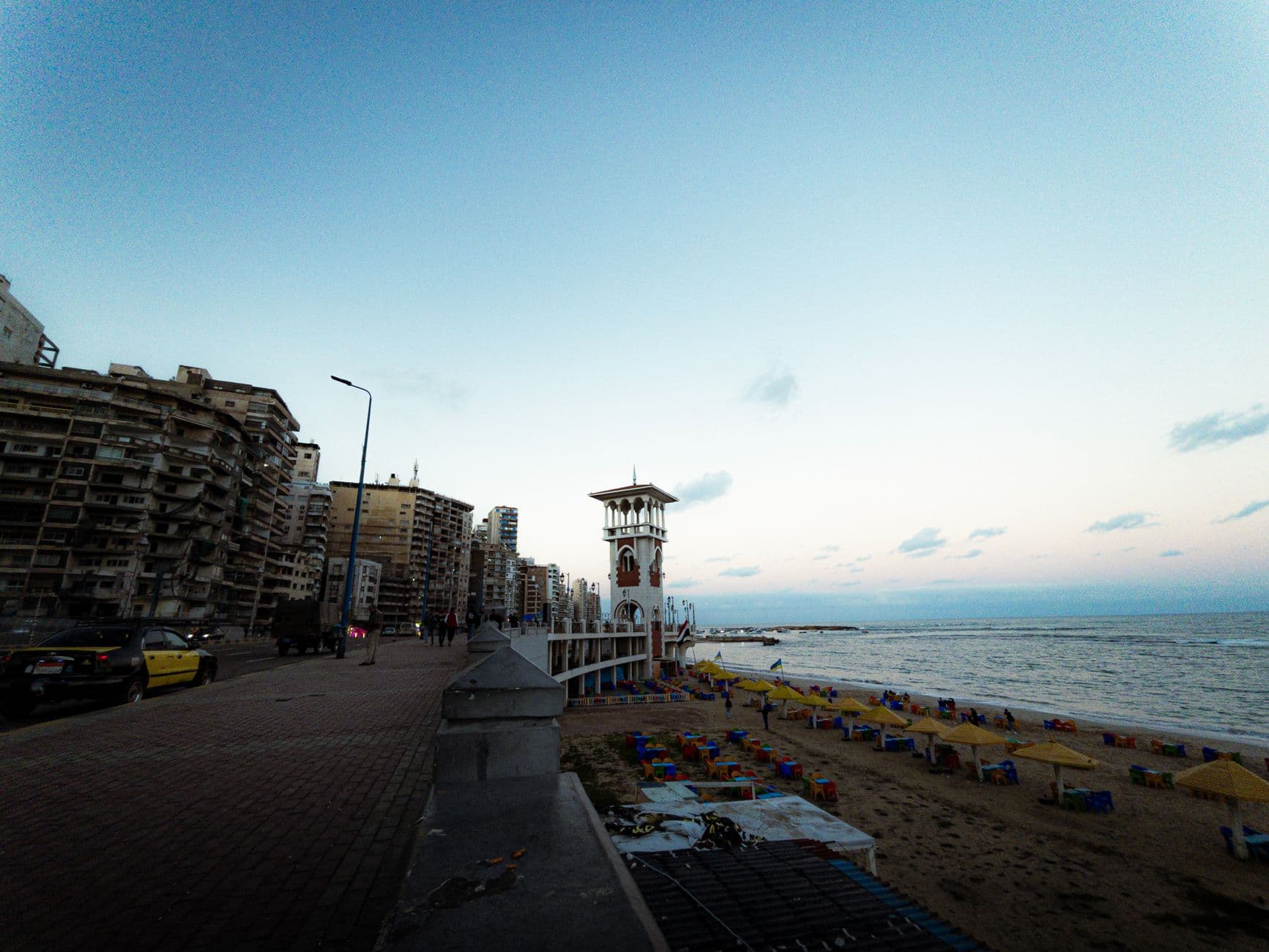
Alexandria is not a Greco-Roman city that became something else. It is a city in which every layer is still present and usually built directly on top of the previous one.
The Attarine Mosque in the old city stands on the site of the Church of St. Athanasius, which itself stood on the site of a temple to Alexander the Great, who was worshipped as a god in his own city. The mosque's minaret incorporates Roman columns. The neighborhood around it, Kom el-Dikka, takes its name from the Arabic for "mound of rubble," because for centuries the ancient city below was simply landfill.
The Abu al-Abbas al-Mursi Mosque, built in its current form in 1775 by an Algerian merchant community, stands on the seafront of the Eastern Harbor, the same harbor where Cleopatra VII's royal fleet was moored, where Caesar arrived, and where the Arab general Amr ibn al-As entered the city in 641 AD after a fourteen-month siege that ended the Byzantine period without destroying the city itself. Amr ibn al-As reportedly wrote to the Caliph Umar in Medina that Alexandria contained 4,000 palaces, 4,000 baths, 400 theatres, 12,000 greengrocers, and 40,000 Jews. Whether accurate or not, the description suggests a city of extraordinary density and commercial life.
The Coptic Orthodox Cathedral of Saint Mark in Alexandria marks the tradition that Mark the Evangelist brought Christianity to Egypt in approximately 42 AD, making the Egyptian church one of the oldest in the world. The Patriarchate of Alexandria predates the Patriarchates of Constantinople, Moscow, and Rome in its claim to apostolic foundation. This detail tends to surprise visitors who assume Egypt's Christian history is secondary to its Islamic one.
---
Common Mistakes
Starting with the Bibliotheca Alexandrina. It is a beautiful building with good exhibitions, but it is a twenty-first century institution built near an ancient site. Start with Kom el-Shoqafa. Start underground. The modern library makes more sense after you have seen what came before it.
Taking a full-day "Greco-Roman Alexandria" tour from Cairo. These tours leave at 5am and return at midnight. You spend four hours on the road and four hours moving between sites in a group. You see nothing properly. Take the train, stay two nights, and do this at a pace that allows actual thought.
Visiting the catacombs at midday. The site gets its worst crowds from 11am to 2pm when tour buses arrive from Cairo. Go at 8am when it opens. You will often have the main chambers to yourself for twenty or thirty minutes, which is the only way to absorb the syncretic art without someone's camera flash competing with the overhead lighting.
The sound and light show at the Bibliotheca Alexandrina. EGP 250 for a production that covers information you will have already absorbed from this guide and the site museums. The money and two hours are better spent at a table at Kadoura fish restaurant on the corniche eating grilled mullet that came out of the Mediterranean that morning.
Skipping the Greco-Roman Museum because of the renovation. The museum has been partially closed for years but sections remain open and the collection on display is worth three hours of serious attention. Check current access status before your visit, but do not assume it is entirely closed and skip it.
Ignoring Alexandria's surviving Jewish heritage. The city had one of the largest Jewish communities in the ancient world, central to the intellectual life of the Ptolemaic and Roman periods. The translation of the Hebrew Bible into Greek, the Septuagint, was produced here in the third century BC at the Ptolemaic court's request. The Eliyahu Hanavi Synagogue, still standing in the city center, was built in the nineteenth century but sits within a tradition of Alexandrian Jewish life that is 2,300 years old.
Assuming the coastline you see is the coastline Cleopatra saw. Ancient Alexandria has subsided between 6 and 8 meters due to seismic activity, and much of the ancient Eastern Harbor, including what is believed to have been the palace quarter, now sits underwater. The Bibliotheca's Center for Underwater Archaeology has been mapping these ruins for decades. Photographs of the recovered statuary are available at the museum inside the Bibliotheca complex and are among the most striking images of the Greco-Roman period in Egypt.
---
Practical Tips
Alexandria runs on its own pace, slower than Cairo and more Mediterranean in its rhythms. Shops close for long midday breaks. Friday mornings are quiet everywhere.
The corniche, the 20-kilometer coastal road that curves around the harbor, is best walked in the early morning or at dusk. The light on the water at both times is unlike anything else in Egypt, partly because Alexandria has weather in a way that Cairo does not: clouds, sea haze, sometimes actual rain between November and February.
For accommodation, staying in the Raml Station or Sidi Gaber area puts you within walking distance or a short taxi ride of most sites. Budget hotels in these neighborhoods cost EGP 400 to 800 per night. Mid-range options closer to the seafront cost EGP 1,200 to 2,500.
Taxis within the city cost EGP 30 to 80 for most journeys. Ride-hailing apps function well in Alexandria and are more transparent on pricing. The tram, one of the oldest tram networks in Africa, still runs and costs EGP 3 for most trips. It is slow, crowded during commute hours, and genuinely charming.
Water at all the sites is expensive and sometimes unavailable. Bring your own. The Catacombs of Kom el-Shoqafa in particular have no facilities inside.
If you read Arabic or travel with someone who does, the signage at Kom el-Dikka is more detailed in Arabic than in the English translations. This is not deliberate gatekeeping, just a funding and prioritization issue. The Arabic panels were written more recently and with more archaeological context.
Frequently Asked Questions
The Weekly Dispatch
More on Egypt, every Friday.
Cultural depth and places most guides never mention.
No spam. Unsubscribe anytime.