Greco-Roman Alexandria: The City That Rewrote the Ancient World
Alexandria once held 700,000 volumes in a library that burned three separate times. The city built under its ruins is still being excavated. Most of it lies under the sea.

Quick Facts
- Best time to visit
- October through April. Mediterranean winters are mild (15 to 20 degrees Celsius), light is clear, and the city is less crowded. Summer (June to August) is humid and hazy.
- Entrance fee
- Catacombs of Kom el-Shoqafa: EGP 360 (approx $7.50 USD), students EGP 180. Greco-Roman Museum: EGP 300 (approx $6 USD), students EGP 150. Pompey's Pillar: EGP 200 (approx $4 USD). Bibliotheca Alexandrina: EGP 200 (approx $4 USD) for foreigners.
- Opening hours
- Catacombs: Daily 8am to 5pm. Greco-Roman Museum: Tuesday to Sunday 9am to 5pm (closed Mondays). Pompey's Pillar: Daily 8am to 4pm. Bibliotheca Alexandrina: Saturday to Thursday 11am to 7pm, Friday 3pm to 7pm.
- How to get there
- From Cairo: train from Ramses Station to Misr or Sidi Gaber Station, EGP 90 to 250, 2 to 2.5 hours. Within Alexandria: white microbuses EGP 3 to 5 per ride, Uber or taxi EGP 50 to 100 across the city.
- Time needed
- Two full days minimum. Day one: western sites (Catacombs, Pompey's Pillar, Greco-Roman Museum). Day two: Bibliotheca Alexandrina, National Museum, Corniche walk, Qaitbay Citadel.
- Cost range
- Budget EGP 600 to 900 per day including accommodation. Mid-range EGP 1,800 to 3,000 per day including a decent seafront hotel.
Quick Facts
Best time to visit: October through April. Alexandria's Mediterranean climate makes summer humid and hazy. Winter light is sharp and the city belongs more to locals than tourists.
Key sites and entrance fees: Greco-Roman Museum: EGP 300 (approx $6 USD), students EGP 150. Reopened after two decades of renovation. Catacombs of Kom el-Shoqafa: EGP 360 (approx $7.50 USD), students EGP 180. Daily 8am to 5pm. Pompey's Pillar and Serapeum complex: EGP 200 (approx $4 USD). Daily 8am to 4pm. Bibliotheca Alexandrina (modern, with ancient history exhibits): EGP 70 for Egyptians, EGP 200 (approx $4 USD) for foreigners. Saturday to Thursday 11am to 7pm, Friday 3pm to 7pm.
How to get there: From Cairo, the train from Ramses Station to Sidi Gaber or Mahattet Masr costs EGP 90 to 250 depending on class; the journey takes 2 to 2.5 hours. The AC bus from Turgoman terminal costs around EGP 100 and takes 3 hours. Within Alexandria, white microbuses run all major routes for EGP 3 to 5. A taxi across the city should cost EGP 50 to 100. Uber operates here and is reliable.
Time needed: Two full days to do this properly. One day for the western sites (Catacombs, Pompey's Pillar, Greco-Roman Museum). One day for the Corniche, the Bibliotheca, and the underwater archaeology context at the National Museum.
Cost range: Budget EGP 600 to 900 per day including accommodation. Mid-range EGP 1,800 to 3,000 per day.
---
Why This Place Matters
Alexander the Great founded roughly twenty cities named after himself. Only one survived as a major civilization. He chose the site in 331 BC reportedly after a dream involving Homer, which is the kind of detail that sounds like mythology until you realize the man was twenty-four years old and genuinely believed it. Within a generation, Alexandria had become the largest city in the world, home to perhaps one million people at a time when Rome still had unpaved roads.
What made Alexandria different from every other Hellenistic city was not its size but its deliberate intellectual ambition. The Ptolemies, the Macedonian dynasty that ruled Egypt after Alexander's death, created the Mouseion, a state-funded research institution that was the closest the ancient world came to a university. The Library attached to it held between 400,000 and 700,000 scrolls depending on which ancient source you trust, which works out to roughly every significant text written in the Mediterranean world up to that point. Euclid developed geometry here. Eratosthenes calculated the circumference of the earth here, to within 2 percent accuracy, in approximately 240 BC, using shadow angles and the distance between Alexandria and Aswan. Hypatia, the last great scholar of classical Alexandria, was murdered by a Christian mob in 415 AD, an event that many historians treat as a symbolic close of the ancient intellectual world.
The Greco-Roman Alexandria history guide that most visitors receive tells them about the Library's burning. The version worth knowing is more complicated: the Library did not burn in a single catastrophic fire. It declined through a series of cuts, conflicts, and neglect across four centuries. The ancient world's greatest act of cultural destruction was not a fire. It was chronic underfunding and political indifference. That should feel familiar.
None of the Library's texts survive. What survives is underneath you: a city of layered occupation, Greek over Pharaonic, Roman over Greek, Coptic over Roman, Arab over all of it. The Kom el-Shoqafa catacombs alone contain three stories of tombs where a man who was culturally Egyptian, religiously Roman, and ethnically Greek might be depicted in all three traditions simultaneously, carved into the same wall.
---
The Catacombs of Kom el-Shoqafa: Where Three Worlds Share a Wall
A donkey fell through the ground in 1900 and revealed what is now considered one of the most important archaeological sites in Egypt. The Catacombs of Kom el-Shoqafa, whose name translates roughly as "mound of broken pottery," were a private burial complex built in the 2nd century AD. The donkey's accident was the first time in perhaps fifteen centuries that anyone had seen them.
What you descend into, via a spiral staircase cut through rock, is a theological argument made in stone. The main burial chamber contains figures that are unmistakably Egyptian in form: Anubis with the jackal head, Thoth with the ibis, the mummification tableau that appears in tombs across three thousand years of Pharaonic tradition. But the statues wear Roman armor. The architectural framing is pure Greek. The man or family buried here saw no contradiction in this. By the 2nd century AD, Alexandria had been absorbing cultural influences for four hundred years, and its educated class moved fluently between traditions without feeling they had to choose.
The detail most visitors walk past without stopping: in the triclinium, a dining room carved into the rock adjacent to the tombs, the living came to eat funerary banquets with their dead. Stone benches line the walls. The food was left on ledges. This was not considered morbid. It was considered necessary maintenance of the relationship between the living and the dead, a practice with roots in Pharaonic Egypt that the Romans found entirely reasonable.
Arrive before 9am if you can. The catacombs are the most atmospheric site in Alexandria and also the most claustrophobic when a tour group is descending the same spiral staircase toward you.
---
Pompey's Pillar and the Temple That Became a Church That Became a Mosque
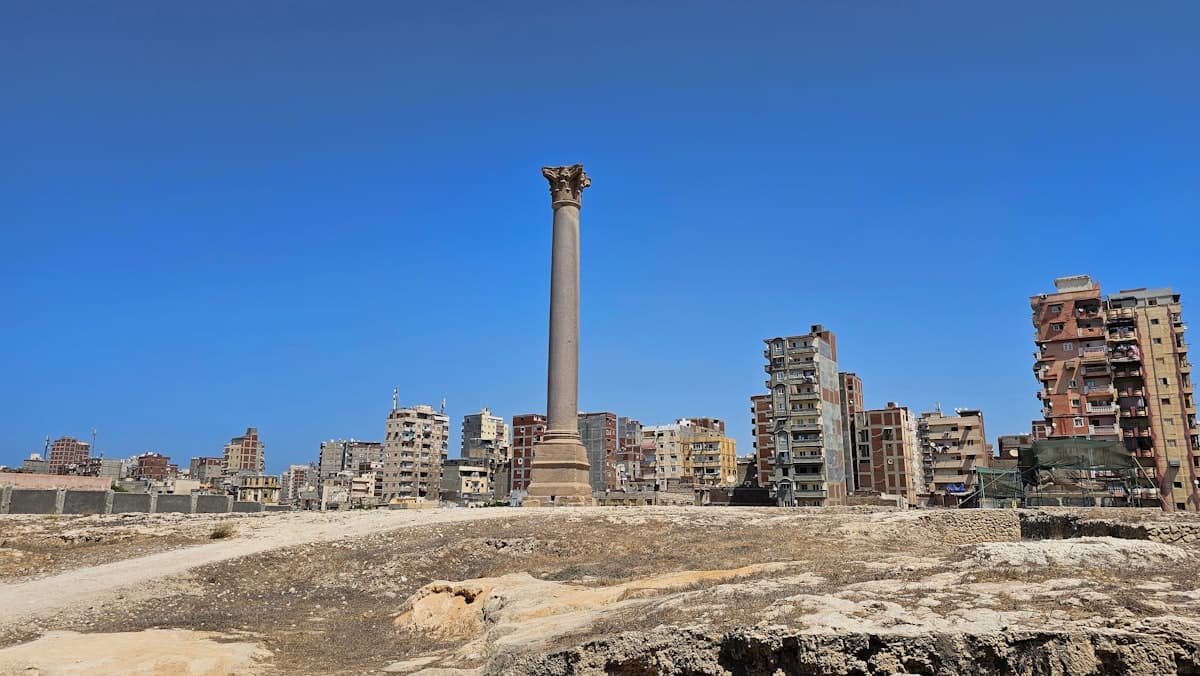
The pillar has nothing to do with Pompey. The Roman general was murdered in Egypt in 48 BC; the pillar was erected in 297 AD to honor the Emperor Diocletian, who had just suppressed a revolt in Alexandria. The name is a medieval European mistake that stuck. Standing 27 meters tall and made from a single piece of red Aswan granite, it is the largest monolithic column erected in the ancient world outside of Rome.
More interesting than the pillar is what surrounds it. The Serapeum, the great temple of Serapis that once dominated this hill, was one of the ancient world's most extraordinary buildings. Serapis was a deity invented by the Ptolemies in approximately 280 BC as a deliberate theological synthesis: a god who combined elements of Osiris, Apis, Zeus, and Hades, designed to be worshipped by both Egyptian and Greek populations simultaneously. The temple was destroyed by a Christian mob in 391 AD on the orders of the Bishop Theophilus, acting under authorization from Emperor Theodosius. An act of state-sponsored religious demolition that ended the last functioning pagan temple in Alexandria.
The sphinxes you see scattered around the Pompey's Pillar complex are not all from the same period. Some are New Kingdom, moved here centuries after they were carved. Alexandria has always been a city that cannibalizes its own monuments.
The skip you should consider: the site itself is underdeveloped for what it represents. You are standing on the ruins of one of the most significant temples in the ancient world, looking at a pillar with a misleading name, surrounded by fragments with no adequate contextual signage. Spend thirty minutes here, then spend the rest of your time at the Greco-Roman Museum, where the artifacts from this hill and others across Alexandria are properly displayed.
---
The Greco-Roman Museum: Finally Worth the Visit Again
The museum closed in 2005 for renovations. It reopened recently after nearly twenty years, which in Egyptian bureaucratic time is not considered unusual. What you find inside is one of the most concentrated collections of Hellenistic and Roman-era Egyptian artifacts anywhere in the world, covering the period from roughly 300 BC to 400 AD.
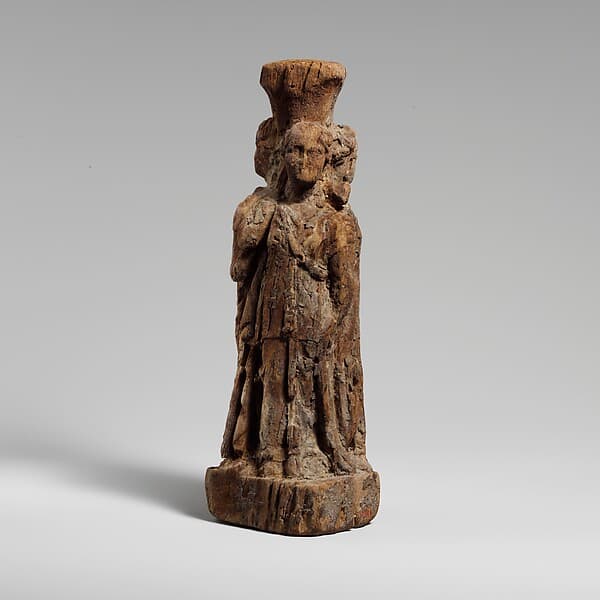
The collection's most important conceptual contribution is not any single object but the accumulation of evidence that Greco-Roman Egypt was not a colonial culture imposing itself on a passive Pharaonic base. It was a genuinely syncretic civilization where Egyptian priests learned Greek, where Greek philosophers were initiated into Egyptian mystery traditions, and where deities exchanged attributes across cultural lines so extensively that separating them became philosophically meaningless. Isis became Isis-Aphrodite. Horus became Harpocrates and then traveled west as an infant god who may have influenced early Christian iconography of the Madonna and child.
The tanagra figurines, small terracotta figures used in domestic worship, are worth slowing down for. They show you the private religious life of ordinary Alexandrians: not the grand theological constructs of philosophers but the household devotions of merchants, weavers, and sailors.
---
The Connections: Alexandria's Layers Below the Layers

Modern Alexandria sits on top of ancient Alexandria, which is both a physical and a conceptual fact. Abu al-Abbas al-Mursi Mosque, the most beautiful mosque in the city, sits in the heart of a district that was the ancient royal quarter. The mosque dates to 1775, was rebuilt in its current form in 1943, and honors a 13th-century Andalusian Sufi saint who fled Seville when it fell to Christian reconquest in 1248. The Sufi saint's tomb became a pilgrimage site. The pilgrimage site became a mosque. The mosque was built over medieval structures that were built over Roman foundations that were built over the neighborhood where Cleopatra's palace once stood. Her palace is now underwater.
The underwater archaeology context is not optional if you are serious about understanding Alexandria. A significant portion of the ancient royal quarter, including what is believed to be Cleopatra's palace complex and the site where Mark Antony's fleet anchored, lies beneath the Eastern Harbour. Franck Goddio, the French underwater archaeologist, has been mapping it since 1992 and has recovered artifacts including sphinxes, statues, and architectural elements. You cannot dive the site as a tourist, but the Bibliotheca Alexandrina's museums contain recovered artifacts and excellent visual documentation.
Coptic Alexandria connects to this history in a way most visitors miss entirely. The Holy Family, according to Coptic tradition, spent time in Egypt during the flight from Herod, and Alexandria's Coptic community traces its founding to Saint Mark, who arrived here around 48 AD. The Coptic community that survived Roman persecution, Arab conquest, Crusader-era disruptions, Ottoman rule, and 20th-century emigration waves is still present in the city. The Coptic Cathedral of Saint Mark in the Mansheya district is not on most Greco-Roman itineraries. It should be, because the Coptic community is the oldest continuous institutional thread connecting modern Alexandria to its ancient predecessor.
---
Common Mistakes
1. Spending only a day. Alexandria requires two days minimum. Most Cairo-based travel packages give you six hours, which is enough time to stand in front of things without understanding any of them.
2. Treating the Bibliotheca Alexandrina as a photo opportunity. The modern library, designed by the Norwegian firm Snohetta and opened in 2002, is architecturally interesting but its real value is what is inside: the Antiquities Museum in the basement, the Manuscripts Museum, and the Sadat Anwar exhibition. The building's circular roof facing the sea is meant to evoke a sun disk. Engage with the content or skip it in favor of the Greco-Roman Museum.
3. Doing the Alexandria day trip from Cairo by bus. The train is faster, more comfortable, and drops you in the center of the city. The bus deposits you at a terminal on the outskirts. Take the Spanish or French train from Ramses to Misr Station.
4. Skipping the corniche walk at 6am. Alexandria's Corniche is 26 kilometers of seafront. The early morning light on the Eastern Harbour, with fishing boats returning and the smell of salt and diesel and coffee from the first open cafes, is the sensory experience that connects you to every sailor, merchant, and philosopher who entered this harbour over two thousand years. You cannot photograph your way into this experience. You have to walk it.
5. Paying for a guided tour at Pompey's Pillar. The site has minimal remaining context and an unlicensed guide will not improve it. Save your guide budget for the Catacombs, where the iconographic layers genuinely require explanation, or the Greco-Roman Museum.
6. Eating near the tourist sites. The seafood restaurants adjacent to the Corniche near Qaitbay Citadel exist to capture tourists who have not walked three more blocks to where Alexandrians actually eat. Mohamed Ahmed on Sharia Shakour is a local institution for fool and falafel breakfasts and costs a fraction of the waterfront alternatives. For fish, Elite Restaurant in Raml Station has been operating since 1953.
7. Assuming the story of ancient Alexandria ended with the Arab conquest in 641 AD. The Arab general Amr ibn al-As, who took the city, reportedly wrote to the Caliph Omar that he had captured a city containing four thousand palaces, four thousand baths, four hundred theaters, and forty thousand Jews. Whether or not those numbers are accurate, the city he conquered was still, six hundred years after its founding, one of the largest in the world. The story did not end. It continued in Arabic.
---
Practical Tips
Alexandria's sites are spread across a long coastal strip. Cluster them geographically: western sites (Catacombs, Pompey's Pillar, Greco-Roman Museum) one morning, central and eastern sites (Bibliotheca, National Museum, Qaitbay Citadel, Montazah if you need green space) the next.
The Greco-Roman Museum is closed on Mondays. Check before you arrive.
For the Catacombs, bring a light layer even in summer. The temperature drops significantly underground. Photography is permitted but flash is restricted in the lower chambers.
Alexandria has a working Mediterranean city atmosphere that is genuinely different from Cairo. Dress modestly in the western districts (Kom el-Shoqafa area) and at religious sites. The Corniche area is more relaxed.
If you are combining this trip with a Greco-Roman Egypt Alexandria history itinerary that includes Cairo, the Egyptian Museum in Cairo holds objects excavated from Alexandria, including portrait mummies from the Fayum that show the same cultural synthesis visible in the Catacombs. They were made in the same period, by the same civilization, for the same reason: the need to hold multiple identities simultaneously without apparent contradiction. This is Alexandria's real inheritance to the world.
Frequently Asked Questions
The Weekly Dispatch
More on Egypt, every Friday.
Cultural depth and places most guides never mention.
No spam. Unsubscribe anytime.