Greco-Roman Alexandria: The History Beneath the City
Alexandria was the world's largest city for 300 years. Almost none of it survives above ground. What does is stranger than you expect.

Quick Facts
- Best time to visit
- October to April. Mediterranean humidity and summer crowds make July and August uncomfortable. October and November offer clear skies, moderate temperatures, and smaller site crowds.
- Entrance fee
- Catacombs of Kom el-Shoqafa: EGP 250 (approx $5 USD), students EGP 125. Serapeum and Pompey's Pillar: EGP 180 (approx $3.50 USD), students EGP 90. Graeco-Roman Museum: EGP 200 (approx $4 USD), students EGP 100.
- Opening hours
- Daily 9am to 5pm for most sites. Catacombs of Kom el-Shoqafa close at 4:30pm. Graeco-Roman Museum closed Mondays.
- How to get there
- From Cairo: Spanish train (Al-Eslah) from Ramses Station, 2h15m, EGP 55 to 120. Within Alexandria: microbus to Pompey's Pillar area EGP 5, Uber or Careem EGP 35 to 55 per trip, negotiated taxis EGP 40 to 50.
- Time needed
- One full day for the three core Greco-Roman sites. Two days recommended if adding the Bibliotheca Alexandrina antiquities exhibition and Eastern Harbour at dawn.
- Cost range
- Budget EGP 600 to 900 per day including transport, all site entries, and street food. Mid-range EGP 1,800 to 3,000 including hotel and a seafood lunch on the Corniche.
Alexander the Great visited Alexandria exactly once. He arrived in 331 BC, sketched a rough plan for his new city in the dirt, watched the seagulls eat the flour his architects had used as markers, and left. He never came back. The city that bore his name, that would become the intellectual capital of the ancient world, the home of the greatest library ever assembled, the city where Cleopatra seduced two Roman generals, the place where Christianity and Neoplatonism fought their most brutal philosophical battles: he never saw any of it.
That fact does something useful to the tourist ego. It reminds you that Alexandria was never really about any one person, not even its founder. It was always about accumulation, layers pressing down on layers, Greek on Egyptian, Roman on Greek, Christian on Roman, Arab on Christian, Ottoman on Arab. You are not visiting a ruin. You are visiting a palimpsest.
Quick Facts
Best time to visit: October to April. Alexandria's Mediterranean climate means summer crowds, humidity, and temperatures that make underground sites feel like saunas. October and November are ideal: warm, clear, manageable.
Main sites and entrance fees: Graeco-Roman Museum: EGP 200 (approx $4 USD), students EGP 100. Reopened after 17-year renovation. Pompey's Pillar and Serapeum: EGP 180 (approx $3.50 USD), students EGP 90. Catacombs of Kom el-Shoqafa: EGP 250 (approx $5 USD), students EGP 125. Royal Jewelry Museum (for context on later layers): EGP 100 (approx $2 USD).
Opening hours: Most sites open daily 9am to 5pm. The Catacombs close at 4:30pm. Arrive 90 minutes before closing at minimum.
Getting there: Alexandria is 225 km from Cairo. The Spanish train (Al-Eslah) takes 2 hours 15 minutes from Ramses Station, costs EGP 55 to 120 depending on class, and is reliable. Microbus from Alexandria's Mahattat Misr to Pompey's Pillar costs EGP 5. Taxis within the city: EGP 30 to 60 per trip depending on distance. Uber and Careem both operate here.
Time needed: One serious day covers the three main Greco-Roman sites. Two days lets you add the Bibliotheca Alexandrina, the Eastern Harbour waterfront, and Montaza for context. Three days if you want to sit with anything.
Cost range: Budget EGP 600 to 900 per day including transport, sites, and street food. Mid-range EGP 1,800 to 3,000 including a seafood lunch on the Corniche and a decent hotel.
---
Why This Place Matters
At its peak under the Ptolemaic dynasty, roughly 300 BC to 30 BC, Alexandria held somewhere between 500,000 and one million people, making it the largest city on earth. Rome, for most of that period, was smaller. The Library of Alexandria, at its height, is estimated to have held 700,000 scrolls, not books in the modern sense but papyrus rolls, each containing one work or part of one work. Ptolemy III allegedly borrowed the official Athenian manuscripts of Sophocles, Euripides, and Aeschylus, paid the enormous deposit required, and then kept the originals, sending back copies. The fine was apparently worth it.
This is the context you need before you visit anything. The physical remains of Greco-Roman Alexandria are, by any honest measure, sparse. The city was built largely of limestone that was quarried and reused across centuries. The Royal Quarters, where Cleopatra met Caesar and where Mark Antony reportedly built himself a hermitage on a small island in the harbour after his defeat, now lie under fifteen feet of water in the Eastern Harbour. French underwater archaeologist Franck Goddio began mapping them in 1996 and found column capitals, statues, sphinx fragments, and what appears to be the Timonium, Antony's final retreat. You cannot dive on these as a casual tourist, but the Bibliotheca Alexandrina has a permanent exhibition of Goddio's finds.
What survives above water is Roman, mostly, rather than Ptolemaic. The Ptolemies built in perishable wood and mud brick alongside their marble. The Romans rebuilt in stone. This is why the Greco-Roman Egypt Alexandria history you can physically touch is filtered through Roman hands.
---
The Catacombs of Kom el-Shoqafa: The Most Important Site Nobody Talks About
Most visitors to Alexandria spend their time at Pompey's Pillar, photograph it, and leave feeling mildly disappointed. They should have spent that time underground.
The Catacombs of Kom el-Shoqafa, discovered in 1900 when a donkey fell through the roof, are the largest Roman funerary complex in Egypt and one of the strangest spaces on earth. They descend three levels, the lowest of which is now permanently flooded, and they contain something architecturally unique: a fusion of Egyptian, Greek, and Roman iconography so thorough that scholars spent decades arguing over which tradition was primary. The answer is all three simultaneously.
In the main burial chamber, carved reliefs show Anubis, the jackal-headed Egyptian god of the dead, wearing Roman legionary armor. Thoth, the ibis-headed scribe of the dead, appears in Greek robes. The burial niches, called loculi, are framed by Greek Corinthian columns resting on a floor patterned with Egyptian lotus motifs. A carving of Medusa, Greek to her core, stares out from the ceiling of the antechamber. Nobody commissioned this as a statement about multicultural harmony. This was simply what educated Alexandrians believed the afterlife looked like by the second century AD: a place where all three of their cultural inheritances would coexist because all three had always coexisted in their city.
The spiral staircase descending to the catacombs once had a central shaft through which ropes could lower the sarcophagi. The main sarcophagus in the principal chamber is carved directly from the rock and was never meant to be removed. Whoever is buried there, and no inscription survives to identify them, was sealed in permanently. The tomb has been empty since at least medieval times, cleared by people who needed the stone or the space, but the carvings remain intact. Bring a flashlight regardless of what the entrance gate tells you about the lighting.
---
Pompey's Pillar and the Serapeum: What Actually Happened Here
The pillar has nothing to do with Pompey. The Roman general Pompey was murdered on an Egyptian beach in 48 BC when his boat reached the shore, stabbed by a soldier before he could even disembark, his head sent to Julius Caesar as a gift that reportedly made Caesar weep. The pillar bearing his name was erected in 297 AD, 345 years after Pompey's death, to honor the Emperor Diocletian. An Arab traveller in the medieval period apparently confused it with a monument to the famous Roman, the name stuck, and now every tour operator in Alexandria uses it.
The pillar itself is worth examining honestly. It stands 26.85 meters tall, is cut from a single piece of Aswan red granite, and was transported 900 kilometers north to be installed here. The capital alone weighs 77 tons. The engineering problem of raising it in the third century AD with no hydraulic equipment has never been fully explained. One working theory involves a temporary earthen ramp constructed on an incline, the pillar rolled into position, then the ramp dismantled. Another involves pontoon flotation in a flooded enclosure. Both remain speculative.
The Serapeum around the pillar is where the story gets darker. This was the temple complex of Serapis, a deity invented by Ptolemy I specifically to bridge Egyptian and Greek religious traditions, combining Osiris and Apis with elements of Zeus and Hades. It worked remarkably well for centuries. In 391 AD, the Christian Emperor Theodosius I issued an edict banning pagan worship. The Bishop of Alexandria, Theophilus, used the edict to order the destruction of the Serapeum. The pagan philosopher Olympius and his followers barricaded themselves inside. When they finally surrendered, the temple was dismantled stone by stone. The branch of the Library of Alexandria housed within it was destroyed in the same event, though this was not the primary library, which had likely already been damaged in Caesar's fire of 48 BC. At the base of Pompey's Pillar, you can see the underground Apis bull galleries, long vaulted corridors where the sacred bulls were stored in sarcophagi before the temple fell. Most visitors photograph the pillar from the entrance and never find them.
---
The Graeco-Roman Museum: Finally Worth Visiting Again
The museum closed in 2005 for renovations that were supposed to take three years. It reopened in 2023 after eighteen years, which is the kind of timeline that should surprise nobody familiar with Egyptian institutional bureaucracy but which did, in fact, delay scholarship on several important pieces for nearly two decades.
It is now one of the better small museums in the country. The collection covers roughly 300 BC to 700 AD, and its particular strength is the objects that illuminate daily life rather than royal power: terracotta figurines of Bes, the dwarf household god beloved across all social classes, coins showing the evolution of Alexandrian portraiture, mummy portraits from the Fayyum that are the oldest realistic individual portraiture in human history. The Fayyum portraits were painted in encaustic wax on wood panels and attached to the mummy wrappings over the face, a practice that ran from roughly the first to third centuries AD. The faces are specific, particular, alive. You know these people in a way you do not know the pharaohs.
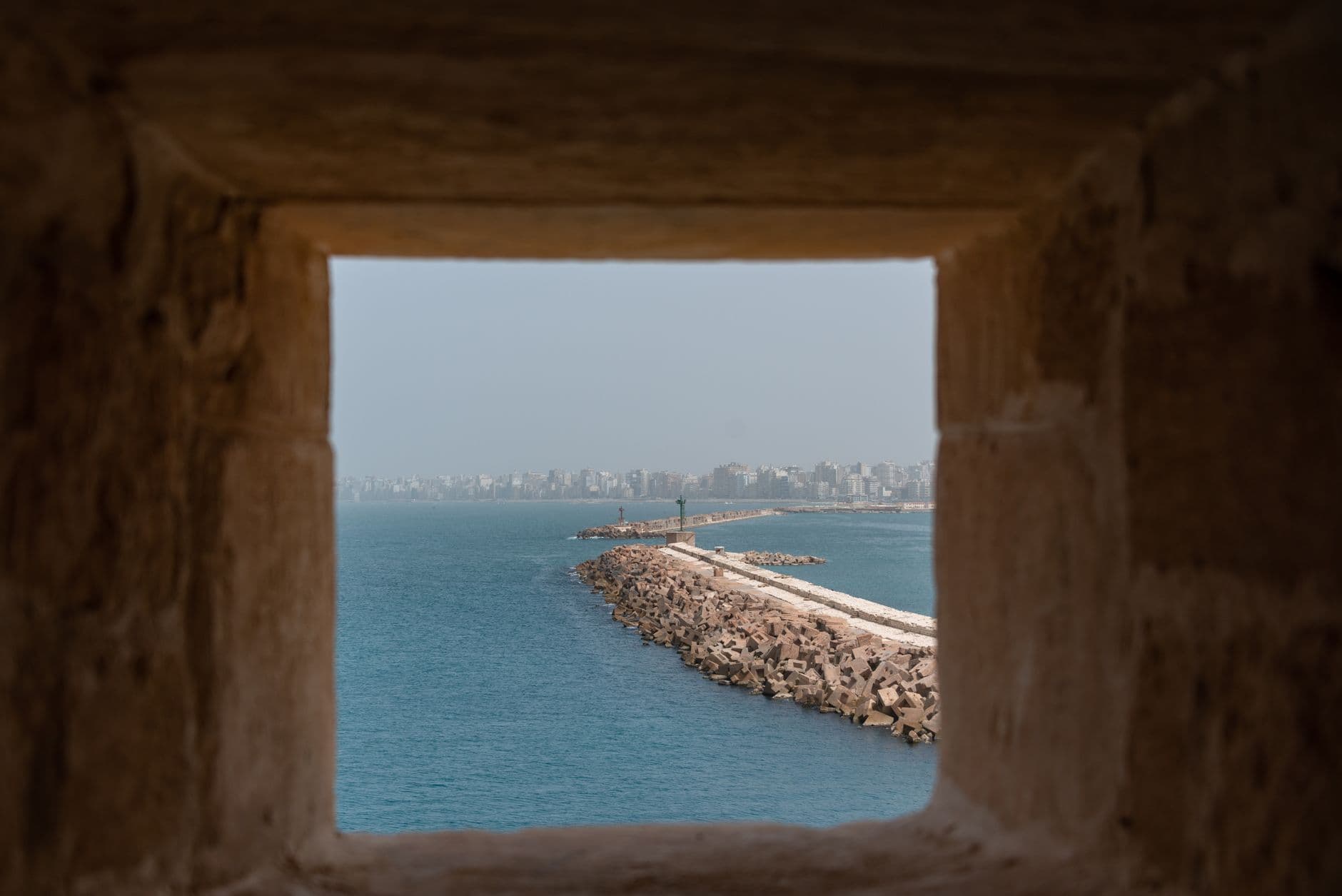
The museum also holds fragments from the original Pharos Lighthouse, one of the Seven Wonders of the Ancient World, which stood at the entrance to the Eastern Harbour. The lighthouse collapsed in a series of earthquakes between 796 and 1303 AD. Sultan Qaitbay built his fifteenth-century fort on its foundations, which is why, if you visit the fort today, you can see granite blocks in its lower walls that are clearly older than the medieval construction surrounding them. The Pharos stood approximately 120 to 140 meters tall. Nothing that height would be built again in the Mediterranean world until the industrial era.
---
The Connections
Alexandria does not exist in a vacuum, and neither does its Greco-Roman layer. When the Arab general Amr ibn al-As took the city in 641 AD, he reportedly wrote to the Caliph Omar asking what to do with the Library. The story that Omar replied "if the books agree with the Quran, they are redundant; if they disagree, they are heretical, so burn them either way" is almost certainly apocryphal, invented by later writers with various political agendas. The Library as a functioning institution had already been damaged multiple times over the previous six centuries. What Amr actually found was a city of perhaps 300,000 people, still the second largest in the region, with functioning churches, synagogues, and a small pagan community still practicing quietly.
The Coptic church of Abu Mena, 45 kilometers southwest of Alexandria, was built over the tomb of Saint Menas, an Egyptian soldier martyred under Diocletian, the same emperor whose pillar stands at the Serapeum. Diocletian, who erected the monument at one end of Alexandria, was executing Christians at the other. The city has always contained its contradictions simultaneously.
In Cairo, the Coptic neighborhood of Old Cairo sits on the site of the Roman fortress of Babylon, which was administered from Alexandria. The administrative thread connecting these two cities runs unbroken from the Ptolemies through the Romans through the Arab conquest. If you are traveling between them, this is not a coincidence to mention casually. It is the actual structure of Egyptian history.
---
Common Mistakes
Spending your best morning at the Bibliotheca Alexandrina. The modern library is architecturally interesting and the Antiquities Museum inside it is genuinely good. But it opens at 10am on weekdays, which means you will be there in the heat of midday. Go to the Catacombs first thing when they open at 9am, while the temperature underground is still manageable.
Assuming Pompey's Pillar is the main event at the Serapeum site. The pillar is visible from the street and is what everyone photographs. The underground Apis bull galleries, accessed through a small door to the left of the main pillar, take ten minutes and are far more interesting. Most guided tours skip them entirely because they require the guide to know something.
Booking a full-day tour from Cairo. The tour operators running day trips from Cairo to Alexandria allocate roughly 90 minutes to each site and spend the middle two hours at a seafood restaurant they have a commission arrangement with. You will see nothing properly. Take the train independently, spend the night, and use the saved commission money on a meal of your own choosing.
The Montazah Palace gardens in high summer. Egyptians love Montazah and the love is understandable, but on a July or August weekend it holds tens of thousands of people. The Greco-Roman sites, by comparison, are quiet year-round. Prioritize accordingly.
Paying for the sound and light show at any site. The Alexandria sound and light experiences cost between EGP 250 and 350, run approximately 45 minutes, and contain no information that is not in this article. The theatrical narration is written for a 1970s sensibility about ancient grandeur. Skip it without guilt.
Neglecting to carry cash in small denominations. The ticket offices at secondary sites like the Apis galleries often cannot change EGP 200 notes. Bring exact amounts or close to it.
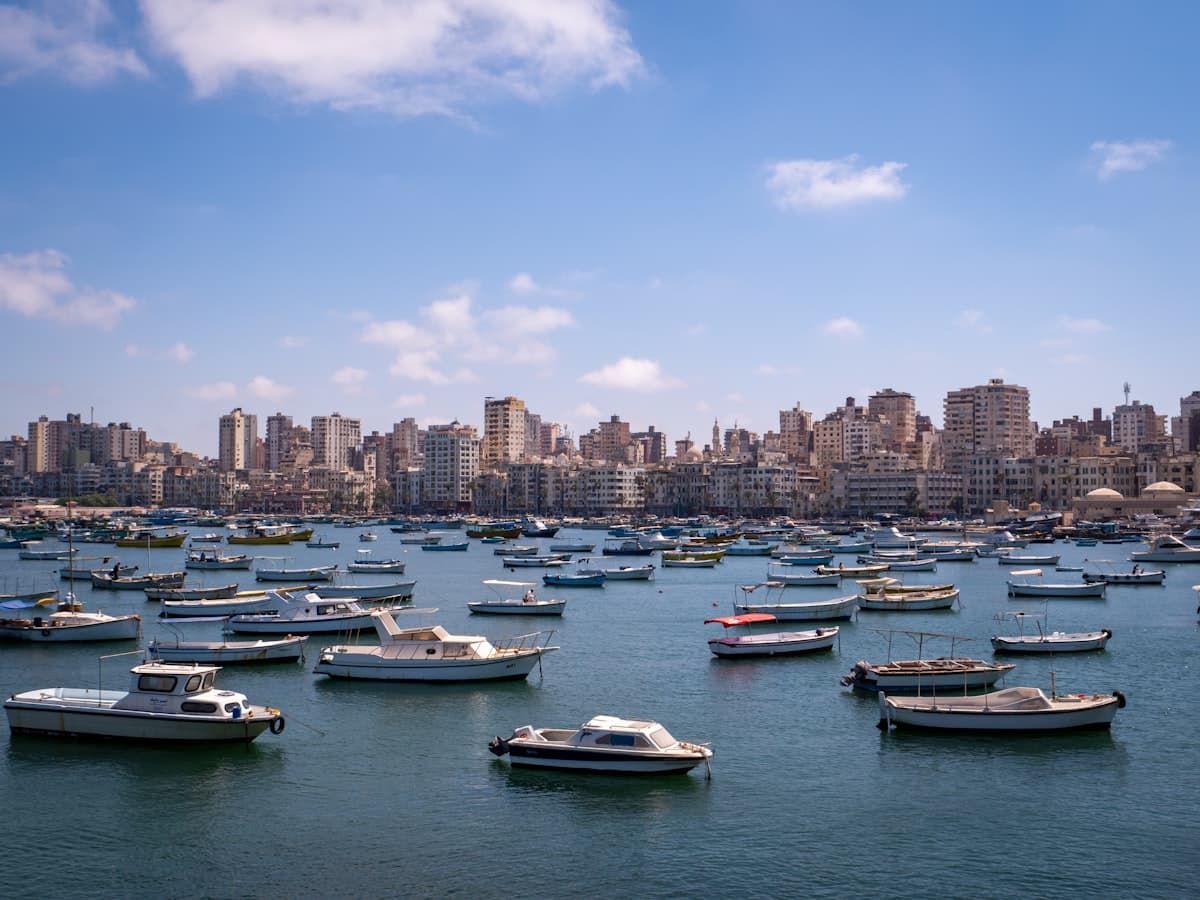
Visiting the Eastern Harbour only at noon. The light on the harbour at 7am, when the fishing boats are returning and the Corniche is still quiet enough to hear the water, is the best light Alexandria offers. The Qaitbay Fort appears from across the water like a weight holding the sea down. This costs nothing and is unavailable on any tour itinerary.
---
Practical Tips
The Graeco-Roman Museum does not always have working English signage. Download the museum's PDF catalogue from the Bibliotheca Alexandrina website before you visit. It is free and more informative than anything available inside.
Water in the Catacombs is not a metaphor. The lowest level is genuinely flooded and you will be turned back. The accessible two levels are enough. Wear shoes that can handle uneven stone stairs in low light.
Alexandria's taxi drivers operate on a negotiated fare system. Agree on the price before you get in. EGP 40 to 50 is reasonable for most cross-city trips. Uber is available and eliminates the negotiation entirely for EGP 35 to 55.
The city's street food circuit around Attarine and the French Quarter area provides some of the best koshari and liver sandwiches in Egypt. Eating at restaurants aimed at tourists on the Corniche costs four times more for half the quality. Walk two streets back from the water.
Photography inside the Catacombs requires a separate ticket, approximately EGP 50. The guards enforce this unevenly. If you want proper photos rather than phone snapshots in poor light, pay the fee and ask the guard to turn on the supplementary lighting in the main chamber, which exists and which they will usually do if asked politely.
Frequently Asked Questions
The Weekly Dispatch
More on Egypt, every Friday.
Cultural depth and places most guides never mention.
No spam. Unsubscribe anytime.