Islamic Golden Age Cairo: A History Guide to the Living City
Cairo contains more medieval Islamic monuments than any city on earth. Most visitors see three. The other 600 are often better.

Quick Facts
- Best time to visit
- October through March for temperatures below 25°C and warm amber light on limestone facades. Avoid July and August when heat makes walking the stone streets exhausting by 10am.
- Entrance fee
- Combined Muizz Street monument ticket: EGP 300 (approx $6 USD). Citadel complex: EGP 450 (approx $9 USD). Museum of Islamic Art: EGP 200 (approx $4 USD). Students half price with valid ID.
- Opening hours
- Most mosques daily 9am to 5pm, closed to non-Muslim visitors Friday 11:30am to 1:30pm. Museum of Islamic Art: Saturday to Thursday 9am to 5pm, closed Friday. Citadel: daily 8am to 5pm.
- How to get there
- Cairo Metro Line 1 to Al-Ataba station (EGP 10), 12-minute walk east to Bab al-Futuh. Uber or Careem from downtown EGP 40 to 70, from Zamalek EGP 50 to 80.
- Time needed
- One full day for Al-Muizz corridor. Two days adding the Citadel and Sultan Hassan. Three days to include Ibn Tulun and the Museum of Islamic Art.
- Cost range
- Budget EGP 600 to 900 per day including transport, tickets, and food from local kushari shops. Mid-range EGP 1,500 to 2,500 adding a licensed guide and sit-down lunch.
Quick Facts
Best time to visit: October through March, when temperatures drop below 25°C and afternoon light turns the limestone facades amber rather than bleaching them white.
Entrance fees: The Islamic Cairo combined ticket costs EGP 300 (approx $6 USD) and covers Al-Hakim Mosque, Bab Zuweila, and the Muizz Street monuments. Individual sites like the Citadel complex charge EGP 450 (approx $9 USD). The Museum of Islamic Art charges EGP 200 (approx $4 USD). Students with valid ID pay half.
Opening hours: Most mosques are open daily from 9am to 5pm, closed to non-Muslim visitors during Friday prayer (approximately 11:30am to 1:30pm). The Museum of Islamic Art opens Saturday through Thursday, 9am to 5pm, closed Friday.
How to get there: Take the Cairo Metro Line 1 to Al-Ataba station (EGP 10, approx $0.20), then walk east for 12 minutes to Al-Muizz Street. Taxis from downtown cost EGP 50 to 80. Ride-share apps (Uber, Careem) run EGP 40 to 70 from Zamalek.
Time needed: One day for the Muizz Street corridor. Two days if you add the Citadel and the Museum of Islamic Art. Three days if you want to do any of this properly.
Cost range: Budget EGP 600 to 900 per day including transport and tickets. Mid-range EGP 1,500 to 2,500 if you add a licensed guide (worth every pound).
---
The world's oldest surviving university is not Oxford, founded in 1096. It is Al-Azhar, in Cairo, founded in 970 AD. For five hundred years, it was the institutional center of the Islamic Golden Age, a place where scholars from Cordoba, Baghdad, Timbuktu, and Samarkand came to study mathematics, astronomy, medicine, and theology under the same roof. It still functions today. You can walk through its courtyard while students memorize the Quran in one corner and debate jurisprudence in another, exactly as they have done for over a thousand years. This is not a museum. It is a civilization that never stopped.
This is the central truth of Islamic Golden Age Cairo history that most visitors miss: the city is not a collection of monuments to something that ended. It is an accumulation of living institutions built in layers, each one added by a dynasty that considered itself the rightful heir to everything that came before.
Why This Place Matters
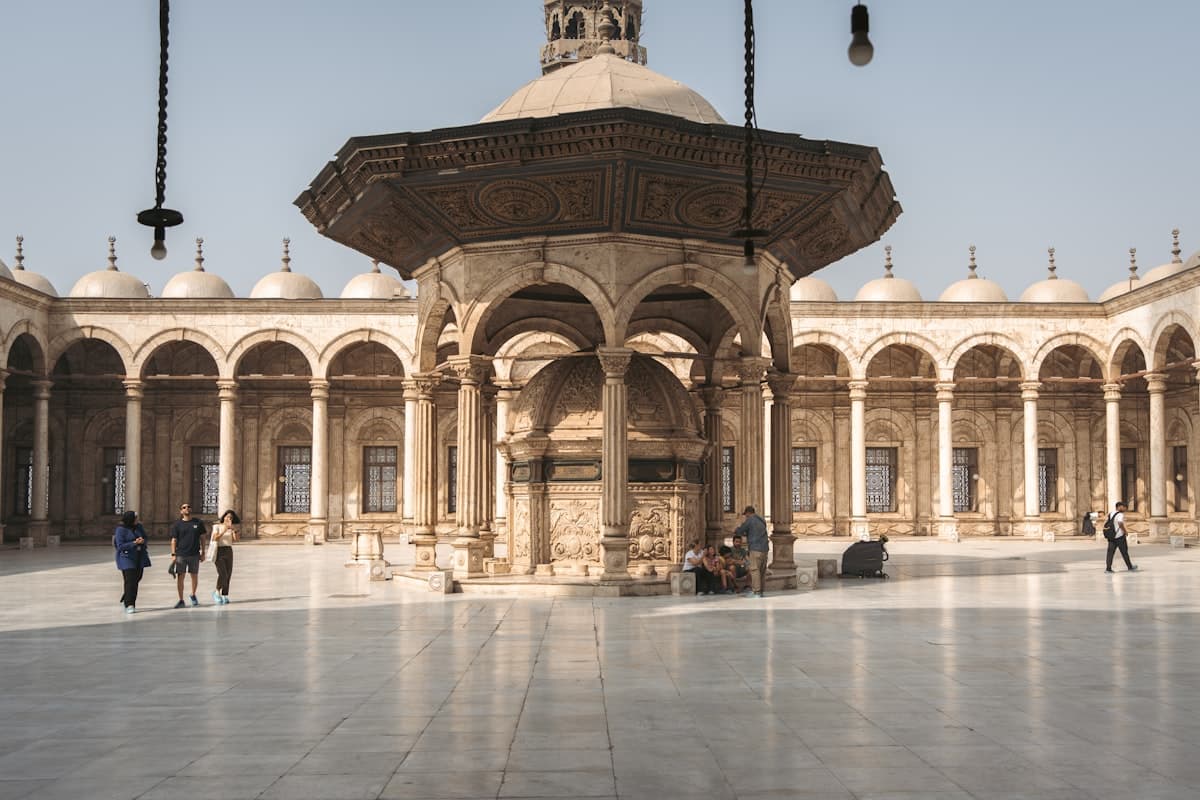
Cairo as we know it was founded in 969 AD by the Fatimid general Jawhar al-Siqilli, who led an army of 100,000 men from Tunisia and took Egypt in a single campaign. He named the new city Al-Qahira, meaning "the Vanquisher." Within two years, he had laid the foundations of both Al-Azhar mosque and an entirely new urban grid that still defines the old city's logic today.
The Fatimids were Ismaili Shia Muslims ruling a predominantly Sunni population, which produced an architectural program that was, in part, a legitimacy campaign. Every mosque they built was a statement: we are the true inheritors of the Prophet's line, and here is the stone evidence. When the Sunni Ayyubid sultan Salah al-Din (Saladin) took Cairo in 1171, he inherited that entire symbolic infrastructure and began building over it. He added the Citadel on the Muqattam Hills, a fortress that would remain the seat of Egyptian power for 700 years, through Ayyubid, Mamluk, and Ottoman rule, until Muhammad Ali moved his government downtown in the 19th century.
The connection that almost no visitors are told: the street currently called Al-Muizz li-Din Allah, the main artery of medieval Cairo, runs along the exact alignment of a Roman road that itself followed a Pharaonic processional route connecting Memphis to the Delta. The Fatimids did not invent the city's spine. They inherited it from Rome, who inherited it from the Pharaohs. The minaret standing at the intersection of Al-Muizz and Al-Azhar Street is anchored to a subterranean Roman cistern.
The Monuments: What You Are Actually Looking At
Al-Muizz Street is frequently called the world's largest open-air museum of Islamic architecture, which is true but unhelpful. What it actually is, is a 1.2-kilometer argument about power. Every sultan who controlled Cairo added something to this street, and the sequence of those additions tells you the history of the Islamic world between 970 and 1800.
Start at Bab al-Futuh, the northern gate, built by the Fatimids in 1087 using Armenian architects brought specifically from Syria. The stones are Roman. The Fatimids dismantled Roman structures at Babylon Fortress, just south of what is now Old Cairo, and hauled the cut limestone north to build their city walls. Inside the gate towers, you can still see Roman inscriptions on the interior surfaces, buried into the Fatimid construction because nobody bothered to chisel them off. They are still there. The guards will let you climb up if you ask politely and tip EGP 20.
Walk south and you pass the Mosque of Al-Hakim, named for the Fatimid caliph who was, by most accounts, clinically disturbed. He banned women from leaving their houses (for a period of roughly eight years), ordered the killing of all dogs in Cairo because their barking disturbed him, and disappeared one night in 1021, almost certainly murdered. His mosque, begun by his father in 990 and completed by Al-Hakim in 1013, was later used as a stable by the Crusaders during the brief Frankish occupation of the area, then as a prison by Saladin, then as a warehouse by Napoleon's army, then as a school, then as a museum, before being restored by the Dawoodi Bohra community (an Indian Ismaili sect) in the 1980s. The restoration is comprehensive and, to some eyes, too clean. But the minarets, the oldest surviving minarets in Cairo, are original.
The Mamluk Layer
The Mamluks deserve more attention than they receive in standard Islamic Golden Age Cairo history coverage. They were enslaved soldiers, mostly Circassian and Turkic, purchased as boys, trained as cavalry, freed upon completing military service, and then systematically rose to rule Egypt for nearly three centuries, from 1250 to 1517. During this period they defeated the Mongols at the Battle of Ain Jalut in 1260, the only significant defeat the Mongol army suffered in the 13th century, and they built some of the most architecturally sophisticated structures in the world.
The complex of Sultan Hassan, built between 1356 and 1363 at the base of the Citadel, is a demonstration of what happens when you combine unlimited resources, the best craftsmen from a conquered world, and a ruler who knows he might be deposed at any moment and wants to leave something permanent. Sultan Hassan was deposed twice and murdered before the building was finished. His body was never placed in the mausoleum he built for himself. The mausoleum is there. He is not in it. The portal, at 38 meters high, is the tallest Mamluk entrance ever built and remains structurally intact after 660 years of Cairo air and earthquakes.
The Museum of Islamic Art: The Underrated Essential
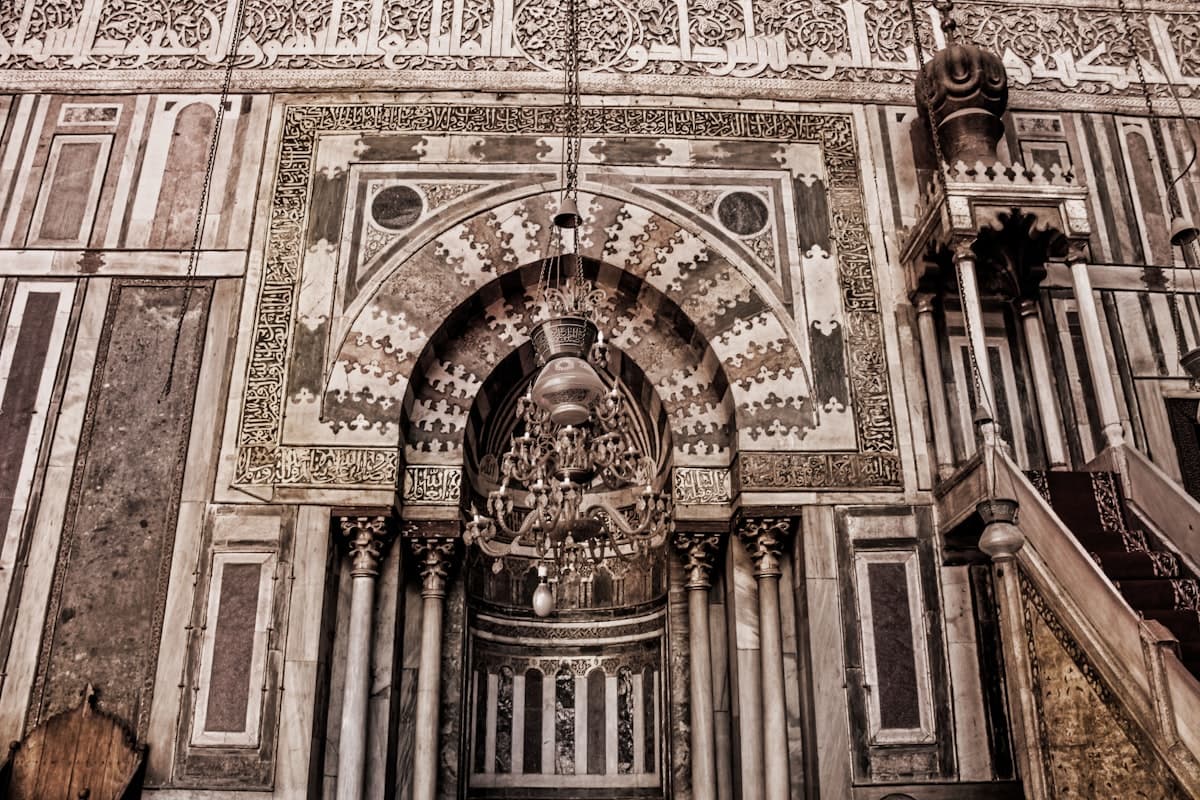
Most visitors to Islamic Cairo skip the Museum of Islamic Art on Bab al-Khalq Square, which is a mistake specific enough to name: the museum contains 102,000 objects spanning twelve centuries of Islamic civilization, including the world's largest collection of Islamic woodwork and the only surviving pieces of the Fatimid caliphs' personal household objects. A rock crystal ewer carved for the Fatimid caliph Al-Aziz in the 10th century sits in a case with no queue in front of it. The same object in the Louvre would have a velvet rope and an audio guide.
The museum was damaged by a car bomb in 2014, targeted at the nearby security headquarters. The restoration took six years. Most of the collection is back on display. The quality of the objects is extraordinary and the crowds are minimal, which, in Cairo, is a combination you do not take for granted.
The Connections
The Citadel of Saladin, which you can see from almost anywhere in medieval Cairo, was built using labor from Crusader prisoners captured at the Battle of Hattin in 1187. The same battle that ended the Crusader Kingdom of Jerusalem. Saladin moved the prisoners to Cairo and put them to work quarrying limestone from the Muqattam Hills and laying foundations. Their labor built the walls that defined Cairo's military geography for the next six centuries.
The Ottoman conquest of 1517 did not destroy Mamluk Cairo. It layered over it. The mosque of Suleiman Pasha al-Khadim, built inside the Citadel in 1528, was the first Ottoman-style mosque in Egypt, bringing with it the pencil-thin minarets and domed prayer halls that had become standard in Istanbul. But its builder, Suleiman Pasha, kept Mamluk craftsmen working on the decoration. The interior tilework is Ottoman in design and Egyptian in execution. You can see the cultural negotiation happening in the plasterwork.
Al-Azhar connects the Islamic Golden Age to the present in ways that are not merely symbolic. The university has issued legal opinions (fatwas) that shaped Egyptian law continuously since the 10th century. Its current Grand Imam has more religious authority in the Sunni world than any single political figure, and the institution receives students from 93 countries. The library holds manuscripts that have never been fully catalogued.
Common Mistakes
Hiring a guide outside the monuments. The men who approach you on Al-Muizz Street offering historical tours are unlicensed and will tell you things that are not true. Hire a licensed guide through the Egyptian Tour Guide Syndicate or a reputable agency. The difference in information quality is not marginal.
Going on Friday morning. Friday is the Islamic holy day. Many mosques close to non-Muslim visitors during the main prayer, typically 11:30am to 1pm, and the streets around Al-Azhar become genuinely difficult to navigate. Saturday morning is the quietest time in the entire district.
The sound and light show at the Citadel. It costs EGP 450 and tells you the same surface-level history you can read on the monuments themselves. The money is better spent on an hour with a licensed guide inside Sultan Hassan.
Spending all your time on Al-Muizz and missing the side streets. The wikala (caravanserai) of Al-Ghuri, half a block east of the main street, is a perfectly preserved 16th-century merchant's inn where craftsmen still work in the upper galleries. It costs nothing to enter and almost nobody goes there.
Skipping the Mosque of Ibn Tulun. It is a 20-minute walk from Al-Muizz and feels like a different city. Built in 876 AD, it is the oldest mosque in Cairo that survives in its original form, predating the Fatimid city entirely. Its spiral minaret, the only one in Egypt, was modeled on the spiral minaret at the Abbasid capital of Samarra in Iraq. It is almost always empty. The silence inside is extraordinary.
Buying the individual tickets before checking the combined ticket. The EGP 300 combined ticket for the Muizz Street monuments saves you money if you plan to visit more than two sites. Most visitors do not know it exists because it is not prominently advertised at individual entrances.
Rushing the Citadel. The Citadel complex contains three separate museums, two mosques of major historical significance, and views over Cairo that explain the city's geography immediately. Most tour groups spend 90 minutes. You need at least three hours to understand what you are looking at.
Practical Tips
Dress conservatively. This is not a suggestion about cultural sensitivity, it is a practical instruction: mosques will not admit you in shorts or sleeveless tops, and the attendant who turns you away will not offer an alternative. Women should bring a scarf for their hair. Some mosques provide coverings at the door, most do not.
Wear shoes you can remove easily. You will remove them at every mosque entrance, sometimes on a stone floor in direct sun. Slip-ons are genuinely more practical than lace-ups.
Bring cash. Smaller monuments and tea shops on the side streets do not accept cards. An ATM at Al-Ataba Metro station is reliable.
The best light on Al-Muizz Street for any kind of photography is between 7am and 9am, before the street fills with vendors and the dust of midday settles over everything. The Citadel photographed at 6am from the parking area on Salah Salem Road, with the domes of Sultan Hassan in the foreground and the city still in shadow behind it, is one of the better views in the city. Almost no one is there at that hour.
If you are doing a multi-day exploration of Islamic Cairo, book accommodation in Zamalek or downtown rather than inside the historic district itself. The hotels immediately adjacent to Al-Muizz are convenient but loud, and the call to prayer from Al-Azhar at 4:30am is not a gentle introduction to the day. It is four amplified voices in close proximity, and the walls of budget hotels in that district are not thick.
Frequently Asked Questions
The Weekly Dispatch
More on Egypt, every Friday.
Cultural depth and places most guides never mention.
No spam. Unsubscribe anytime.