Islamic Golden Age Cairo History Guide: The City Within a City
Cairo's medieval quarter contains more listed monuments than any other city on earth. Most visitors walk through it in two hours and see almost none of it.

Quick Facts
- Best time to visit
- October to March. Winter mornings from 7am to 10am offer the best light and the coolest temperatures in the narrow lanes.
- Entrance fee
- Mosque of Ibn Tulun EGP 100 (approx $2 USD); Sultan Hassan complex EGP 180 (approx $4 USD); Museum of Islamic Art EGP 200 (approx $4.50 USD); Beit al-Suhaymi EGP 100. Many mosques free with donations expected.
- Opening hours
- Most mosques 9am to 5pm daily. Museum of Islamic Art 9am to 5pm, closed Tuesdays. Hours shift during Ramadan.
- How to get there
- Metro Line 2 to Al-Azhar stop, 8-minute walk (EGP 7). Taxi from Downtown EGP 40 to 60. Ride-hailing app EGP 35 to 55.
- Time needed
- One full day for core monuments. Two days if including the Museum of Islamic Art. Three days to combine with the Citadel at a reasonable pace.
- Cost range
- Budget EGP 400 to 700 per day including entry fees, street food, and transport. Mid-range EGP 1,200 to 2,000 with guided tour and restaurant meals.
[Islamic Golden Age Cairo History Guide](https://feluccas.com/history/islamic-golden-age-cairo-a-complete-history-guide): The City Within a City
Cairo's medieval quarter contains more UNESCO-listed monuments per square kilometer than any other urban area on earth. Most visitors walk through it in two hours, photograph the same three doorways, and leave believing they have seen Islamic Cairo. They have seen the lobby. This guide goes further.
Quick Facts
Best time to visit: October to March. Summer heat in the narrow lanes of medieval Cairo is not a romantic inconvenience; it is a genuine deterrent. The light in winter mornings, roughly 7am to 10am, is also the best for photography, when it falls at angles through the mashrabiyya screens.
Entrance fees: Many mosques are free to enter, though donations are expected. The complex of Sultan Hassan costs EGP 180 (approx $4 USD); the Mosque of Ibn Tulun is EGP 100 (approx $2 USD); the Museum of Islamic Art charges EGP 200 (approx $4.50 USD). Students pay roughly half at ticketed sites. Beit al-Suhaymi, one of the finest Ottoman houses in Cairo, costs EGP 100.
Opening hours: Most mosques open 9am to 5pm daily, though hours shift during Ramadan. The Museum of Islamic Art opens 9am to 5pm, closed Tuesdays. Confirm Beit al-Suhaymi hours locally, as they change seasonally.
How to get there: The metro to Al-Azhar stop (Line 2) puts you eight minutes' walk from the heart of medieval Cairo. A taxi from Downtown will cost EGP 40 to 60. Ride-hailing apps (Uber, Careem) run EGP 35 to 55. Avoid driving here; the lanes were designed for donkeys and have not been rethought since.
Time needed: A single serious day covers the main monuments. Two days allows you to move slowly enough to notice the details that matter. Three days is not excessive if you include the Citadel and the Museum of Islamic Art.
Cost range: Budget EGP 400 to 700 per day including entry fees, food from street vendors, and transport. Mid-range EGP 1,200 to 2,000 if you add a guided tour and sit-down meals.
Why This Place Matters
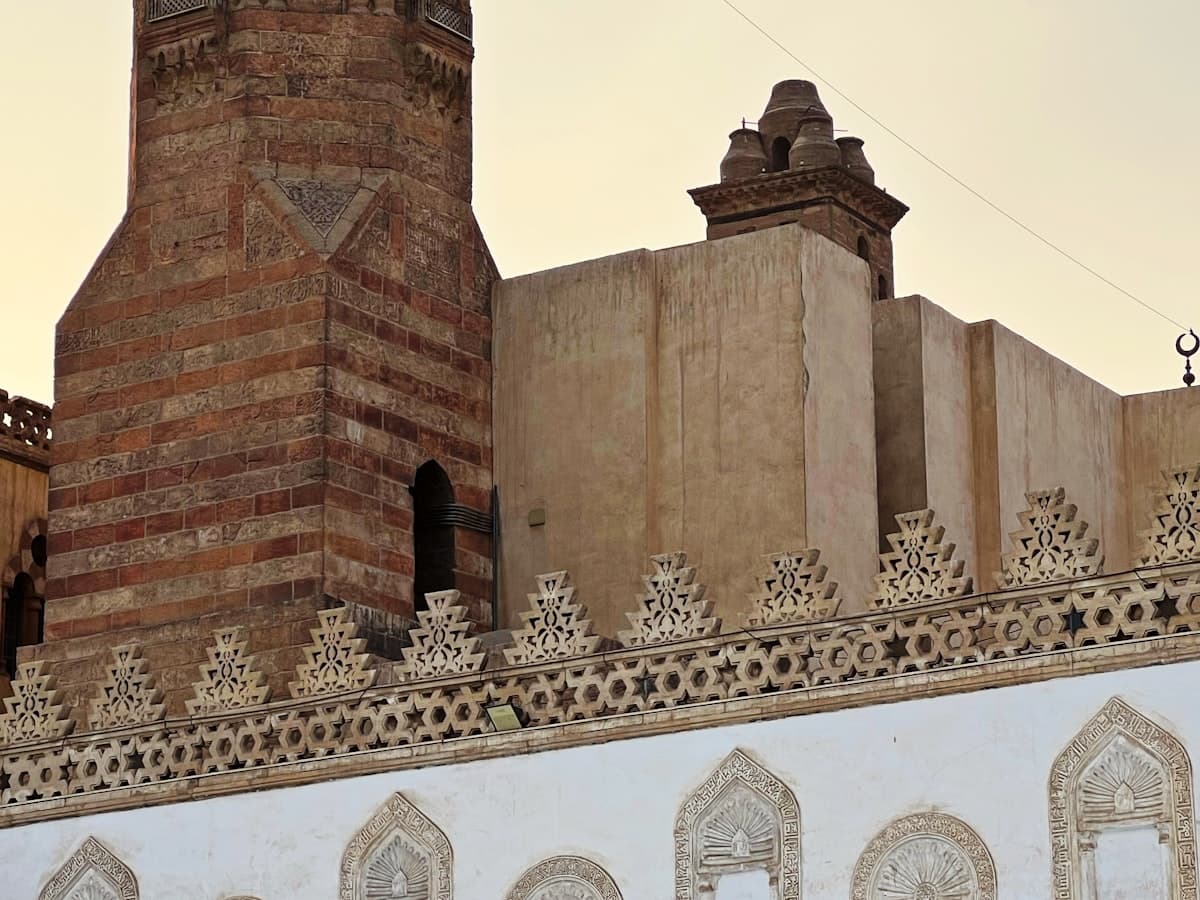
In 969 CE, a Fatimid general named Jawhar al-Siqilli conquered Egypt and founded a new royal city north of Fustat, the existing Arab capital. He named it al-Qahira, the Victorious. That city, layered over eleven centuries by Fatimids, Ayyubids, Mamluks, Ottomans, and Khedives, is what we now call Islamic Cairo, and engaging with its history is the closest available experience to understanding the Islamic Golden Age as a living urban tradition rather than a textbook concept.
What most visitors do not know: the street plan of medieval Cairo has changed remarkably little since the Fatimid period. Al-Muizz li-Din Allah Street, the great spine of the old city, follows the same route it did in the tenth century. You are not walking through a reconstructed historic district. You are walking through the same city, still in use, still inhabited, still performing its original functions in many of its buildings.
The Fatimids who built Cairo were an Ismaili Shia dynasty, which created a productive tension with the Sunni population they governed. Al-Azhar University, founded in 970 CE, was originally a Shia institution designed to propagate Fatimid doctrine. When Saladin defeated the Fatimids in 1171 and restored Sunni rule, he converted Al-Azhar to Sunni teaching. It has operated continuously ever since, making it the oldest continuously operating university in the world, though Al-Azhar's defenders and the University of Bologna's defenders argue this point energetically.
The Monuments Nobody Explains Properly
The Mosque of Ibn Tulun
Before the Fatimids arrived, there was another city here. Ahmad ibn Tulun, a Turkish governor sent by the Abbasid Caliph in Baghdad, decided in 876 CE that he was effectively his own ruler and built a mosque to prove it. The Mosque of Ibn Tulun is the oldest mosque in Cairo still standing in its original form, and it is the one that rewards the slowest looking.
The minaret is the first thing that stops you. It has an exterior spiral staircase, a design found almost nowhere else in Egypt but common in Iraq, specifically at the Great Mosque of Samarra. Ibn Tulun had it built by an architect who modeled it on what he knew from back home, which tells you something about the cosmopolitanism of ninth-century Islamic civilization: a Turkish governor, building in Egypt, with an Iraqi-trained architect, creating a monument that looks like nothing else in the country.
The mosque covers 2.5 hectares and was designed to hold Ibn Tulun's entire army at Friday prayers. The pointed arches that frame its courtyard predate the pointed arches of Gothic European cathedrals by roughly two centuries. Whether the Gothic arch was borrowed from Islamic architecture or arrived independently remains a genuine scholarly debate. Standing in the courtyard of Ibn Tulun, you are standing in one of the possible origin points of European medieval architecture.
Sultan Hassan and Al-Rifai: The Conversation Across the Street
The Mosque and Madrasa of Sultan Hassan, built between 1356 and 1363, used limestone blocks quarried from the outer casing of the Giza pyramids. This was not laziness. It was a statement: the new order consuming and repurposing the old. The building cost so much and displaced so many residents that Sultan Hassan was assassinated before its completion, partly because the treasury was empty and the population was furious. His body was never placed in the tomb he built for himself.
The four iwans of Sultan Hassan represent the four schools of Sunni Islamic jurisprudence, the Hanafi, Maliki, Shafi'i, and Hanbali, each given its own vaulted hall and its own students. This was Cairo as a center of Islamic legal education at a moment when the Mongol destruction of Baghdad in 1258 had shifted the intellectual capital of the Islamic world westward. Cairo filled that vacuum deliberately. The Mamluk sultans understood that controlling Islamic scholarship meant controlling Islamic legitimacy.
Directly across the square, the Al-Rifai Mosque looks like it has always been there. It has not. It was completed in 1912, built by the Khedival family to house their own tombs alongside the tomb of the founder of the Rifai Sufi order. The last Shah of Iran, Mohammad Reza Pahlavi, is buried here, exiled and dead in Cairo in 1980. The juxtaposition of a fourteenth-century Mamluk complex and a twentieth-century royal mausoleum facing each other across a square is exactly the kind of compressed history that makes Cairo unlike anywhere else.
Al-Muizz Street: Reading the Layers
Walk north from the square of Sultan Hassan to Bab al-Futuh, the Fatimid gate at the northern end of Al-Muizz Street, and you are covering roughly two kilometers that contain Fatimid gates, Mamluk fountains and schools, Ottoman merchant houses, Napoleonic-era interventions, and nineteenth-century Khedival additions, all pressing against each other without apology.
The Sabil-Kuttab of Abdel Katkhuda, built in 1744 by an Ottoman official who wanted to memorialize himself through public charity, is typical of the layering: the sabil, a public water fountain on the ground floor, dispensed free water to passersby; the kuttab, a Quran school on the upper floor, educated children from the neighborhood. Philanthropy and piety combined in one building. The Ottoman bureaucrat who built it was working within a tradition established by the Mamluks, who inherited it from the Fatimids, who adapted it from Abbasid practice. Nothing in Cairo was invented from nothing.
The Connections
Islamic Cairo does not exist in isolation from the Egypt that preceded it. The Fatimid walls built in the eleventh century by an Armenian architect named Badr al-Gamali incorporated stone taken from earlier pharaonic and Roman structures. The northern gates, Bab al-Futuh and Bab al-Nasr, are constructed with a sophistication of military engineering that suggests Badr al-Gamali had studied Byzantine fortification manuals, which were themselves drawing on Roman precedents.
The Citadel, begun by Saladin in 1176, sits on a spur of the Muqattam Hills chosen partly because a network of shafts and wells could be sunk through the limestone to reach the water table, a hydraulic engineering problem solved with techniques used by Pharaonic engineers in the same hills two thousand years earlier.
Al-Azhar's curriculum today still includes classical texts from the ninth and tenth centuries, the period when Islamic scholars were translating Greek philosophy and medical texts and producing original work in mathematics, astronomy, and optics that would not be matched in Europe for three centuries. When you sit in the courtyard of Al-Azhar, you are sitting in an institution with an unbroken institutional memory that reaches back to a moment when Cairo was the most intellectually productive city in the world.
Common Mistakes
Doing Al-Muizz Street in the wrong direction. Most guided tours start at the southern end near Al-Azhar and walk north. Start at Bab al-Futuh in the north and walk south instead. The street descends gradually, the crowds thin out the further north you go, and the light in the morning falls better on the western facades when you are heading south.
Paying for a guide at the gate of every monument. Unofficial guides will approach you repeatedly and many of them know their history. But they are also incentivized to take you to specific shops. Hire one guide for a full day from a reputable agency, brief them on what you want to see, and you will learn more and spend less.
Visiting the Citadel without going to the Mosque of Muhammad Ali. The Ottoman mosque that dominates the Citadel skyline is the most prominent landmark in Cairo. It is also, architecturally, one of the least interesting buildings in the complex, modeled on the Hagia Sophia by a Turkish architect who had never been to Istanbul when he designed it. The medieval Mamluk mosque inside the Citadel, the Mosque of al-Nasir Muhammad, tells you more about Cairo's actual history and receives a fraction of the foot traffic.
The Khan el-Khalili sound and light experience. Several tour operators now offer evening walking tours of Khan el-Khalili with theatrical narration and lighting effects, costing EGP 300 to 500 per person. The bazaar is genuinely worth visiting at night, when the crowds thin and the coffee shops fill up. But the theatrical tour tells you nothing that reading this article will not give you, and it traps you in a group moving at the pace of the slowest member. Go independently, find Fishawi's Cafe, order a tea, and stay until you are ready to leave.
Missing the Museum of Islamic Art. This is the most consistent mistake. The Museum of Islamic Art on Bur Said Street, reopened after restoration in 2010 and damaged again in a 2014 car bombing outside the building, contains 102,000 objects spanning thirteen centuries of Islamic material culture. It is one of the great museums in the world and receives perhaps five percent of the visitors that the Egyptian Museum draws. A morning here teaches you more about the Islamic Golden Age Cairo history than walking past the same four buildings that every group tour visits.
Skipping Beit al-Suhaymi. This Ottoman-era merchant house on Al-Muizz Street is one of the finest examples of Cairene domestic architecture in existence. The mashrabiyya screens on the upper floors, the tiled courtyards, the painted ceilings: this is how the wealthy merchant class of seventeenth-century Cairo actually lived. It receives a fraction of the attention it deserves.
Visiting Friday midday. Friday prayers create surges of activity around the major mosques that make movement difficult and many interiors inaccessible to tourists. Either arrive before 11am or visit after 2pm.
Practical Tips
Dress conservatively. This is not advice for your comfort; it is practical. Mosques will require women to cover their hair and both sexes to cover their arms and legs. Carrying a light scarf is easier than borrowing one at every entrance. Men in shorts will be turned away at several sites.
The best food in medieval Cairo is not in the restaurants. The best food is from the vendors along Al-Muizz Street: ful medames, koshari, and feteer, the Egyptian layered pastry, sold from storefronts that have been doing exactly this for generations. A full meal costs EGP 30 to 60.
Leave your large bag at the hotel. The lanes of medieval Cairo are narrow, crowded, and not always well-paved. A small daypack is the right call. Your camera or phone, water, cash (many sites do not take cards), and a printed or downloaded map for when you inevitably lose signal in the deeper lanes.
The best time of day is 8am to 11am. After noon, the tour groups arrive and the lanes fill. By 2pm in summer, the heat inside the narrow streets is significant. The mosques are coolest in the morning, the light is better, and the call to prayer echoing off the Fatimid stonework at dawn is something that no description adequately prepares you for.
Frequently Asked Questions
The Weekly Dispatch
More on Egypt, every Friday.
Cultural depth and places most guides never mention.
No spam. Unsubscribe anytime.