Islamic Golden Age Cairo History Guide: Walk the Caliphs' City
Cairo has more medieval Islamic monuments than any city on earth. Most tourists walk past 90% of them to reach the same two mosques. Here is the full picture.

Quick Facts
- Best time to visit
- October through March. November and February are ideal: cool enough for long walking days, dry, and the low-angle light in late afternoon hits the Mamluk stonework beautifully.
- Entrance fee
- Citadel complex EGP 450 (approx $9 USD), students EGP 225. Qalawun complex EGP 200 (approx $4 USD). Ibn Tulun mosque EGP 200 (approx $4 USD). Gayer-Anderson Museum EGP 200 (approx $4 USD). Al-Azhar Mosque free. Al-Azhar Park EGP 30 (approx $0.60 USD).
- Opening hours
- Most mosques daily 9am to 5pm, closed to tourists during Friday midday prayers (approx 12:30pm to 2pm). Citadel closes 5pm in winter, 6pm in summer. Al-Azhar stays open longer as a functioning institution.
- How to get there
- Taxi from central Cairo to Khan el-Khalili or Citadel: EGP 80 to 150 (approx $1.50 to $3 USD). Uber and Careem typically EGP 60 to 120. Metro Line 2 to Sayyida Zeinab then 15-minute walk to Ibn Tulun: EGP 8 flat fare.
- Time needed
- Half day for al-Muizz Street corridor plus one major mosque. Full day adds Ibn Tulun and the Citadel. Two days covers the district seriously.
- Cost range
- Budget EGP 600 to 900 per day including transport, entry fees, and lunch. Mid-range EGP 1,500 to 2,500 including a licensed guide for a half-day session.
[Islamic Golden Age Cairo History Guide](https://feluccas.com/history/islamic-golden-age-cairo-a-complete-history-guide): Walk the Caliphs' City
Cairo has more medieval Islamic monuments than any city on earth. Not the most famous. Not the most photographed. More, as in a higher count of surviving structures from the 10th through 16th centuries than Istanbul, Baghdad, or Cordoba. UNESCO designated the entire historic district a World Heritage Site in 1979, covering roughly 600 monuments across an area you can walk in four hours. The average visitor enters two of them. This guide is for people who want to do better than that.
Quick Facts
Best time to visit: October through March. Summer heat in the narrow lanes of Islamic Cairo is serious: shade is rare and the stone radiates warmth until 10pm. November and February are ideal for long walking days.
Entrance fees: Most mosques charge EGP 100 to 200 (approx $2 to $4 USD) per person. The Citadel complex, which includes the Mosque of Muhammad Ali and several museums, costs EGP 450 (approx $9 USD) for foreigners, EGP 50 for Egyptians. Al-Azhar Mosque is free. The Qalawun complex and Ibn Tulun mosque each cost EGP 200 (approx $4 USD). Students with valid ID pay half at most sites.
Opening hours: Most mosques open daily 9am to 5pm, though al-Azhar stays open longer as a functioning religious institution. The Citadel closes at 5pm in winter, 6pm in summer. Friday midday prayers close many mosques to tourists for roughly 90 minutes around 12:30pm.
How to get there: Taxi from central Cairo to Khan el-Khalili or the Citadel costs EGP 80 to 150 (approx $1.50 to $3 USD). The Cairo Metro Line 2 stops at Sayyida Zeinab, a 15-minute walk from Ibn Tulun mosque. Uber and Careem are reliable and usually cheaper than hailed taxis. Bus routes exist but are not worth the confusion for first-time visitors.
Time needed: A serious half-day covers the Qalawun complex, al-Azhar, and Ibn Tulun. A full day adds the Citadel, the wikala of al-Ghuri, and the Northern Walls. Two days lets you breathe.
Cost range: Budget EGP 600 to 900 per day including transport, entry fees, and lunch from a local restaurant. Mid-range EGP 1,500 to 2,500 with a licensed guide for at least one session.
Why Islamic Cairo Matters
The city that became Cairo was not born when Islam arrived. The Fatimid caliph al-Muizz li-Din Allah entered a walled city called al-Fustat in 969 CE and immediately began building a royal capital just north of it, which he named al-Qahira: the Victorious. Al-Fustat itself had been founded in 641 CE by the Arab general Amr ibn al-As on top of a Byzantine fortress, which itself occupied the site of a Roman fortification built over a Pharaonic canal leading to the Red Sea. The city you walk through today is not a succession of civilizations. It is a compression of them, one pressed into the other like geological strata, except these strata are still occupied.
The Islamic Golden Age in Cairo is not a single period. It runs in phases. The Fatimids, who were Shia Ismaili caliphs from North Africa, built al-Qahira and al-Azhar between 969 and 1171 CE. Saladin then dismantled Fatimid rule, introduced Sunni institutions, and began the Citadel in 1176 CE. The Mamluks, who were predominantly Circassian and Turkic soldier-slaves who seized power from their own masters, dominated from 1250 to 1517 CE and built the majority of the monuments you will actually see. Then the Ottomans arrived, were almost immediately uninterested in Cairo as anything other than a province, and the city began a long plateau that lasted until the 19th century.
What this means for you as a visitor: almost every major Islamic monument you enter is Mamluk. Understanding what the Mamluks were explains everything about why these buildings look the way they do.
The Mamluks Built This City, and Their Story Is Extraordinary
The word mamluk means "owned" in Arabic. These were men purchased as boys, usually from Circassia in the Caucasus or from Turkic territories in Central Asia, brought to Egypt, converted to Islam, trained as elite cavalry, and given freedom upon completing their military service. The system produced soldiers of extraordinary loyalty and skill. It also produced men with no family dynasties to protect, which meant that when a sultan died, his mamluks fought each other for succession with complete ruthlessness. Of the 24 Mamluk sultans between 1250 and 1382 CE, more than half were deposed or killed by their own commanders.
This political instability had a strange architectural consequence. Because no sultan could count on his heirs maintaining his legacy, every sultan built his own funerary complex immediately, during his lifetime, as a statement of permanent presence. The city filled with mosques, madrasas, mausoleums, and hospitals funded by waqf endowments, religious trusts designed to be legally inviolable in perpetuity. The Qalawun complex on al-Muizz Street, built between 1284 and 1285 CE in a single year, contains a mosque, a madrasa, a mausoleum, and a hospital called a maristan that treated 4,000 patients per day at its peak, funded by an endowment that continued paying for care for 700 years. The building is still standing. You can walk its corridors for EGP 200.
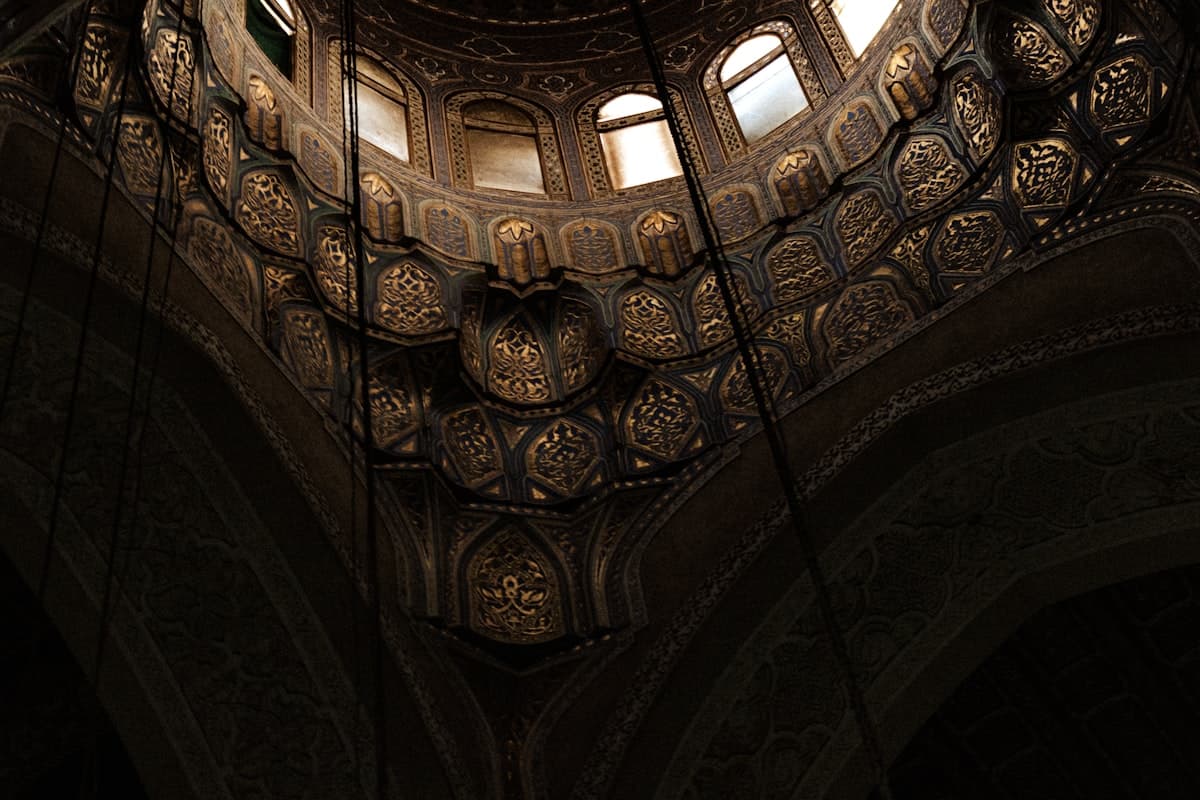
Inside the mausoleum of Sultan Qalawun, look up. The stucco window grilles follow geometric patterns that appear in Gothic cathedrals of the same era. This is not coincidence. Qalawun fought the Crusaders and negotiated with them. Material culture moved across those borders in both directions.
Al-Muizz Street and Ibn Tulun: Two Ways to Read the City
Al-Muizz li-Din Allah Street is the spine of medieval Cairo, and it is free to walk. A two-kilometer corridor running between two Fatimid gates, Bab al-Futuh to the north and Bab Zuweila to the south, it passes the Qalawun complex, the madrasa and mausoleum of al-Nasir Muhammad, the wikala and sabil-kuttab of al-Ghuri, the mosque of al-Hakim, and dozens of smaller structures. Street vendors sell koshari and sugarcane juice from the same spots they have occupied for decades. At night, when the monuments are lit and the traffic thins, it looks like a film set, except nothing about it is reconstructed. The stonework is original. The lanes are original. Even the commercial chaos has a medieval precedent: this was always a market street.
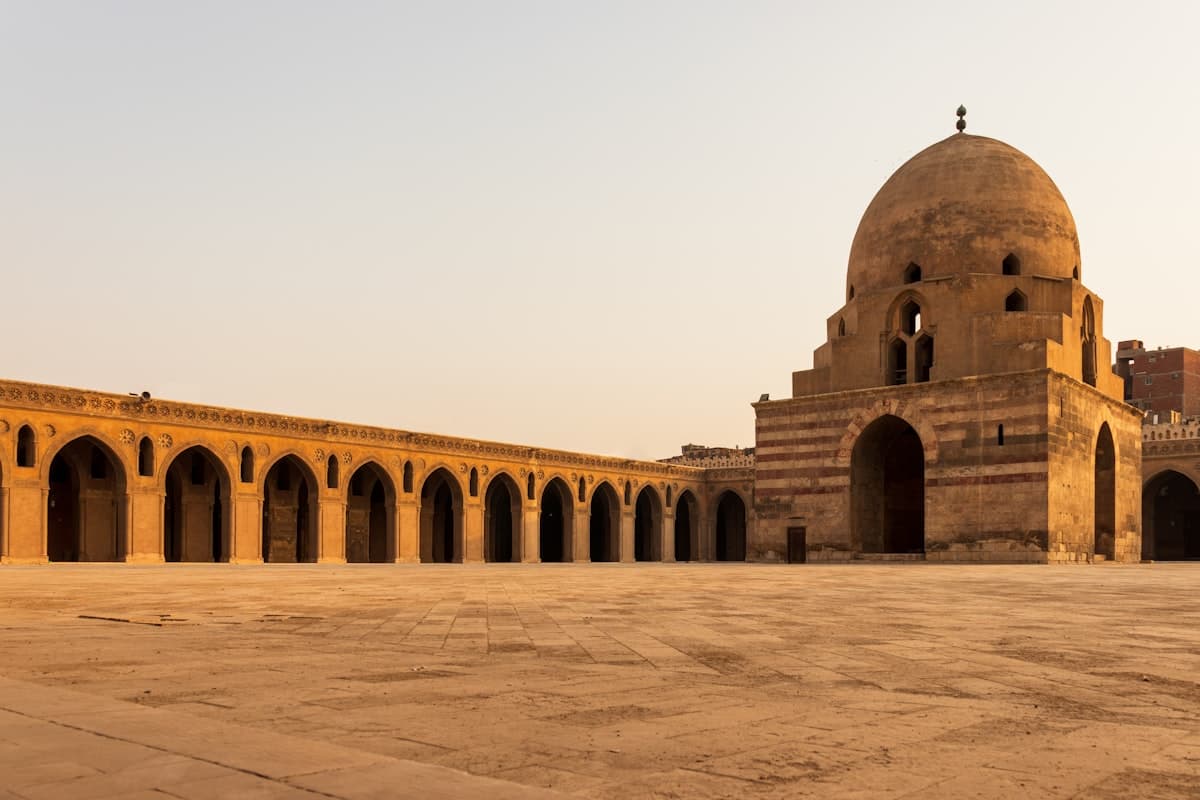
Ibn Tulun mosque is a different kind of experience entirely, and it belongs to a pre-Mamluk, pre-Fatimid chapter. Ahmed ibn Tulun was an Abbasid governor sent from Baghdad in 868 CE who promptly declared autonomy and built his own city called al-Qata'i. The mosque he completed in 879 CE is the oldest intact mosque in Egypt and one of the oldest in the world. Its spiraling external minaret, unique in Egypt, is modeled on the minaret of the Great Mosque of Samarra in modern Iraq, which Ibn Tulun had seen as a child. When the Abbasids retook Egypt in 905 CE, they destroyed al-Qata'i entirely. The mosque survived only because tearing it down would have been theologically problematic. Stand in the center of its vast ablutions courtyard, 92 meters on each side, and understand that everything you are standing in was built in less than three years.
The Gayer-Anderson Museum, attached to Ibn Tulun's southern wall, is one of Cairo's best and most ignored institutions. Major John Gayer-Anderson, a British army officer, spent decades assembling a collection of Islamic decorative arts and lived in two 17th-century houses he connected by a bridge. The museum costs EGP 200 to enter (approx $4 USD) and is almost never crowded.
The Connections: Nothing Here Exists Alone
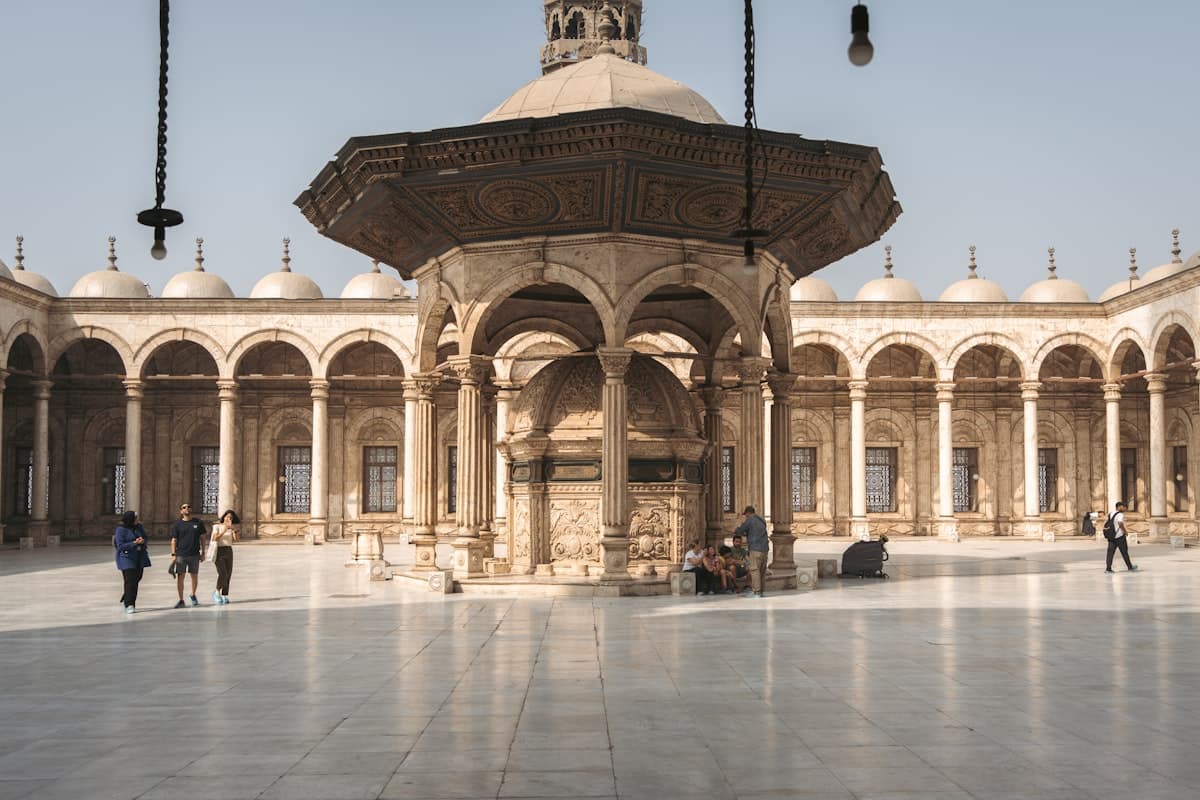
The Citadel of Saladin sits on the Muqattam Hills at the city's southeastern edge, and its position is not accidental. Saladin chose it in 1176 CE because it commanded sight lines over both al-Fustat and al-Qahira, allowing him to monitor the city he had just seized from the Fatimids. The Muhammad Ali Mosque that dominates the Citadel skyline today was built between 1830 and 1848 CE, a deliberate visual statement by an Ottoman Albanian general who had himself only recently consolidated power by massacring the remaining Mamluk leadership in this very courtyard in 1811. The mosque's Ottoman-style domes and minarets are modeled on the Blue Mosque in Istanbul, which in turn borrowed from the Hagia Sophia in Constantinople, which was itself influenced by Roman basilica architecture. You are looking at a monument where the architectural influences travel from Rome to Byzantium to the Ottomans and terminate in Cairo, built by an Albanian ruler of Egypt, dedicated to an Islamic prophet.
Al-Azhar University, founded by the Fatimids in 970 CE, is the oldest continuously operating university in the world, predating the University of Bologna by over a century. It began as a Shia Ismaili institution. When Saladin took power, he converted it to Sunni orthodoxy and spent years trying to suppress its influence before finally giving up and accepting it as a Sunni institution. It remains the most influential Sunni scholarly institution on earth. The mosque attached to it is free to enter and functions as it has for over a thousand years: students sit in circles around scholars in the courtyard, learning by recitation. This is not a re-enactment.
Common Mistakes
Arriving between 12pm and 2pm on a Friday. Most mosques close to non-Muslim visitors for Friday prayers. You will be turned away at the door and waste the best light of the day.
Paying for a horse or carriage ride through Islamic Cairo. These are never faster than walking, significantly more expensive, and prevent you from stopping at anything. The entire point of this district is the stops.
Doing the Citadel before the street-level monuments. The Muhammad Ali Mosque is impressive in scale but almost entirely stripped of its historical complexity as it is presented to tourists. If you arrive at the Citadel first, you will have given your best energy to a 19th-century building with excellent views. The Qalawun complex and Ibn Tulun are more historically dense and reward sustained attention. Save the Citadel for late afternoon when the light on the city below is worthwhile.
The sound and light show at the Citadel costs EGP 350 and delivers a narrated history you could read in twenty minutes. The production values have not improved since the 1990s. Skip it.
Hiring any guide who approaches you unsolicited outside a monument. Licensed Egyptologist guides can be booked through your hotel, the Egyptian Tourist Authority office in Misr Travel Tower, or established companies like Memphis Tours. The difference in knowledge is not marginal. An unlicensed guide at the Qalawun complex will tell you it is old and beautiful. A licensed Egyptologist will explain the relationship between the Gothic window grilles and Qalawun's diplomatic negotiations with the Kingdom of Cyprus.
Wearing shoes that require untying. You will remove your shoes at every mosque entrance. Slip-ons save approximately 40 minutes over a full day.
Skipping al-Azhar park as a place to recover. The park sits on 74,000 square meters of reclaimed Mamluk-era garbage that had accumulated against the Fatimid walls for 500 years. When the Aga Khan Trust excavated the site in the early 2000s, they uncovered a section of the original Ayyubid wall that had been buried for centuries. The park has clean bathrooms, shade, and sells bottled water at non-tourist prices. It costs EGP 30 to enter.
Practical Tips
Dress conservatively regardless of your gender. Women should carry a scarf to cover hair before entering mosques. Many sites provide robes if you are underdressed, but the robes are worn by everyone who forgot that day and are laundered accordingly.
Cash in Egyptian pounds is essential. Ticket booths at smaller monuments do not accept cards. ATMs at the entrance to Khan el-Khalili and inside the Citadel complex are usually functional. Withdraw before you start your day.
Hire a licensed guide for at least one half-day session. The rate for a 4-hour Egyptologist guide runs EGP 800 to 1,500 (approx $16 to $30 USD) depending on their qualifications. The Qalawun complex alone justifies this expense. You cannot read the Arabic inscriptions running around every doorway, and those inscriptions are not decorative: they are legal documents, Quranic citations chosen with specific intent, and political statements aimed at rivals who are now also dead.
Crowd reality: al-Muizz Street is genuinely crowded between 10am and 1pm on weekends. Arrive before 9am or after 3pm. The northern section above the al-Hakim mosque is always quieter than the southern section near Khan el-Khalili.
Photography is permitted in most mosques but not during prayers. Ask before pointing a camera at anyone in a place of worship. The staff at most monuments are accustomed to tourists and will tell you clearly if you are in a restricted area.
Frequently Asked Questions
The Weekly Dispatch
More on Egypt, every Friday.
Cultural depth and places most guides never mention.
No spam. Unsubscribe anytime.