Islamic Golden Age Cairo History Guide: Walking the Caliphate's Capital
Cairo was the richest city on earth in 1340. Most tourists walk its medieval streets looking at mosques without knowing whose hands built them or whose gold paid for them.

Quick Facts
- Best time to visit
- October to March. Temperatures between 15 and 25 degrees Celsius make multi-hour walking viable. April and May are acceptable but warming. June to September is genuinely punishing for on-foot exploration of an outdoor city.
- Entrance fee
- Al-Azhar Mosque free. Citadel complex EGP 450 (approx $9 USD), students EGP 225. Ibn Tulun EGP 100 (approx $2 USD). Museum of Islamic Art EGP 200 (approx $4 USD), students EGP 100. Al-Muizz combined monument ticket EGP 400.
- Opening hours
- Most mosques daily 9am to 5pm, closing during prayer times. Al-Azhar closed Friday noon to 2pm. Museum of Islamic Art Saturday to Thursday 9am to 5pm, closed Friday. Citadel daily 8am to 5pm.
- How to get there
- Cairo Metro Line 1 to Attaba station (EGP 8), then 10-minute walk east to Al-Muizz Street. Taxi from Downtown EGP 50 to 80. Uber EGP 60 to 100. For Ibn Tulun, taxi from Al-Muizz area costs EGP 30 to 50.
- Time needed
- Half day minimum for Al-Muizz Street and Ibn Tulun. Full day if adding the Citadel. Two days recommended for a thorough visit including the Museum of Islamic Art.
- Cost range
- Budget EGP 600 to 900 per day covering entry fees, street food, and local transport. Mid-range EGP 1,800 to 3,000 per day with private guide and sit-down meals.
Quick Facts
Best time to visit: October to March, when temperatures drop below 25°C and walking the old city for four or more hours becomes possible without medical consequences.
Entrance fees: Al-Azhar Mosque is free. The Citadel complex costs EGP 450 (approx $9 USD), students EGP 225. Ibn Tulun Mosque costs EGP 100 (approx $2 USD). The Museum of Islamic Art costs EGP 200 (approx $4 USD), students EGP 100. A combined ticket covering multiple Fatimid and Mamluk monuments is available at some kiosks inside Al-Muizz Street for EGP 400.
Opening hours: Most mosques open daily from 9am to 5pm, though Al-Azhar closes during Friday prayers from noon to 2pm. The Museum of Islamic Art runs Saturday to Thursday, 9am to 5pm, closed Friday.
Getting there: From Midan Tahrir, take the Cairo Metro Line 1 to Attaba station (EGP 8). From there, Al-Muizz li-Din Allah Street is a ten-minute walk east. Taxis from Downtown cost EGP 50 to 80. Uber runs EGP 60 to 100 depending on traffic.
Time needed: A serious half-day covers Al-Muizz Street, Ibn Tulun, and one or two Mamluk complexes. A full day adds the Citadel and the Museum of Islamic Art. Two days is not excessive.
Cost range: Budget EGP 600 to 900 per day (entry fees, street food, local transport). Mid-range EGP 1,800 to 3,000 per day if adding a guided tour and lunch.
---
In 1340, Cairo's population stood at approximately 500,000, making it the largest city west of China and the wealthiest in the Muslim world. Bubonic plague killed half of that population within eight years. What survived the plague, the Crusades, the Mongols, and six centuries of subsequent empires is still standing in the streets between Bab al-Futuh and the Citadel, and most visitors walk through it in two hours looking for a good photo of a minaret.
This is a guide to slowing down.
Why Islamic Cairo Matters: The Capital the West Forgot
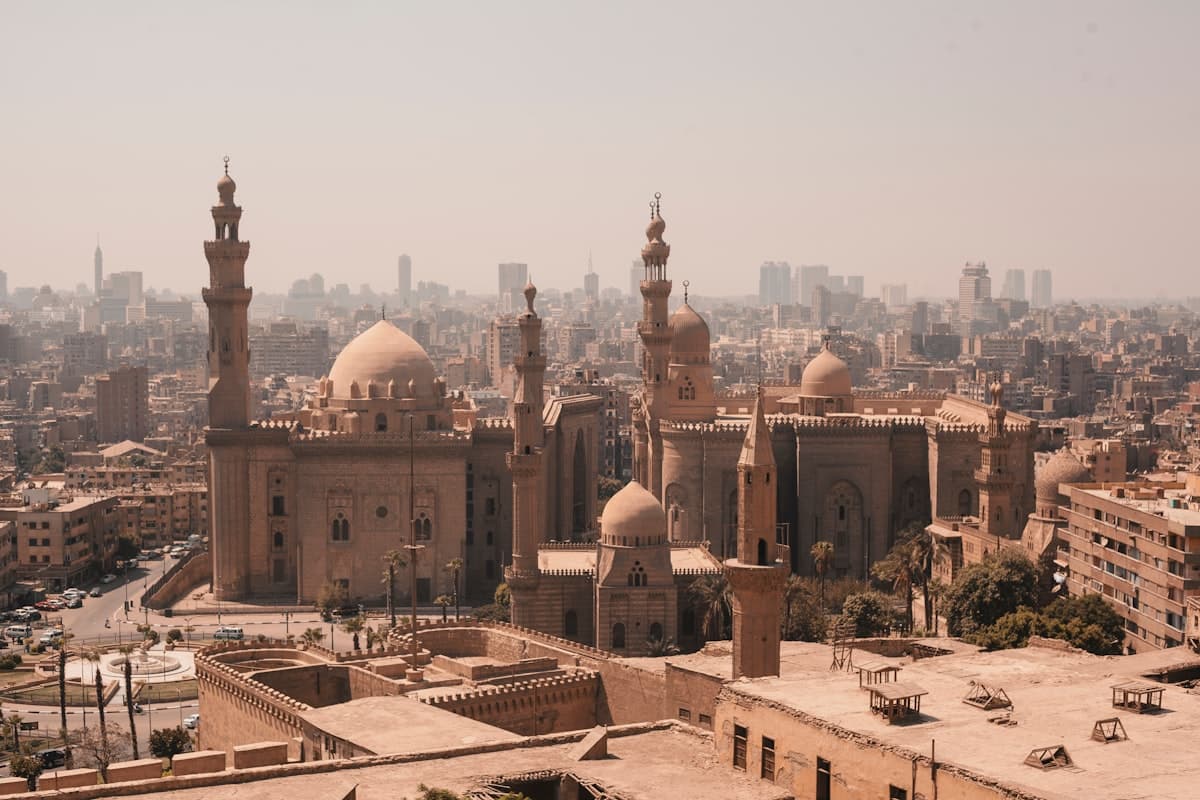
When Baghdad fell to the Mongols in 1258, the Abbasid Caliphate collapsed in a single week of violence. The Mongol commander Hulagu Khan reportedly executed Caliph Al-Musta'sim by wrapping him in a carpet and having horses trample him, a method chosen because Mongol tradition prohibited spilling royal blood on the ground. The libraries of Baghdad burned. The canals of Mesopotamia were destroyed. An entire center of world civilization was erased.
Cairo absorbed what survived. The Mamluk sultan Baybars invited the surviving Abbasid princes to Cairo and installed one as Caliph, a largely ceremonial role but a politically crucial one. Suddenly Cairo was not merely the capital of Egypt. It was the seat of the Caliphate, the protector of the holy cities of Mecca and Medina, and the intellectual heir to Baghdad. Scholars, architects, theologians, and scientists flooded in. The result was a building boom that lasted two centuries and produced the densest concentration of medieval Islamic architecture anywhere on earth.
This is the context most Islamic Golden Age Cairo history guides skip. The monuments you see are not the products of a stable, prosperous civilization choosing to express its faith through architecture. They are, in many cases, the anxious expenditure of slave-soldier sultans who needed to demonstrate legitimacy they had never legitimately inherited.
Al-Muizz Street: The Living Spine of the Fatimid City
Al-Muizz li-Din Allah Street is named for the Fatimid caliph who conquered Egypt in 969 CE and founded Cairo as a royal enclosure, not a city for ordinary people. Cairo's residents lived outside the walls; the caliph and his court lived within. The street running through that original enclosure is still there, still flanked by monuments, still navigable on foot.
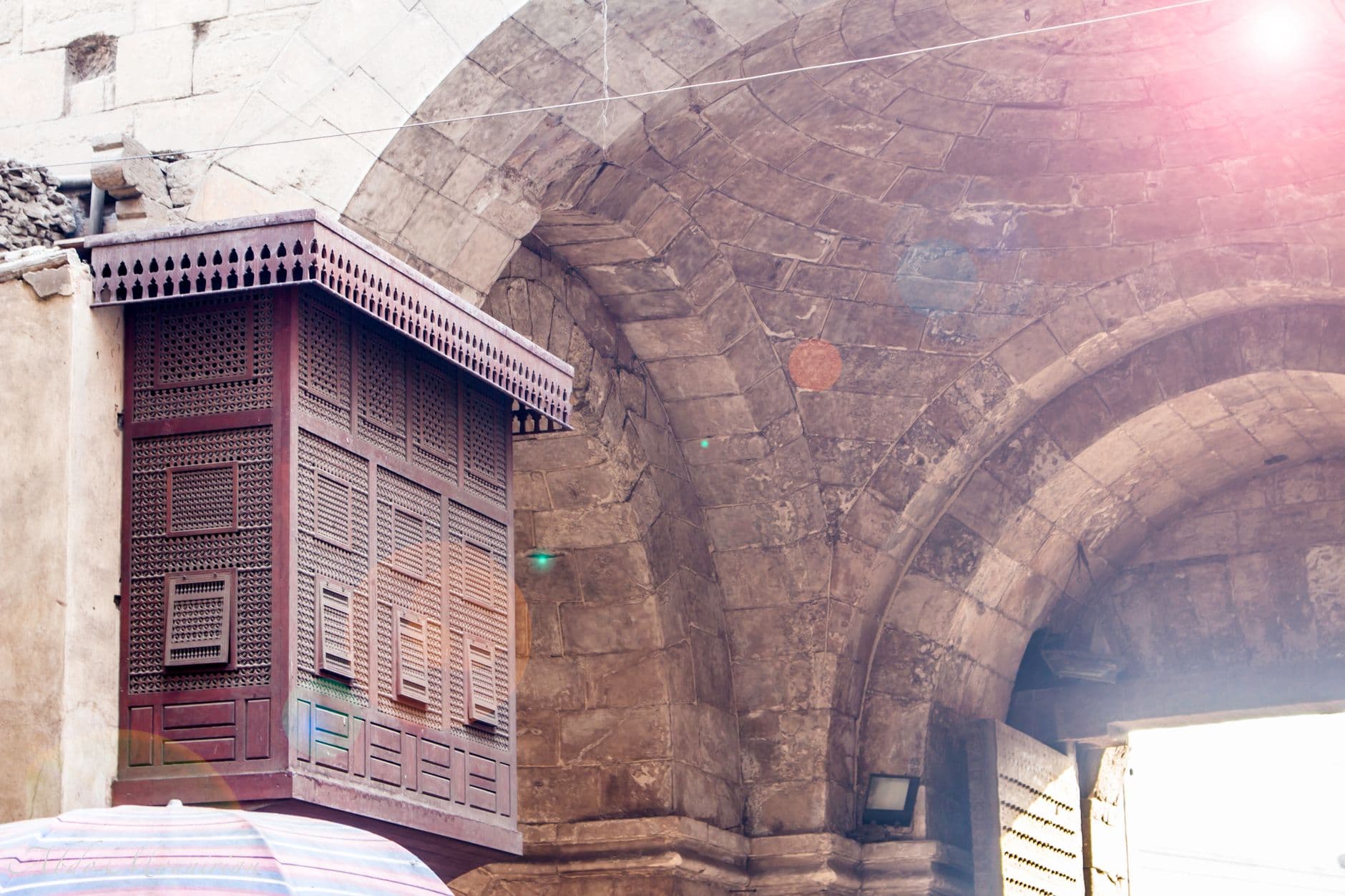
Start at Bab al-Futuh, the northern gate, built in 1087 by Armenian architects brought from Syria by the Fatimid vizier Badr al-Jamali. The quality of the stone cutting is worth pausing over. Look at the joints between blocks: the fit is so precise that the gates have survived nine centuries of earthquakes, Crusader threats, Ottoman bombardment, and Cairo's particular genius for structural neglect. The towers are hollow, containing entire rooms, staircases, and what was once a secret passage. You can go inside for free if you ask the attendant, and almost nobody does.
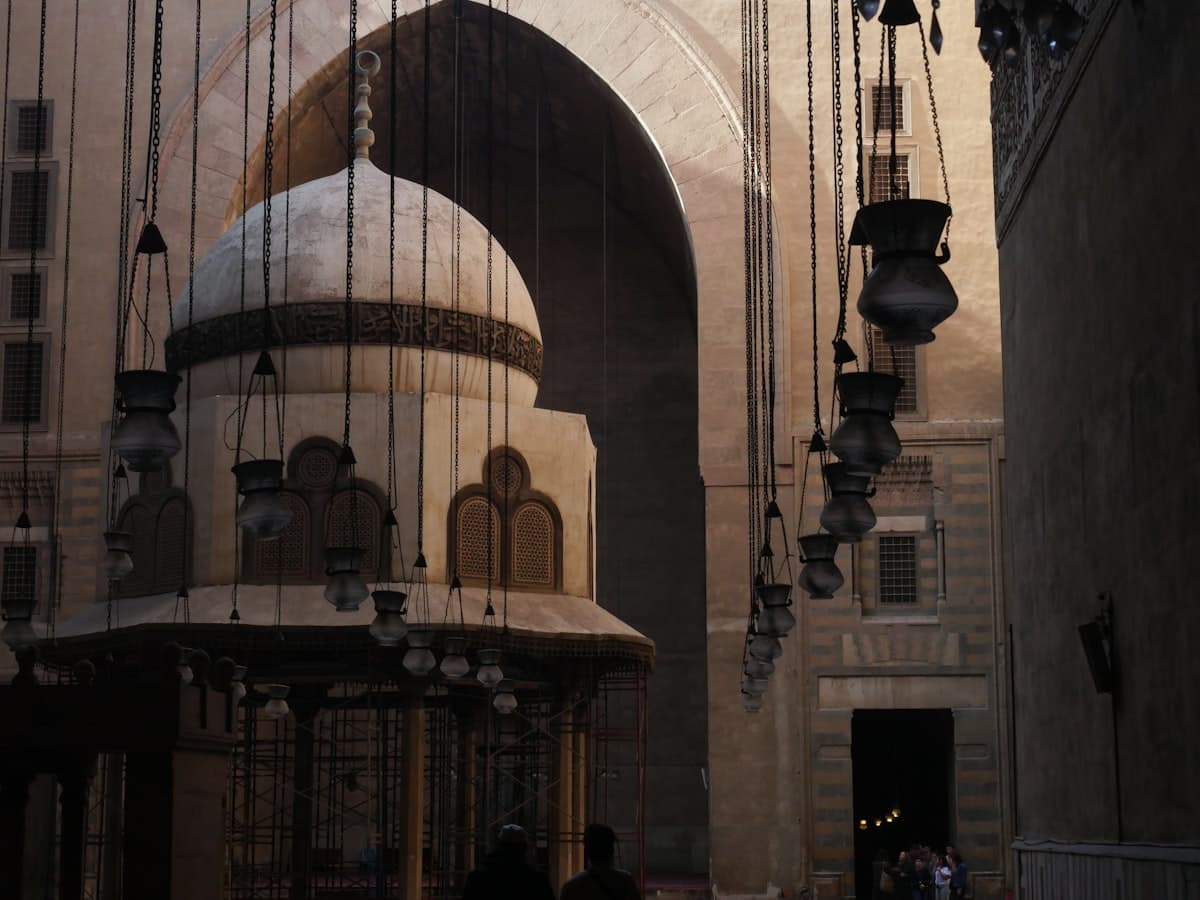
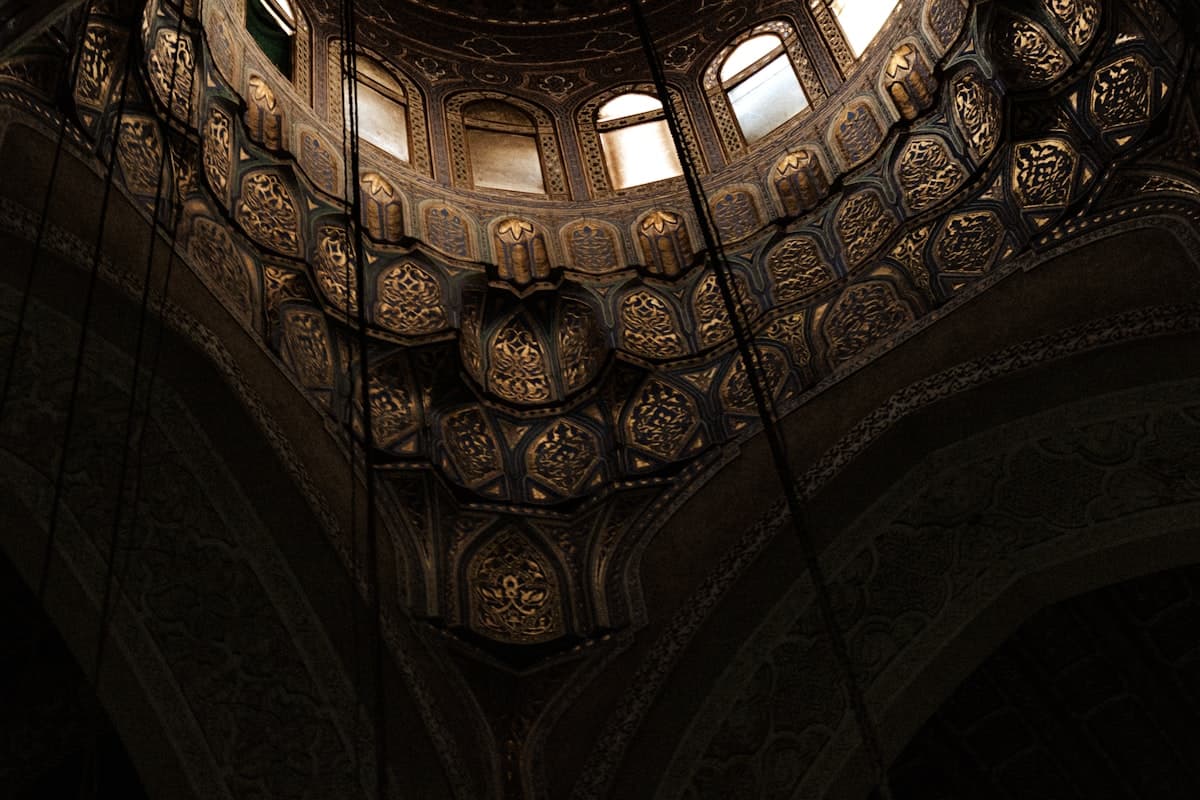
Fifteen minutes south, the Madrasa and Mausoleum of Sultan Qalawun occupies a frontage of 67 meters on Al-Muizz Street, completed in 1285. Qalawun paid for it partly using ransom money from Crusader prisoners taken at the Battle of Homs. The mausoleum interior contains one of the most extraordinary spaces in Cairo: a wooden muqarnas ceiling above an octagonal structure, lit by stained glass windows that were themselves built to imitate the Church of the Holy Sepulchre in Jerusalem, which Qalawun had reportedly admired. A Mamluk sultan building a mosque that consciously quoted a Christian church. Islamic Cairo is full of these complications.
The street is pedestrianized from sunset onward and functions as a neighborhood market during daylight. Buy your koshary at the cart near the Madrasa of Sultan Barquq. It costs EGP 25 and will recalibrate your understanding of carbohydrates.
Ibn Tulun: The Mosque That Outlasted an Empire
Ahmad ibn Tulun built his mosque between 876 and 879 CE, making it the oldest mosque in Cairo to survive in its original form. Ibn Tulun was technically a governor reporting to the Abbasid Caliph in Baghdad. In practice he was running an independent state, collecting Egypt's tax revenue, building a private city called Al-Qata'i north of Fustat, and spending freely. His mosque covers 2.6 hectares, making it the largest mosque in Cairo by footprint. It was built in a single year and ten months.
The minaret is the only spiral minaret in Egypt, a form that echoes the famous minaret of the Great Mosque of Samarra in Iraq, where Ibn Tulun spent his youth at the Abbasid court. He was reproducing a memory in stone. After his death, his dynasty collapsed within two generations, and his entire private city of Al-Qata'i was demolished out of political spite. The mosque survived because it was too expensive to tear down and too useful as a granary, a prison, and eventually a caravanserai. Its actual religious function was restored only in the fourteenth century.
The ablution fountain in the courtyard is a reconstruction, but the sycamore wood carved into the windows surrounding the courtyard arcade is largely original, some of it dating to the ninth century. You are looking at carved wood from the age of Charlemagne. Most visitors photograph the spiral minaret, walk one lap of the courtyard, and leave. The better move is to climb the minaret (ask the attendant, tip EGP 20) and look north toward where Al-Qata'i once stood, now entirely replaced by twentieth-century apartments.
Skip the Gayer-Anderson Museum attached to the mosque's south wall. It is an eccentric British officer's collection of antiques displayed in two medieval houses, and while the architecture is interesting, the EGP 200 admission buys you approximately the same experience as a mid-range antique shop, without the option to purchase anything.
The Mamluk System: Architecture Built by Former Slaves
The Mamluks who built much of what you now call Islamic Cairo were purchased as children, usually from Circassian, Turkic, or Greek families in the lands north of the Black Sea. They were trained as soldiers, converted to Islam, and upon completing their service received freedom and, if capable, military promotion. The system produced some of the most effective military commanders of the medieval world. It also produced a ruling class with no dynastic legitimacy, no tribal claim to power, and an extremely short average reign: the average Mamluk sultan ruled for seven years before being deposed or assassinated.
This explains why Mamluk architecture is so relentlessly personal. Every sultan built a complex containing a mosque, a madrasa, a khanqah for Sufi orders, a hospital, and a mausoleum, all attached to each other, all bearing his name, all constructed as quickly as possible. The complex was a literal monument to a man who knew his successors might erase his political legacy but could not easily demolish stone. Sultan Hassan's mosque-madrasa, completed in 1363 and still the largest medieval mosque in Cairo by interior volume, was built by a sultan who was deposed before its completion and assassinated shortly afterward. He never saw it finished. His body was never placed in the mausoleum he built for himself.
That mausoleum dome, rising above the Citadel district, is one of the finest pieces of architecture in Africa. Stand on the steps at 6am, before the tour buses arrive, and the light hits the stone facade in a way that reveals the geometric ornament carved into every surface. The building is 660 years old and the stone still cuts clean.
The Connections: How These Monuments Link to Everything Else
The Citadel, which commands the skyline above Islamic Cairo, was begun by Saladin in 1176 CE using stone quarried partly from smaller pyramids at Giza. The connection is literal: you can stand inside Saladin's walls and see Giza limestone shaped by Pharaonic quarry workers recycled into an Islamic fortress. The French scholar who confirmed this during Napoleon's 1798 expedition noted that the mason's marks on the Citadel blocks matched those found at Giza.
Al-Azhar, founded in 970 CE by the Fatimids as a Shia institution to train Ismaili missionaries, was converted to Sunni teaching after Saladin took Egypt in 1171. It is today the oldest continuously operating university on earth, predating the University of Bologna by approximately a century. Its current rector still issues religious rulings that influence the practice of Islam across sixty countries. The medieval library contains manuscripts that survived because librarians hid them from Saladin's officers during the Sunni conversion.
The route connecting these monuments passes over the course of a canal that the Pharaohs dug, that the Romans improved, that the Arabs used to transport grain, and that the Ottomans eventually filled in. Cairo's Islamic Golden Age was not built on empty sand. It was built on everything that came before.
Common Mistakes
Arriving after 10am on weekends. Al-Muizz Street becomes genuinely difficult to navigate on Friday and Saturday mornings as school groups and local visitors fill it. Arrive by 8:30am or accept the crowds.
Paying for a group tour of Islamic Cairo. Standard tours spend forty minutes at Ibn Tulun and twenty at two Mamluk complexes, then drive to Khan el-Khalili for shopping. You will learn almost nothing and see less than you would by walking with this article and a decent map. Hire a private licensed guide for a half-day (roughly EGP 800 to 1,200) if you want interpretation. The Ministry of Tourism maintains a list of licensed guides at their downtown office.
Spending time at the Khan el-Khalili tourist market. The bazaar is primarily a market for tourist goods manufactured outside Egypt. The narrow lanes directly north of the market, around the Al-Hussein Mosque area, contain actual working craftsmen: coppersmiths, calligraphers, and bookbinders. Walk five minutes past the main market entrance and the economics change completely.
Skipping the Museum of Islamic Art. The Citadel and the street monuments get all the attention, but the Museum of Islamic Art on Bur Said Street holds one of the largest collections of medieval Islamic artifacts in the world. A fourteenth-century astrolabe, the wooden panels from Ibn Tulun's original prayer niche, a complete Mamluk-era bronze door. The building was damaged by a car bomb in 2014 and has been partially restored. It is never crowded. Two hours there will change how you see everything in the streets outside.
Wearing inadequate footwear. The streets of Islamic Cairo are cobbled, uneven, frequently wet, and often covered in a fine layer of debris from adjacent construction. Sandals are a mistake. Lightweight walking shoes are not.
Photographing inside mosques without judgment. Most mosques allow photography in the courtyard but not during prayer. The guards will tell you if you ask. Photographing worshippers without permission is both rude and increasingly likely to result in your phone being confiscated temporarily.
Practical Tips
Wear layers. The interior spaces of Mamluk mosques are substantially cooler than the street, and moving between them and direct sun for four hours is the specific condition that produces sudden headaches. Women should bring a scarf for mosque entrances. Men in shorts will be offered a wrap at most mosque doors for free or for a EGP 10 tip.
The best single day in Islamic Cairo: start at Ibn Tulun at 9am (quiet, almost no tourists). Walk north through the neighborhood to Al-Muizz Street by 11am. Spend ninety minutes on the street itself. Eat lunch at one of the local restaurants on Muski Street, where a full meal runs EGP 80 to 150. Visit the Madrasa of Sultan Hassan and the Al-Rifa'i Mosque opposite it (the last Shah of Iran is buried in Al-Rifa'i, which surprises most visitors) in the afternoon. The Citadel closes at 5pm; arrive no later than 3pm if you want adequate time inside.
Drink water consistently. Dehydration at these latitudes happens faster than most visitors from northern climates expect, and the cognitive decline it produces makes you appreciate the architecture significantly less.
Frequently Asked Questions
The Weekly Dispatch
More on Egypt, every Friday.
Cultural depth and places most guides never mention.
No spam. Unsubscribe anytime.