Islamic Golden Age Cairo History Guide: What Survives
Cairo contains more medieval Islamic monuments than any other city on earth. Most tourists walk past 90% of them to reach the Pyramids. The ones they miss are often better.

Quick Facts
- Best time to visit
- October to March. Cooler temperatures make walking between monuments viable, winter light is lower and warmer for photography, and crowds are smaller than summer peak months.
- Entrance fee
- EGP 400 to EGP 600 per major site (approx $8 to $12 USD). Cairo Pass covers most sites for approximately EGP 1,500 ($30 USD). Ibn Tulun: EGP 150 ($3 USD). Gayer-Anderson Museum: EGP 300 ($6 USD).
- Opening hours
- Most mosques and monuments daily 9am to 5pm. Citadel opens 8am. Closures for Friday prayer roughly 11:30am to 1:30pm. Hours shift seasonally and without consistent notice.
- How to get there
- Taxi from Downtown Cairo to Al-Muizz Street: EGP 80 to EGP 120. Metro to Al-Sayeda Zeinab (Line 1, EGP 10) then 15-minute walk to Ibn Tulun. Uber or Careem from central hotels: EGP 100 to EGP 200. Microbus from Tahrir to Citadel area: EGP 5.
- Time needed
- Minimum 3 days for serious coverage. Al-Muizz Street alone requires 4 to 5 hours. Sultan Hassan requires 2 hours minimum. Ibn Tulun plus Gayer-Anderson fills a half-day comfortably.
- Cost range
- Budget EGP 600 to EGP 900 per day including transport, entry, and food. Mid-range EGP 1,800 to EGP 2,800. Guide hire adds EGP 800 to EGP 1,500 per day and is worth it for at least one day.
Quick Facts
Best time to visit: October to March. The limestone absorbs heat in summer and corridors inside madrasas and mosques become ovens by noon. Winter light is also lower and warmer, which does extraordinary things to carved stucco.
Entrance fees: A combined Islamic Cairo ticket covering major sites (Ibn Tulun Mosque, Sultan Hassan Complex, Al-Rifa'i Mosque, and the Citadel) runs approximately EGP 400 to EGP 600 per site depending on current Ministry of Antiquities pricing (roughly $8 to $12 USD each). The Cairo Pass, sold at major museums for around EGP 1,500 ($30 USD), covers many sites and saves both money and time at ticket queues.
Opening hours: Most mosques open daily from 9am to 5pm, though hours shift informally. The Citadel complex opens at 8am. Expect closures on Friday midday for prayers, roughly 11:30am to 1:30pm.
Getting there: From Downtown Cairo, a taxi to Al-Muizz Street runs EGP 80 to EGP 120. The metro to Al-Sayeda Zeinab station (Line 1, EGP 10) puts you within 15 minutes on foot of Ibn Tulun. For the Citadel, exit at Al-Malek al-Saleh and walk uphill, or take a microbus from Tahrir for EGP 5. Rideshare apps (Uber, Careem) are reliable and cost EGP 100 to EGP 200 from most central hotels.
Time needed: Islamic Cairo cannot be done in a day if you are paying attention. Three focused days is a reasonable minimum. Al-Muizz Street alone deserves five hours.
Cost range: Budget EGP 600 to EGP 900 per day including transport and entry. Mid-range EGP 1,800 to EGP 2,800.
---
Why This Place Matters
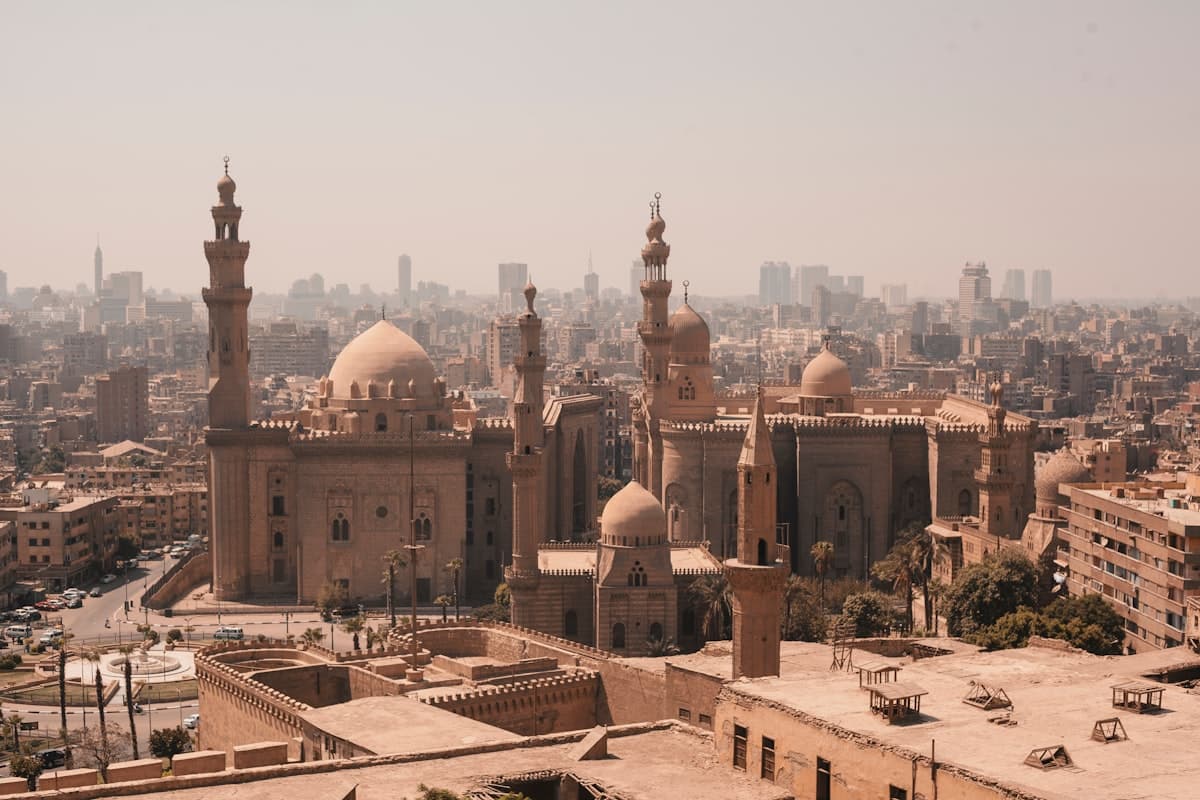
In 969 AD, a Fatimid general named Jawhar al-Siqilli, himself a freed Greek slave commanding the army of a North African caliph, founded a walled city north of the existing settlement of Fustat. He named it Al-Qahira, meaning "The Victorious," after the planet Mars, which was in ascendance at the moment the foundation stones were laid. This is the origin of Cairo. The city that exists today grew outward from those walls over the following thousand years, accreting mosques, madrasas, caravanserais, and mausoleums the way a coral reef builds itself, each dynasty adding its layer, nothing completely replacing what came before.
The Islamic Golden Age, roughly spanning the 8th through 14th centuries, produced in Cairo an urban fabric that is unmatched in its density and survival rate. UNESCO designated the historic core a World Heritage Site in 1979, citing over 600 categorized monuments within a single square kilometer. The actual count of significant structures, many unrestored and unremarked by signage, runs considerably higher. For anyone serious about understanding the Islamic Golden Age Cairo history, the city is not a destination with monuments in it. It is itself the monument.
What makes this particular city extraordinary is not that it preserved its past. It is that it never stopped using it. The mosque of Ibn Tulun, completed in 879 AD, holds Friday prayers today. Al-Azhar University, founded in 970 AD, is the oldest continuously operating university in the world still granting degrees. The medieval spice markets in Khan el-Khalili have been selling to the same trade routes, reconfigured but unbroken, since the Mamluk period.
---
Ibn Tulun and the First Cairo: What Predates the Famous
Before Al-Qahira, before the Fatimids, there was Ibn Tulun. Ahmad ibn Tulun was an Abbasid governor who decided, in 868 AD, that he preferred ruling Egypt to administering it on behalf of Baghdad. He built his own city, Al-Qata'i, north of Fustat, and at its center he built a mosque so large it could hold his entire army at prayer. That mosque, Ibn Tulun's mosque, is the oldest intact mosque in Cairo. It is also the one most travelers skip because it requires a slight effort to reach.
This is a mistake. The mosque covers 2.5 hectares and its spiral minaret, unique in Egypt and probably inspired by the Great Mosque of Samarra in Iraq, is the only element you are permitted to climb. From the top, the view across the rooftops of medieval Cairo toward the Citadel and the Mokattam Hills beyond it is the single best orientation point in the city. There is no better place to understand the physical logic of how Islamic Cairo was laid out.
Inside, the stucco friezes running along the tops of the arched porticos are original. Not restored. Not reconstructed. Cut in the late 9th century, they carry Quranic inscriptions in early Kufic script, a form of Arabic calligraphy so angular and geometric that newcomers often do not recognize it as text at all. Run your eyes along the band of stone just above the arches and read what survives: passages from Surah Al-Baqarah, worn in places, but continuous.
Adjacent to the mosque, the Gayer-Anderson Museum occupies two 16th and 17th century houses connected by a passage. Major Robert Gayer-Anderson, a British officer and collector, lived here from 1935 to 1942 and filled both buildings with Islamic, Pharaonic, and Persian objects arranged with idiosyncratic obsessiveness. The house itself is the exhibit. Its mashrabiya screens, painted ceilings, and qa'a reception halls demonstrate domestic Islamic architecture at a quality most tourists never see because they spend their entire visit in mosques. Entry runs EGP 300 (roughly $6 USD).
---
Al-Muizz Street: The World's Oldest Open-Air Museum of Islamic Architecture
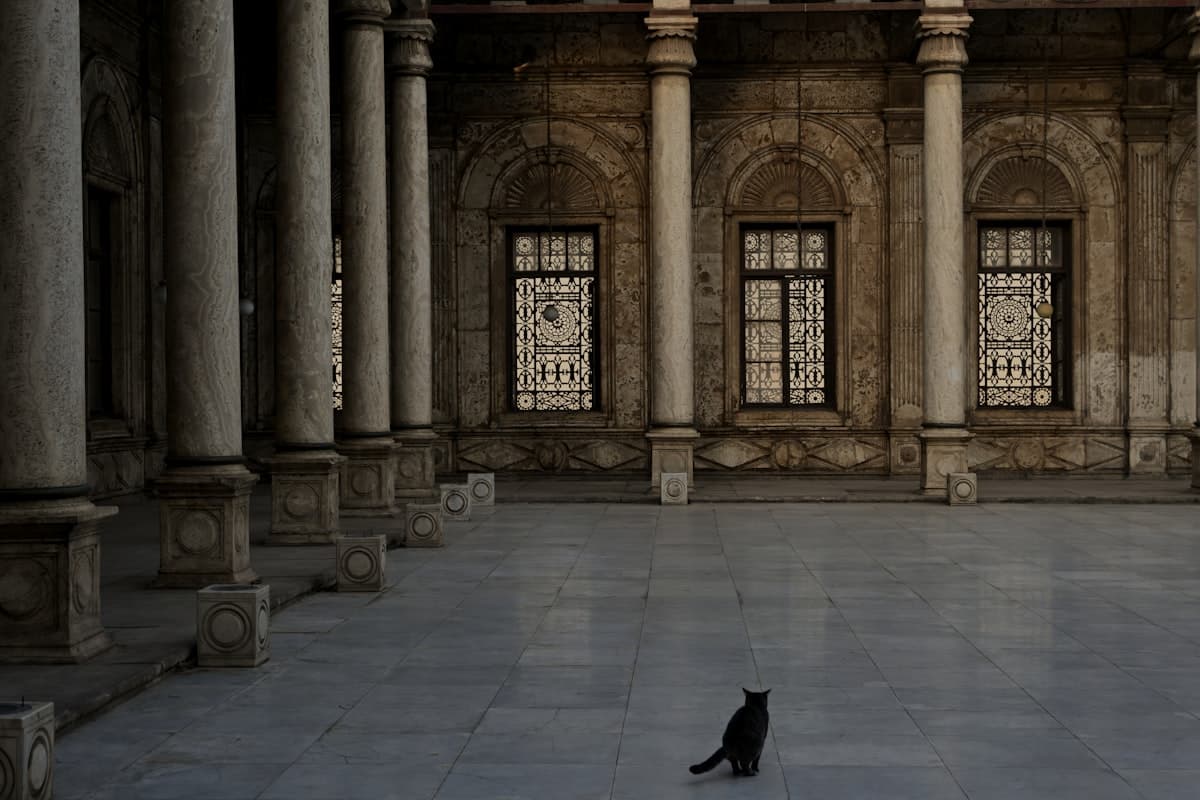
Al-Muizz li-Din Allah Street was the Fatimid main artery, running north to south through the walled city for roughly one kilometer. Today it is a pedestrianized street and the density of Islamic-era monuments per square meter is higher here than anywhere else on earth. That is not a superlative deployed carelessly. No other street in the world contains so many consecutive, varied, and significant examples of medieval Islamic architecture within a continuous walkable distance.
The northern gate, Bab al-Futuh, was built in 1087 AD. The stone used in its construction was taken from earlier Pharaonic and Roman structures. You can see, if you look at the base of the towers, blocks of a different cut and color, ancient Egyptian stone repurposed by Fatimid engineers with complete pragmatism. Climb inside the gate, which is possible with a small tip to the guard managing the staircase, and walk through the passage connecting Bab al-Futuh to the southern Bab al-Nasr. The hollow interior of the wall was used as a garrison. You are walking through the military architecture of 11th-century Cairo.
Halfway down the street, the complex of Qalawun, completed in 1285 AD, contains a madrasa, a mausoleum, and a hospital. The hospital, Al-Maristan al-Mansuri, was one of the most sophisticated medical institutions of the medieval world, with separate wards for fever, surgery, eye diseases, and psychiatric illness, all funded by endowment (waqf) so that treatment was free regardless of the patient's religion or wealth. As a person who holds a medical degree, I find this particular fact worth sitting with: free, specialized, religiously inclusive hospital care in 13th-century Cairo, funded by Islamic charitable law, a system so effective that it continued operating for two centuries after Qalawun's death.
Further south, the madrasa and mausoleum of Sultan Barquq, built in 1386, is the first royal tomb in the City of the Dead tradition within Cairo proper. Barquq was the first Burji Mamluk sultan, a Circassian man who rose from slave soldier to ruler of Egypt and Syria. His tomb is decorated with the most accomplished example of ablaq stonework in Cairo, alternating courses of red and white limestone cut with a precision that still reads as architectural confidence after six centuries.
---
The Citadel and Sultan Hassan: Power Made Permanent in Stone
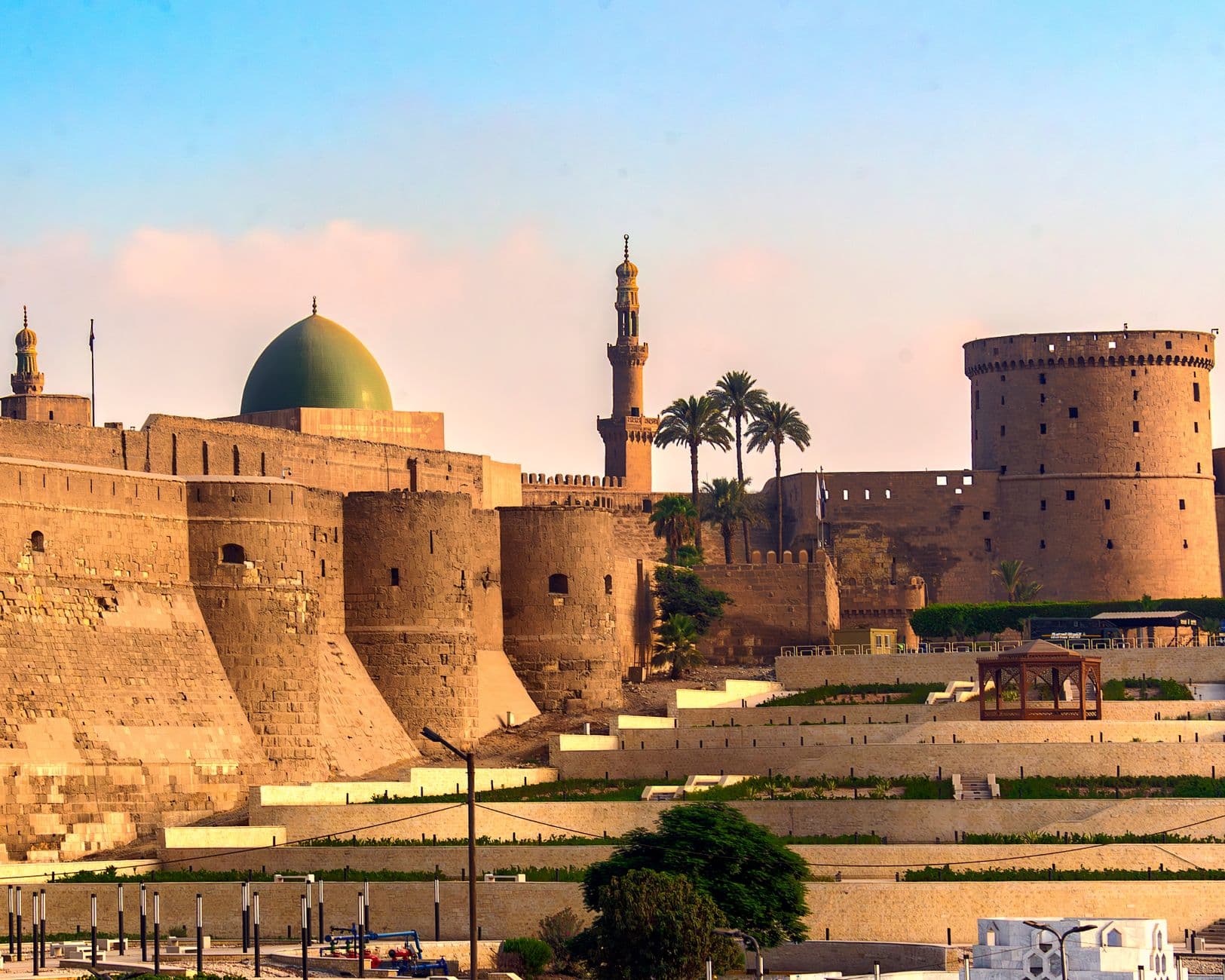
Saladin began the Citadel in 1176 AD as a fortification against Crusader threat. Every dynasty that followed him modified it: the Ayyubids, the Mamluks, the Ottomans, Muhammad Ali. The result is a layered monument in which almost nothing is from a single period and the most visually dominant structure, Muhammad Ali's Ottoman-style mosque completed in 1848, is often the one people find least interesting once they understand the context.
Below the Citadel, on the street called Al-Saliba, stands the complex of Sultan Hassan. It was commissioned in 1356 and completed in 1363, and it is the single most ambitious piece of architecture from the Mamluk period anywhere in the world. The entrance portal is 38 meters high. When it was built it was the tallest entrance gate in Islamic architecture. The four iwans (vaulted halls) arranged around the central courtyard follow a cruciform plan borrowed from Persian madrasa architecture, repurposed here to house four schools of Sunni legal interpretation simultaneously under one roof. The acoustic behavior of the central courtyard, which captures and amplifies sound in ways that feel designed rather than accidental, is not a coincidence. It was built as a place of both prayer and legal debate, and the architecture serves both.
What most visitors walk past is the narrow passage in the northeastern corner that leads to the mausoleum chamber. The dome above Sultan Hassan's cenotaph is 21 meters in diameter. Its transition zone, the squinches converting the square base to the circular drum, is covered in stalactite carving (muqarnas) of a density and intricacy that took craftsmen working simultaneously from four directions. Sultan Hassan himself never saw it completed. He was assassinated in 1361, two years before construction ended.
---
The Connections: How Islamic Cairo Links to Everything Else
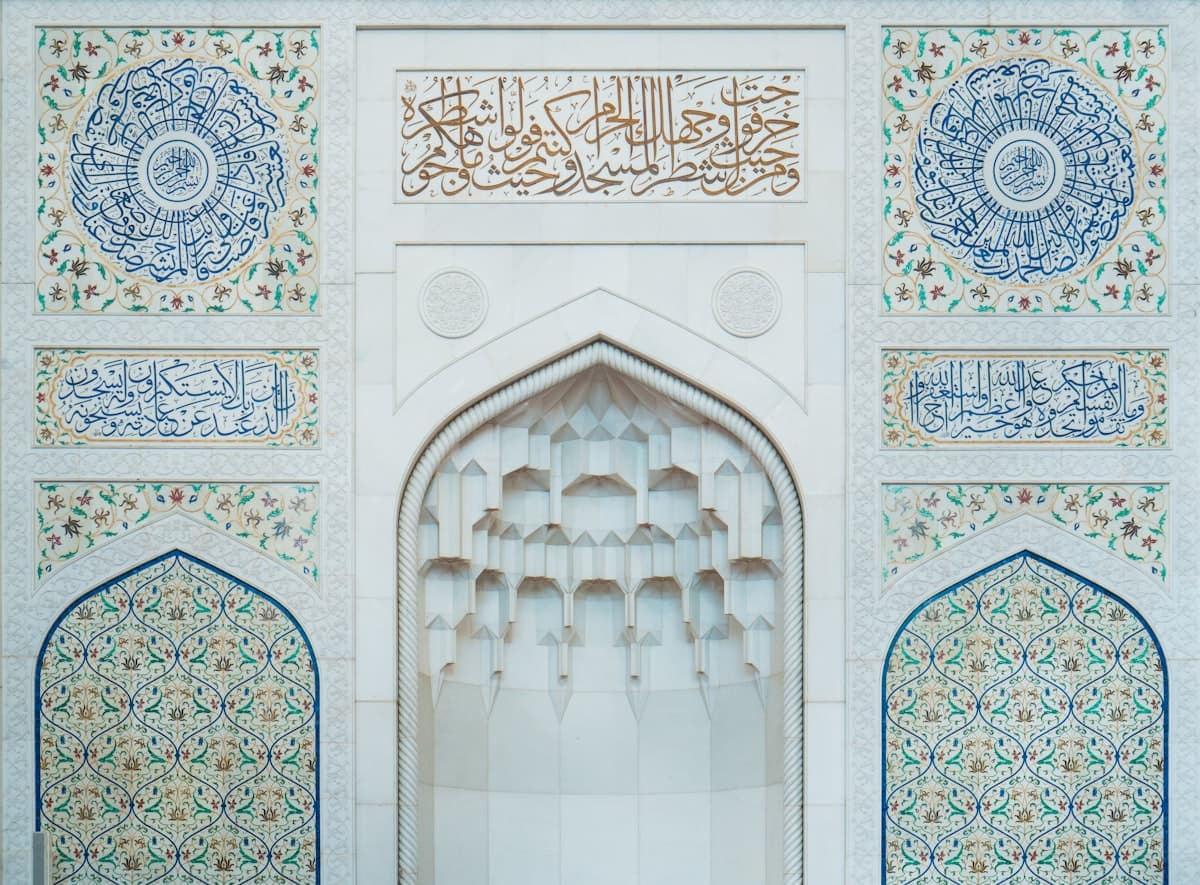
The logic of Islamic Cairo cannot be understood without understanding what it replaced, absorbed, and preserved. Fustat, the first Arab city in Egypt, founded in 641 AD after the Muslim conquest, was built directly adjacent to the Roman fortress of Babylon. That fortress still stands, partly, in the Coptic Cairo neighborhood one kilometer south. The Hanging Church, one of the oldest Christian churches in Egypt, is built into the southern towers of the Roman fortress. The Ben Ezra Synagogue, where the Cairo Geniza was discovered in 1896 (a collection of 300,000 Jewish manuscript fragments dating back to the 9th century, one of the most significant documentary archives ever found), sits 100 meters from the Hanging Church. Islam, Christianity, and Judaism built their foundational Egyptian institutions within a single city block.
The Mamluks, who produced the most concentrated flowering of Islamic architecture in Cairo's history, were themselves a military caste of enslaved soldiers, predominantly Turkic and Circassian, who had been purchased as children and trained as soldiers. They ruled Egypt from 1250 to 1517 and built more significant mosques, madrasas, and khans in Cairo than any other dynasty. Their patrons had been the Ayyubids, Saladin's dynasty, who had in turn displaced the Fatimids. Each conquest added a layer rather than erasing what existed below. The Ottoman conquest of 1517 added minarets with pencil-thin forms over existing Mamluk buildings. Muhammad Ali's 19th-century modernization project demolished some Mamluk structures and preserved others by accident. The British colonial period created the Egyptian Museum and produced the first systematic archaeological cataloguing of Islamic monuments, largely so that they could be studied rather than protected.
Understanding the Islamic Golden Age Cairo history means understanding that the gold did not come from a single dynasty. It accumulated and it survived because the city was too large, too layered, and too inhabited to be swept clean.
---
Common Mistakes
Visiting Khan el-Khalili as your primary Islamic Cairo experience. Khan el-Khalili is a tourist market. It was built as a caravanserai in 1382 by the Mamluk emir Djaharks el-Khalili, and its original function as a commercial hub for international trade is genuinely interesting. But the experience today is aggressive hawking, inflated prices, and souvenirs manufactured elsewhere. If you spend your half-day in Islamic Cairo here, you have spent it in a gift shop. Walk through quickly if you must, but give your actual time to Al-Muizz Street two blocks north.
Paying for the sound and light show at the Citadel. It costs EGP 350 and tells you nothing you will not learn from 20 minutes of reading before your visit. The Citadel at dusk is worth your time. The theatrical narration over colored lights is not.
Going at midday in any month. The light is flat and harsh, the stone reflects heat, and every tour group from every hotel in Cairo arrives between 10am and 1pm. At 8am, the mosques are cool, the light is lateral and gold, and the only other people present are locals using the buildings for their intended purpose. This changes the experience completely.
Ignoring the Coptic and Jewish layers in your Islamic Cairo day. Coptic Cairo is 20 minutes on foot from Ibn Tulun. The Ben Ezra Synagogue and the Hanging Church together take 90 minutes and cost almost nothing to enter. Treating Islamic Cairo as an isolated historical period misses the entire point of how this city was built.
Rushing Sultan Hassan to see Al-Rifa'i across the street. Al-Rifa'i Mosque, built between 1869 and 1912, contains the tombs of the last Shah of Iran, Mohammad Reza Pahlavi, as well as several Egyptian royal family members. It is impressive in scale and its construction story is politically interesting. But it is a 19th and 20th century building presented in the same breath as a 14th-century masterpiece. Give Sultan Hassan the time it demands before crossing the street.
Skipping Ibn Tulun because it is not on the standard tour. The standard tour is wrong about this. Ibn Tulun is 250 years older than any Fatimid structure in Cairo, its fabric is largely original, and you will almost certainly be nearly alone inside it. This is a rare thing in any ancient city.
---
Practical Tips
Dress conservatively. Women should carry a scarf for mosque entry. Shoe bags are sometimes provided at mosque entrances; if not, a plastic bag in your pocket saves you from carrying your shoes. This is not optional and it is not negotiable.
Hire a licensed guide for at least one day. The Egyptian Tourist Authority maintains a registry; your hotel can connect you, or you can find well-reviewed individual guides through travel forums. A good guide for Islamic Cairo charges EGP 800 to EGP 1,500 for a full day and will open closed sections, explain iconography, and navigate the informal permission systems that get you onto rooftops and into restricted chambers. This is money that changes the quality of what you see.
Bring cash. Many smaller monuments and mosque custodians operate on informal tipping systems for special access. EGP 50 to EGP 100 (roughly $1 to $2 USD) gets you into a locked room or onto a staircase in places where no ticket exists.
The neighborhoods immediately surrounding Al-Muizz Street are poor and occasionally disorienting if you are navigating alone. They are not dangerous. Accept that you will get slightly lost and that this is how you find the unrestored 14th-century sabil-kuttab (water fountain and Quran school) that is not in any guidebook, covered in scaffolding, and more moving than anything on the official circuit.
Frequently Asked Questions
The Weekly Dispatch
More on Egypt, every Friday.
Cultural depth and places most guides never mention.
No spam. Unsubscribe anytime.