Mamluk Egypt: Cairo's Greatest Medieval City, Unfiltered
The Mamluks ruled Egypt for 267 years and were, every one of them, former slaves. Their mosques still dominate Cairo's skyline. Most tourists walk past them.

Quick Facts
- Best time to visit
- October to April. November and March are ideal: cool enough to walk the narrow lanes for several hours, with manageable tourist numbers. Avoid July and August when heat in Islamic Cairo's enclosed streets is significant.
- Entrance fee
- Sultan Hassan Mosque-Madrasa: EGP 200 (approx $4 USD). Al-Rifa'i Mosque: EGP 100 (approx $2 USD). Al-Azhar Mosque: free. Citadel: EGP 450 (approx $9 USD). Combined Islamic Cairo monument ticket: EGP 600 (approx $12 USD).
- Opening hours
- Most mosques daily 9am to 5pm, closed to non-Muslims during Friday prayer (approx 11:30am to 1:30pm). Citadel daily 8am to 5pm. Khan el-Khalili shops open from approximately 10am to midnight, some later.
- How to get there
- Metro Line 1 to Ataba (EGP 10), then 20-minute walk southeast. Uber or Didi from Downtown Cairo: EGP 60 to 100. Negotiated taxi: EGP 50 to 80. No direct metro stop for Islamic Cairo; walking from Ataba is the standard approach.
- Time needed
- Half-day (4 to 5 hours) for Muizz Street and Sultan Hassan. Full day (7 to 8 hours) to add the Citadel and Al-Azhar. Two days covers the City of the Dead Mamluk cemeteries and the Ibn Tulun mosque.
- Cost range
- Budget EGP 400 to 700 per day including entry fees, street food, and transport. Mid-range EGP 1,200 to 2,000 per day including a private guide and a sit-down lunch.
The men who built Cairo's most extraordinary skyline were not born free. Every sultan of the Mamluk dynasty, which ruled Egypt from 1250 to 1517, began life as a purchased slave, typically a Turkic or Circassian child bought from the steppes of Central Asia and trained as a soldier in Cairo. They overthrew their masters, defeated the Mongols at the Battle of Ain Jalut in 1260 (the first decisive check on Mongol expansion in history), and then built a city so dense with architecture that Islamic Cairo contains more medieval monuments per square kilometer than any city on earth. UNESCO recognized 600 of them. Most visitors see three.
Quick Facts
Best time to visit: October through April. Summer heat in Islamic Cairo is genuine and unpleasant; the lanes between monuments are narrow and trap heat. November and March offer cool mornings and manageable crowds.
Entrance fees: The main complexes charge separately. Sultan Hassan Mosque-Madrasa: EGP 200 (approx $4 USD). Al-Rifa'i Mosque: EGP 100 (approx $2 USD). Al-Azhar Mosque: free for non-Muslims (modest donation expected). Khan el-Khalili bazaar: free entry. The combined Islamic Cairo tourist ticket covering multiple monuments costs EGP 600 (approx $12 USD) and is worth buying at the first ticket booth you encounter on Muizz Street.
Opening hours: Most mosques open daily 9am to 5pm, with closures during Friday prayer (approximately 11:30am to 1:30pm). Al-Azhar keeps irregular hours; arrive before noon.
Getting there: Metro Line 1 to Al-Sayeda Zeinab, then a 15-minute walk north. Alternatively, take the metro to Ataba and walk southeast into Islamic Cairo (20 minutes). Taxis from Downtown Cairo cost EGP 50 to 80. Uber runs EGP 60 to 100 depending on traffic. Do not let anyone tell you a tuk-tuk cannot navigate these streets. They do, constantly.
Time needed: A serious half-day covers Muizz Street and Sultan Hassan. A full day adds the Citadel, the Qalawun complex, and Al-Azhar. Two days, done properly, begin to approach what is actually here.
Cost range: Budget EGP 400 to 700 per day. Mid-range EGP 1,200 to 2,000 per day including a guide.
Why This Place Matters
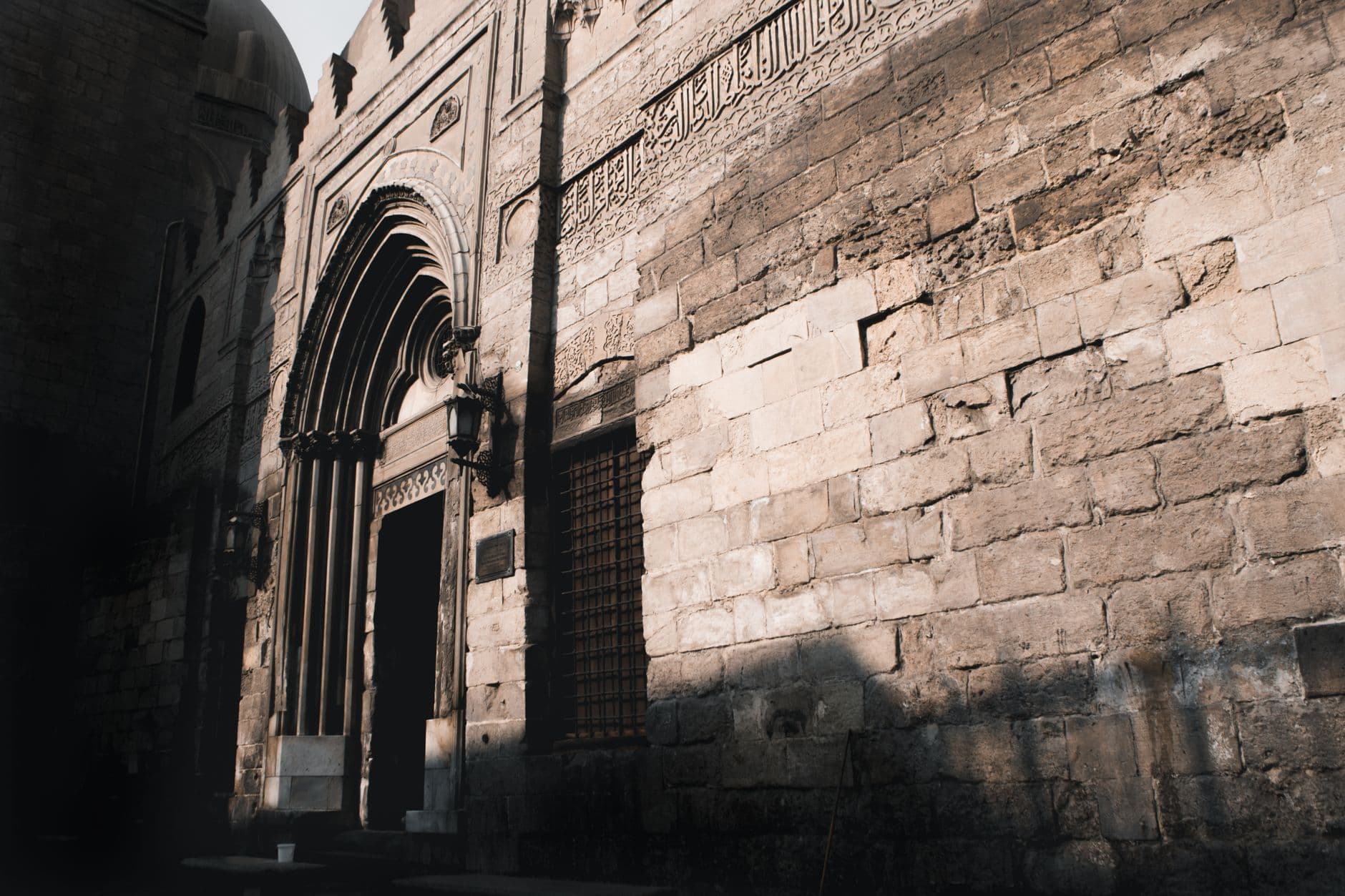
Mamluk Egypt is the reason Cairo looks the way it does. When Napoleon's forces arrived in 1798 and his scholars began documenting everything, they found a city shaped almost entirely by 267 years of Mamluk construction: the striped stone facades, the stalactite portals called muqarnas, the minarets with their triple tiers, the sabil-kuttab buildings where street fountains sat beneath Qur'anic schools on their upper floors. The Ottomans, who defeated the last Mamluk sultan Tuman Bay in 1517 and hanged him from the Bab Zuweila gate, built relatively little in Cairo. They inherited a city already complete.
What makes Mamluk architecture specifically remarkable is its competitive logic. Each sultan, knowing his reign might end violently (and statistically, it usually did: the average Mamluk sultan ruled for about six years before being deposed or killed), invested heavily in funerary complexes that would preserve his name after death. The result is a city where ambition and mortality are built into the stone. The complex of Sultan Qalawun, completed in 1285, contains a mausoleum, a madrasa, and a hospital (maristan) along a single facade on Muizz Street. That hospital remained operational for six centuries.
The Mamluk period also explains Al-Azhar University, founded in 970 CE by the Fatimids but consolidated into the world's preeminent center of Sunni Islamic scholarship under Mamluk patronage. Today it enrolls approximately 500,000 students across its campuses. Its rulings on Islamic law still carry weight from Indonesia to Morocco.
What You Will Actually See on Muizz Street
Al-Muizz li-Din Allah Street is the main artery of Islamic Cairo, named for the Fatimid caliph who founded Cairo in 969 CE. Walk it from north to south, entering at Bab al-Futuh (Gate of Conquests), one of three surviving Fatimid gates built in 1087 using stone that, in a detail no guide mentions, was quarried partly from older Pharaonic monuments in Heliopolis. The gate's towers are hollow; you can climb inside them for EGP 40 and stand in chambers where Crusader prisoners were once held.
The street narrows south of the gate into a sequence of Mamluk facades so dense they begin to blur. Stop at the Qalawun complex. The mausoleum's interior borrows directly from the Church of the Holy Sepulchre in Jerusalem, which Qalawun's architects had apparently studied: the same alternating red and white marble columns, the same octagonal plan beneath the dome. Qalawun had fought the Crusaders his entire career. He built his tomb in the shape of their holiest church. Egyptians do not find this strange; it is simply what Cairo does, absorbing everything.
Further south, the sabil-kuttab of Abd al-Rahman Katkhuda (1744) sits at a fork in the street where the Ottoman-era merchant added a two-story fountain-school directly onto a Mamluk lane, narrowing it further. The building is not open to the public most days. Stand outside it at 7am before the vendors arrive and the street smells of cardamom from the coffee cart at the corner, and the light comes in at a low angle off the minarets, and you will understand why people move to Cairo.
Sultan Hassan and the Architecture of Intimidation
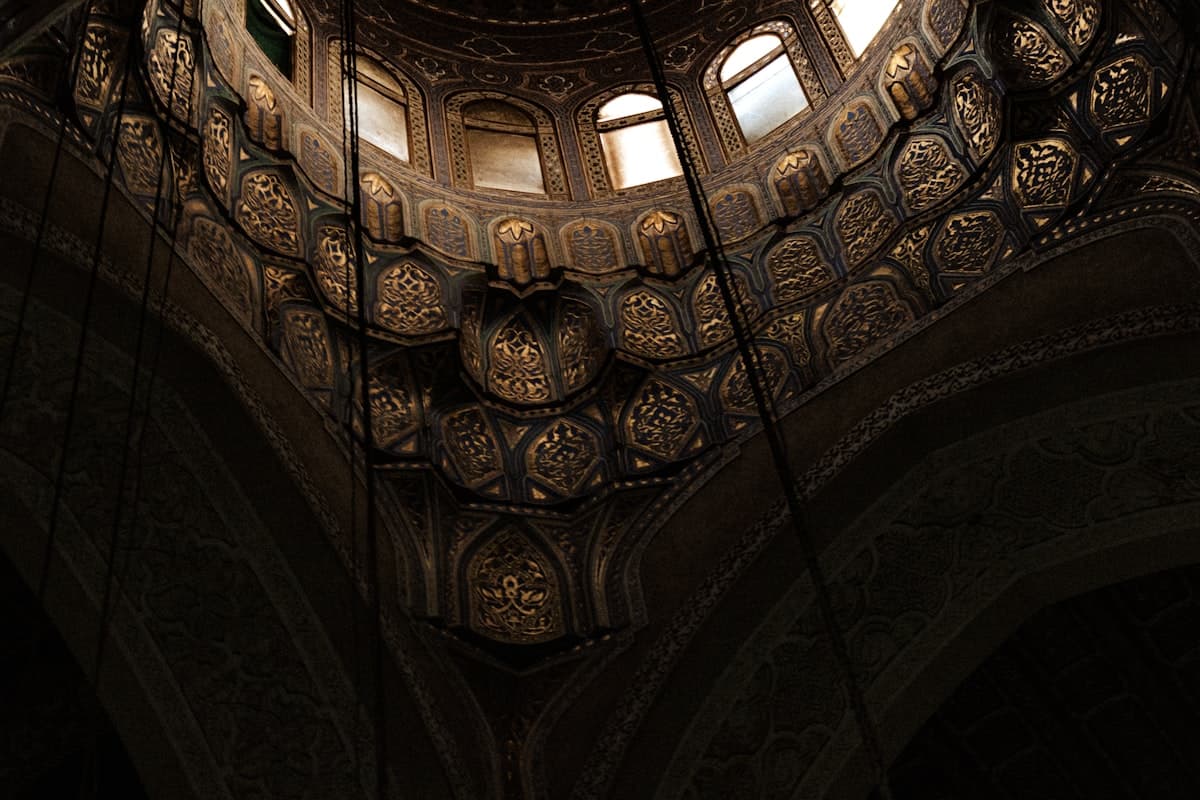
No building in Mamluk Cairo is more deliberately overwhelming than the Mosque-Madrasa of Sultan Hassan, begun in 1356 and completed (mostly) by 1363. Its entrance portal reaches 38 meters in height, which made it the tallest point in Cairo when built. The door itself, bronze-sheathed and original, weighs several tons. The design was intentional: the building was meant to make everyone who entered feel small, including the sultan.
Sultan Hassan had a complicated claim to the throne. He was crowned at age thirteen, deposed, restored twice, and assassinated in 1361 before the building was finished. His body was never placed in the mausoleum he designed. Nobody knows where he was buried. His massive tomb sits empty, or rather, it contains the remains of two of his sons, placed there later as a kind of consolation.
The building's four iwans (vaulted halls opening onto a central courtyard) correspond to the four Sunni legal schools: Hanafi, Maliki, Shafi'i, Hanbali. Students from each school lived and studied in the apartments stacked above their respective iwan, roughly 500 students in total. The logic was that funding religious education would secure prayers for the sultan's soul in perpetuity. Perpetuity ended when he was killed, but the building remains.
Directly across the square, Al-Rifa'i Mosque was built between 1869 and 1912 by the Egyptian royal family as their dynastic mausoleum, designed deliberately to match the Mamluk style of Sultan Hassan opposite it. Inside, the last Shah of Iran, Mohammad Reza Pahlavi, is buried. He died in Cairo in 1980 after Anwar Sadat granted him asylum when no other country would. The tomb receives almost no visitors. Entry costs EGP 100 and you may have the room to yourself.
The Connections
Mamluk Cairo does not exist in isolation from anything. The Citadel of Saladin, which the Mamluks inherited and expanded, sits on a spur of the Muqattam Hills that had been quarried for Pyramid stone by the Old Kingdom. The mosque of Muhammad Ali inside the Citadel (Ottoman, 1848) was built over the site of Mamluk palaces that Muhammad Ali demolished specifically to erase Mamluk architectural memory after he massacred the last Mamluk leaders in the Citadel in 1811, an event known as the Massacre of the Citadel, in which 470 Mamluk beys were killed in a single afternoon.
The Mamluk spice trade funded the architecture. Cairo under the Mamluks was the primary transit point for spices moving from Asia to Europe, a monopoly that made the city extraordinarily wealthy and that Vasco da Gama's 1498 sea route around Africa was specifically designed to break. It worked. Within thirty years of da Gama's voyage, Mamluk revenues had collapsed, the Ottomans had invaded, and Cairo began its long economic contraction. The spice trade's end is one reason the Mamluk monuments were so poorly maintained for four centuries: there was simply no money.
Khan el-Khalili, the bazaar that tourists now associate with perfume bottles and papyrus, was established as a caravanserai by the Mamluk emir Djaharks el-Khalili in 1382 specifically to profit from that spice transit. The original structure was demolished by Sultan al-Ghouri in 1511 and rebuilt. The bones of the current market date to the Mamluk-to-Ottoman transition. The coffee in the Fishawy cafe, which claims to have been open continuously since 1773, costs EGP 85. Drink it.
Common Mistakes
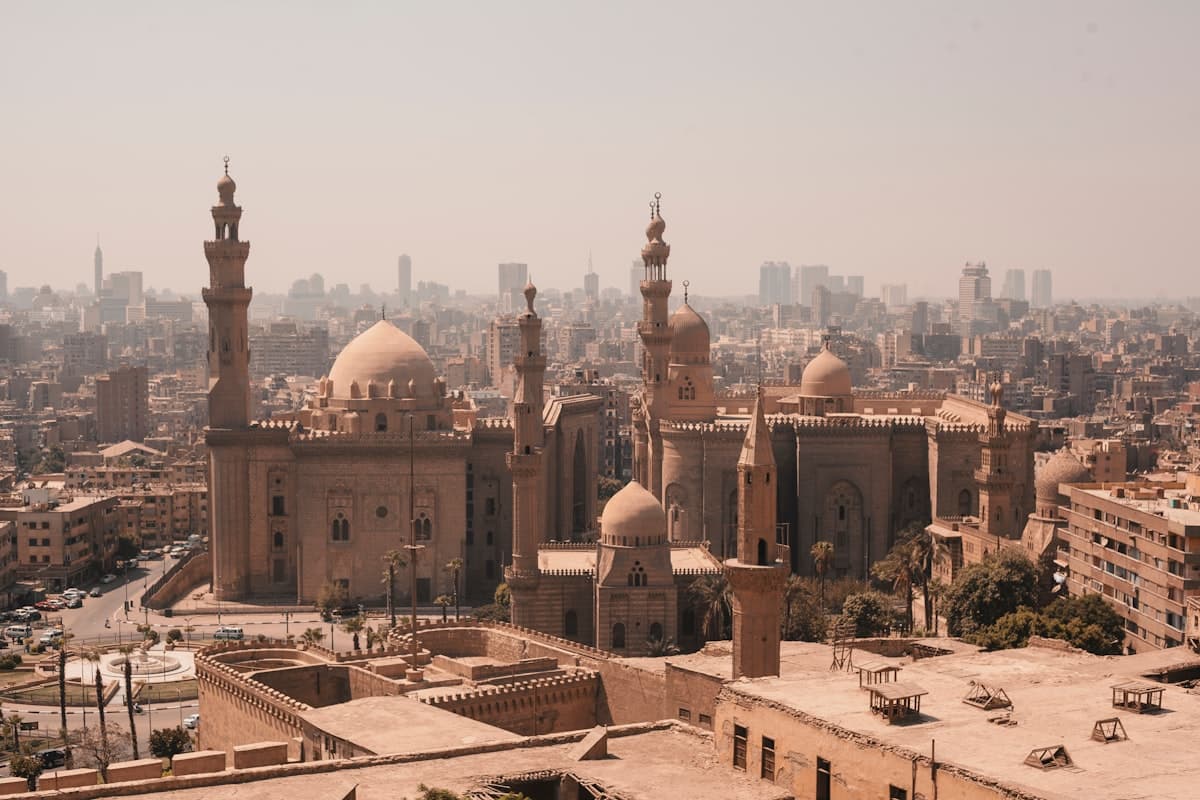
Visiting the Citadel before Islamic Cairo. The Citadel is visually dominant and tour operators go there first. But it is largely Ottoman and 19th century, with the Mamluk layers buried or destroyed. Start at Bab al-Futuh, walk Muizz Street south, and arrive at Sultan Hassan with context. The Citadel makes more sense as an endpoint.
Taking a guided group tour of Khan el-Khalili. Every group tour of Khan el-Khalili ends in a perfume shop or papyrus gallery where the guide earns a commission. The bazaar is walkable alone. The shops worth entering are the ones without touts at the door.
The sound and light show at the Citadel. It costs EGP 350, runs 45 minutes, and tells you approximately nothing you will not learn from reading this article. The theatrical narration was written in the 1970s and has not been updated. Skip it and use the evening to eat koshari at Abou Tarek (25 Champollion Street), which has been serving the same recipe since 1950.
Skipping the Qalawun complex interior because the exterior looks locked. Ring the bell. Someone will open it. The maristan (hospital) section is partially accessible and contains carved stucco decoration that predates anything in the Alhambra by a decade and clearly influenced it.
Arriving at Sultan Hassan at midday. The light in the central courtyard is best in the early morning, when it comes in low through the northeastern iwan. By 11am the space is full of tour groups and the acoustics, which are extraordinary, become noise rather than echo.
Photographing inside mosques without asking. Most mosques permit photography. A few do not. The correct approach is to ask the caretaker at the entrance. It costs nothing and avoids an unpleasant confrontation at the mihrab.
Overlooking the Mamluk cemeteries. The City of the Dead, the vast necropolis east of Islamic Cairo, contains Mamluk funerary complexes that are less visited and, in several cases, architecturally superior to the monuments on Muizz Street. The complex of Sultan Barquq (died 1399) is a 20-minute walk from Bab al-Futuh and almost always empty. The silence inside its dome is complete.
Practical Tips
Dress conservatively regardless of gender. For women, loose trousers and a top that covers the shoulders are sufficient for most complexes; a scarf for the head is needed inside active mosques and is better carried than borrowed from the entrance (the borrowed ones are not clean). For men, shorts below the knee are fine. Sandals are practical since you will remove shoes at every mosque entrance.
The best English-language guide to hire independently is found through the Egyptian Tourist Authority office near the Citadel; expect to pay EGP 400 to 600 for a half-day. Avoid the guides who approach you at Bab al-Futuh; they work on commission from specific shops.
Carry small bills. Ticket offices sometimes claim not to have change for EGP 200 notes. Whether this is true is debatable. EGP 20 and 50 notes solve the problem.
Water: buy it at a corner shop, not from vendors near the monuments, where prices are three times higher. A 1.5-liter bottle costs EGP 10 to 15 at a regular shop.
If you have one afternoon and one morning for Mamluk Cairo history in Cairo, spend the afternoon on Muizz Street from north to south, ending at the Khan el-Khalili for coffee at Fishawy as the light drops. Spend the morning at Sultan Hassan and Al-Rifa'i before 9am, when both complexes are nearly empty and the square between them belongs entirely to you.
Frequently Asked Questions
The Weekly Dispatch
More on Egypt, every Friday.
Cultural depth and places most guides never mention.
No spam. Unsubscribe anytime.