Mamluk Egypt: The Cairo History Guide Worth Your Time
The Mamluks ruled Egypt for 267 years and built more of Cairo than any dynasty before or since. Most visitors walk past their greatest monuments without knowing who made them.

Quick Facts
- Best time to visit
- October to April. Comfortable temperatures, strong morning light, and manageable crowds on weekdays. Avoid July and August when lane temperatures in Islamic Cairo can exceed 38°C.
- Entrance fee
- Combined Islamic Cairo district ticket EGP 200 (approx $4 USD). Individual sites including Sultan Hassan and Qalawun Complex: EGP 100 each (approx $2 USD). Al-Azhar Mosque: free. Museum of Islamic Art: EGP 150 (approx $3 USD). Students with valid ID pay 50% at most sites.
- Opening hours
- Most Mamluk mosques daily 9am to 5pm, closed to visitors during Friday midday prayers (approx 12pm to 1:30pm). Museum of Islamic Art: Tuesday to Sunday 9am to 5pm, closed Mondays.
- How to get there
- Taxi or Uber from Tahrir Square: EGP 30 to 50, 15 to 20 minutes. Microbus from Downtown Cairo to Khan al-Khalili: EGP 5. Metro Line 1 to Sadat Station then taxi: most practical from other parts of the city. Cairo Metro does not reach Islamic Cairo directly.
- Time needed
- 5 to 6 hours for the al-Muizz Street corridor plus Sultan Hassan. Full day (8 to 9 hours) if combining with the City of the Dead necropolis and the Museum of Islamic Art.
- Cost range
- Budget EGP 300 to 600 per day including transport, entry fees, and street food. Mid-range EGP 1,200 to 2,000 including a licensed guide and a sit-down lunch.
Quick Facts
Best time to visit: October to April, when temperatures stay below 25°C and the light in the narrow lanes of Islamic Cairo turns gold by mid-morning.
Entrance fees: The Mamluk monuments fall under several ticketing categories. The combined Islamic Cairo ticket covering Sultan Hassan Mosque, Al-Rifa'i Mosque, and selected nearby sites costs approximately EGP 200 (approx $4 USD) per adult. Individual monuments like the Qalawun Complex charge EGP 100 (approx $2 USD). Students with valid ID pay half price at most sites.
Opening hours: Most Mamluk mosques open daily from 9am to 5pm, though hours shift slightly in Ramadan. Al-Azhar Mosque is open for visitors outside prayer times and charges no entry fee.
How to get there: From Tahrir Square, take the Cairo Metro Line 1 to Sadat Station, then a taxi or rideshare (Uber, Careem) to Bab Zuweila or Midan Salah al-Din for roughly EGP 30 to 50. A microbus from Downtown to Khan al-Khalili costs EGP 5. Walking from Bab al-Futuh south along al-Muizz Street covers most major Mamluk monuments in a single corridor.
Time needed: Half a day for the key monuments on al-Muizz Street. A full day if you include Sultan Hassan, the Mamluk necropolis in the City of the Dead, and the Citadel.
Cost range: Budget EGP 300 to 600 per day including transport and entry. Mid-range EGP 1,200 to 2,000 if you add a guide and lunch at a sit-down restaurant in Khan al-Khalili.
---
Why This Place Matters
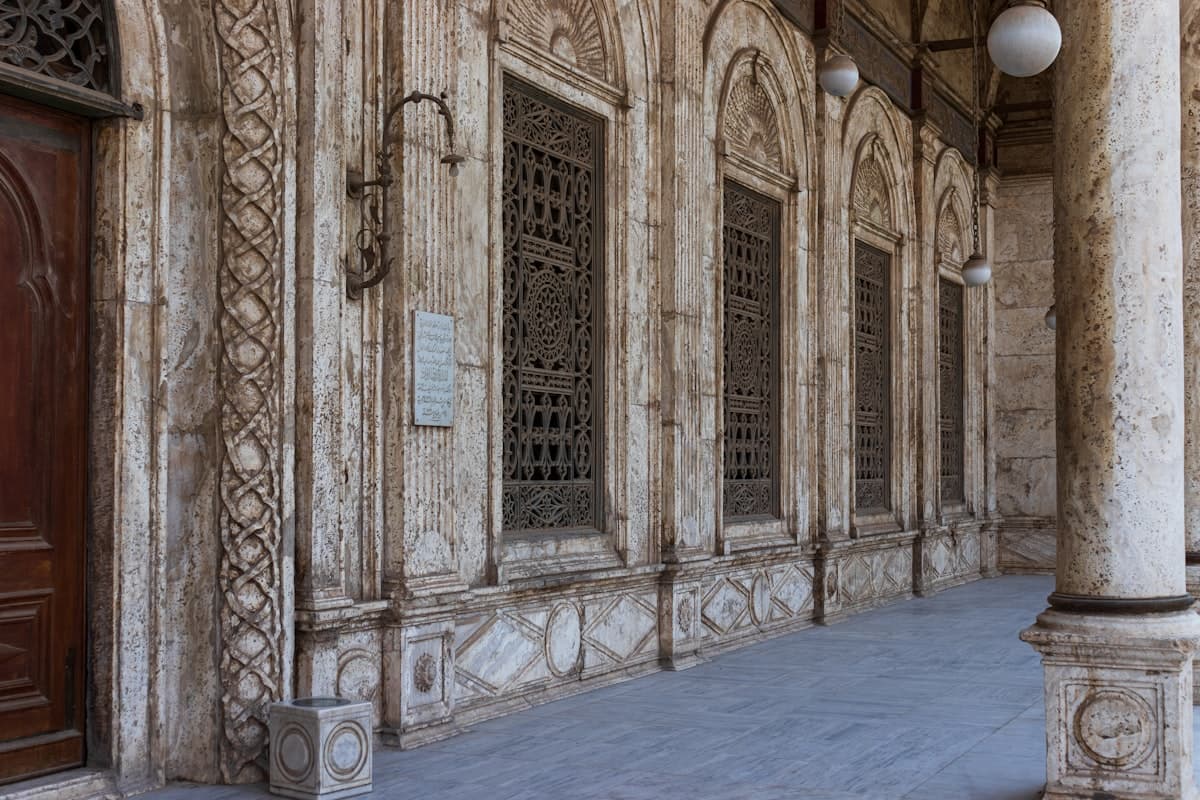
The Mamluk sultanate produced 267 years of uninterrupted rule over Egypt, from 1250 to 1517, and the rulers who built the most were people who had been bought and sold as children. The word mamluk means "one who is owned." These were enslaved soldiers, mostly Turkic and Circassian, purchased from the steppes of Central Asia and the Caucasus, trained as cavalry, converted to Islam, and eventually handed enough military power that they deposed the Ayyubid dynasty and took Egypt for themselves.
The architecture they left behind is the reason Cairo is a UNESCO World Heritage city. In one three-block stretch of al-Muizz li-Din Allah Street, you pass the Qalawun Complex (1285), the al-Nasir Muhammad Complex (1304), and the Barquq Complex (1386), a concentrated sequence of mausoleums, madrasas, and sabil-kuttabs built in stone so precisely cut that the joints are barely visible today. No other street in the world has this density of medieval Islamic architecture in active use.
What Cairo's Mamluk monuments represent is not nostalgia. Al-Azhar University, founded in 970 CE by the Fatimids but shaped decisively by Mamluk patronage, remains one of the oldest continuously operating universities on earth and still issues religious rulings that influence the lives of over a billion Muslims. The Mamluks funded its curriculum, built its annex structures, and established the endowments that kept it running when the Ottomans arrived and tried to redirect Egypt's wealth northward.
---
What You Are Actually Walking Through
Most visitors to Islamic Cairo follow a guide who points upward at minarets and explains architectural styles. The better approach is to look at the street level first.
The Mamluk builders did something unusual: they incorporated public welfare infrastructure into their religious monuments. The sabil, a public water fountain dispensing free water to passersby, appears on the ground floor of almost every Mamluk complex. Above the sabil sits the kuttab, a Quranic school for orphan boys, often funded in perpetuity by the same endowment. Sultan Qaytbay, who ruled from 1468 to 1496, built sabils across Cairo with such consistency that his name became synonymous with the form. His complex in the Northern Cemetery includes what many architects consider the finest stone dome in Egyptian Islamic architecture, carved with an interlocking arabesque that has no repeated seam across its entire surface.
The Qalawun Complex on al-Muizz Street is worth slowing down for. Sultan Qalawun built it between 1284 and 1285, in thirteen months, which is extraordinary given the scale: a madrasa, a mausoleum, and a maristan (hospital) that treated patients regardless of religion, gender, or ability to pay, and included wards for different illnesses, a pharmacy, running water, and musicians hired to help patients sleep. The maristan is mostly gone, but the mausoleum interior survives with its stucco windows and marble floor, and it sits on the foundations of the Fatimid western palace that stood there before it. Qalawun's architects stripped columns from that palace and reused them, which is why the interior columns do not match.
The Sultan Hassan Mosque: Scale as Political Statement
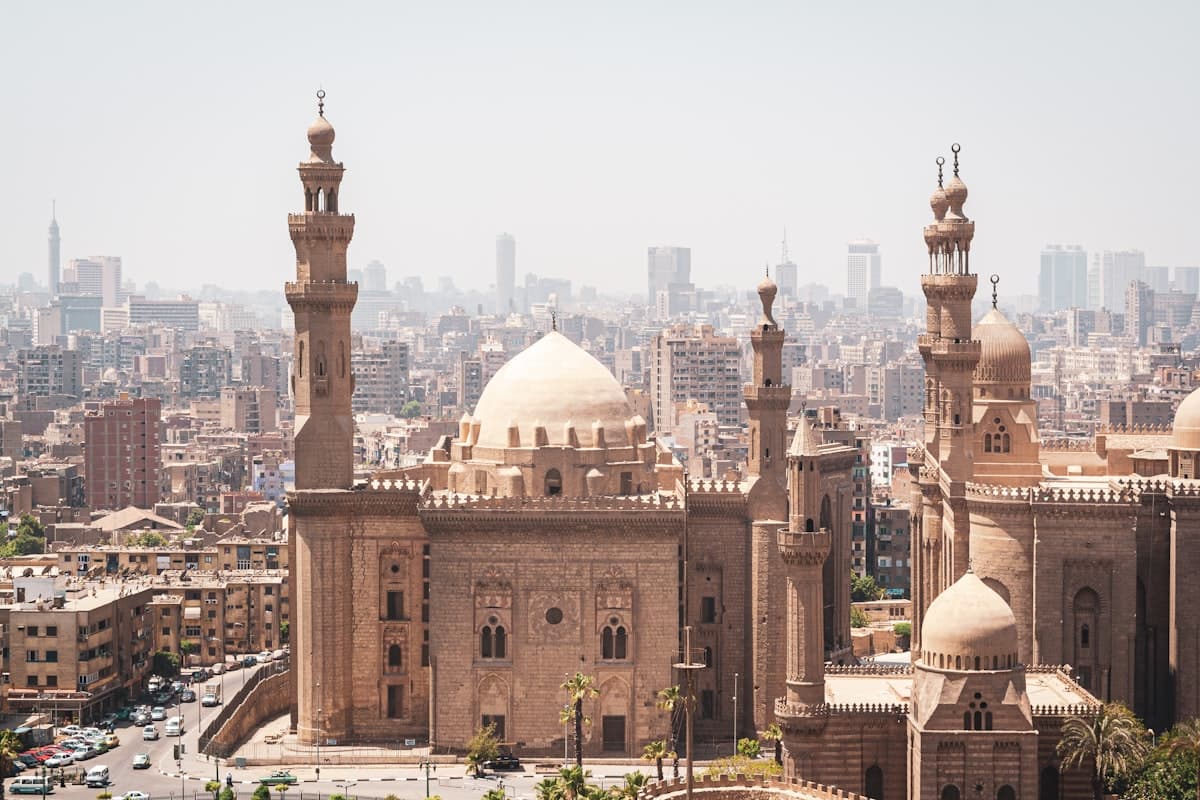
The mosque of Sultan Hassan, completed in 1363, is one of the largest mosque-madrasa complexes ever built anywhere. Its walls reach 36 meters at their highest point. The entrance portal at 38 meters tall was, at the time of construction, the tallest doorway in the Islamic world. Sultan Hassan himself never saw the building finished: he was assassinated in 1361, two years before completion, and his body was never placed in the mausoleum he built for himself because his enemies feared that his tomb would become a pilgrimage site for his supporters.
The building's position was also a military calculation. It faces the Citadel directly. Whoever held the mosque's roof could fire down into the Citadel's lower sections, which is exactly what happened during several later military conflicts. The Mamluk amirs who controlled Cairo after Hassan's death apparently regretted its placement immediately.
Stand inside the central courtyard at midday and look up. The four iwans (vaulted halls) are oriented to the four schools of Sunni Islamic law, the Hanafi, Maliki, Shafi'i, and Hanbali, each school given its own teaching space and student housing. You are standing inside a functioning medieval university, a law school, and a congregational mosque simultaneously.
---
The City of the Dead: The Necropolis Most Visitors Skip
About two kilometers east of Sultan Hassan, past the Citadel, lies the Qarafa, the Mamluk necropolis that Cairenes simply call the City of the Dead. It is not dead. Approximately half a million people live there, in and around the mausoleums and tomb complexes of Mamluk sultans and their families. Residents have been living in the cemetery since at least the Fatimid period, and today the neighborhood has electricity, a postal address, and a school.
The mausoleum of Sultan Qaytbay here (not to be confused with his other complexes in the city) is the most architecturally refined of all the Mamluk tombs. Its exterior stone dome, carved with a pattern that appears to change geometry as you walk around it, influenced mosque design from Istanbul to Delhi. The Ottoman architect Mimar Sinan is documented as having studied Mamluk Cairo, and the Qaytbay dome is specifically cited in architectural histories as a model for Ottoman stonework.
The Qarafa is not on most tour itineraries. The tuk-tuks that navigate its narrow lanes charge about EGP 20 for a circuit. The residents are accustomed to the occasional visitor and largely indifferent. Go on a weekday morning.
---
The Connections: Nothing Stands Alone
The Mamluk history Cairo guide tends to present these monuments as self-contained medieval objects. They are not.
Al-Azhar Mosque sits on ground that the Fatimid general Jawhar al-Siqilli consecrated in 970 CE, a site chosen in part because it sat near a Pharaonic canal route that connected the Nile to the eastern Delta. The Mamluks expanded the mosque six times. The Ottomans added two minarets after 1517. The French army under Napoleon used it as a stable and a barracks in 1798, an act of desecration that Cairenes still reference. Egyptian nationalists held meetings there in 1919. Every layer of Cairo's political history is physically present in that one building.
The Citadel that the Mamluks used as their seat of government was begun by Saladin (Salah al-Din al-Ayyubi) in 1176, using limestone quarried partly from the outer casing stones of smaller Giza pyramids. When Muhammad Ali Pasha consolidated Ottoman power in the early nineteenth century, he invited the last Mamluk leaders to the Citadel for a banquet in 1811 and had them massacred in its courtyard, ending the Mamluk presence in Egypt that had persisted even through Ottoman rule as a semi-autonomous class. The mosque Muhammad Ali subsequently built on the Citadel is the one most tourists photograph. It stands on the site of the Mamluk palace it replaced.
---
Common Mistakes
1. Starting at Khan al-Khalili. The bazaar is at the southern end of al-Muizz Street. Start at the northern gate, Bab al-Futuh, and walk south. You see the monuments in rough chronological order and arrive at the bazaar when you are ready to stop, not before you have seen anything.
2. Visiting on a Friday morning. Most Mamluk mosques restrict non-Muslim visitors during Friday prayers, which run from roughly noon to 1:30pm. Arriving at 11am means you may be turned away from multiple sites. Plan Friday visits for afternoon.
3. Paying for the sound and light show at the Citadel. It costs EGP 350 and tells you a version of Egyptian history assembled for an audience assumed to have no prior knowledge. The Citadel itself, visited during daylight with a good book or audio guide, is far more informative. Skip the show.
4. Ignoring the interiors in favor of the exteriors. Every major Mamluk complex has an interior that is better than its facade. The Qalawun mausoleum, the Sultan Hassan iwans, the Barquq khanqah: the stone carving, marble inlay, and woodwork inside are what required the money and the skill. Most tour groups spend four minutes inside and fifteen outside.
5. Hiring a guide at the gate of a single monument. The guides stationed at individual monuments know that monument and nothing else. If you want context that spans the whole district, arrange a licensed guide in advance through the Egyptian Tourism Authority or a reputable agency. Expect to pay EGP 400 to 700 for a half-day. It is worth it for a first visit.
6. Missing the Mamluk woodwork at the Museum of Islamic Art. The Museum of Islamic Art on Bur Said Street holds a collection of Mamluk mashrabiyya screens, minbar panels, and Quranic manuscript stands that were removed from monuments for preservation. Entry costs EGP 150 (approx $3 USD). The wooden minbar from the Ibn Tulun Mosque alone justifies the visit.
7. Assuming "Islamic Cairo" means only Mamluk Cairo. The district also contains Fatimid, Ayyubid, and Ottoman monuments. If you understand the sequence, Fatimid (909 to 1171) then Ayyubid (1171 to 1250) then Mamluk (1250 to 1517) then Ottoman (1517 to 1798), what you see makes more sense. The Mamluks were always building in conscious dialogue with what came before them.
---
Practical Tips
Dress conservatively. Women should carry a scarf to cover hair when entering mosque interiors; cotton scarves are sold at every corner for EGP 20. Men in shorts may be asked to wear a robe provided at the entrance, which wastes time.
The light on al-Muizz Street is best between 8am and 10am, when it enters the lane from the east at a low angle and strikes the stone facades directly. By midday the narrow street is in shadow and photographically flat.
Carry cash. Most Mamluk monuments do not accept cards, and the ATMs nearest to Bab al-Futuh are inside the neighborhood rather than on the main road.
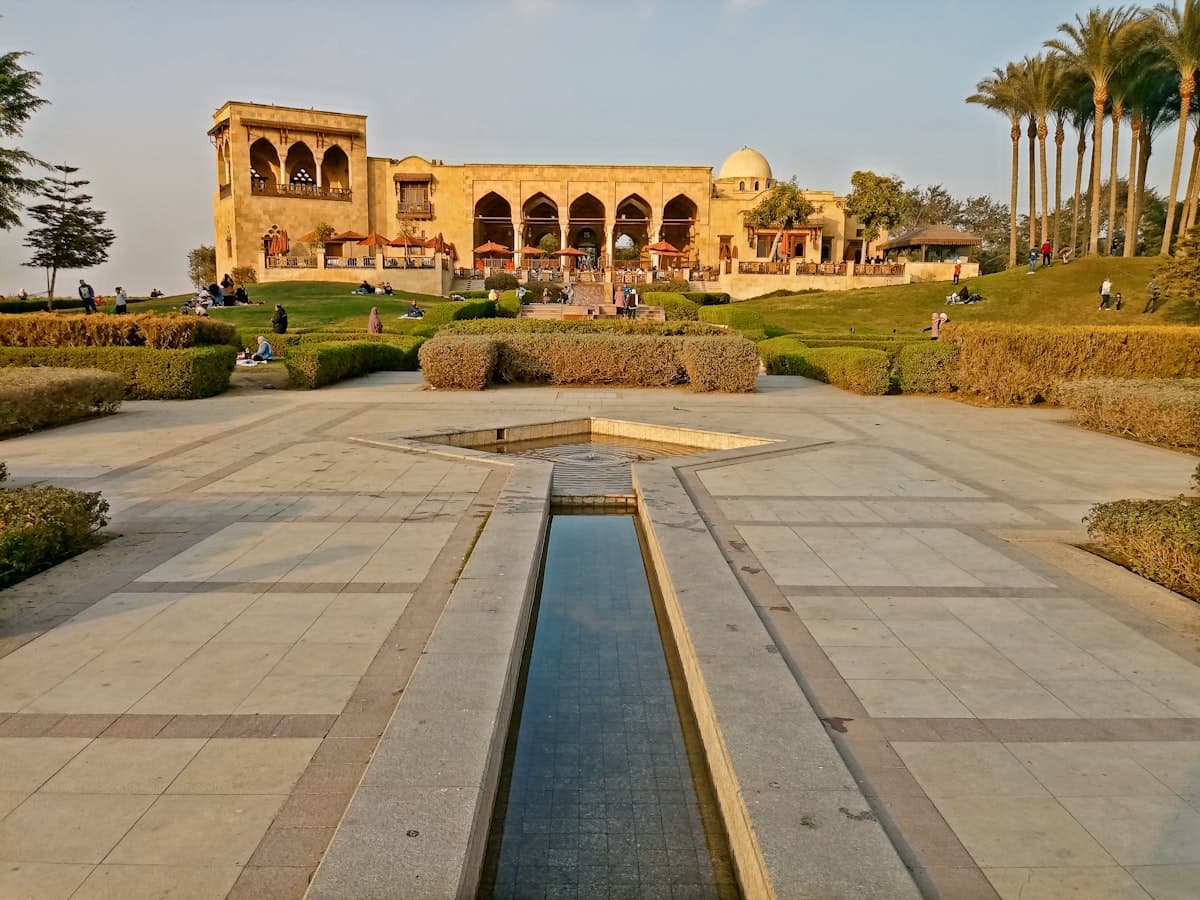
For a late lunch, Al-Azhar Park, built on rubble cleared from the Darb al-Ahmar neighborhood and opened in 2005, offers a cafe with a direct view over the Ayyubid city walls toward the Citadel. The park itself, funded by the Aga Khan Trust, is a quiet place to process what you have seen. Entry is EGP 35.
Hydrate seriously between May and September. The lane temperatures in narrow Islamic Cairo streets can be eight to ten degrees higher than open-air temperatures due to reduced air circulation. This is not the season for a leisurely walking tour.
Frequently Asked Questions
The Weekly Dispatch
More on Egypt, every Friday.
Cultural depth and places most guides never mention.
No spam. Unsubscribe anytime.