Mamluk Egypt: The Cairo History Guide You Actually Need
The Mamluks ruled Egypt for 267 years and built more of Cairo than the Pharaohs did. Most visitors walk past their greatest monuments without knowing who made them.

Quick Facts
- Best time to visit
- October to February for manageable heat and clear morning light. Avoid June to August unless you begin before 8am.
- Entrance fee
- Sultan Hassan: EGP 200 (approx $4 USD). Qalawun Complex: EGP 150 (approx $3 USD). Bab Zuweila with minaret: EGP 100 (approx $2 USD). Ibn Tulun: EGP 100 (approx $2 USD). Al-Muizz Street corridor: free.
- Opening hours
- Most sites daily 9am to 5pm. Avoid Friday morning during prayer times (approximately 11:30am to 1:30pm). Some interiors close for brief midday breaks.
- How to get there
- Taxi from Downtown Cairo: EGP 60 to 100. Uber: EGP 80 to 130. Metro to Al-Sayeda Zeinab station (EGP 8) plus 12-minute walk to Ibn Tulun. No private vehicle recommended inside the quarter.
- Time needed
- One full day for major Mamluk monuments. Two days to include smaller monuments along Al-Muizz and understand the broader Fatimid to Mamluk layering.
- Cost range
- Budget EGP 800 to 1,200 per person including all entrance fees, lunch, and transport. With licensed private guide: EGP 2,500 to 3,500 per person.
The men who built the most beautiful quarter of Cairo were, legally, property. The Mamluk sultans, who ruled Egypt from 1250 to 1517, were purchased as boys in the markets of the Black Sea steppe, Central Asia, and the Caucasus, converted to Islam, trained as cavalry soldiers, and then, in a system so specific it has no real parallel in history, allowed to seize power entirely. The word mamluk means "owned." They were slaves who became kings, and the city they left behind is so dense with their ambition that you cannot walk a straight block in Islamic Cairo without passing something they commissioned, endowed, or fought over.
Quick Facts
Best time to visit: October to February. The light in Islamic Cairo is best in the morning, and the heat between June and August makes the narrow streets genuinely difficult after 10am.
Key sites and entrance fees: Madrasa and Mausoleum of Sultan Hassan: EGP 200 (approx $4 USD), students EGP 100 Al-Rifa'i Mosque (directly opposite, essential for context): EGP 100 (approx $2 USD) Mosque of Ibn Tulun (technically Abbasid, but foundational for understanding the Mamluk city): EGP 100 (approx $2 USD) Al-Muizz Street corridor (open-air): free Qalawun Complex on Al-Muizz: EGP 150 (approx $3 USD) Bab Zuweila (with minaret climb): EGP 100 (approx $2 USD)
Opening hours: Most sites open daily 9am to 5pm, though hours can shift by 30 minutes seasonally. Al-Muizz Street is best visited in the morning before tour groups arrive around 10:30am.
How to get there: Taxi from central Cairo (Downtown or Zamalek) costs EGP 60 to 100 depending on traffic. The Metro to Al-Sayeda Zeinab station is EGP 8 and puts you a 12-minute walk from Ibn Tulun. Uber runs EGP 80 to 130. Do not attempt to drive your own vehicle into the Al-Muizz corridor; the lanes were designed for a loaded camel, not a Kia.
Time needed: One focused day covers the major Mamluk monuments. Two days if you want to understand rather than photograph.
Cost range: EGP 800 to 1,200 for a full day including all entrance fees, lunch in the quarter, and transport. Mid-range with a private guide: EGP 2,500 to 3,500.
Why This Place Matters
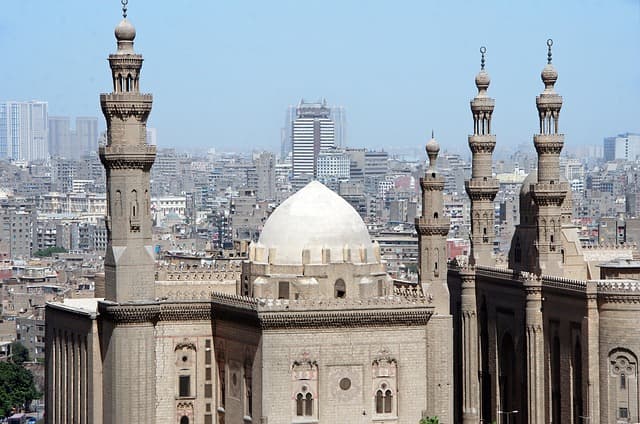
Most visitors to Cairo organize their mental map around two poles: the Pyramids at Giza, old beyond imagining, and the Egyptian Museum or its replacement, the Grand Egyptian Museum, full of objects they have seen in textbooks. The Mamluk city does not fit this schema, and that is precisely why it rewards attention.
The Mamluks arrived in power at the exact moment Egypt needed them. In 1258, the Mongol army of Hulagu Khan sacked Baghdad, killed the Abbasid Caliph, and effectively ended the Islamic world's political center of gravity. Cairo absorbed the shock and became that center instead, partly because the Mamluks were the only military force in the region who stopped the Mongols, at the Battle of Ain Jalut in 1260, a victory so consequential that historians still debate whether it prevented a Mongol conquest of North Africa and possibly the Iberian Peninsula.
This history is not background noise. It explains why Mamluk sultans built so obsessively. They were men of uncertain legitimacy, who had seized power by force from the dynasty they served, ruling a city that had just become the most important in the Islamic world. They built mosques, madrasas, hospitals, and mausoleums at a rate that still shapes the Cairo skyline, because piety in stone was the primary currency of political authority.
What You Are Actually Looking At
The Sultan Hassan Complex: A Building That Tells You Everything
The Madrasa and Mausoleum of Sultan Hassan, built between 1356 and 1363, is the single best argument for spending serious time with Mamluk Cairo history. Its entrance portal is 38 meters high, the tallest in the medieval Islamic world. The sultan who commissioned it was 13 years old when he first came to power, deposed, reinstated, and then assassinated before the building was complete. His body was never placed in the mausoleum he built for himself.
The building's layout is a cruciform plan with four iwans, arched halls facing a central courtyard, one for each of the four schools of Sunni Islamic law. This was not decorative pluralism. It was a political statement: the sultan as the patron and arbiter of all legitimate Islamic legal tradition. Between the iwans are residential cells for students, roughly 4,000 of them at full capacity, each school forming its own self-contained vertical neighborhood.
What most visitors do not stop to notice: the stone used for the carved decorations near the base of the walls is not Islamic in origin. It was quarried, in large part, from the casing stones of the Pyramids at Giza. The Mamluks stripped the smooth white limestone facing from the Pyramids across several generations, using it for buildings across Cairo. The rough, stepped appearance of the Pyramids today is, in part, a Mamluk renovation.
Al-Muizz Street: Five Layers Underfoot
Al-Muizz Li-Din Allah Street was the spine of Fatimid Cairo, laid out in 970 CE when the Fatimid dynasty founded the city. The Mamluks inherited this street and lined it with their own monuments so systematically that walking it today means reading five distinct periods of Islamic architecture within a single kilometer.
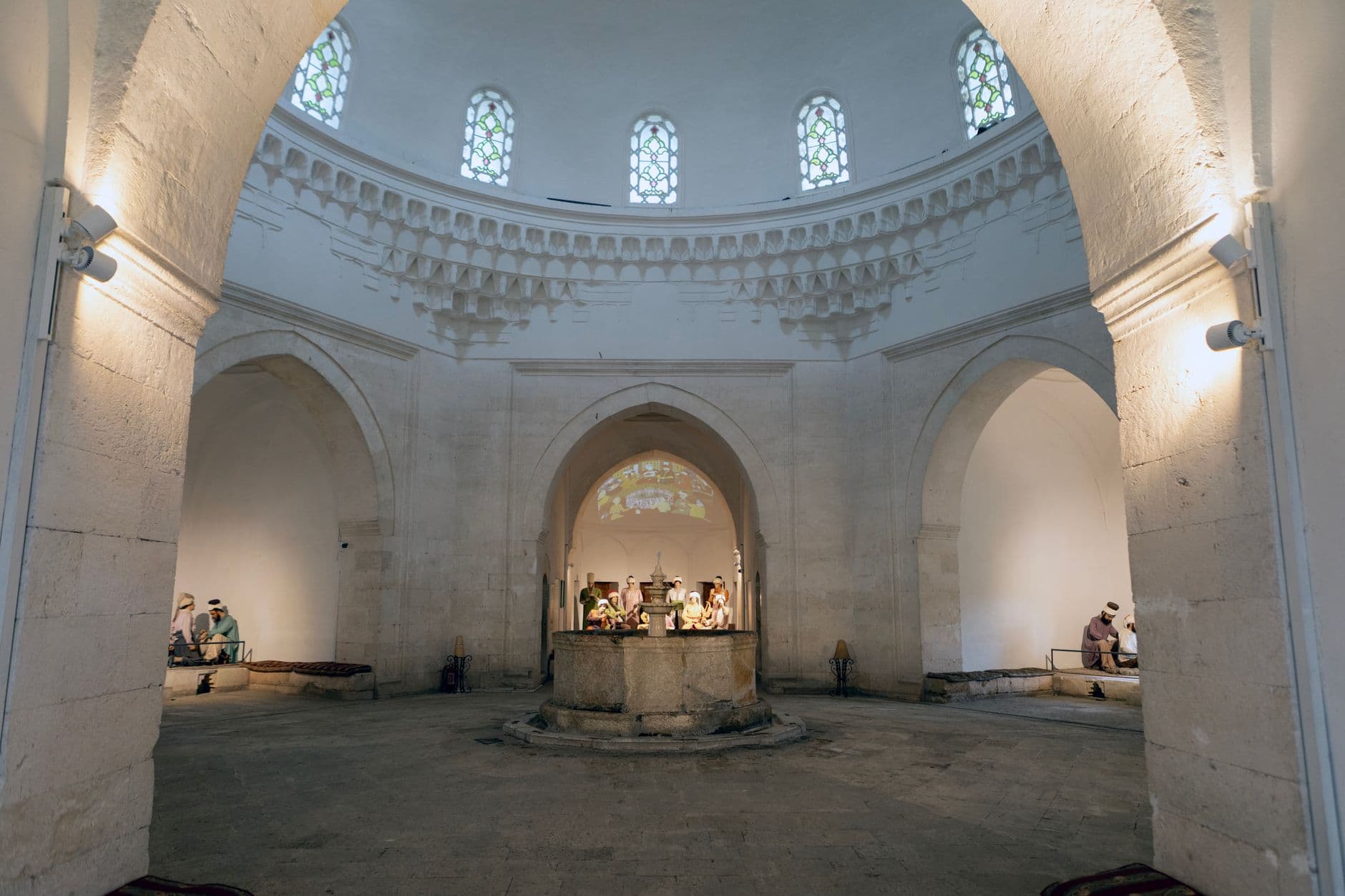
The Qalawun Complex, built in 1284 to 1285, is the anchor. Sultan Qalawun built it in only 13 months, an almost impossible construction timeline that he reportedly managed by paying workers around the clock in shifts. The complex includes a madrasa, a mausoleum, and a maristan, a hospital, which treated patients for free regardless of religion or social status, and which provided a daily allowance to discharged patients so they could afford to eat while they recovered. The maristan served Cairo for six centuries. The Ottoman traveler Evliya Çelebi, writing in the 1670s, described it as still operating, still treating the poor, still giving out bread.
The street itself sits above a Pharaonic canal that once connected the Nile to the eastern desert. Roman engineers modified it. Arab engineers built the Fatimid city over it. The canal silted and was filled, but it dictated the orientation of the streets above it for two thousand years. When you walk Al-Muizz, you are following water that stopped flowing before Islam existed.
Bab Zuweila: The Gate Where History Ended Publicly
Bab Zuweila, the southern gate of Fatimid Cairo, completed in 1092, became under the Mamluks the city's primary site of public execution. The last Mamluk sultan, Tuman Bay, was hanged here three times by the Ottoman conquerors in 1517. The rope broke twice. On the third attempt it held. The Ottomans had defeated the Mamluks at the Battle of Ridaniyya, just north of Cairo, in a single morning, because the Mamluks had superior cavalry and the Ottomans had artillery, and cavalry does not win against artillery. The Mamluk era ended not with a long decline but with a technology gap.
Climb the minarets of the attached mosque of Al-Mu'ayyad, which are bolted onto the gate itself because the sultan ran out of space and simply used the city's most prominent structure as a foundation. The view from the top looks north along Al-Muizz toward the Fatimid city, and east toward the Citadel, and the particular quality of the light over the medieval city's roofscape at 9am, before the haze builds, is worth more than any sound and light show in Egypt.
The Connections
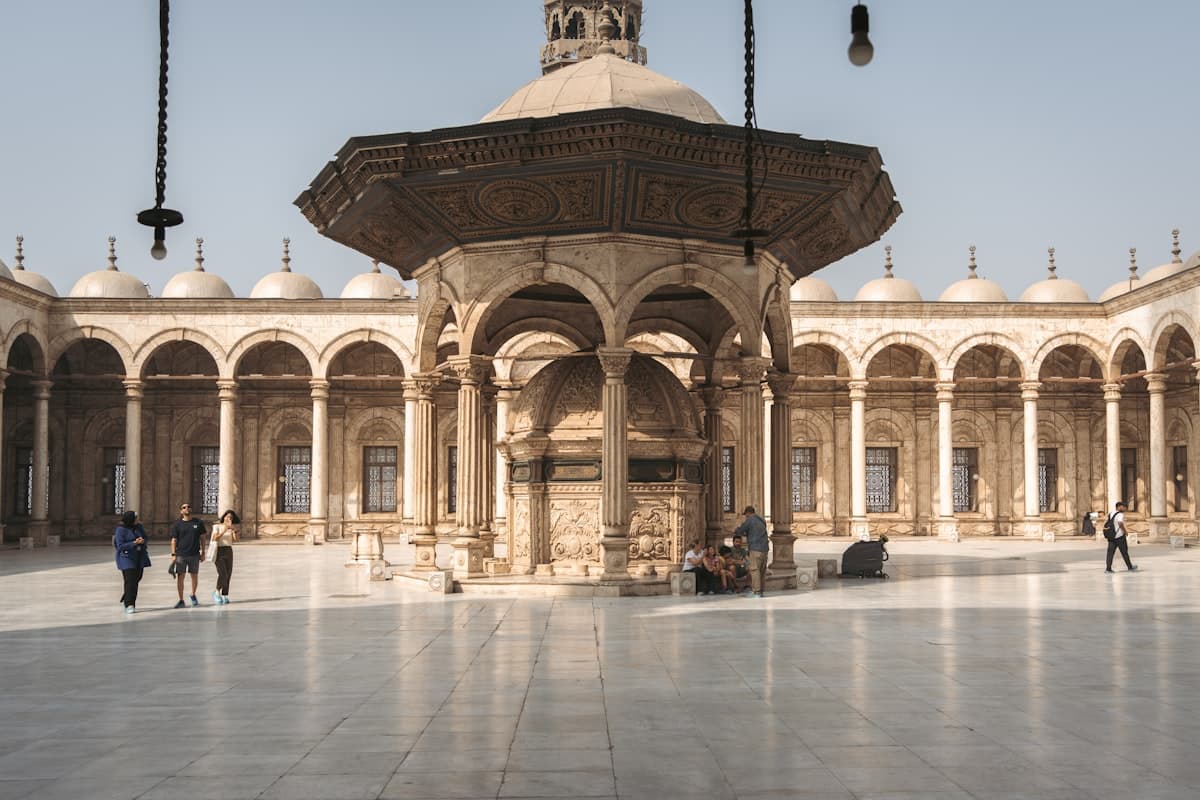
Nothing in Cairo exists in isolation, and the Mamluk monuments make this most obvious. The Citadel of Saladin, which the Mamluks inherited and expanded, sits above a limestone ridge that was quarried by Old Kingdom Egyptians to build the Pyramids. The Muhammad Ali Mosque that now dominates the Citadel's silhouette was built in 1830 by an Ottoman Albanian ruler who demolished the last surviving Mamluk palace on the same site to build it, which is either irony or continuity depending on your perspective.
The Mamluk hospital at Qalawun borrowed its architectural layout from a Crusader hospital in Damascus, which the Mamluks had captured and apparently admired enough to replicate. Their most gifted architects often came from the same Central Asian regions as the soldiers, bringing with them decorative traditions from Anatolia, Persia, and the Silk Road cities. A carved stucco panel in the Qalawun mausoleum uses geometric patterns first developed in Seljuk Iran. Egyptian Coptic woodworkers produced the carved screens inside the same building. The Mamluk aesthetic is a forced synthesis of everything the slave trade connected.
Common Mistakes
1. Starting at the Citadel. Most guides begin here because it is visible from everywhere and feels like an obvious landmark. But the Citadel's interior, dominated by the 19th-century Muhammad Ali Mosque, is largely Ottoman, not Mamluk. Begin at Sultan Hassan and Al-Rifa'i, understand the Mamluk aesthetic, then climb to the Citadel for context.
2. Booking a Mamluk walking tour that lasts two hours. Two hours in Islamic Cairo is orientation, not understanding. A guide who tells you they can cover the Mamluk monuments in two hours is selling you a photograph tour. Budget four hours minimum for the Al-Muizz corridor alone.
3. Visiting on a Friday morning. Many monuments are closed or have restricted access during Friday prayers, and the street around functioning mosques is genuinely impassable during the sermon. Friday afternoon after 2pm is fine. Saturday morning is ideal.
4. Skipping Ibn Tulun because it is not technically Mamluk. The Mosque of Ibn Tulun, built in 876 to 879, is the oldest mosque in Cairo to survive in its original form, and it provides the architectural baseline against which all Mamluk building makes sense. The Mamluks actually restored it in 1296. It is also, practically, the least crowded major monument in the Islamic city, which makes it the best place to sit and think.
5. Paying for the Al-Muizz sound and light show. It costs EGP 350, runs for 45 minutes, and recites a chronology of Islamic Cairo that you will find more precisely and interestingly in any reasonable book about the city. The street at night is genuinely worth walking. The produced show is not worth your time or money.
6. Hiring guides from touts at the gate. Unlicensed guides at Bab Zuweila and the Sultan Hassan entrance will tell you confident, detailed, specific facts about the buildings that are frequently wrong. The Ministry of Tourism licensed guide rate is posted at the Syndicate; ask to see credentials and agree on price before you begin.
7. Ignoring the interiors in favor of the facades. The exterior of the Qalawun complex is extraordinary. The interior of the mausoleum, with its stained glass and painted stalactite ceiling, is more extraordinary still. Visitors who photograph the street and move on miss what the buildings actually are.
Practical Tips
Wear shoes you can slip off quickly. You will remove them at every functioning mosque, sometimes on cold marble, sometimes on worn carpet. Socks are a practical kindness to yourself.
Women should carry a scarf, not because it is legally required at all sites, but because entering a mausoleum or active prayer space with bare shoulders creates friction that slows your visit. A lightweight cotton scarf takes up no space and solves the problem.
The best single meal near the Mamluk monuments is at Felfela on Al-Muizz, not the tourist branch Downtown but the original, which serves ful, ta'miya, and grilled kofta at prices that reflect the neighborhood rather than the guidebooks. Lunch for two costs EGP 150 to 250.
If you are serious about Mamluk Cairo history as a subject, carry a copy of Doris Behrens-Abouseif's "Cairo of the Mamluks." It is dense, scholarly, and the best thing written about the architecture in English. Read the relevant chapters the night before each site.
Crowds peak between 10am and 1pm on weekdays. Arrive at Sultan Hassan before 9am if you want the courtyard to yourself. The light in that space in the early morning, falling through the upper windows of the four iwans in four different angles simultaneously, rewards the early alarm.
Frequently Asked Questions
The Weekly Dispatch
More on Egypt, every Friday.
Cultural depth and places most guides never mention.
No spam. Unsubscribe anytime.