Mamluk Egypt: The Complete Cairo History Guide
The Mamluks ruled Egypt for 267 years, built half of Islamic Cairo, and were technically slaves. Their architecture outlasted their dynasty by seven centuries. Here is where to find it.

Quick Facts
- Best time to visit
- October to March for cooler temperatures (18 to 28 degrees C) and better light on stone. Avoid July and August when the medieval quarter reaches 38 degrees C in the afternoon and narrow streets hold heat long after sunset.
- Entrance fee
- EGP 200 per major monument (approx $4 USD). Al-Sultan Hassan: EGP 200. Qaitbay Mosque: EGP 100. Ibn Tulun: EGP 100. Madrasa of Barquq: EGP 60. Budget EGP 600 to 800 for a full day of monuments.
- Opening hours
- Most sites daily 9am to 5pm. Al-Sultan Hassan and Al-Rifai open until 6pm in winter. Al-Azhar restricts non-Muslim entry during Friday midday prayers (approximately 12pm to 2pm).
- How to get there
- Taxi from Tahrir Square to Bab Zuweila or Al-Sultan Hassan: EGP 50 to 80. Metro to Sadat station then 15-minute walk or EGP 20 to 30 tuk-tuk. Uber or Careem from central Cairo: EGP 40 to 70. Taxi from Citadel to Northern Cemetery: EGP 40 to 60.
- Time needed
- One full day for core circuit (Citadel area, Al-Sultan Hassan, Al-Muizz Street). Two days if adding Northern Cemetery. Three days for comprehensive coverage including Ibn Tulun.
- Cost range
- Budget EGP 700 to 1,200 per day including transport, entry fees, and street food. Mid-range EGP 1,500 to 2,000 adding a licensed guide and a sit-down lunch.
Quick Facts
Best time to visit: October to March, when the narrow medieval streets stay below 28°C and the light on stone turns copper rather than white.
Entrance fees: The Islamic Cairo complex ticket covers multiple sites at EGP 200 per monument (approx $4 USD each). Al-Sultan Hassan Mosque: EGP 200. Qaitbay Mosque (Northern Cemetery): EGP 100. Ibn Tulun: EGP 100. The Madrasa of Barquq in the Northern Cemetery: EGP 60. Individual monument tickets are sold on site. Budget EGP 600 to 800 for a full Mamluk day.
Opening hours: Most mosques open daily 9am to 5pm, though Al-Sultan Hassan and Al-Rifai open until 6pm in winter. Al-Azhar mosque (Fatimid foundation with heavy Mamluk additions) opens from 9am and closes during Friday prayers for non-Muslims.
Getting there: From Tahrir Square, a taxi to the Al-Muizz Street entrance costs EGP 50 to 80. The metro stops at Sadat (Line 1 and 2 junction) or Al-Shohadaa, both a 15-minute walk. Ride-hailing apps (Uber, Careem) run EGP 30 to 60 depending on surge.
Time needed: One day for a focused Mamluk circuit. Two days if you add the Northern Cemetery. Three if you want to understand what you are actually looking at.
Cost range: Budget EGP 700 to 1,200 per day including transport and entry fees. Add EGP 150 to 200 for lunch in the medieval quarter.
---
The men who built half of Islamic Cairo were purchased as children. They were brought from the Caucasus and Central Asian steppes, converted to Islam, trained as cavalry, and sold to Egyptian sultans who found them more loyal than sons because they had no tribal allegiances to betray. The Mamluks, whose name derives from the Arabic for "owned," seized power from their Ayyubid masters in 1250, the same year they defeated the Seventh Crusade and captured the French King Louis IX at the Battle of Fariskur. They then ran Egypt for 267 years, built a civilization whose street grid still shapes Cairo today, and were finally broken by Ottoman artillery at the Battle of Marj Dabiq in 1516, a battle fought in Syria that ended with their sultan dead on the field and Egypt changed forever.
This is the Mamluk Egypt history Cairo visitors walk through without quite understanding what they are seeing.
Why This Place Matters
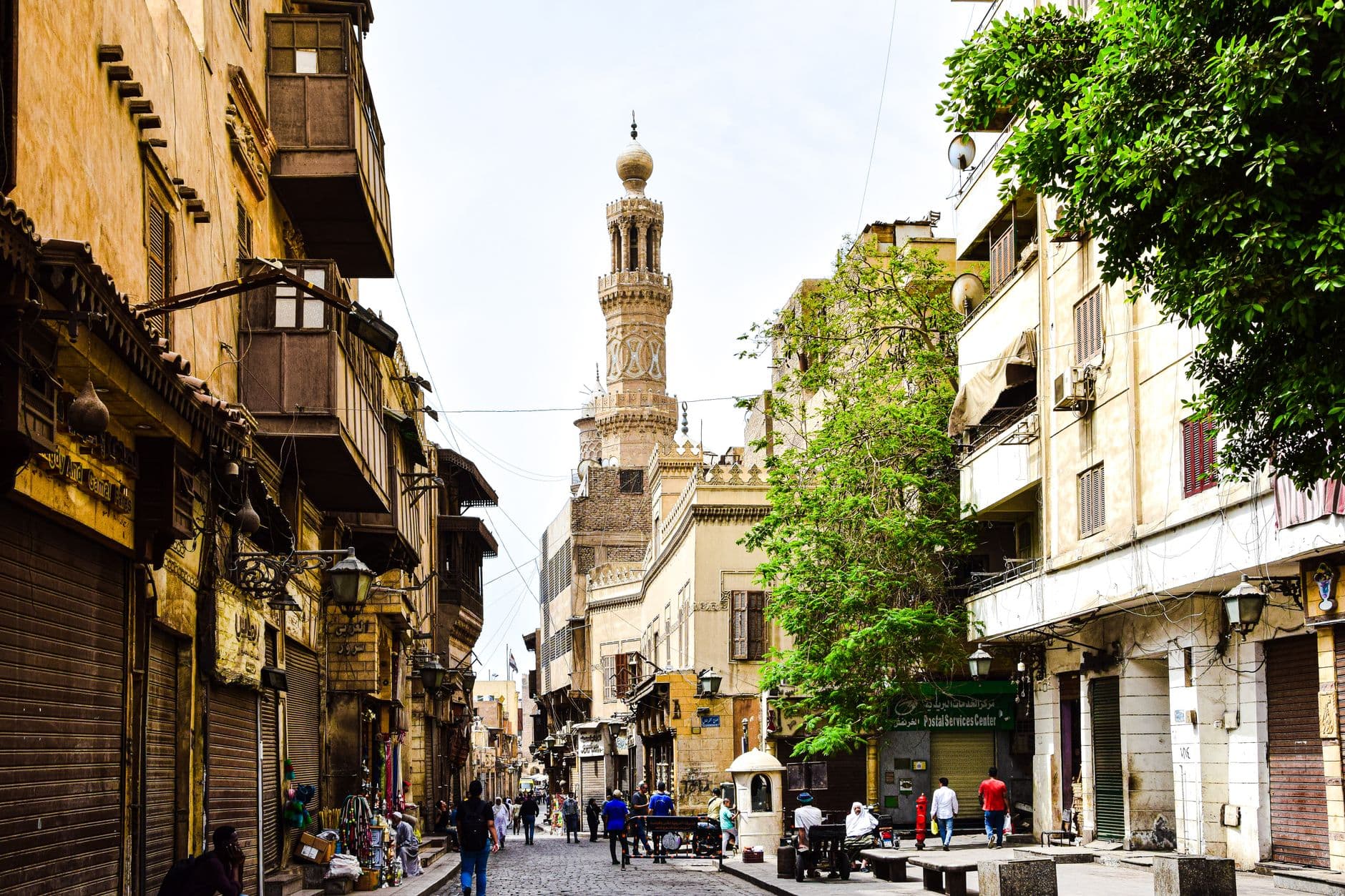
The Mamluk period produced a concentrated burst of architectural ambition that has few equivalents anywhere in the medieval world. Between 1250 and 1517, Mamluk sultans and emirs built more than 150 religious and civic monuments in Cairo alone, many of which survive. Compare that to contemporary Europe: Paris in the same period produced Notre Dame and the Sainte-Chapelle. Cairo produced a city.
What makes this architecturally significant beyond its quantity is the structural experimentation. The Mamluk builders solved the problem of inserting monumental sacred architecture into a pre-existing dense urban fabric by developing a tripartite facade system: a recessed entrance portal, flanking minarets of distinctive carved stone, and a sabil-kuttab (a street-level water fountain topped by a Quran school) built into the corner of nearly every foundation. Walking Al-Muizz Street today, you see this formula repeated across 700 years with variations that function almost like a design conversation across generations.
The connection most visitors miss: the Mamluks did not build on empty land. Al-Sultan Hassan Mosque, completed in 1363 and widely considered the greatest medieval mosque in Egypt, sits directly across from the Citadel on ground that held Roman fortifications in the third century. The mosque's stone was partly quarried from smaller Fatimid and Ayyubid structures, meaning the building contains, literally, the compressed rubble of civilizations. The four iwans of Al-Sultan Hassan are also the four legal schools of Sunni Islam made physical: each one was a madrasa for a different legal rite. You pray toward Mecca in a building that is simultaneously a theological law school, a mausoleum, and a political statement.
What You Will Actually See: The Core Mamluk Circuit
Al-Sultan Hassan and Al-Rifai: Two Mosques, One Argument
Start at the base of the Citadel on Al-Qal'a Square. The two mosques facing you were built six centuries apart and look it. Al-Sultan Hassan (1356 to 1363) is Mamluk. Al-Rifai (finished 1912) is neo-Mamluk, meaning it is a 20th-century Egyptian khedival project dressed in borrowed medieval clothes. Most tours present them as a pair without explaining that distinction, which matters.
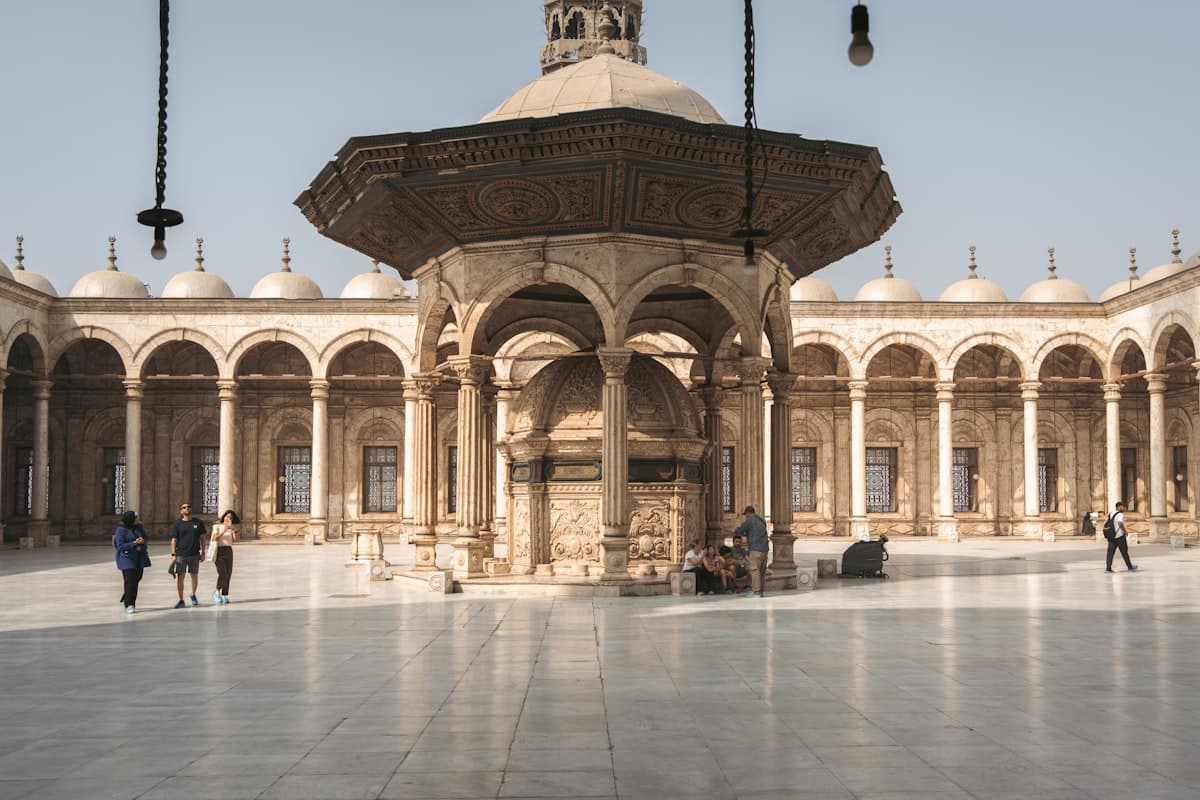
Al-Sultan Hassan is the one worth your full attention. Its entrance corridor is intentionally disorienting: you enter through a monumental portal and turn sharply before reaching the central court, a design choice that prevents anyone outside from seeing the qibla wall. The central courtyard contains a marble ablution fountain whose original wooden canopy collapsed in the 16th century and was never replaced. The four surrounding iwans are cavernous, their ceilings coffered with geometric stucco that still shows traces of the original lapis blue and gold pigment if you look at the upper corners in strong morning light.
The sultan who built it, Al-Sultan Hassan, was murdered before its completion and was never buried in the mausoleum he designed for himself. His tomb chamber sits empty. His body was reportedly taken by political rivals; its location remains unknown. The mausoleum dome above that empty chamber is 48 meters high, the tallest medieval dome in Cairo.
Al-Rifai next door is where the last Egyptian king, Farouk, is buried alongside Mohammad Reza Shah Pahlavi of Iran, who died in Cairo in 1980. Skip the EGP 100 entry fee unless that specific post-royal irony is interesting to you. The interior is fussy where Al-Sultan Hassan is severe.
Al-Muizz Street: Reading the Layers
Al-Muizz Li-Din Allah Street is named for the Fatimid caliph who took Cairo in 969. Its current form is almost entirely Mamluk and Ottoman. Walk it from the southern Bab Zuweila gate northward to Bab al-Futuh, roughly 1.2 kilometers, and you are moving through 700 years of continuous civic investment.
The Madrasa and Mausoleum of Al-Ghuri (1503 to 1505) sits on either side of the street near Al-Azhar: the madrasa on one side, the mausoleum on the other, connected by a wooden musharabiya bridge that is now gone. Al-Ghuri was the last independent Mamluk sultan. He built his funerary complex twelve years before his defeat at Marj Dabiq, died in that battle aged around 70, and was never buried here either. His mausoleum is occupied by the body of an Ottoman governor. Egyptian rulers have a persistent problem with dying in the wrong place.
Further north, the Sabil-Kuttab of Abd al-Rahman Katkhuda (1744) is technically Ottoman but built entirely in the Mamluk vocabulary, demonstrating how thoroughly the Mamluk aesthetic colonized everything that came after it. The structure distributes free water at street level while teaching Quran upstairs. It is a social welfare project built in stone and it still stands at a street corner in active use.
The Northern Cemetery: Where the City Buries Its Ambition
Cairo's City of the Dead is not a metaphor. Roughly half a million people live among the tombs in the Northern Cemetery, a UNESCO-listed necropolis that the Mamluk sultans built as a second city of mausoleums east of the old walls. The Mamluk complex of Sultan Qaitbay (1474) is the architectural peak of the entire period: a mosque-madrasa-mausoleum combination whose stone dome is carved with an interlocking geometric arabesque that took master craftsmen approximately three years to complete. No mortar was used in the dome's decorative exterior carving. The pattern is cut directly into the stone.
The Mamluk complex of Sultan Barquq (1400 to 1411) nearby is the first mausoleum in Cairo to house a sultan's remains rather than just commemorate him. His two daughters are buried in matching domed chambers flanking his own, which is either touching or dynastic calculation depending on your reading of Mamluk family politics.
To reach the Northern Cemetery: taxi from the Citadel costs EGP 40 to 60. Tell the driver "Arafa" or "Qaytbay." Expect to navigate narrow streets past laundry lines and children on bicycles threading between tombs.
The Connections: What the Mamluks Built On and What They Left Behind
Mamluk Egypt history does not begin or end with the Mamluks. The Citadel they expanded was built by Saladin (Salah al-Din al-Ayyubi) between 1176 and 1183 on a spur of the Muqattam Hills using labor that included Crusader prisoners. The Mamluks then used the Citadel as their primary seat of power and added the Mosque of Muhammad Ali in the 19th century, which means the single most-photographed feature of the Citadel skyline is not Mamluk at all but Ottoman-Egyptian neo-baroque.
Ibn Tulun Mosque (completed 879), the oldest mosque in Cairo to survive in its original form, predates the Mamluks by four centuries but was heavily restored by them in 1296. The restoration is documented. The restoring emir, Lajin, had hidden in the mosque after participating in the murder of a sultan and swore that if he survived he would restore the building. He became sultan in 1296 and did exactly that. The Mamluk addition of a central ablution fountain, unusual because it interrupts Ibn Tulun's famous open courtyard, dates from Lajin's penance.
The Ottoman conquest of 1517 did not erase the Mamluk system. The Ottomans retained the Mamluk administrative structure, simply inserting a pasha above it. Mamluk beys continued to govern Egyptian provinces until 1798, when Napoleon's Army of the Orient defeated them at the Battle of the Pyramids, a battle fought not at the pyramids but several kilometers away near Embaba. Napoleon named it for geography that would sell newspapers in Paris.
Common Mistakes
Arriving without a guide and leaving without context. The Mamluk monuments in Islamic Cairo are dense with inscriptions, heraldic emblems, and architectural codes that are invisible without explanation. Hiring a licensed Egyptologist guide for half a day (EGP 400 to 700, negotiate before you go) converts a walk among impressive facades into an actual education. The blazon system, in which Mamluk emirs used cup-bearer, polo-stick, or sword symbols to mark their rank and monuments, is one of the most readable medieval heraldic systems in the world once someone points it out.
Doing the Citadel before Al-Sultan Hassan. The standard tour route sends you up to the Citadel first, which means you arrive at Al-Sultan Hassan in the afternoon with tired feet and flat light. Reverse it. Go to Al-Sultan Hassan at 9am when the eastern light cuts through the qibla iwan at a low angle and the tour groups have not arrived. Then walk uphill to the Citadel.
The sound and light show at the Citadel costs EGP 300 and tells you nothing that this article, or a 40-minute conversation with any knowledgeable Cairene, would not tell you better. It is a laser show with narration that has not been updated in years. Skip it with confidence.
Skipping Al-Muizz at night. The street is pedestrianized and lit after sunset, far less crowded than midday, and the stone changes color completely under artificial light. Many of the mosque facades are floodlit. It is a different experience, not a lesser one.
Rushing Qaitbay to get back to the main city. The Northern Cemetery requires a specific trip and the inclination to explore a living neighborhood built around the dead. Tourists who do it in 45 minutes and leave have not done it. Budget two hours minimum, drink tea at one of the small cafes near the mosque, and accept that this is not a monument on a circuit but a place where people actually live.
Assuming Al-Azhar is a Mamluk monument. Al-Azhar was founded by the Fatimid general Jawhar al-Siqilli in 970, one year after the Fatimid conquest, as a Shia institution. The Mamluks converted it to Sunni Islam after 1250 and added the majority of what you see today, including the main minarets. Al-Azhar University, the oldest continuously operating university in the world according to most definitions, grew from a Mamluk educational endowment. But the Fatimid bones are underneath.
Practical Tips
Dress conservatively for all mosque visits: shoulders and knees covered for both men and women, shoes removed at the entrance. Carrying a small cloth bag for your shoes is sensible. Women are not required to cover their hair at most Mamluk mosques functioning as tourist sites, though a scarf is appreciated at active prayer spaces.
Friday midday means closures and restricted access across the Islamic Cairo quarter. Plan around it or plan for it specifically: the call to prayer at a major Mamluk mosque on a Friday is one of the more acoustically extraordinary experiences Cairo offers, stone amplifying sound in ways that were very deliberately engineered.
Photography is generally permitted inside monuments for personal use. Some sites charge EGP 50 for camera permits. Video is occasionally restricted. Ask before raising a camera at the entrance.
The medieval quarter has significant uneven paving, loose stones, and steps that are not marked or lit. Comfortable closed shoes are not optional. Sandals in the Northern Cemetery are a specific mistake you will not make twice.
For lunch, the area around Al-Azhar has good fuul and koshary shops for EGP 30 to 60. Naguib Mahfouz Cafe in Khan el-Khalili (adjacent to Al-Muizz) is reasonable but runs about three times the street price. El Fishawy, the famous coffee house in the alley behind the Khan, has been continuously open since 1773, which makes it younger than most of what surrounds it but still old enough to qualify.
Frequently Asked Questions
The Weekly Dispatch
More on Egypt, every Friday.
Cultural depth and places most guides never mention.
No spam. Unsubscribe anytime.