Modern Egypt's 1952 Revolution: A Cairo History Guide
Naguib Mahfouz heard the tanks from his apartment window and kept writing. The revolution that ended 2,500 years of foreign rule lasted fewer than six hours.

Quick Facts
- Best time to visit
- October through February. Cairo's winter allows the kind of extended outdoor walking between sites that this thematic tour requires. Summer heat above 38C makes moving between Tahrir, Heliopolis, and the Citadel genuinely punishing.
- Entrance fee
- Egyptian Museum EGP 450 (approx $9 USD), students EGP 225. Cairo Military Museum at Citadel EGP 100 (approx $2 USD). Abdeen Palace Museum EGP 200 (approx $4 USD). Citadel complex entry EGP 450 (approx $9 USD) covers Military Museum.
- Opening hours
- Egyptian Museum daily 9am-5pm. Citadel complex 8am-5pm (winter), 8am-6pm (summer). Abdeen Palace Museum 9am-4pm, closed Fridays. Nasser House Heliopolis: hours irregular, verify locally before visiting.
- How to get there
- Cairo Metro Line 1 to Sadat Station (EGP 7-8) for Egyptian Museum and Abdeen Palace. Taxi from Downtown to Citadel EGP 80-120. Minibus from Ataba Square to Citadel EGP 5-7. Ride-hailing apps (Uber, Careem) reliable and trackable throughout central Cairo.
- Time needed
- Two full days minimum to visit Egyptian Museum modern galleries, Abdeen Palace, Citadel Military Museum, and Corniche landmarks. Add a half-day for Heliopolis if visiting Nasser's house.
- Cost range
- Budget EGP 600-900 per day including transport, entry fees, and food. Mid-range EGP 1,500-2,500 per day if adding a private specialist guide, which for this topic is worth the cost.
Quick Facts
Best time to visit: October through March, when Cairo is cool enough to walk between sites without losing your mind to the heat.
Key sites covered: Egyptian Museum (Tahrir Square), the Revolutionary Command Council building (now a government annex near the Nile Corniche), Cairo Military Museum (Citadel), Abdeen Palace Museum, Radio Building on the Corniche.
Entrance fees: Egyptian Museum: EGP 450 (approx $9 USD), students EGP 225 Cairo Military Museum at the Citadel: EGP 100 (approx $2 USD) Abdeen Palace Museum: EGP 200 (approx $4 USD) Radio Building: no public entry, exterior only
Opening hours: Egyptian Museum daily 9am-5pm. Citadel complex 8am-5pm (winter), 8am-6pm (summer). Abdeen Palace Museum 9am-4pm, closed Fridays.
How to get there: The Egyptian Museum sits directly on Tahrir Square, reachable by Cairo Metro Line 1 (Sadat Station, EGP 7-8). The Citadel is best reached by taxi from Downtown (EGP 80-120 depending on traffic) or by minibus from Ataba. Abdeen Palace is a 12-minute walk from Tahrir.
Time needed: Two full days to do this properly. One day for Tahrir, the Egyptian Museum's modern holdings, and Abdeen. A second day for the Citadel's Military Museum and the Corniche landmarks.
Cost range: Budget EGP 600-900 per day including transport and entry. Mid-range EGP 1,500-2,500 if you add a guided historian tour, which for this topic is genuinely worth it.
---
Why This Place Matters
On the night of July 22 into July 23, 1952, a group of army officers calling themselves the Free Officers Movement staged a coup so swift and so bloodless that King Farouk had time to pack his luggage before boarding a ship to exile in Monaco. By morning, Egypt's constitutional monarchy was functionally over. The transition from the palace to the barracks took about five hours. Egypt had been ruled by foreigners, in one form or another, since the Persians arrived in 525 BC. The era that ended that July night had lasted nearly 2,500 years.
This is the context that most visitors miss when they treat the 1952 revolution as a footnote between Pharaonic history and the present day. The modern Egypt revolution of 1952 was not a coup in the ordinary sense. It was the first time in two and a half millennia that Egypt was governed by Egyptians. The officers who took power were sons of minor civil servants, village teachers, and provincial merchants. Mohammed Naguib, the face of the revolution in its first year, was the son of a postal worker. Gamal Abdel Nasser, who would become the defining figure of the Arab twentieth century, grew up in a one-room apartment in Alexandria's working-class Bacos neighborhood.
Cairo holds this history in layers. The Egyptian Museum's upper floor contains a room dedicated to the royal family whose reign the revolution ended, including objects from Farouk's estate that were seized after his departure. The palace at Abdeen, where Farouk received foreign dignitaries and accumulated a legendary collection of coins and weapons, is now a state museum where you can walk through rooms that look almost exactly as they did on the night he left. The city itself, if you know where to look, is a map of what happened and what it cost.
---
The Night It Happened: The Sites That Witnessed the Coup
The Free Officers chose the night of July 22 deliberately. It was Farouk's birthday, and the king was celebrating at his palace in Alexandria. Most of his senior military commanders had gathered at a club in Heliopolis for a late-night card game. The officers seized the headquarters of the armed forces in Agouza, on the west bank of the Nile, without firing a single shot. By 7am, they controlled Egyptian state radio.
The radio building on the Corniche, a squat Italianate structure near Maspero, is where Anwar Sadat, then a junior officer and later Egypt's third president, read the revolution's first communique to the Egyptian people. The building is not open to the public and is rarely mentioned in any tour. Stand outside it and you are standing at the precise point where Egypt's modern political identity was announced to itself. The building's facade has barely changed. There is no plaque.
Farouk officially abdicated on July 26 from Alexandria's Ras el-Tin Palace, another site closed to visitors. He boarded the royal yacht with 204 pieces of luggage, a collection said to include pornographic playing cards, 50,000 coins, and enough jewelry to fill a mid-sized bank vault. Some of these objects are now in the Abdeen Palace Museum, displayed in glass cases with the same bland museum tags used for Pharaonic pottery sherds. This is worth thinking about. The distance between kingship and exhibit, in Egypt, is sometimes a matter of months.
---
Nasser's Cairo: The City He Built and What Remains
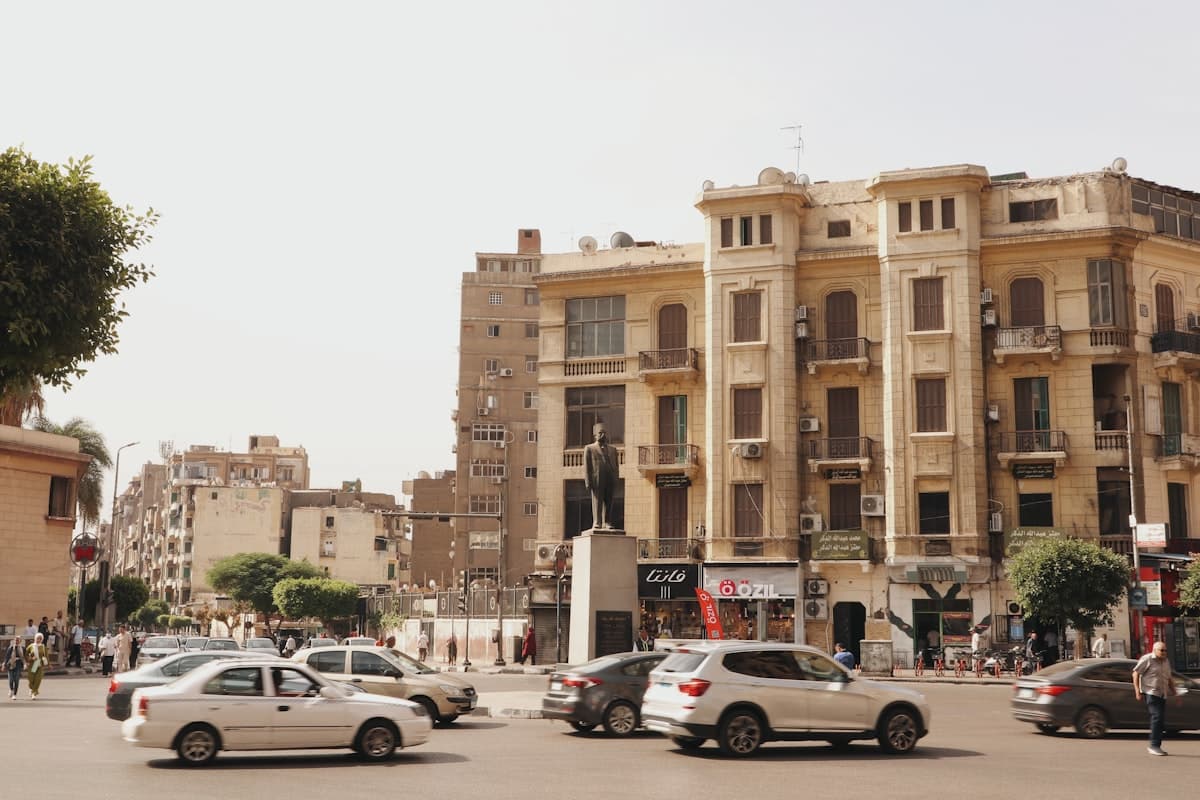
Nasser governed Egypt from 1954 until his death in 1970, and Cairo still operates inside the infrastructure he built. The High Dam at Aswan, which he initiated over British and American objections and eventually financed with Soviet help, is the most dramatic example. But Cairo itself carries his imprint in ways that are harder to see.
Corniche el-Nil, the riverside road that defines central Cairo's geography, was substantially expanded under Nasser's urban development program. The brutalist apartment blocks that line the city's middle-income neighborhoods, housing millions of people whose parents were rural migrants, are products of his nationalization of construction and property. The Cairo Tower on Gezira Island, completed in 1961 at a height of 187 meters, was built partly as a deliberate gesture toward the United States, which had offered Nasser $3 million in 1956 as a bribe to undermine Soviet influence. Nasser used the money to build the tower and publicly dedicated it to the Egyptian people, a story that Cairenes have been enjoying for sixty years.
Nasser's own home, a modest villa in the Manshiyat al-Bakri neighborhood of Heliopolis, is technically preserved as a museum but is inconsistently open, poorly signed, and receives almost no visitors. This is a genuine loss. The interior has been maintained largely as he left it, including his library, which reveals a man who read obsessively across Arabic literature, military history, and international law. That the leader who nationalized the Suez Canal and redirected Arab political thought for a generation lived in a house that a successful accountant might own today is itself a fact worth sitting with.
For the modern Egypt revolution 1952 history guide that most visitors never find, the Manshiyat al-Bakri house is the single most significant undervisited site in Cairo. Ask your hotel concierge about current opening times before making the trip, because the hours posted online are fiction.
---
Abdeen Palace: The Throne Room as Museum
Abdeen Palace, completed in 1874 under Khedive Ismail at a cost that helped push Egypt into the debt crisis that led to British occupation, served as the seat of Egyptian royal power until 1952. Farouk was born there. The revolution did not demolish it. Instead, it was converted to a state reception palace and opened in parts to the public as a museum, which is either a statement about Egyptian pragmatism or Egyptian irony, depending on your temperament.
The arms museum within Abdeen is the section most worth your time. It contains weapons presented to Egyptian rulers across five centuries of Ottoman, Khedival, and royal governance: a jeweled sword given by Napoleon, rifles presented by the Sultan of Morocco, a pearl-handled pistol whose provenance card lists it as a gift from an unspecified European monarch during an unspecified visit. The cumulative effect is that of a ledger of diplomatic transactions, each object representing a relationship, an alliance, a calculated flattery.
The silver room, housing Farouk's collection of silver service pieces, is vast and slightly overwhelming. It is not a silver room in the sense of a display case. It is a room, full-sized, whose walls and tables and cabinets are entirely occupied by silver. The quantity is not the interesting thing. The interesting thing is that nearly every piece was made in Europe, on commission from the Egyptian royal court, at a time when Egypt was theoretically independent but practically occupied. The aesthetics of Egyptian royal power in this period were almost entirely imported, which is part of what the revolution was reacting against.
---
The Connections
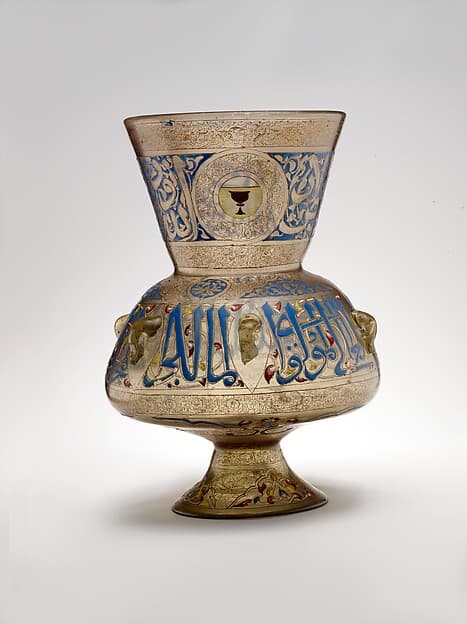
The 1952 revolution did not happen in a vacuum, and Cairo makes this visible if you are willing to read the city sideways. The Egyptian Museum sits at Tahrir Square, which is named Liberation Square, which was renamed after the revolution. Before 1952 it was called Ismailia Square, after Khedive Ismail, the same ruler who built Abdeen Palace and whose debt financing the British used as justification for occupation in 1882. The square itself is a compressed timeline of Egyptian political identity: a name change that took a decade to normalize, a museum built by the French in 1902, a plaza that became the center of the 2011 uprising that echoed 1952 in ways that Egyptians debated for years afterward.
The Citadel, where the Military Museum now houses displays on the 1952 revolution alongside exhibits on ancient and medieval Egyptian military history, was built by Saladin in the twelfth century using stones quarreled from the smaller Giza pyramids. The Ottoman ruler Muhammad Ali, who established the dynasty that Farouk's abdication ended, made the Citadel his seat of power in the nineteenth century. The hall where the Military Museum now shows photographs of the Free Officers' first press conference is built on a foundation that has housed every form of power Egypt has known since the Crusades. That continuity is not decorative. It is what Egypt is.
---
Common Mistakes
Skipping the Egyptian Museum's modern galleries for the ancient ones. The rooms on the upper floor dedicated to the royal family and the pre-revolutionary period are almost always empty while tourists line up three-deep for Tutankhamun. The objects in those rooms, including seized royal personal effects and documents from the transitional government, are directly relevant to understanding Cairo as a living city.
Taking an organized Nile cruise that markets itself as including a 1952 revolution tour. These invariably spend forty-five minutes on the history and four hours on perfume shops and papyrus stores. If modern Egyptian history is your interest, hire a private historian guide through Cairo's university networks, which will cost EGP 1,500-2,500 for a full day but deliver ten times the content.
The sound and light show at the Citadel costs EGP 350 and covers roughly one thousand years of history in ninety minutes, meaning it allocates about four minutes to the entire modern era. Skip it entirely. Read two chapters of Khaled Fahmy's "In Quest of Justice" instead, which you can find at the Diwan bookshop on Abdel Khalek Tharwat Street for EGP 200.
Assuming Abdeen Palace Museum keeps regular hours. It does not. Closures for state functions happen with no online notice. Go on a Tuesday or Wednesday morning and call the palace switchboard the day before if you are treating this as a primary destination.
Missing Naguib Mahfouz's Cairo. Mahfouz set his Cairo Trilogy, which tracks an Egyptian family across the 1919 revolution through 1952, in the alleys of Islamic Cairo around Al-Hussein and Khan el-Khalili. Walking those streets with the trilogy in mind is a way of understanding what the revolution meant to ordinary Cairenes that no museum can replicate. The coffee house Al-Fishawi, where Mahfouz famously spent afternoons for decades, is real, is still operating, and is not overcrowded before 10am.
Conflating the 1952 revolution with the 2011 uprising without understanding both. They share a geography, a square, and certain rhetorical echoes, but the differences matter enormously and Cairo's residents will respect you for knowing them. The 1952 event was a military coup with popular legitimacy but no popular participation. The 2011 uprising was the reverse. Cairenes are precise about this distinction and will engage you seriously if you demonstrate you understand it.
---
Practical Tips
Cairo's traffic is a genuine constraint on this kind of thematic touring. The sites connected to the modern Egypt revolution 1952 history are spread across Tahrir, Heliopolis, and the Citadel, which can mean ninety minutes in a taxi between two of them on a bad day. Plan your route geographically rather than thematically: start at Abdeen Palace, walk to the Egyptian Museum (twelve minutes), then take the metro or a taxi to the Citadel in the afternoon.
For Arabic speakers or anyone traveling with an Arabic-speaking companion, the Egyptian National Archives in the Corniche area holds public reading rooms and periodically exhibits documents from the revolutionary period. The staff is genuinely knowledgeable and the collection includes original communiques from July 1952. This is not listed on any tourist site and requires a visit during morning hours.
October through February is the right window. Thematic historical touring requires walking and standing and reading, none of which is practical in Cairo's summer heat.
Carry cash in small denominations. Museum ticket offices frequently lack change, and the inability to make exact payment has a way of costing you an extra EGP 50 at every entry point over the course of a day.
For serious readers, the American University in Cairo Press publishes some of the best English-language scholarship on this period, and the AUC bookstore on Mohammed Mahmoud Street, a two-minute walk from Tahrir, carries it all. Budget EGP 500-800 for books if you want to leave Cairo understanding what you saw.
Frequently Asked Questions
The Weekly Dispatch
More on Egypt, every Friday.
Cultural depth and places most guides never mention.
No spam. Unsubscribe anytime.