Mohamed Ali Pasha and the Modernization of Egypt: Cairo's Divided Legacy
He executed 470 Mamluk beys at a dinner party, then built a mosque that looks Ottoman but sits on a Pharaonic hill. Mohamed Ali's Cairo is everywhere if you know what to look for.

Quick Facts
- Best time to visit
- October through February for clear air and the chance to see the Pyramids from the Citadel terrace. Arrive at 8am opening time or after 3pm to avoid tour group crowds.
- Entrance fee
- EGP 450 (approx $9 USD) for the full Citadel complex including the mosque and Military Museum. Students with valid ID: EGP 225. Egyptian nationals: EGP 30.
- Opening hours
- Daily 8am to 5pm (winter, October to April), 8am to 6pm (summer, May to September). Mosque closes to visitors during Friday midday prayers, approximately 11:30am to 1:30pm.
- How to get there
- Metro Line 1 to Mar Girgis, then microbus to Citadel gate (EGP 5 to 10 total). Bolt or Careem app from downtown Cairo: EGP 80 to 120. Street taxis from Tahrir: negotiate firmly or avoid.
- Time needed
- 2 hours minimum for mosque and museum. 4 to 5 hours if combining with a walk along the Citadel walls and the Mamluk tombs in the City of the Dead below.
- Cost range
- Budget EGP 600 to 900 for the day including transport, entry, and street food. Mid-range EGP 1,500 to 2,200 with a private guide and lunch at a sit-down restaurant.
Quick Facts
Primary site: The Mosque of Mohamed Ali, Cairo Citadel (Salah al-Din Square, Al-Khalifa) Entrance fee: Citadel complex EGP 450 (approx $9 USD), students EGP 225. The mosque itself is included. Opening hours: Daily 8am to 5pm (winter), 8am to 6pm (summer). Closed during Friday prayers, roughly 11:30am to 1:30pm. How to get there: Metro to Mar Girgis station (Line 1), then a microbus or taxi up to the Citadel gate, roughly EGP 20 to 40. A Bolt from downtown Cairo should cost EGP 80 to 120. Avoid private taxis from the tourist rank at Tahrir, which quote four times the real price. Time needed: Two hours minimum for the mosque and the military museum. Add another ninety minutes if you plan to walk the walls and look out over the city. Best months: October through February, when the air over Cairo is clear enough that you can actually see the pyramids from the Citadel terrace. In summer, the haze erases them. Cost range: Budget EGP 600 to 900 for the day including transport and entry. Mid-range EGP 1,500 to 2,200 if you add lunch at Farouk Restaurant near the Citadel and a private guide.
---
Why This Place Matters
On March 1, 1811, Mohamed Ali Pasha invited every senior Mamluk leader in Egypt to a celebration at the Citadel. He fed them, honored them, and then, as they rode in procession through the narrow gate known as Bab al-Azab, his soldiers opened fire from the walls above. Between 470 and 500 Mamluk beys were killed in under an hour. One man, a commander named Amim Bey, allegedly survived by jumping his horse off the Citadel wall and escaping into the city below. The Mamluk ruling class, which had governed Egypt in various forms since 1250 AD, was finished.
This is where the story of Mohamed Ali Pasha modernizing Egypt truly begins: not with factories or schools or a French-trained army, but with a massacre at a dinner party. The man who would drag Egypt into the nineteenth century did it first by eliminating everyone who might stop him.
Mohamed Ali was not Egyptian. He was born in Kavala, in what is now northern Greece, in 1769, the same year as Napoleon Bonaparte. He came to Egypt in 1801 as a commander of Albanian mercenary troops sent by the Ottoman Empire to help expel Napoleon's occupying forces. He maneuvered brilliantly through the chaos that followed, playing the Mamluks against the Ottomans and both against the Egyptian ulema, until the Ottoman sultan appointed him Wali, governor, of Egypt in 1805. He spent the next six years neutralizing every rival, culminating in the Citadel massacre.
What he built afterward is the reason you are here. In roughly forty years, Egypt under his control went from an Ottoman backwater to a regional power that humiliated the Ottoman army twice and forced Britain and France to intervene diplomatically to stop Egyptian forces from reaching Istanbul. He sent student missions to France, founded a medical school staffed by French doctors, built the first modern irrigation system in the Nile Delta, established textile factories, launched a navy, and created a conscript army that eventually numbered 130,000 men. He did all of this by taxing cotton so aggressively that the peasant farmers who grew it remained desperately poor. Modernization, in Egypt as elsewhere, had a class structure.
---
The Mosque on the Hill: What You Are Actually Seeing
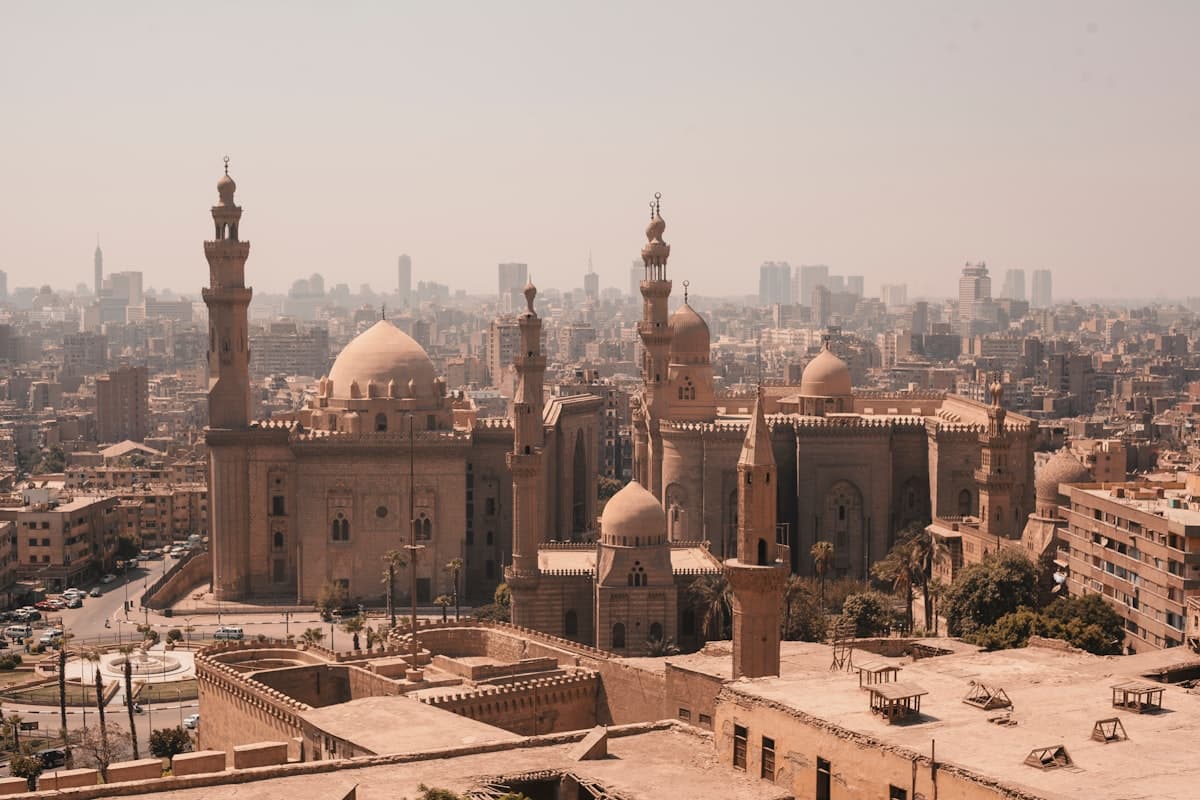
The Mosque of Mohamed Ali dominates the Cairo skyline from the east in a way that feels almost aggressive. Its two minarets and large central dome are visible from the roof of nearly any building in Islamic Cairo. Most visitors assume it is an Ottoman mosque transplanted to Egypt. That reading is almost right but misses the specific ambition involved.
Mohamed Ali commissioned the mosque in 1830 from a Greek architect named Yusuf Boshna, modeled closely on the Sultan Ahmed Mosque in Istanbul, the Blue Mosque. He wanted it to be read as a statement: Egypt under his rule was a peer of the Ottoman capital, not a province. The mosque was not completed until 1848, the year Mohamed Ali died, effectively senile from dementia. He never saw it finished.
The interior is covered in alabaster quarried from the hills of Beni Suef, which is why Egyptians call it the Alabaster Mosque. The alabaster panels, pale gold and slightly translucent, catch the light differently at each hour. Come before 10am, when tour groups are still organizing themselves at the gate, and the interior is almost silent. The light through the high windows falls across the alabaster in a way that rewards patience.
In the courtyard, there is an elaborate clock tower that houses a clock France gave to Egypt in 1846 as a diplomatic gift. Egypt gave France the Luxor Obelisk in return, the one that still stands in the Place de la Concorde in Paris. The Cairo clock has never worked properly. The Paris obelisk has stood for 180 years. The Egyptians arguably made the better deal without knowing it.
Do not miss the terrace on the mosque's northern side. On a clear winter morning, you can see the Pyramids of Giza to the southwest, the minarets of the Ibn Tulun mosque in the middle distance, and the curve of the Nile. The city spreads out below you in a way that makes its layers visible: medieval minarets, nineteenth-century Khedival boulevards, twentieth-century concrete, and construction cranes. Cairo's entire condensed history is in that view.
---
What the Military Museum Does Not Explain
Inside the Citadel complex, the Military Museum occupies the former Harem Palace of Mohamed Ali. The museum is predictable in its heroism and useful for a different reason than the one it intends. The exhibits about Mohamed Ali's army reforms show the weapons, uniforms, and battle maps, but they do not tell you where the soldiers came from.
The mass conscription that built Mohamed Ali's army was experienced by Egyptian peasant families as a catastrophe comparable to a plague. The fellahin, the farming class, had never before been subject to military service under Ottoman or Mamluk rule. When conscription began in the 1820s, families maimed their sons deliberately, cutting off index fingers so they could not pull a trigger, damaging eyes, to make them ineligible. Villages emptied ahead of recruitment drives. Mohamed Ali responded by conscripting men and marching them immediately to training camps far from their home districts, making desertion nearly impossible.
The army those conscripts built conquered Sudan in 1820 and 1821, a campaign commanded by Mohamed Ali's son Ismail, who was killed by a Sudanese chief in 1822. It then fought the Greeks during the Greek War of Independence, on the Ottoman side, with consequences that eventually dragged Britain and France into the conflict and ended with the destruction of the Egyptian fleet at Navarino in 1827. None of this is presented with much nuance in the military museum. Read Khaled Fahmy's book "All the Pasha's Men" before you visit and you will find the experience considerably richer.
The museum costs nothing beyond your Citadel entry ticket. Most visitors walk through in twenty minutes. Give it forty-five and read the French-language captions if your Arabic is limited; they are more detailed than the English versions.
---
The Connections: Layers Under the Citadel
The hill the Citadel sits on has been strategically important for longer than Cairo has existed. The site's commanding position over the Nile valley and the desert routes east toward Sinai made it a natural fortification point. Salah al-Din, whom Europeans called Saladin, began building the Citadel in 1176 AD after he took control of Egypt from the Fatimid Caliphate. The stone he used came partly from the outer casing of smaller pyramids at Giza. You can still see repurposed limestone blocks in the Citadel's lower walls.
Salah al-Din never actually lived in the Citadel he designed. He left Egypt in 1182 to fight the Crusades and never returned. The Mamluks who succeeded him finished the complex and turned it into the seat of Egyptian government for six centuries. Sultan al-Nasir Mohamed ibn Qalawun, who ruled in three separate reigns between 1293 and 1341, built the oldest mosque still standing inside the Citadel. Look for it near the northern enclosure: it has a Gothic doorway stripped from a Crusader church in Acre after 1291, incorporated as a trophy of Islamic victory over the Crusades.
When Mohamed Ali demolished the Mamluk structures to build his own mosque and palace complex in the 1820s, he was doing what every Egyptian ruler had done: building his legitimacy in stone directly over the legitimacy of his predecessors. The Citadel is not one monument. It is an argument between rulers, conducted in architecture across eight centuries.
From the Citadel, walk downhill into the City of the Dead, the vast necropolis northeast of the hill where the Mamluk sultans built their funerary complexes. The Mausoleum of Sultan Barquq and the Mausoleum of Sultan Qaitbay are two kilometers from the Citadel gate and receive perhaps one-tenth the visitors. Qaitbay's dome, carved in geometric stone lacework, is technically more accomplished than anything in the mosque above it on the hill. The entry fee is EGP 80 for non-Egyptians. The guardian will let you climb to the roof if you ask politely and tip EGP 20.
---
Common Mistakes
Arriving between 10am and 2pm on a weekday. This is when tour buses from the cruise ships unload. The mosque courtyard, which holds perhaps 200 people comfortably, fills to 600. Arrive at 8am when the Citadel opens or after 3pm when the groups leave.
Paying for a guide at the gate. The unofficial guides who approach you at the entrance vary wildly in accuracy and will often steer you toward shops where they earn commission. If you want a guide, book one through a reputable agency in advance: Mohamed Gouda at Cairo Heritage Tours has been recommended consistently by serious travelers and charges EGP 600 to 800 for a two-hour Citadel visit.
Spending all your time in the mosque and skipping the Citadel walls. The view from the northern terrace, outside the mosque complex, over Islamic Cairo is the best elevated view of that district available to the public. Most visitors photograph the mosque and leave without walking fifty meters to the terrace.
Taking the Sound and Light show at the Citadel. It costs EGP 350, runs forty-five minutes, tells you nothing specific about Mohamed Ali Pasha modernizing Egypt's reforms, and ends with colored lights on the mosque exterior that look exactly like what they are: colored lights. Skip it entirely.
Combining the Citadel with the Egyptian Museum in the same half-day. Both deserve full attention. Doing both in one morning means doing neither properly. The Egyptian Museum alone requires three hours if you are moving at a useful pace.
Ignoring the Al-Nasir Mohamed Mosque inside the Citadel. Because Mohamed Ali's mosque is visually dominant, most visitors never find the older mosque twenty meters away. The Gothic doorway from Acre is one of the stranger objects in Cairo: a piece of Crusader Europe embedded in a Mamluk Egyptian wall as a deliberate provocation to Christian visitors, seven centuries ago.
Buying water from the vendors inside the Citadel gates. They charge EGP 25 to 30 for a bottle that costs EGP 8 at any kiosk on the street below. Bring two liters from outside, especially between May and September.
---
Practical Tips
Dress codes are real and enforced at the mosque: shoulders and knees covered for everyone, and women will be asked to cover their hair. Scarves are available at the entrance for EGP 10, though bringing your own is more hygienic and less awkward.
The Citadel sits on a hill with uneven paving stones throughout. Comfortable shoes with ankle support are not optional. The descent through the Citadel's outer gate toward the Souq al-Silah street below involves steep steps that become slippery in any moisture.
For context before your visit, Khaled Fahmy's "All the Pasha's Men" is the definitive English-language history of Mohamed Ali's army and the social costs of his modernization project. Juan Cole's "Napoleon's Egypt" is useful for understanding the context Mohamed Ali walked into in 1801. Neither is available at the Citadel bookshop, so order them before you travel.
If you are visiting in winter, the Citadel is sometimes foggy in the early morning, which eliminates the pyramid view but gives the mosque a quality of light that afternoon sunshine does not. Both versions are worth experiencing if you have multiple days in Cairo.
The closest good lunch to the Citadel is at Abou El Sid on Road 9 in Maadi, about fifteen minutes by Bolt. For something closer and less expensive, the small fuul and ta'meya shops along Salah Salem street below the Citadel wall serve the real food of the neighborhood and cost EGP 30 to 60 for a full meal.
Frequently Asked Questions
The Weekly Dispatch
More on Egypt, every Friday.
Cultural depth and places most guides never mention.
No spam. Unsubscribe anytime.